
Someone on r/shopify_growth scraped 47,420 live Shopify stores and found that only 12.5% of them had a blog at all. Only 0.6% met Google's speed standard. Those two numbers explain most of what follows, because the best Shopify SEO tools split into two jobs. Some fix the store. Others give it pages worth finding.
I spent 800 hours scraping 47,000+ Shopify stores (actually). Here's the data: themes, niches, apps and speed.
Disclaimer: this is a genuine research. It is not AI generated.Disclaimer 2: This is purposefully thorough to cover everything found. There is a 'TL;DR' section for a quick summary at the end. Out of a 47,420-store dataset, I found that: Pa...
This list covers ten tools: Semrush, Ahrefs, RankControl, Booster SEO, TinySEO, Avada SEO Suite, SearchPie, Tapita, StoreSEO and Search Atlas. We checked each one on October 18, 2026 against its own pricing page and Shopify App Store listing.
The short verdicts:
- For keyword and competitor research: Semrush, or Ahrefs if links matter most to you.
- For writing and publishing the pages: RankControl.
- For technical fixes on a budget: Booster SEO, TinySEO or Tapita.
- For agencies running many stores: Search Atlas.
Before you pay for any of them, connect free Google Search Console. It's the only place your clicks and rankings come straight from Google.
What Shopify already does for free
A lot of Shopify SEO apps sell you things the platform already does. Shopify's SEO overview in its Help Center says three things are handled automatically. Canonical tags are added to stop duplicate pages showing in results. The sitemap.xml and robots.txt files are generated for you. And themes write title tags that include your store name.
Its sitemap help page adds one more. Themes include structured data, so product pages already carry price, stock and review details that can show as rich results.
What Shopify doesn't do is write anything. The title and meta description for each product, collection and post are still yours to fill in, and so is the blog. That's where the 12.5% figure bites. Most stores have no pages that answer the questions buyers type into Google or ask ChatGPT.
We think of this as the plumbing-and-pages split. Apps fix plumbing, like tags, schema, image size and broken links. Research tools tell you which pages to make. Then someone has to make the pages, and that last step is the one most stores skip.
Every app now sells AI search
We pulled the App Store listing for each of the seven Shopify apps on this list and searched the page text. All seven market some kind of AI search feature right in the listing. Six of the seven advertise an LLMs.txt generator, and only Avada doesn't. Five mention ChatGPT or Claude by name.
That's useful to know before you compare them, because the AI claims mostly describe the same few features. An LLMs.txt file, structured data and AI-written meta tags help AI crawlers read your store. None of the apps reports whether any AI engine actually named your store afterwards.
Reddit is blunt about this. In an r/digital_marketing thread asking for the best Shopify apps for AI visibility, several replies backed SearchPie, TinySEO and Smart SEO for schema and image work. One reply said not to expect any Shopify app to get a store into ChatGPT on its own.
200+ SaaS teams already track their AI citations.
They know exactly when ChatGPT mentions their brand, and when it stops. Do you?

The quick comparison
| Tool | Type | Starting paid price | Free plan or trial | Writes content | Tracks AI answers |
|---|---|---|---|---|---|
| Semrush | Research suite | $139/mo | Free plan, 7-day trial | Add-on, WordPress only | From $199 Starter |
| Ahrefs | Research suite | $129/mo | Limited free tools | No | Brand Radar from $199/mo |
| RankControl | Content and tracking | $400/mo | 7-day trial | Yes, publishes to Shopify | Yes, 7 engines |
| Booster SEO | Shopify app | $39/mo | Free plan, 14-day trial | No | No |
| TinySEO | Shopify app | $14/mo | Free plan, trial | AI blog drafts | No |
| Avada SEO Suite | Shopify app | $34.95/mo | Free plan, 7-day trial | No | No |
| SearchPie | Shopify app | $39/mo | Free plan, 7-day trial | No | No |
| Tapita | Shopify app | $9.99/mo | Free plan | AI blog posts | No |
| StoreSEO | Shopify app | $14.99/mo | Free plan, 7-day trial | Yes | No |
| Search Atlas | SEO suite | $99/mo | 7-day trial | Yes, to any CMS | From $199 Growth |
Prices are monthly, checked on October 18, 2026 against each vendor's pricing page and App Store listing.
1. Semrush
Semrush is the research suite most Shopify stores outgrow Search Console into. You get keyword volumes, competitor rankings, a site audit and position tracking in one login. Its plans are now named SEO, Starter, Pro+ and Advanced. The SEO plan costs $139 a month, Starter $199 and Pro+ $299, with each about 16% cheaper billed yearly.
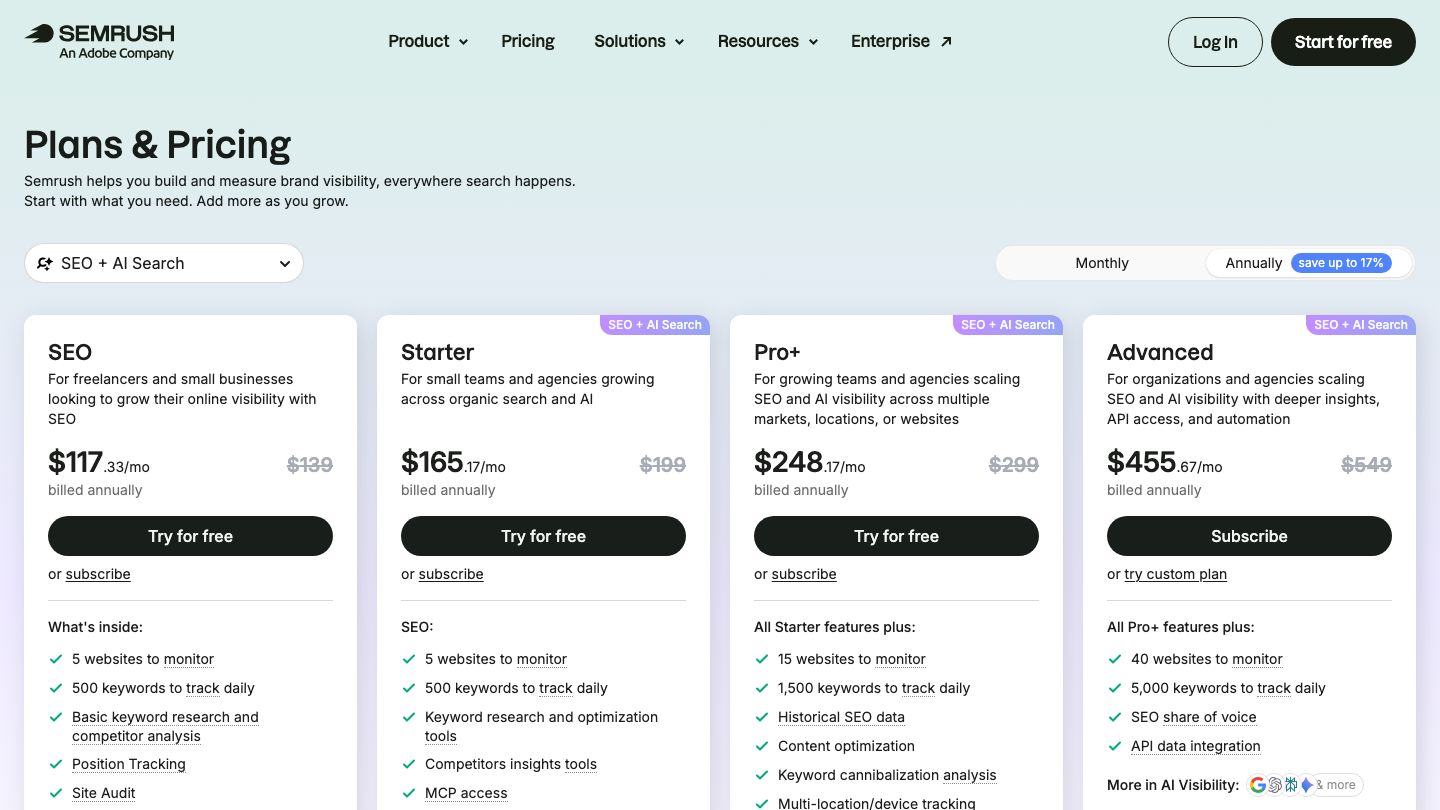
For AI search, the cheapest plan doesn't help. Semrush's AI visibility features start on Starter, so a store that wants to see how it shows up in AI answers is paying $199 from day one.
The gap for Shopify is publishing. Semrush's ContentShake writing add-on pushes drafts to WordPress through a plugin and has no Shopify connection, so you'd copy each post in by hand.
Price: from $139/mo, free plan and trial. Best for: stores that want one research suite.
2. Ahrefs
Ahrefs is the stronger pick if links are your problem. Its backlink index is the reason most SEOs pay for it, and its keyword data is as good as Semrush's. Plans run Lite at $129 a month, Standard at $249 and Advanced at $449, with Enterprise at $1,499.
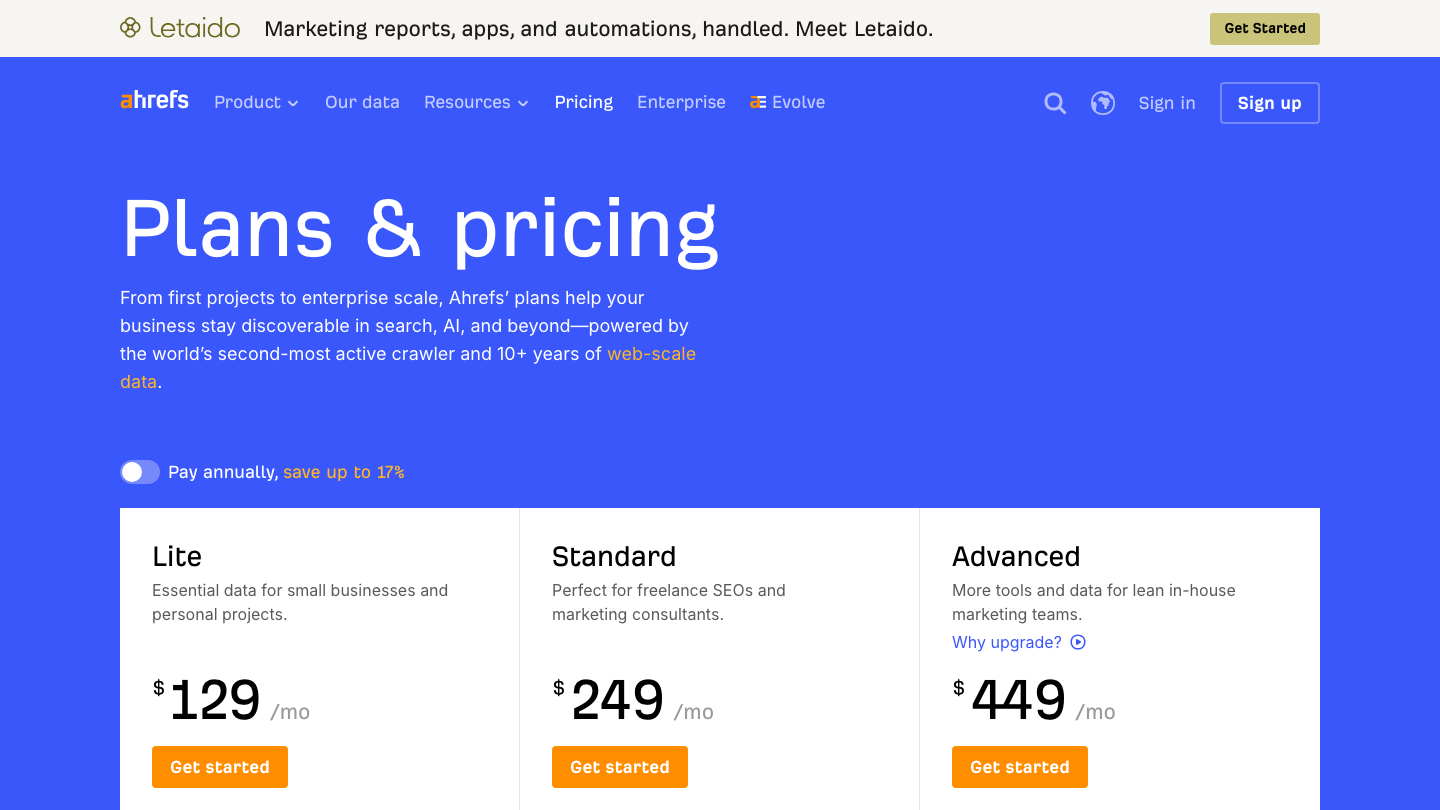
AI tracking is a separate product here. Brand Radar, which shows where your brand turns up in AI answers, starts at $199 a month on top of a plan.
Plenty of small store owners think both suites cost too much for what they track. In an r/SEO thread from October 13, one owner asked for alternatives to Ahrefs and Semrush. Several replies said both were overkill for a site watching 10 to 20 keywords and pointed to cheaper tools.
Looking for alternatives for Ahrefs & Semrush
Hello, I hope everyone is doing well! I wanted to ask for recommendations for SEO/GEO websites similar to Ahrefs and Semrush. I have been using Ahrefs mainly for a while but I wanted to explore other options as well, as some data seems to b...
Price: from $129/mo, no trial. Best for: link research.
3. RankControl
RankControl is our product, and it does the step the rest of this list leaves to you. It writes each article against the pages already ranking for its keyword, matched to your brand voice. Then it scores the draft for how easily AI engines can quote it, with a list of fixes. The finished post publishes straight to your Shopify blog, with the search listing title and description filled in.
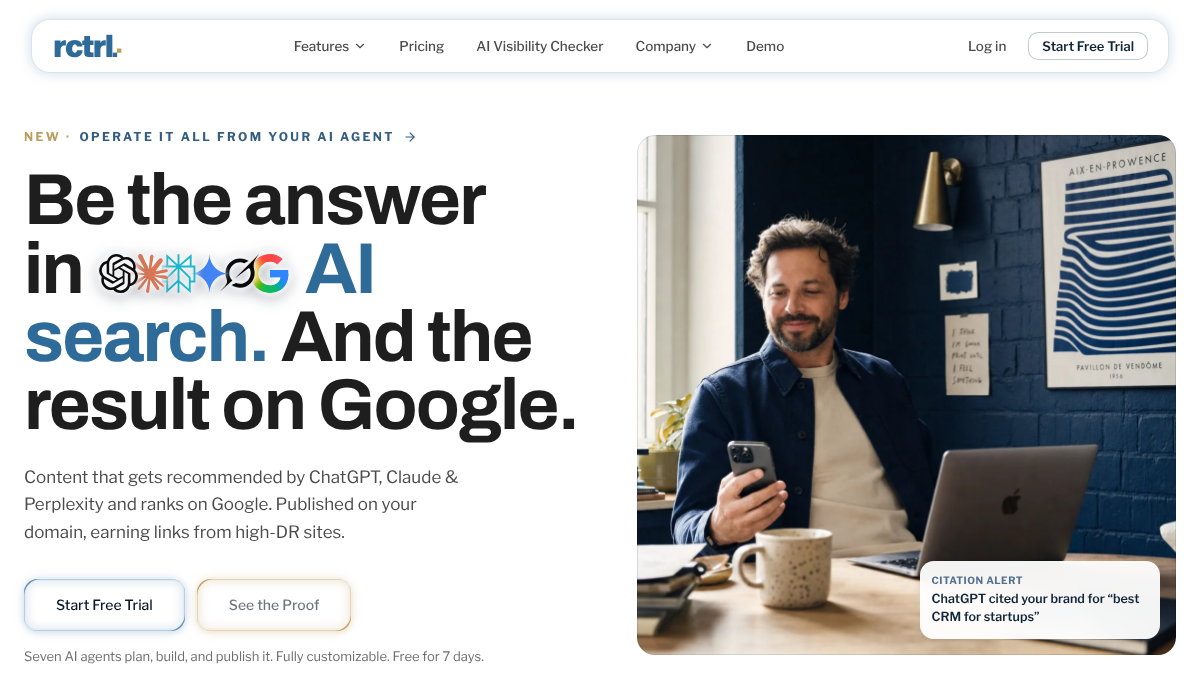
After that, its AI visibility tracking checks up to 50 buyer questions every week across seven AI engines, including Google AI Mode and Google AI Overviews. It marks whether each answer mentioned you, cited you or both, and records every source the answer used. Expect the traffic from Google and AI search to come first. Citations tend to follow more slowly, as other sites link to and mention your pages.
It isn't cheap next to a $14 app. It's one plan at $400 a month, or $4,000 a year, with 100 pages a month and a 7-day trial. It also won't compress your images or fix product meta tags, so most stores would still run one app below for that. If you'd rather drive the writing from Claude yourself, our guide to publishing Shopify posts from Claude with MCP shows the manual route.
Price: $400/mo, 7-day trial. Best for: stores short on writing time.
How often does ChatGPT mention your brand?
Most founders have no idea. The answer might surprise you.

4. Booster SEO
Booster has the most reviews of any app here, at 4.8 stars from 5,486. Its pitch is that it runs on its own. It scans the store, fixes broken links and meta tags, and compresses images without you approving each change.
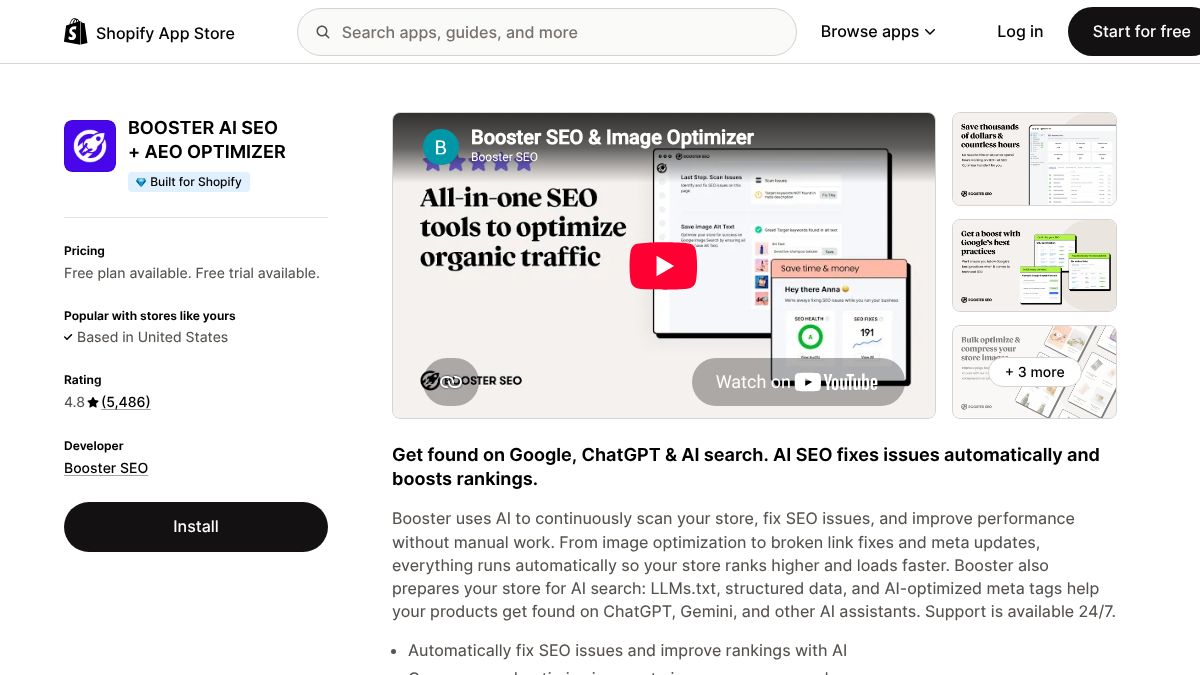
For AI search it adds an LLMs.txt file, structured data and meta tags written for ChatGPT and Gemini. There's no blog writer. Pro is $39 a month and Premium $69, and it has the longest trial on this list at 14 days.
Price: from $39/mo, free plan. Best for: hands-off technical fixes.
5. TinySEO
TinySEO used to be called TinyIMG, and image compression is still its core. It holds a 5.0 rating from 2,553 reviews. It also adds JSON-LD schema, an LLMs.txt file, IndexNow pings and AI blog drafts.
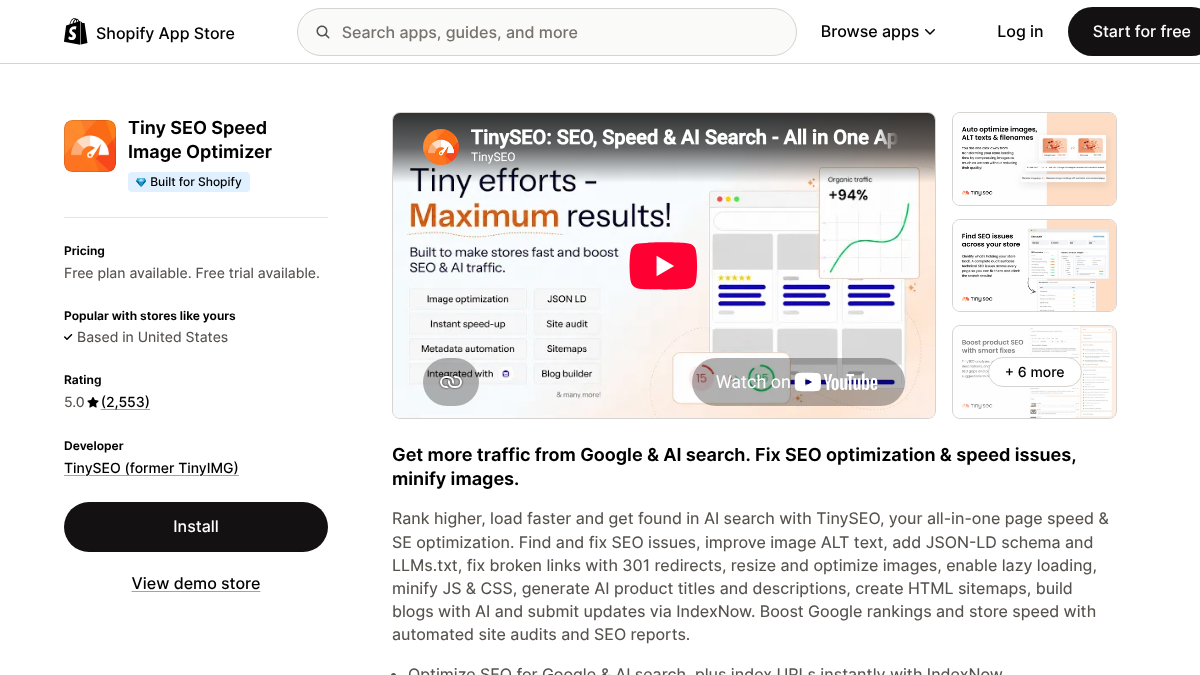
Plans are $14, $23 and $49 a month, with a free plan. The blog feature is the thing to try before you trust it. A draft from an app still needs a person who knows the products to read it.
Price: from $14/mo, free plan. Best for: image-heavy stores on a budget.
6. Avada SEO Suite
Avada suits owners who want to be told what to do. Its SEO audit agent and checklist walk through the store page by page, with an on-page optimizer for each product. It has 4.9 stars from 4,693 reviews.
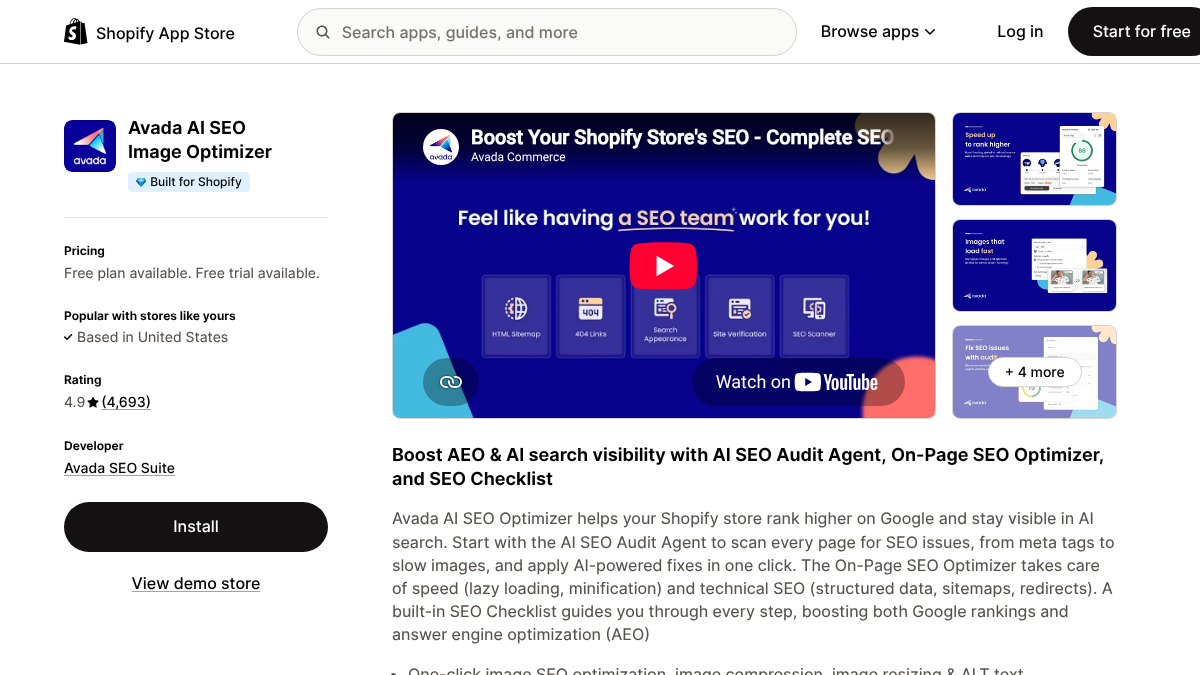
It's the one app here with no LLMs.txt generator in its listing. That isn't a big loss, since an LLMs.txt file is a small signal at best. Pro costs $34.95 a month and Enterprise $99.
Price: from $34.95/mo, free plan. Best for: owners who want a checklist.
7. SearchPie
SearchPie leans on schema. It writes JSON-LD for products and other pages, adds AI SEO tags and an LLMs.txt file, and flags issues that Google Search Console reports. It has 4.9 stars from 2,451 reviews.
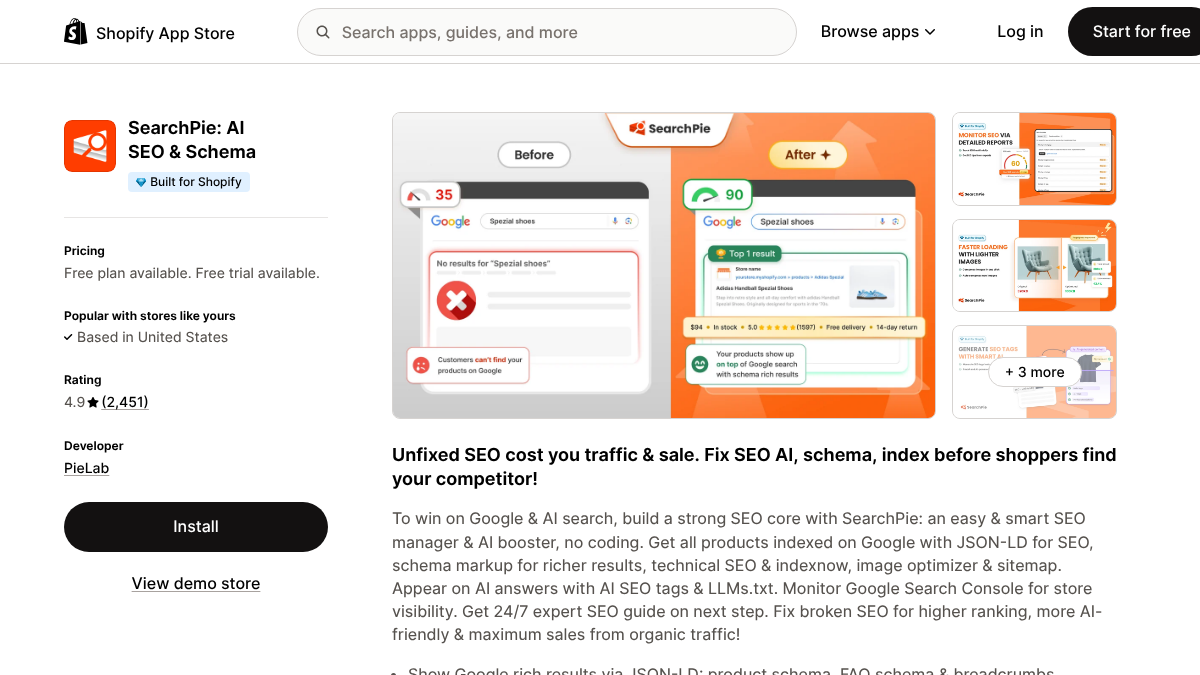
The free Starter plan is generous. Premium is $39 a month and Enterprise $99, with a 7-day trial. Like Booster, it doesn't write content.
Price: from $39/mo, free plan. Best for: schema-first stores.
8. Tapita
Tapita is the cheapest paid start on the list, at $9.99 a month for Business. Premium jumps to $49.99. It covers speed, schema, multilingual SEO and an LLMs.txt file, and it can draft blog posts with AI credits.
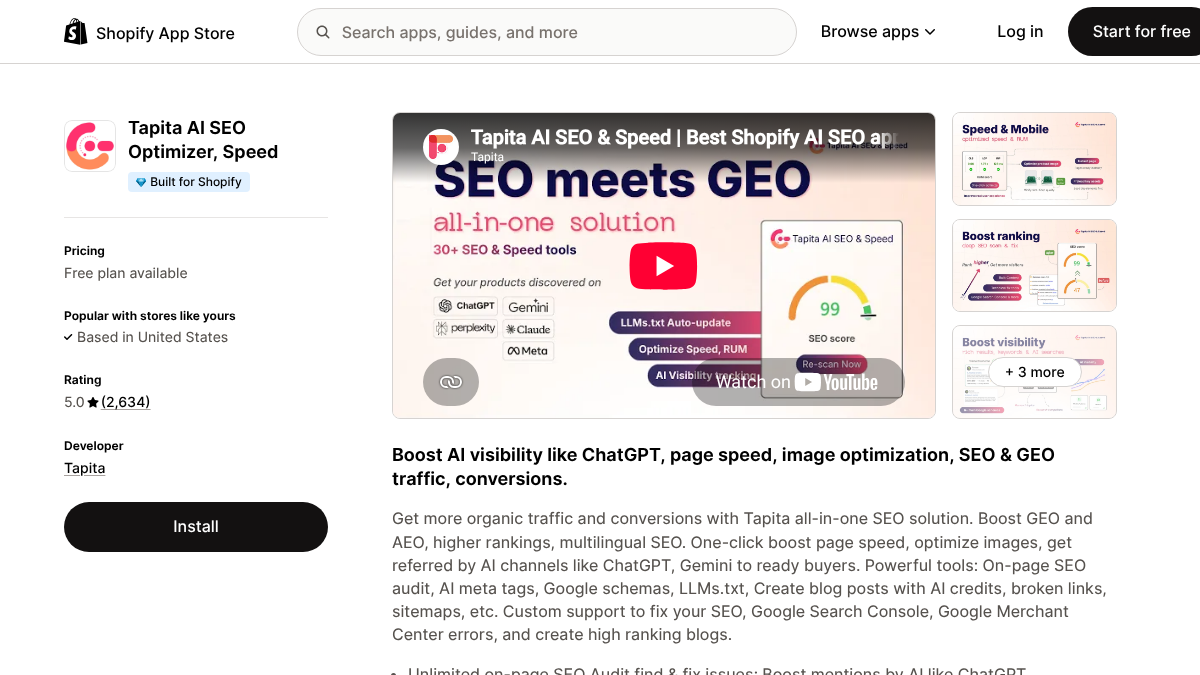
It has 5.0 stars from 2,634 reviews. The multilingual tools are the reason to pick it over TinySEO if you sell in more than one language.
Price: from $9.99/mo, free plan. Best for: the cheapest paid start.
9. StoreSEO
StoreSEO has the fewest reviews of the apps here, at 763, all averaging 5.0. What sets it apart is a connector for Claude and ChatGPT. You can ask an AI assistant to fix alt text, meta tags and schema on your store from a chat window.
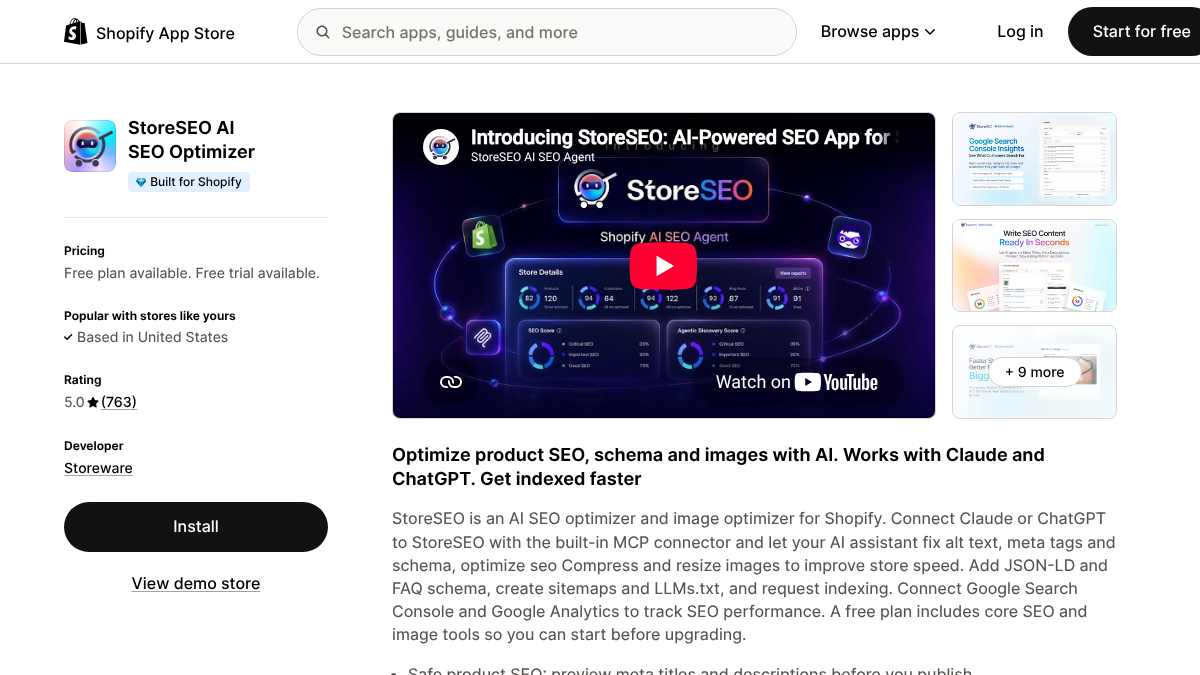
Lite is $14.99 a month and Essential $39.99. Advanced costs $249.99, which is a big jump for an app. Its listing also shows a content writer.
A store owner on X wrote about where that kind of setup can go wrong. They had an AI agent pull keywords through the Ahrefs API, draft 15 to 20 articles in Shopify, cross-link them and publish, then admitted they never read what it produced. Whatever tool writes your posts, read them before they go live.
@Liam21345 IIRC I asked it to research keywords through ahrefs api (I have the cheapest sub for my other business), build a plan of 15-20 articles and draft them in shopify, then cross links and publish. Didn’t even read what the slop cannon came up with 💀
 Mrs. LS@unhurriedselfOct 17, 2026
Price: from $14.99/mo, free plan. Best for: owners who already use AI assistants.
10. Search Atlas
Search Atlas is a full SEO suite built around OTTO, an agent that makes on-site changes for you. It's aimed at agencies, with the Pro plan pitched at packaging Search Atlas for clients. Plans are Starter at $99 a month, Growth at $199, Pro at $399 and Agency from $999.
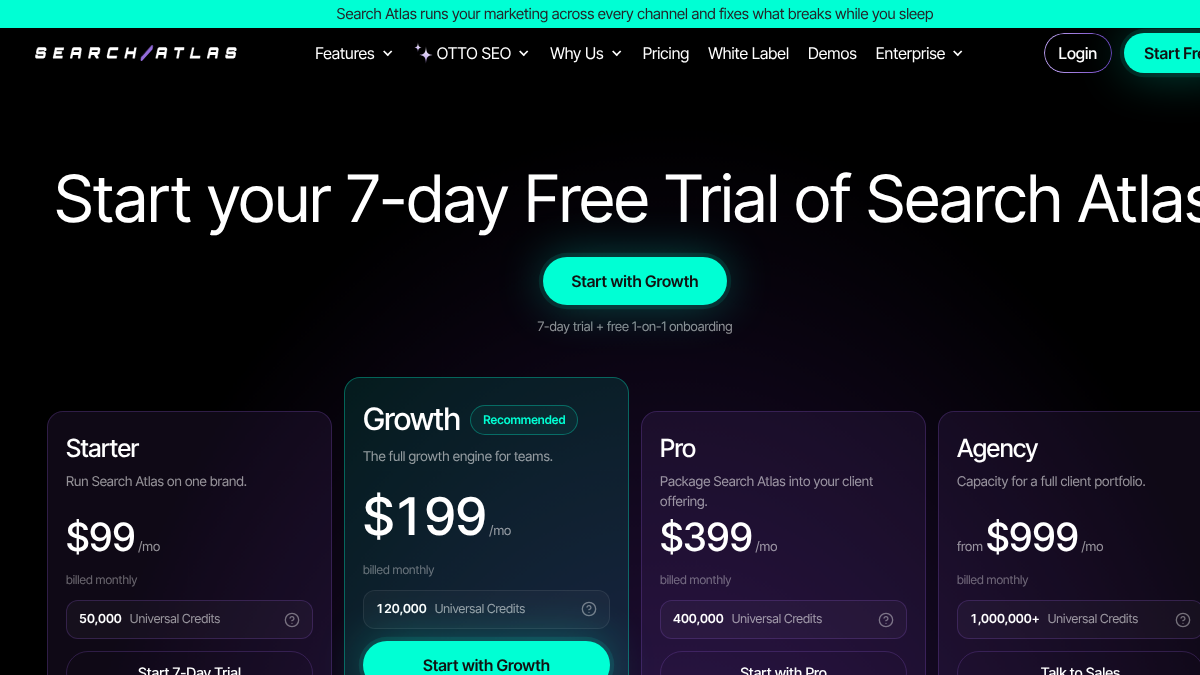
Its entry price is lower than ours, and even Starter can connect and publish to any CMS. AI visibility tracking starts on Growth, which lists ChatGPT, Gemini and Google AI Mode. Usage runs on a monthly pool of credits, so what you can do depends on how fast you spend them. Our RankControl vs Search Atlas comparison goes through the credits in detail.
Price: from $99/mo, 7-day trial. Best for: agencies running many brands.
How to pick
Start with what Shopify already gives you. Then match the next tool to your biggest gap.
- If your store is slow or untidy, install one app from numbers 4 to 9. You don't need two, because they overlap heavily.
- If you don't know which pages to make, add Semrush or Ahrefs. Pick one, not both.
- If you know what to write but never get to it, that's a content gap, and it's the one most stores have.
For product answers in ChatGPT specifically, there's a separate route through Shopify's product feed. Our guide to AEO for Shopify covers it. And if you also run a site outside Shopify, our list of SEO tools for small marketing teams covers the general kit.
Doing it yourself or handing it off
An app takes an afternoon to set up. The pages take much longer. A good store article, with real product detail, a clear answer and checked facts, takes about three hours to write and publish. At four a month, that's a working day and a half you're not spending on the store.
You can do that yourself with Search Console, one app and a research suite. Or RankControl can write and publish the articles to your Shopify blog, at up to 100 pages a month, and you spend your time reading them instead. It works with Shopify and the other destinations natively, so nothing gets pasted by hand.
15 hours a week manually. Or 15 minutes with RankControl.
Track citations, monitor competitors, and fix content gaps across every AI search engine. Automatically.