
In September, an SEO intern posted in r/SEO that their boss expected results from one page within 30 days. The thread drew more than 200 comments. Most said that's not how it works, and one of the top replies said that if speed is what matters, the boss should start paying for ads.
Boss wants SEO results in 30 days. Am I being unreasonable for feeling stressed?
I recently joined as an SEO intern and I'm not sure if what I'm experiencing is normal or if I'm just new to the industry. My manager assigned me a page to work on and expects to see results within a month. I'm doing keyword research, conte...
So how long does SEO take? The honest answer depends on how old your site is and how crowded your topic is. Rather than guess, we checked the ages of the pages and sites that rank on Google today.
What 309 first-page results show
On October 19, 2026, we searched 40 everyday questions, from "how to clean a cast iron skillet" to "best crm for real estate agents." Then we read each first-page result's publish date from its own page and looked up when its domain was registered. We found publish dates for 168 pages and registration dates for 292 results.
| Page age | Share of first-page results |
|---|---|
| Under 3 months | 7% |
| Under 6 months | 16% |
| Under 1 year | 24% |
| Under 2 years | 44% |
| Under 3 years | 59% |
| Under 5 years | 76% |
The median ranking page was about 2.2 years old. That's close to what Ahrefs found in its 2017 study of 2 million keywords, where the average top-10 page was more than two years old. Ahrefs also found that only 5.7% of new pages reached the top 10 within a year.
One caveat applies. Some sites reset their publish date when they update a post, so a few "new" pages are really old ones refreshed. That makes our page ages a floor rather than an exact figure.
How old the winning sites were
The domains were older still. The median ranking result sat on a domain registered about 22 years ago. Only 9 of 292 results, about 3%, were on domains younger than two years.
Those nine tell the real story. Six ranked for AI-era topics, like "what is generative engine optimization" and "best ai writing tool," where older sites hadn't written much yet. The other three were software lists, for invoicing apps, email marketing tools and schema markup.
So a new site can rank, and fast, on a topic too new for established sites to own. On the other 34 searches, from cast iron care to fixing a faucet, every first-page result with a known registration date was on a domain more than two years old.
A registration date isn't a launch date, though. Some owners buy older domains, and some businesses sit on a domain for years before building a site. Treat domain age as a rough sign of history, not proof.
We'll show you exactly where your brand stands in AI search.
No commitment. $0 due today, cancel anytime. See how ChatGPT, Perplexity, Claude, Gemini, Grok, and Google AI Mode talk about your brand today.

Typical timelines by situation
Here's how we'd set expectations from that data, Ahrefs' study and the r/SEO and r/WebsiteSEO threads where people shared their first results. These are rough ranges, not promises.
| Your situation | First impressions | Steady traffic |
|---|---|---|
| New domain, established topic | 1 to 3 months | 12 months or more |
| New domain, brand-new topic | Days to weeks | 2 to 6 months |
| Older site, new page on a familiar topic | Days to weeks | 3 to 6 months |
| Older site, improving pages on page two | Days | 4 to 12 weeks |
| Local business with a Google Business Profile | Weeks | 2 to 6 months |
In an r/WebsiteSEO thread asking how long SEO took to work the first time, one person said about four months on several fresh sites to reach 50 to 150 clicks. Another said to count on a year before seeing anything interesting. Both fit the table, since the gap mostly comes down to competition.
The early spike that fades
New sites often get a brief burst of traffic and then lose it, which feels like a penalty. This month, a site owner in r/WebsiteSEO said they launched four sites in one month, including a tire directory with about 50,000 pages. All four reached around 100 visits a day, then dropped to near zero within weeks.
The replies agreed on two causes. One was that the first burst is Google testing new pages before it decides where they belong. The other was that tens of thousands of near-identical pages on a month-old domain give Google little reason to trust any of them.
The fix they suggested matches the data above. Pick one site, deepen the pages that already get impressions and give it three to six months. A few dozen useful pages on a new domain usually do better than thousands of thin ones, which Google's spam policies call scaled content abuse.
If you're starting a new site, plan the first 90 days around a small set of pages you can make the best answer on the web. Our 90-day AI SEO timeline lays out a week-by-week version for SaaS.
Why older sites move faster
An older site already has links, indexed pages and a track record. A new page there gets crawled sooner and starts with some trust. That's also why updating works so well.
Two in three pages in our sample that showed both dates, 76 of 114, had been updated more than a month after first publishing. Sixty-nine had been edited within the past year, so most first-page pages were recently maintained.
The fastest win for an older site is a page sitting between positions 8 and 20. A reply in the r/SEO thread made the same point, and suggested rewriting three to five of those pages first. Our guide to moving page-two rankings covers how.
What Google says
Google doesn't publish a timeline. Its own page on hiring an SEO tells you to ask the person what results they expect to see, and in what timeframe. The same page warns that "no one can guarantee a #1 ranking on Google," so be wary of anyone who promises a date.
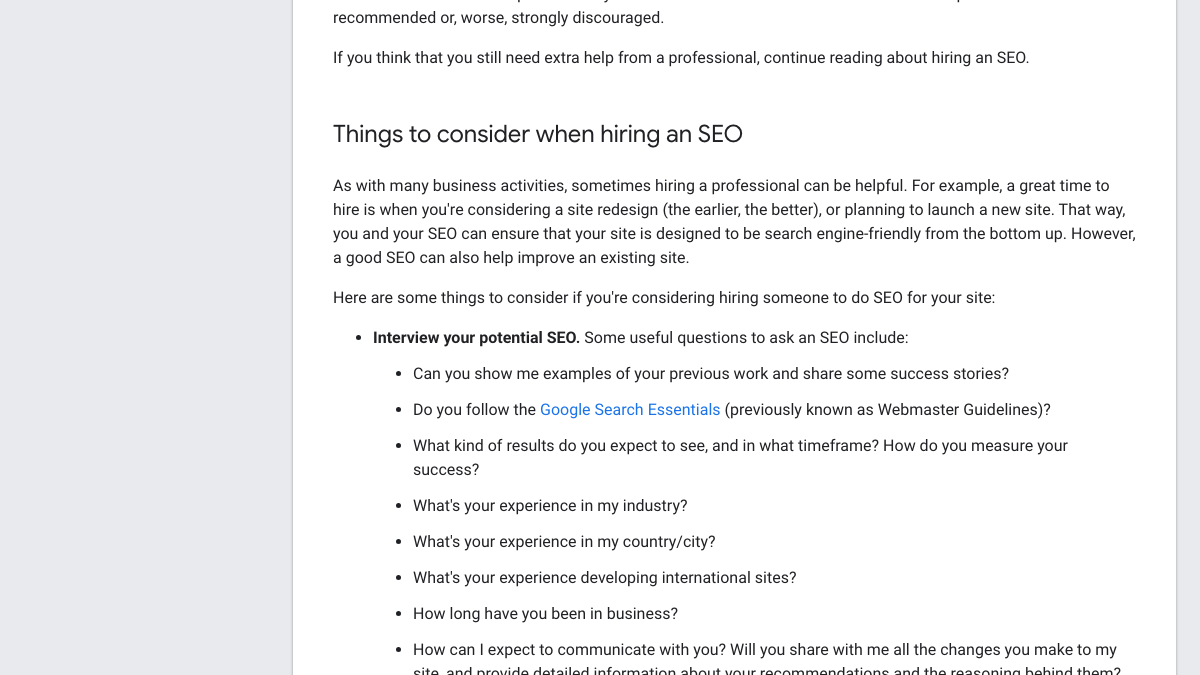
Google's 2017 video on hiring an SEO was more direct. It said that in most cases an SEO needs four months to a year to make changes and then see a benefit. That still matches the data above for most sites.
Know exactly what AI says about your competitors.
RankControl's Recon Agent monitors competitor citations across ChatGPT, Perplexity, Claude, Gemini, Grok, and Google AI Mode. See where they show up and you don't.

AI search runs on a different clock
Google rankings aren't the only place buyers look now, and AI answers move differently. ChatGPT and Perplexity search the web live for many questions, so a new page can be cited soon after it's indexed if it's the clearest answer. For brand questions, though, models lean on what they already learned, which updates much more slowly.
That cuts both ways. When we checked 49 businesses on Google's first page for our AI visibility audit guide, ChatGPT named just one of them for the same search. Ranking on Google didn't carry over automatically. Our post on how long AI search takes to learn a brand covers that slower clock.
How to tell it's working before traffic arrives
Traffic is the last thing to move. The useful signals show up in Search Console well before it.
- Pages get indexed. In the first weeks, check that new pages show as indexed.
- Impressions grow. Your pages start appearing for searches, even at position 40.
- New queries appear. Search Console lists searches you didn't target.
- Average position improves. A query moving from 70 to 35 is progress, even with no clicks.
- Clicks and leads follow. On an established topic, this is usually months later.
Another reply in the r/SEO thread suggested saving a baseline of positions, impressions and indexed pages before changing anything. That turns "is SEO working?" into a weekly comparison instead of a feeling.
What the first year costs in time
Here's a rough monthly budget for a small site doing SEO by hand, by my estimate.
| Task | Hours a month |
|---|---|
| Plan and write four to six pages | 16 to 24 |
| Update pages sitting on page two | 3 to 5 |
| Earn a few links | 6 to 10 |
| Check Search Console and rankings | 2 to 3 |
| Total | 27 to 42 |
Most of that happens before traffic shows up, which is why so many sites quit around month three.
Doing it yourself or handing it off
You can do all of this by hand. Or RankControl can keep the work moving while you wait for it to pay off. It plans and writes articles from your brand profile and publishes them to your site once you approve. It also checks your rankings and your AI citations on six engines every week, and its analytics count AI-referred visitors separately, so you see progress before the traffic report does.
26 content formats. Published on your domain. Matched to your brand.
Guides, comparisons, listicles, case studies, and more. RankControl generates content that gets cited by ChatGPT, Perplexity, Claude, Gemini, Grok, and Google AI Mode.