
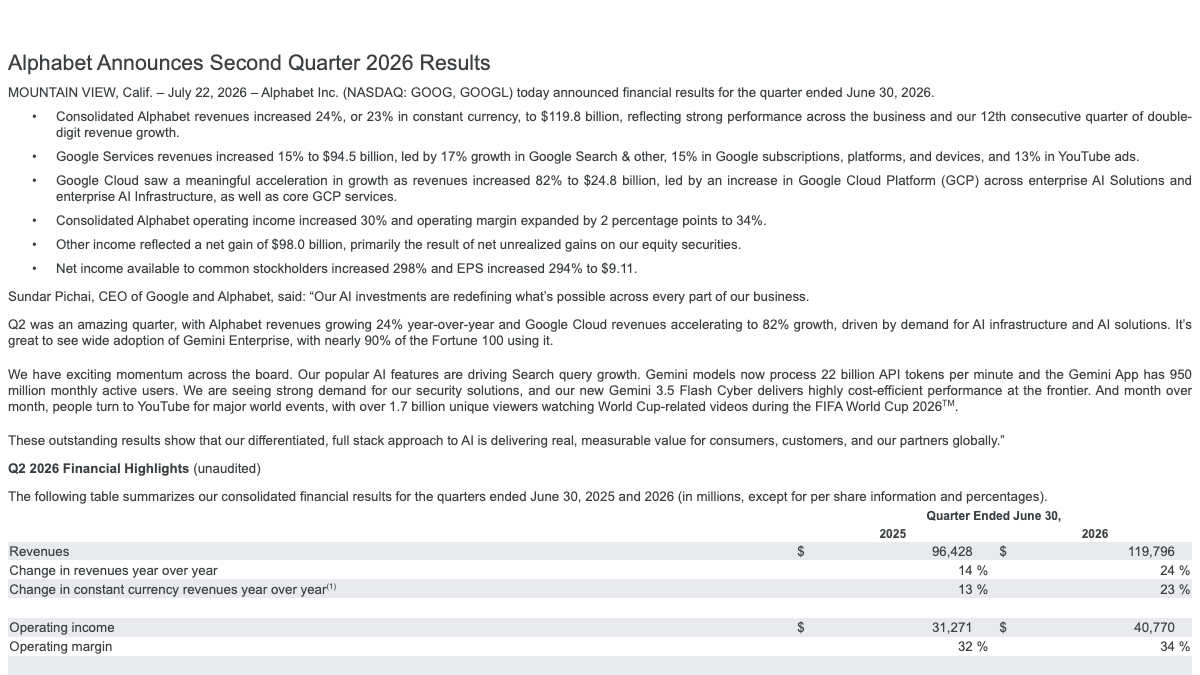
Two pieces of search news came out seven weeks apart in 2026, and at first glance they argue with each other. On June 8, SparkToro reported that 68% of US Google searches now end without a click. Then on July 22, Alphabet reported Search revenue up 17%. Sundar Pichai added that its "popular AI features are driving Search query growth."
Both are true. Whether Google search is shrinking depends on what you count, and you could count searches, clicks or market share. To see which parts are actually moving, we pulled three years of US search volume for 230 everyday keywords on October 19, 2026.
The short answer
Here's the scoreboard, with a source for each line.
| Measure | Direction | Source |
|---|---|---|
| Search revenue | Up 17% year over year (Q2 2026) | Alphabet |
| Search queries | Growing, says Google | Alphabet |
| Everyday keyword volume (US) | Up 8% in total, but 115 of 217 keywords down | Our check, Google Keyword Planner |
| Google's share of search | 89.94%, down from 91.58% three years earlier | Statcounter |
| Searches ending without a click | 68.01%, up from 60.45% in 2024 | SparkToro and Similarweb |
| Searches going to AI Mode | 0.34% (January to April 2026) | SparkToro and Similarweb |
The pattern is plain. People aren't searching Google less. They're clicking out of it less. If your business runs on organic traffic, I'd argue that difference matters more than any headline about Google's decline.
Back in July, our post on the 15% search volume drop covered the Datos per-user numbers. Here we pick up from there and look at which kinds of searches are moving.
What we checked
Our basket held 230 US keywords split into seven groups. Some were definitions ("what is a roth ira") and some were how-tos ("how to change a tire"). Others were "best" product searches, "near me" searches and the brand names people type to reach a site. The last two groups were quick answers like "kg to lbs," and the names of AI tools.
For each keyword we pulled monthly Google search volume from October 2023 to September 2026. Then we compared the 12 months to September 2026 with the 12 months before.
| Search type | Keywords | Total volume change | Median keyword change | Keywords down |
|---|---|---|---|---|
| Definitions ("what is") | 59 | +8.1% | +8.5% | 21 |
| How-tos | 39 | -4.4% | -1.4% | 20 |
| "Best" product searches | 39 | +16.0% | -25.8% | 33 |
| "Near me" | 30 | +17.1% | -1.1% | 15 |
| Brand names | 30 | +3.7% | 0.0% | 14 |
| Quick answers | 20 | +19.2% | -5.0% | 12 |
| AI tool names | 10 | +55.5% | +35.3% | 4 |
Why do the totals and medians so often disagree? A few huge keywords dominate each group. "Weather" alone averaged about 132 million US searches a month, so the median is the better guide to a typical search.
One caveat applies to everything that follows. Google's Keyword Planner rounds volumes into broad steps. A keyword can jump from 27,100 to 33,100 with no real 22% change behind it. So I'd read single keywords loosely and give the group patterns more weight.
Definitions held up, which surprised us
Definitions were the group we'd have bet on losing. AI Overviews answer "what is an etf" right at the top of the page, so why would anyone keep typing it? They do, though. The median definition search rose about 8.5% year over year, and 38 of 59 held steady or grew.
What changed is the click, not the search. People still put the question to Google. They just don't need to leave once the answer is on the page, which matches the zero-click data below.
The biggest swings in the group followed the news, in both directions. "What is socialism" more than doubled, while "what is a recession" fell 78%. Moves that size usually track the headlines, not some change in how people use Google.
"Best" searches split Google's own tools
The "best" group gave us the sharpest pattern, and then the strangest one.
In Keyword Planner, 33 of 39 "best" searches fell. The median drop was 26% in one year and about 45% over two. Six of the biggest went the other way by implausible amounts, with "best camera" and "best tablet" each up about tenfold in a year. Jumps like that usually mean Google changed how it groups similar searches. Demand didn't explode, so we'd treat those six as noise.
Then we checked the same searches in Google Trends, and it disagreed.
| Search | Keyword Planner, one year | Google Trends, same period |
|---|---|---|
| best car insurance | Down 74% | - |
| best password manager | Down 58% | - |
| best air fryer | Down 32% | Up 36% |
| best credit card | - | Up 27% |
| best dog food | - | Up 43% |
Your competitors are building backlinks while you read this.
Organic outreach, social mentions, and citations from Editorial Circle member sites, with managed backlinks available as an add-on. Grow your domain authority without running the campaign yourself.

Part of the gap is that the two tools measure different things. Keyword Planner estimates raw searches. Trends shows a search's share of all searches, scaled from 0 to 100. Even so, they shouldn't point in opposite directions this often.
Trends has its own trouble this year, too. Analyst Alex Papageorgiou checked 1,033 US keywords and found that 35% peaked in exactly the same month, April 2026, then dropped the month after. Our readings looked much the same. Most of the "best" searches sat unusually high from January to June 2026 and fell back from July.
We call this the two-tool problem. For a single keyword, Google's own data sources now disagree so much that one trend line proves very little. So if a tool tells you demand for your product fell by a third, check your own Search Console impressions before you believe it.
Google is the front door to AI
The fastest risers in our basket were the names of AI tools. "Chatgpt" averaged about 120 million US Google searches a month over the last year, up 53%. "Gemini" more than doubled. "Claude" grew more than sevenfold, to about 5.3 million a month.
So people use Google to reach the AI tools that compete with it, and every one of those searches counts as Google search volume. Those searches help explain how the total can grow while some kinds of searching move elsewhere.
How-tos slipped, and a few jumped
How-tos were the only everyday group where the total and the median both fell. Twenty of the 39 were down. "How to file taxes" and "how to invest in stocks" each lost about 40%. People now take questions like those to YouTube, TikTok and AI chat, where a walkthrough or a back-and-forth beats a list of links.
A couple went the other way. "How to start a business" roughly tripled to about 148,000 searches a month, and "how to lose weight" more than doubled. Both are broad life questions with no single answer, which may be why people still start them on Google.
Brand searches show where attention moved
People type a brand name to get somewhere, so brand searches work as a rough map of attention. "Reddit" had the biggest gain among the 30 brands, up 45% year over year to about 23 million US searches a month.
| Brand | Change, year over year | US searches a month |
|---|---|---|
| Up 45% | About 23 million | |
| Youtube | Up 17% | About 223 million |
| Spotify | Up 27% | - |
| Down 10% | - | |
| Netflix | Down 15% | - |
| CNN | Down 28% | - |
Google has been surfacing Reddit threads heavily, and many people now add "reddit" to their searches on purpose. One r/enshittification post with more than 1,200 upvotes complained that the trick had stopped working, because only the first result was a Reddit thread and the rest weren't related.
Older destinations like Facebook, Netflix and CNN slipped, with CNN losing the most. YouTube and Spotify kept growing.
Quick answers split down the middle
Twelve of the 20 quick answers were down, the most even split of any group. What decided which way a search went? Mostly it came down to whether Google answers it with its own tools.
| Search | Change, year over year |
|---|---|
| weather | Up 24% |
| calculator | Up 23% |
| timer | Up 35% |
| USD to EUR | Down 34% |
| dollar to peso | Down 30% |
| kg to lbs | Down 26% |
Conversions and lookups were the ones that fell. A phone's built-in tools or an AI assistant give you those answers just as easily, so fewer people need Google for them.
The two-year view
Stretch the window to two years and some of the noise smooths out. We compared the 12 months to September 2024 with the 12 months to September 2026, and total volume rose in most groups.
| Group | Total volume change over two years |
|---|---|
| Definitions | Up about 18% |
| How-tos | Up 12% |
| "Near me" | Up 19% |
| Brand names | Up 10% |
| Quick answers | Up 30% |
| "Best" product searches | Down about 9% |
The "best" group is the exception, and that 9% drop already includes the six suspicious jumps. Leave those out and the fall gets much steeper. So "best" searches are the one place in our basket where Keyword Planner points to a real decline, and also where Trends disagrees the most.
Clicks are what's shrinking
If you want the real decline, look at clicks. SparkToro's June study used Similarweb's panel of US desktop and mobile browser searches from January to April 2026. It found that 68.01% of Google searches ended without a click. In 2024 the figure was 60.45%.
The breakdown shows how searches and revenue can both grow while sites lose traffic. Searches that led to a click of any kind fell 9.51 points, which is a 22.9% decline. Meanwhile, the share of searchers who ran another search rose 7.2 points.
Put those together and Google gets more searches per session while it keeps more of them on its own pages. Rand Fishkin also noted that the data leaves out searches inside the Google app. Google is even more aggressive with on-page answers there, so the real zero-click share is likely higher.
As a site owner, I'd watch this number before any other. A page can keep its ranking and its impressions and still lose clicks. Our roundup of zero-click search statistics compares the main studies.
Google's share is slipping, slowly
By real searches and clicks, Google still dominates. Statcounter put its share of search worldwide at 89.94% in September 2026, down from 91.58% three years earlier. Bing grew from 3.01% to 5.29% over the same stretch.
ChatGPT barely shows up on this measure. In Statcounter's head-to-head data, it sent 0.39% of the referrals that Google and ChatGPT sent to websites worldwide. Our search engine market share post breaks that down by country and device.
So the competition is real, but in click terms it's small. People ask ChatGPT plenty of questions, yet it sends very few visits out, and that's a different problem from Google losing searchers.
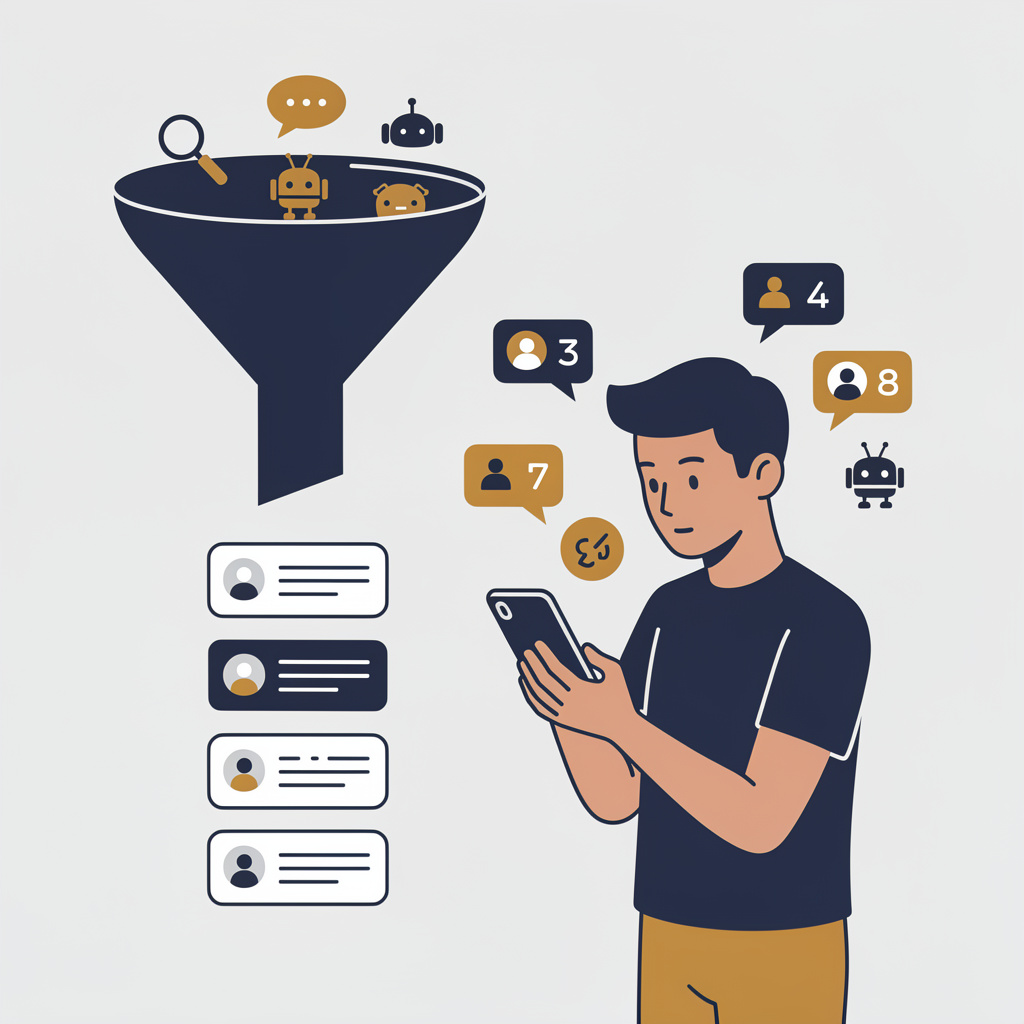
You're getting AI traffic. But do you know where it comes from?
RankControl credits every visit to the assistant that sent it: ChatGPT, Perplexity, Claude, Gemini, Copilot, or Grok. Full source attribution, next to your Google traffic.
AI Mode isn't the cause yet
Blaming AI Mode for falling clicks is tempting. SparkToro's data says it's too early. From January to April 2026, only 0.34% of US Google searches went to AI Mode.
Don't expect it to stay that small. At I/O 2026, Google said AI Mode had passed 1 billion monthly users and that its queries were more than doubling each quarter. If that pace holds, AI Mode will start to show clearly in click data during 2027. Our post on AI Mode passing a billion users covers what that means for rankings.
What the money says
Alphabet's own numbers all point up. Google Search and other revenue reached $63.3 billion in the second quarter of 2026, against $54.2 billion a year earlier. Pichai credited AI features with driving query growth, and he said the Gemini app had 950 million monthly active users.
Search also outgrew Google Services as a whole, which rose 15% to $94.5 billion. Search ads are still pulling the rest of the business along instead of lagging behind it.
How can revenue rise while outbound clicks fall? Google earns from ads on its own pages, and SparkToro's data showed paid clicks growing even as clicks to the open web fell. A Google that shows answers and ads, and sends fewer visits out, can make more money from the same searches.
Be careful with "query growth", though. Alphabet doesn't publish a query count, and the phrase could include the extra searches people run within one session. I'd treat it as a direction, not a number. Our Google search statistics page traces the yearly count Google has shared.
What would change this answer
Three things over the next few months could change the picture. The first is Alphabet's third-quarter report in late October. Another quarter of Search revenue growth would keep the arrow pointing the same way. A slowdown would be the first sign of a real dip, and so would a change in how Pichai describes query growth.
AI Mode's share is the second. SparkToro said it hopes to repeat its study in six to twelve months. If AI Mode moves from a fraction of a percent to a few percent of searches, clicks to websites could fall faster than they have so far. Google has also been testing AI Mode as the default search experience, and our post on AI Mode default tests tracks that.
The third is the data itself. Suppose Keyword Planner and Trends keep disagreeing at the keyword level. Then first-party data, like your own Search Console impressions and server logs, becomes the most reliable measure you have.
What it means for your site
Every source tells the same story. Demand on Google is roughly flat to growing, and clicks per search are falling. Here's how we'd plan around that.
Start judging pages by impressions and conversions as well as clicks. When a page loses clicks while its impressions hold, it's losing to on-page answers, not to competitors. And before you trust a keyword tool's trend, check your own Search Console. With Keyword Planner and Trends split on "best" searches, your own impressions are the most reliable demand signal you've got.
Then aim to be the source the answer uses. When Google answers on the page, the cited source is often the only site that gets a click, so AI Overview and AI Mode citations are worth tracking next to your rankings.
Lean into the searches that still click, too. SparkToro's Rand Fishkin pointed to brand searches, local businesses and high-intent buying searches as the categories that still benefit from SEO. Our "near me" group held up as well, with a median change near zero.
If you're in B2B, our post on what happens to SEO if buyers stop searching Google covers the buying side in more depth.
How to watch this for your own site
You don't need a 230-keyword panel to see this on your own site. Search Console already gives you impressions, clicks and average position for every page. Compare this quarter with the same quarter last year.
Flat or rising impressions with falling clicks means you're seeing the zero-click shift. If impressions fall too, demand or rankings have changed, and that needs a different fix. Then add a monthly check on whether Google's AI answers and ChatGPT cite your pages for your main questions.
You can run those checks by hand each month. Or RankControl can run them for you. Every week we check your Google rankings and whether ChatGPT, Perplexity, Claude, Gemini, Grok, Google AI Mode and Google AI Overviews cite your pages. Our analytics separate AI-referred visits from the rest, so a drop in Google clicks doesn't hide growth elsewhere.
We'll show you exactly where your brand stands in AI search.
No commitment. $0 due today, cancel anytime. See how ChatGPT, Perplexity, Claude, Gemini, Grok, Google AI Mode, and Google AI Overviews talk about your brand today.