In February 2024, Gartner predicted that by 2026, "traditional search engine volume will drop 25%" as buyers moved to AI chatbots. It's now late 2026. In July, Google reported that Search usage hit an all-time high during the World Cup, that AI Mode had passed a billion monthly users, and that Search revenue grew 17% in the quarter.
So buyers haven't stopped searching Google. But ask B2B software buyers where they start, and half of them now say a chatbot. Both things are true at once, and the gap between them is where the real question about SEO sits.
Our view, stated up front: SEO doesn't disappear when buyers leave Google, because SEO was never really about Google. It was about being the page that answers the question wherever the question gets asked. The part that's dying is the click, and teams that measure SEO only by clicks are the ones who will feel it first.
Buyers haven't stopped searching Google
Start with the numbers the doom forecasts skip. SparkToro and Datos found in March 2025 that Google search grew more than 20% in 2024 and handled roughly 373 times as many searches as ChatGPT. That comparison only covered search engines and chatbots, though. A year later, SparkToro's broader study of 41 sites where people search found Google's real US share is closer to 70% than 90% once Amazon, YouTube, Reddit and the rest are counted. Amazon, Bing and YouTube each still drew more desktop search activity than ChatGPT.
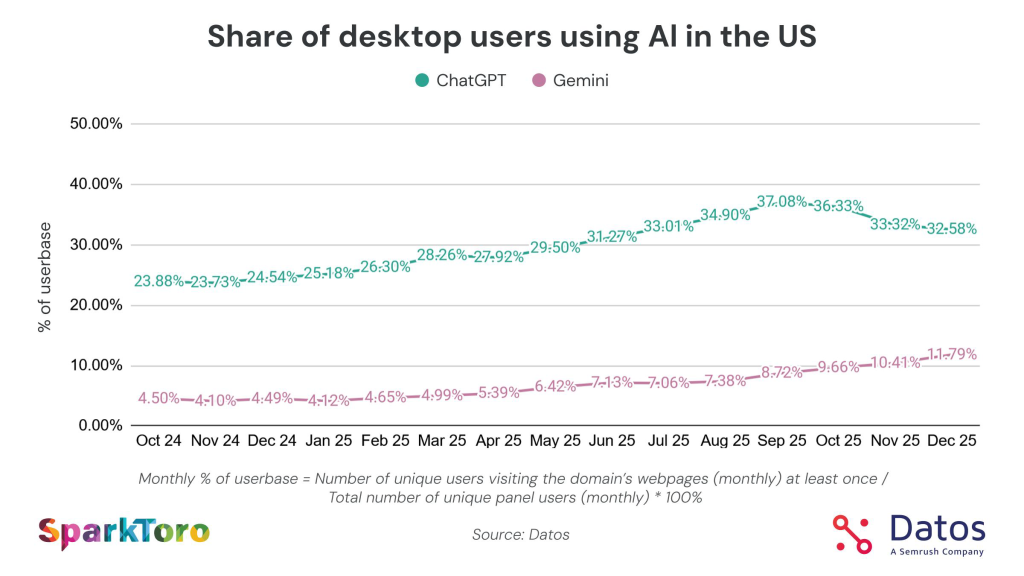
The same study charted ChatGPT's reach on US desktops. Its share of users climbed from about 24% in October 2024 to a peak of 37% in September 2025, then slipped to under 33% by December, while Gemini's share nearly tripled to about 12%.
Google's own reporting points the same way. On its July earnings call, Sundar Pichai said AI Overviews and AI Mode were "driving an incremental increase in Search queries overall."
One caveat matters here. Google has every reason to describe its search business as growing, and it reports queries and revenue, not how many of those searches send anyone to a website. The counter-evidence is real too: in May 2025, Apple's Eddy Cue testified that searches in Safari had fallen in April for the first time in 22 years, and he blamed AI. The honest summary is that total searching is up, while some specific places and some specific kinds of search are losing ground.
What changed is where they start
For B2B buyers, the shift is sharper than the overall numbers suggest. G2 surveyed 1,076 B2B software buyers in March 2026, and 51% said they now start their research in an AI chatbot more often than in Google. A year earlier that figure was 29%.
That doesn't mean Google leaves the process. Forrester's buyer research, published in January, found 94% of business buyers used AI somewhere in their purchase, and twice as many named generative AI as a more meaningful source than any other, vendor websites included. Buyers ask a chatbot to frame the problem and build a shortlist, then use Google to check the vendors on it. G2 put the share of buyers who use a chatbot somewhere in their research at 71%, up from roughly 60% seven months earlier.
We'd call this the first-stop shift. Buyers aren't abandoning search, they're changing which engine gets the first question, and the first question is where the shortlist gets made.
A post in r/ChatGPT this summer described the pattern from the user's side. The poster still uses Google for websites, news and specific sources, but opens ChatGPT first for explanations and for figuring something out. The top replies split the same way: Google for quick one-step answers, AI for anything with several parts.
I think I’ve reached the point where Googling feels slower than asking ChatGPT.
I’ve caught myself opening ChatGPT before Google for almost everything now.I still use Google for websites, news, and specific sources, but for explanations, brainstorming, or figuring something out, ChatGPT is usually my first stop.Anyone...
Vendor evaluation is exactly that kind of question, which helps explain why B2B research moved first.
The click is the real casualty
Even on Google, fewer searches end at a website. Rand Fishkin reported in June that from January to April 2026, 68% of Google searches in Similarweb's panel ended without a click, a 12.5% rise in two years. He described it as the fastest the zero-click trend had grown in SparkToro's data. After correcting a math error in his first chart, he put it this way: for every 1,000 Google searches, 232 clicks go to the open web.
Apologies - my prior graphic from this research had a math error. For every 1,000 Google searches, *232* clicks go to the open web. It's now corrected in the blog post: https://t.co/wIrac9r0a3 https://t.co/tCqfrO9cVC
 Rand Fishkin@randfishJun 9, 2026

Google says its AI features send "billions of clicks to websites every week," but it doesn't publish a click-through rate, so there's no way to check that against the zero-click trend. What's clear is that the answer increasingly happens on the results page or inside the chatbot, and the visit, when it comes, comes later and from a buyer who has already decided more.
That's the part of SEO that's in trouble: the model where you rank, earn the click and convert on your own page. Traffic reports built on that model will keep showing declines even in months when your brand is gaining ground in answers.
Your competitors are building backlinks while you read this.
Organic outreach, social mentions, and citations from Editorial Circle member sites, with managed backlinks available as an add-on. Grow your domain authority without running the campaign yourself.
The clicks that remain are worth more
There's a quieter half to the zero-click story. Buyers who click out of an answer have usually done more of their research before they arrive, so they land further along. Semrush found that visitors from AI search converted at 4.4 times the rate of traditional organic visitors.
That changes what a good month looks like. A B2B site can lose a large share of its informational traffic and still gain pipeline, if the lost clicks came from top-of-funnel questions and buyers now land on pricing, comparison and demo pages instead. In G2's survey, 53% of software buyers said AI research was more productive than traditional search, which suggests they'll keep arriving with more of the decision made.
It also changes which pages deserve the most care. The page a buyer reaches after an answer, usually pricing, a comparison or a specific feature, now does more of the persuading than the blog post that used to introduce you.
If buyers really did stop, what would SEO become?
Take the thought experiment seriously for a moment. Someone in r/SEO_Xpert asked it directly this spring: if Google disappeared tomorrow and only AI search existed, what would your strategy become?
If Google disappeared tomorrow and only AI search existed… what would your SEO strategy become?
Serious question. Would you still: build backlinks? write blogs? focus on keywords? care about topical authority? Or would everything shift toward: brand mentions communities Reddit YouTube citations entity SEO? Curious what experienced SEO...
The best replies didn't throw the playbook out. One said blogs would become more answer-focused, backlinks would matter more for trust than for ranking power, and keywords would turn into clusters of questions. Another argued that a lot of SEO people would discover they had never really been building authority in the first place.
Here's how we'd sort the pieces:
| Fades | Survives | Grows |
|---|---|---|
| Rank position as the main KPI | Crawlable, server-rendered pages | Mentions on sites engines trust |
| Click-through rate tuning | Indexing in the engines' search sources | Review profiles and original data |
| Planning by keyword volume | Pages that answer questions directly | Per-engine citation tracking |
| Chasing individual SERP features | Topical coverage and internal links | Self-reported attribution |
The middle column is most of what good SEO already does. AI engines still retrieve pages from a search index before they answer, whether that's Google's, Bing's, Brave's or their own, so being crawlable and indexed doesn't stop mattering. Answering the question in the first lines of a page matters more, because engines quote passages rather than send visitors to scroll.
SparkToro's own conclusion was to redefine the acronym. In its words, "search is a behavior, not a channel," and SEO should mean search everywhere optimization. Our explainer on what SEO for ChatGPT is called covers the other names teams use for the same work.
Why brand becomes the whole game
The last column is where the shift bites hardest. If fewer buyers click through to compare sources, the engine's own sense of which brands matter decides more of the outcome.
Fishkin raised a pointed version of this in August: AI tools often already know which brands they're going to search for and recommend, so studying the sources they cite may tell you less than it seems.
I'm worried that citation analysis research is misleading us... badly. AI tools often already know which brands they're going to search for and recommend, so looking at the sources or URLs ain't gonna help you much. Full report: https://t.co/lpoS9q7Bfp https://t.co/wZrPtucp76
Rand Fishkin@randfishAug 12, 2026
The data backs the direction, if not every detail. Ahrefs studied 75,000 brands and found branded web mentions correlated with visibility in AI Overviews at 0.664, against 0.218 for the number of backlinks. Being talked about across the web counts for more than being linked, which is why our guide on brand mentions vs backlinks argues for moving part of the link budget toward earned mentions.
For a B2B company, that makes review profiles, analyst coverage, customer stories on other sites and genuine community presence part of SEO. RankControl's Link Control finds sites that cover the topic of each published article and drafts outreach from your own mailbox, which covers part of that work.
You're getting AI traffic. But do you know where it comes from?
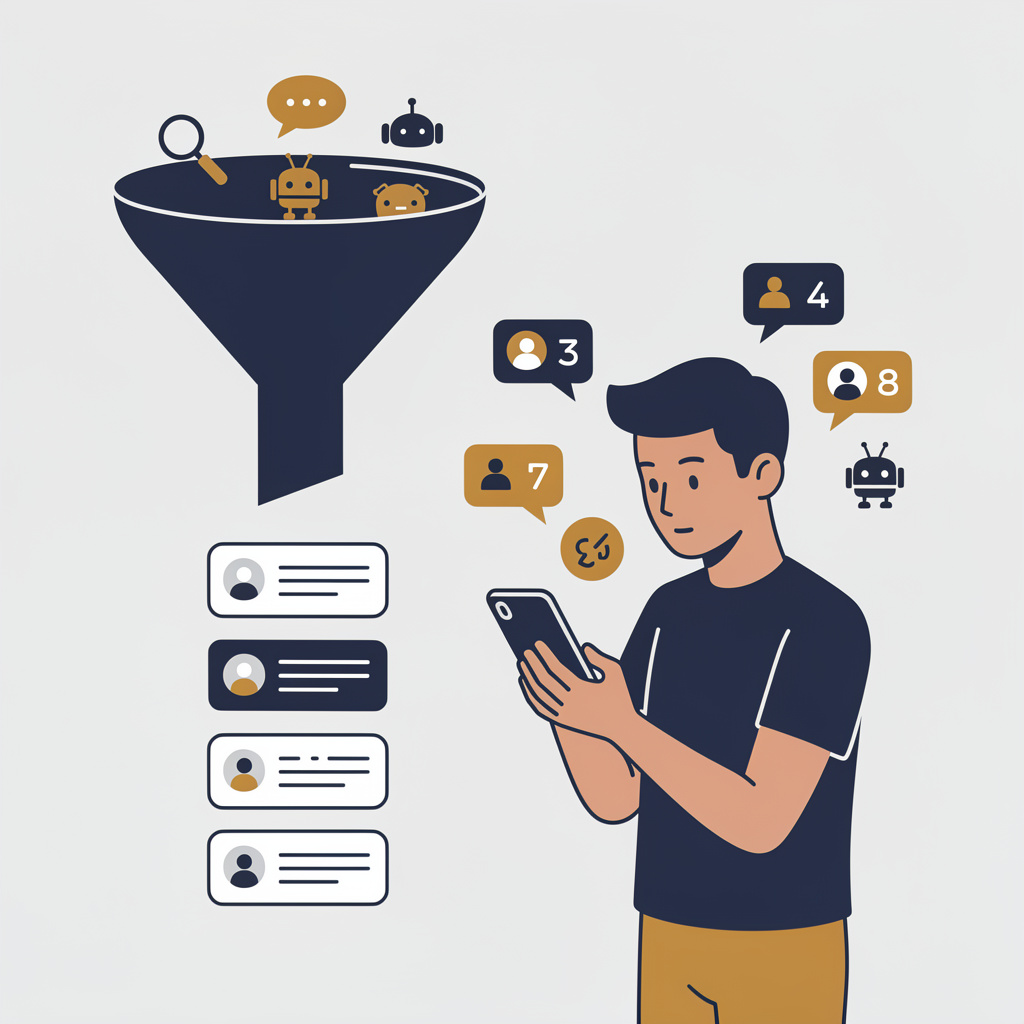
RankControl credits every visit to the assistant that sent it: ChatGPT, Perplexity, Claude, Gemini, Copilot, or Grok. Full source attribution, next to your Google traffic.
The no-regret moves for the next year
You don't need to predict whether Google holds 70% or 50% of search to act. These moves pay off in either future:
- Keep the Google work. It still handles most searches, and Google's AI features draw on the same ranking systems.
- Track a fixed set of 30 to 50 buyer questions every week on each AI engine, logging citations and named mentions separately.
- Rewrite your most commercial pages so the answer sits in the opening lines, with the number, the product name and the condition in one sentence.
- Put part of the budget into mentions on the review sites, publications and communities the engines cite for your category.
- Add a free-text "how did you hear about us?" field to your demo form, because many buyers who meet you in an answer arrive later by typing your name.
RankControl's AI visibility tracking handles the second move across six engines, and the content engine handles much of the third by writing each article against what already ranks. Our complete guide to answer engine optimization walks through the rest engine by engine.
What would change our mind
An opinion is only useful if you know what would overturn it. Three signals would make us more pessimistic about Google-first SEO.
The first is Google's own query growth stalling. If future earnings calls stop claiming record usage, or quietly stop mentioning query volume, that's a real change. The second is ChatGPT's desktop share resuming its climb after its late-2025 dip. The third, and the one to watch most closely, is AI-referred traffic. Conductor's benchmark of 13,770 domains put AI referrals at about 1% of sessions, and a move into the mid-single digits would mean buyers are clicking out of answers at scale.
Until then, the evidence supports a less dramatic story: buyers search in more places and click less.
Where this leaves your SEO team
If buyers did stop searching Google, SEO would lose its scoreboard and keep its purpose. The teams in the best position are the ones already measuring citations and mentions alongside rankings, and already earning attention off their own site. In practice, that means one monthly report with four lines side by side: Google rankings and clicks for your key pages, the share of buyer questions where AI engines cite you, named mentions, and the pipeline buyers attribute to either.
That work adds up. Publishing eight solid articles a month takes 16 to 24 hours, checking 50 questions on six engines takes about five hours a week, and outreach for mentions sits on top. Those are rough estimates. For a quick read on where you stand today, our free AI visibility checker shows who ChatGPT cites for three buyer questions in your market.
You can run all of it yourself, and plenty of teams do. Or RankControl's agents can run it every month, in Google and in the chatbots, while you decide how much of next year's budget to move.
We'll show you exactly where your brand stands in AI search.
No commitment. $0 due today, cancel anytime. See how ChatGPT, Perplexity, Claude, Gemini, Grok, and Google AI Mode talk about your brand today.