
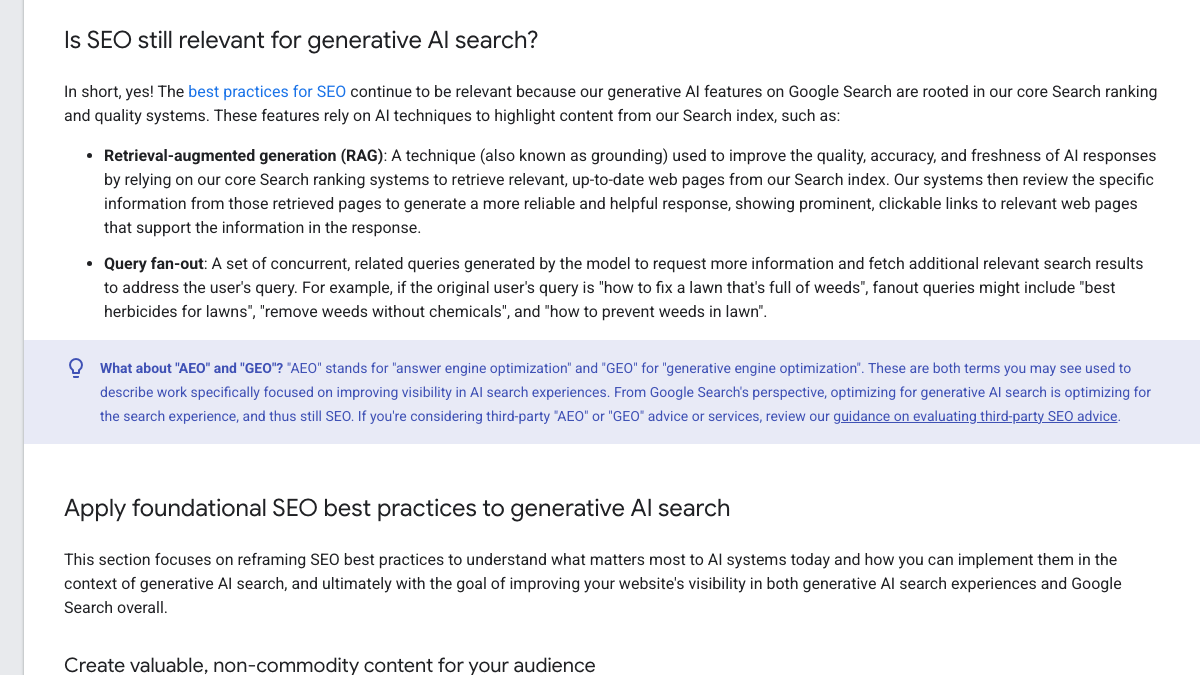
Nobody has settled the name, and that includes Google, which gave two different answers this year. According to its Search Central guide, optimizing for generative AI search "is optimizing for the search experience, and thus still SEO." In June, Brendon Kraham, Google's VP of Search and Commerce on the ads side, went another way and titled a piece "Good SEO is good GEO."
So if you're unsure what SEO for ChatGPT is called, that's not on you. We'll set the common names side by side and look at what the platforms call the work. After that come the search numbers and our take on which name fits which audience. Every source was checked on September 26, 2026.
The short answer
No name is official. As we see it, five labels carry most of the usage, and all five aim at one outcome: AI answers that cite your pages and recommend your brand.
| Name | Stands for | Where you'll see it | US searches, Aug 2026 |
|---|---|---|---|
| AI SEO | AI search engine optimization | Broad marketing use, and also "using AI to do SEO" | 4,400 |
| GEO | Generative engine optimization | A 2023 Princeton paper, Microsoft Advertising, Google's ads team | 3,600 |
| AEO | Answer engine optimization | Marketing teams, HubSpot, agencies | 2,900 |
| AI search optimization | Plain description | SEO consultants such as Aleyda Solis | 1,600 |
| LLM SEO or LLMO | Large language model optimization | Technical SEO discussions | 590 and 320 |
Those search numbers are Google Ads estimates for the US, rounded by Google into buckets, so treat small differences between labels as noise. The exact phrases people ask about, "SEO for ChatGPT" and "ChatGPT SEO", pull only a few hundred searches a month each. Most people, we'd guess, meet the idea under a bigger name first.
GEO's history is the easiest to pin down. The term traces back to a Princeton paper, "GEO: Generative Engine Optimization," which first went online in November 2023. AEO predates it as marketing shorthand from the featured-snippet and voice-search years, and that older sense still hangs around. If you want each term's full backstory, our explainer on LLM SEO vs GEO vs AEO vs AIO has it.
What the platforms call it
Don't expect the engines to settle this for you. They disagree with one another, and a couple of them disagree internally.
Take Google's Search Central guide. It carries a shaded box headed "What about 'AEO' and 'GEO'?", explains both terms, then concludes the work is "still SEO," with a link to Google's advice on how to evaluate third-party SEO services.
Over on the ads side, Google prefers GEO. Kraham's June piece for Think with Google has GEO in its headline, even as the text says the best formula for success "remains foundational SEO." Back in April, Addy Osmani, a Google engineer on Gemini and Cloud, had written about AEO as "agentic engine optimization," meaning sites built so AI agents can use them. Glenn Gabe caught the clash immediately.
New post from @addyosmani (a Google engineer working on Gemini and Cloud). And yep, he has a new version of the acronym AEO -> Agentic Engine Optimization (AEO) I think at some point, Google needs to come out with an official stance on all of this. Because as of now, the various https://t.co/fEvXAk70ct
 Glenn Gabe@glenngabeApr 13, 2026

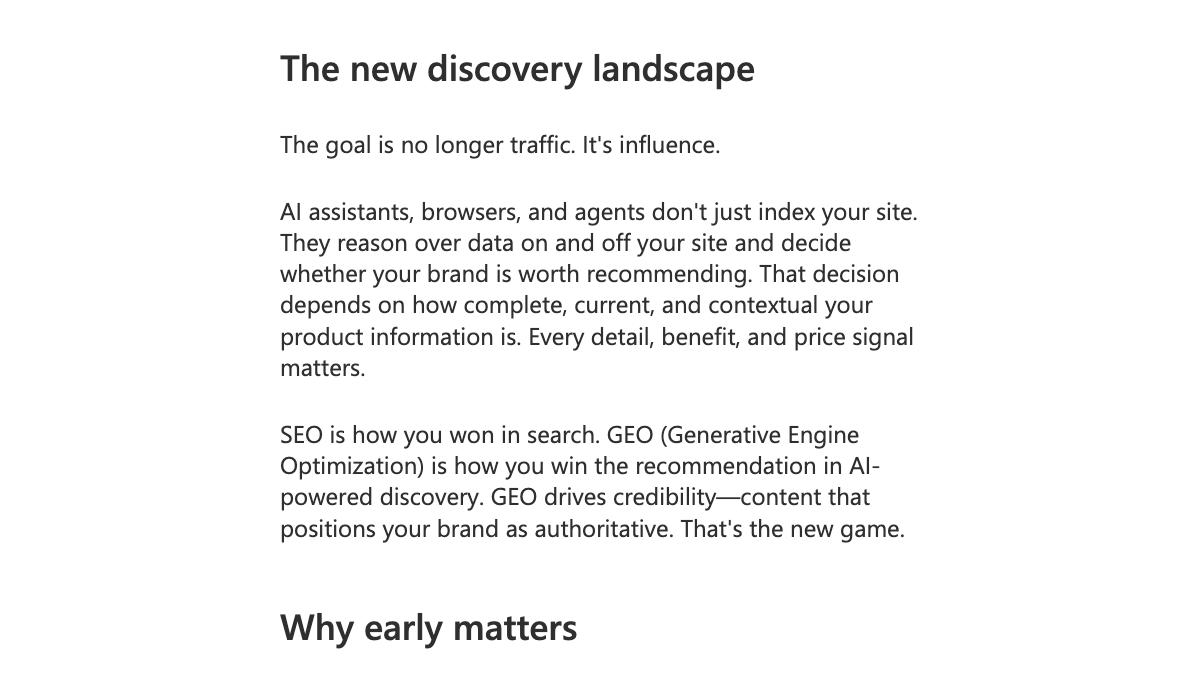
Microsoft has the same split. Its Microsoft Advertising team put out a retail guide in January, and according to Search Engine Roundtable, the guide defined AEO as "Answer/Agentic Engine Optimization." The post announcing it, though, is called "From Discovery to Influence: A Guide to GEO," and it spells out the difference in a single sentence.
Measurement tools haven't picked a side. When Bing Webmaster Tools launched its report in February, the name it chose was "AI Performance." OpenAI's publisher FAQ doesn't use a label at all; it simply says that any public website can appear in ChatGPT search, provided it isn't blocking OAI-SearchBot.
200+ SaaS teams already track their AI citations.
They know exactly when ChatGPT mentions their brand, and when it stops. Do you?

What people actually search for
Search interest tells a cooling story. Every label peaked roughly a year ago, and the two biggest have fallen a long way since:
| US searches | September 2025 | August 2026 |
|---|---|---|
| "AI SEO" | About 12,100 | 4,400 |
| "Generative engine optimization" | 6,600 | 3,600 |
A couple of names didn't fade. Searches for "answer engine optimization" stayed somewhere between roughly 1,900 and 2,900 through the year and finished at the level they started. "AI search optimization" slipped during the winter, then ended the year flat, at about 1,600.
The bare acronyms barely work as data. Type "AEO" alone and you're mixed up with American Eagle Outfitters, which trades under that ticker, and with a customs program called Authorized Economic Operator, all inside the roughly 27,100 US searches the acronym gets each month. "GEO" by itself mostly means geography. If you're naming a service or a job title after one of these, write the full term out at least once.
Why "AI SEO" is the most confusing label
Of all the labels, "AI SEO" is the one we'd avoid when precision matters, since it has two meanings. For some people it's about letting AI handle SEO tasks such as writing drafts or grouping keywords into clusters. For others it's about getting AI engines to cite you.
Google's own results for "ai seo" show both, as we saw when we looked in late September. Salesforce's guide, ranked second, used the term for automating keyword research and content work with AI. Three spots below it, a different page described AI SEO as helping large language models understand a site and cite it, and a tools roundup ranked between the two blended both meanings into one list.
If a vendor or a job listing uses the phrase, ask which meaning they have in mind before anything else. Software that writes blog drafts for you and a service that monitors your ChatGPT citations are solving different problems.
Is it different from SEO?
On Google, hardly at all. Kraham's piece says Google's generative AI features "are rooted in the same core ranking and quality systems as traditional Search," and that those features draw their content from the search index Google already has.
Outside Google, the label starts to carry real meaning. ChatGPT searches OpenAI's own index together with Bing, Claude does its web searching through Brave Search, and Perplexity runs an index of its own. A page that ranks nicely on Google can still be absent from their answers. What you measure shifts as well: citations and named mentions replace positions, and mentions on other people's sites weigh more than they do in classic rankings. For how each engine chooses sources, see our complete guide to answer engine optimization.
Who does the work
We'd worry less about the naming fight than most people do, because whichever word wins, the same people do the work. Aleyda Solis, an SEO consultant, asked her audience in July who handles AI search optimization at their company, and she got more than 1,212 votes. The SEO team took 86% of them. Another 9% went to an AI search team that has SEOs in it.
While some still debate what AI search optimization should be called (GEO, AEO, LLMO…), companies have already answered the question that actually matters: who does the work 👇 I did a poll asking who's in charge of AI Search Optimization in the company you work at/with and https://t.co/0HgGBXFc1P
 Aleyda Solis 🕊️@aleydaJul 2, 2026

She was upfront about the bias: her audience is heavy on SEO people. Even allowing for that, just 1% said AI search sat with a team containing no SEOs, which suggests companies see the work as part of search, not as a separate department.
A thread in r/DigitalMarketing last December asked for GEO and AEO explained "in a simple way," and more than a hundred people replied. One of the more practical replies said about 80% of GEO and AEO is stuff you already know if you know SEO.
Can someone explain GEO and AEO in a simple way? Trying to understand these newer terms clearly.
I understand SEO really well but GEO and AEO are confusing for me. Can someone explain GEO and AEO in a very simple and easy way? Like how they actually work in real digital marketing. I’m trying to learn this properly so any clear explanat...
How often does ChatGPT mention your brand?
Most founders have no idea. The answer might surprise you.

Which name to use, and with whom
Our rule of thumb is to match whoever you're talking to. SEO people are comfortable with AEO or GEO and mostly know both. Executives tend to respond to "AI search visibility," because the phrase describes the outcome they want and leaves the method out of it.
Clients, for their part, seldom use any acronym. A consultant in an r/aeo thread on selling this kind of work said most of theirs never ask for GEO by name. They want to know why ChatGPT, Gemini or Perplexity leaves them out, and showing them a live answer for their category that names a competitor persuades better than a definition.
Curious how people here are handling GEO/AEO conversations with clients.
It’s coming up more often now, and I’d imagine anyone working in SEO, digital or strategy is starting to hear the same questions. What I’m more interested in is how you make it tangible in the sales conversation. Are you showing live exampl...
For vendors, we apply something we call the label test. Anyone selling "GEO" or "AEO" as a discipline of its own should be able to tell you what they'd do that your SEO team wouldn't. A convincing answer covers which engines, how they'd measure, and what they'd actually change on your site and off it. If you don't hear one, find out which engines they check and how often.
RankControl keeps to the plain wording. Its AI visibility tracking runs 50 of your buyer questions every week across six engines, ChatGPT, Claude and Grok among them, and logs where you're cited and who gets named in your place.
Whatever you call it
The only reason the name matters, in our view, is that it decides who owns the work and how it's measured. If the new name pulls budget from the people who already know search, you've paid a price for the label. If it wins your SEO team the resources to cover ChatGPT and Perplexity on top of Google, use it.
Call it anything you like; the job doesn't change. You publish pages that answer what buyers ask and earn mentions on sites the engines trust. Then you keep those pages up to date and re-run the same questions on every engine each week. Doing it all by hand, you'd spend 16 to 24 hours a month writing and publishing eight solid articles. Checking 50 questions on six engines takes about five more hours every week. Both are rough estimates.
You're free to run that loop yourself, under whatever name your team prefers. Or hand it to RankControl's content engine and agents, which can run it every month and leave you free to focus on your product.
15 hours a week manually. Or 15 minutes with RankControl.
Track citations, monitor competitors, and fix content gaps across every AI search engine. Automatically.