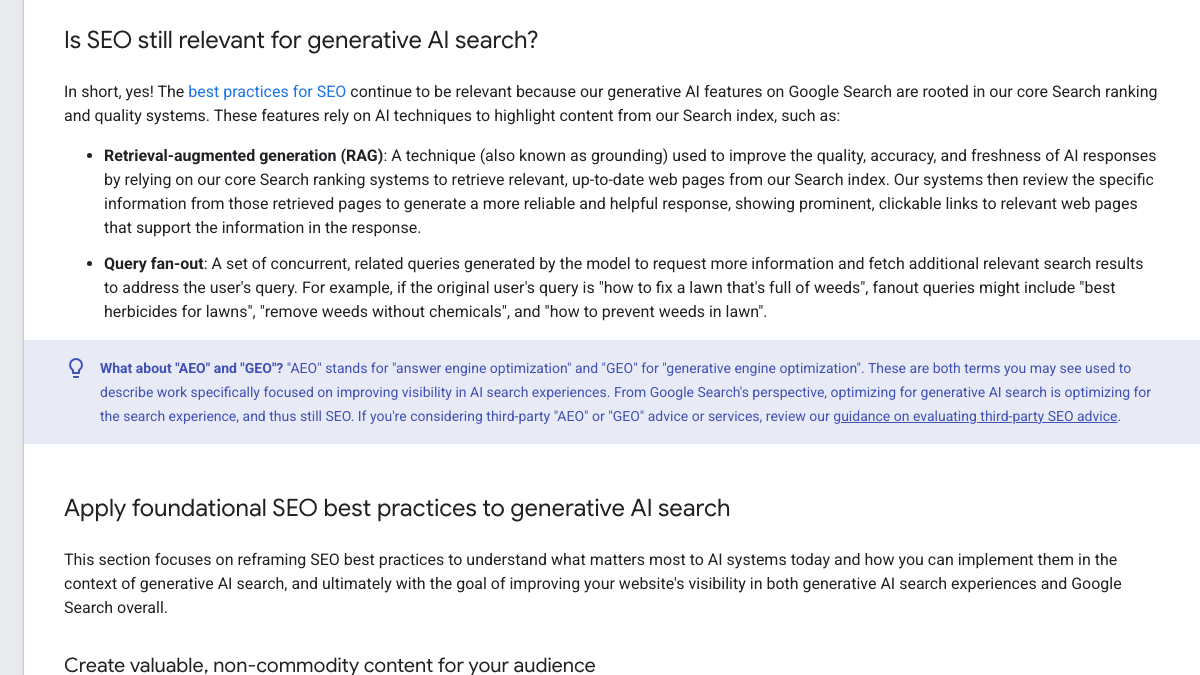
Google's own guide to AI search has a shaded box titled "What about 'AEO' and 'GEO'?" Its answer is short: from Google Search's perspective, optimizing for generative AI search "is optimizing for the search experience, and thus still SEO."
That's true for Google, and it covers only part of the job. ChatGPT, Claude and Perplexity don't search Google's index, and they cite different sites. This answer engine optimization guide covers where each engine looks for sources and what earns citations, then how to measure the work and plan your first 90 days. Google's guide and the other sources below were checked on September 26, 2026.
What answer engine optimization covers
Answer engine optimization, or AEO, is the work of getting your pages used as sources in AI answers and your brand named in them. Those are two different results. A citation is a link to your page under the answer, and a mention is your brand's name inside the answer text, which is the part a buyer actually reads.
The gap between them can be huge. The owner of a three-month-old news site posted in r/SEO that AI engines had cited about 700 of its pages but named the site just five times. Of those citations, 659 came from ChatGPT and none from Gemini.
ChatGPT has cited about 700 of our pages and named the site five times. Is a citation worth anything without the name?
Context so you know what size site this is. News, English, 84% US traffic. Three months old website and domain and most of the growth happened in the last six weeks. Semrush currently estimates 171K monthly organic off 2.3K ranking keywords...
So AEO has two scoreboards, and both vary by engine. For the term's history and a longer definition, see our explainer on what AEO means.
How answer engines choose their sources
Every engine answers in two steps. It searches an index for pages that match the question, and then it writes an answer from what it retrieved. Most engines run several related searches at once, which Google calls query fan-out; its guide's example turns "how to fix a lawn that's full of weeds" into searches such as "best herbicides for lawns."
What differs is the index each engine searches:
| Engine | Where it searches | Crawler to allow |
|---|---|---|
| Google AI Overviews and AI Mode | Google's own index | Googlebot |
| Gemini | Google Search grounding | Googlebot, and Google-Extended for grounding |
| ChatGPT | Bing plus OpenAI's own index | OAI-SearchBot |
| Perplexity | Its own index | PerplexityBot |
| Claude | Brave Search | Claude-SearchBot |
| Grok | Its own web search plus posts on X | Documented bots, used inconsistently |
We call the result the index gap. A page can sit on page one of Google and still be invisible to Claude if Brave doesn't rank it, or to ChatGPT if Bing never indexed it. One 2026 analysis of 5.3 million AI citations found that only 9% of the most-cited domains were shared by all five engines it tracked.
Even inside Google, rankings and citations have drifted apart. In March, Ahrefs reported that just 38% of AI Overview citations came from pages in the top 10, down from 76% a year earlier.
The first gate: can the engines read your pages?
Nothing else in this guide matters if an engine's crawler can't fetch your page. Two blockers catch most sites, and the first is JavaScript. Vercel's crawler study found that none of the major AI crawlers render JavaScript, with Gemini the exception because it runs on Googlebot, so content that only appears after scripts run never reaches ChatGPT, Claude or Perplexity.
The second blocker is your CDN. On July 1, 2025, Cloudflare changed its default to block AI crawlers unless site owners allow them, and bot-fighting settings can do the same thing quietly. Check your robots.txt and firewall rules for OAI-SearchBot, PerplexityBot and Claude-SearchBot. Training bots such as GPTBot and ClaudeBot are a separate decision.
Then verify your site in Bing Webmaster Tools, since Bing feeds ChatGPT's search, and search your top queries on Brave to see whether Claude can find you.
In an r/aeo thread asking whether AEO works for anyone, one marketer described a B2B site that started getting cited on two tracked prompts after about six weeks of making it crawlable, structuring its commercial pages and fixing internal links.
Is AEO actually working for anyone yet?
keep seeing people talk about optimizing for ChatGPT, Perplexity, Gemini, etc., but I’m still not sure what actually moves the needle. Are you seeing real traffic, leads, or mentions from AI search? And if you are, what have you actually do...
Once you connect a traffic source, RankControl's analytics shows AI crawler visits as they arrive, which is the quickest way to confirm the bots are getting through.
Your competitors are building backlinks while you read this.
Organic outreach, social mentions, and link exchanges, with managed backlinks available as an add-on. Grow your domain authority without running the campaign yourself.

What to put on the page
Start with the answer. A July 2026 study of 1,249 ChatGPT answers found that the free tier, which carries most of ChatGPT's use, usually works from a snippet of about 200 characters taken from the top of a page and almost never opens the page itself. If the first two sentences under a heading don't answer the question on their own, that snippet gives the engine nothing to quote.
Write sentences that make sense when lifted out alone, with the number, the product name and the condition in the same sentence.
Evidence helps, within limits. In the Princeton GEO benchmark, adding quotations and statistics from credible sources raised a page's visibility in generated answers by roughly 30 to 40%, while keyword stuffing lowered it. A NeurIPS 2025 follow-up, C-SEO Bench, found most such edits did little once pages competed in realistic conditions, where retrieval rank mattered most. Read together, the two papers suggest sourced stats and quotes work mainly as a tiebreaker for pages that already get retrieved, and the Princeton gains were largest for pages ranked lower.
Cover the questions around the main one. Because engines fan a question out into related searches, a page that also answers the pricing, comparison and setup questions gets more chances to be retrieved than one built for the head term alone. Put comparisons in tables and include real prices where you can. Our AEO best practices for 2026 goes through the on-page tactics that still hold up.
RankControl's content engine writes each article against the pages already ranking for its keyword and scores it for how easily AI engines can quote it, with a fix list.
What happens off your site
Engines weigh what other sites say about you more heavily than what you say about yourself. Ahrefs' study of 75,000 brands found branded web mentions correlated with visibility in AI Overviews at 0.664, while the number of backlinks came in at 0.218. Links still help you rank in Google, which feeds the candidate pool, but being talked about counts for more. When Ahrefs repeated the study in December and added YouTube, mentions in YouTube videos correlated most strongly of all, at about 0.74.
For a B2B brand, that points the budget toward review profiles, earned press, YouTube reviews and community threads. Our piece on brand mentions vs backlinks goes through the data in more detail.
Reddit is the channel that changed fastest. Tracking firms saw Reddit's share of ChatGPT citations fall by about 86% within days of the ChatGPT 5.6 release in August. That doesn't mean Reddit stopped mattering. SEO consultant Lily Ray highlighted analysis by Suganthan Mohanadasan in which Reddit filled 84 of ChatGPT's 221 retrieved results in one test, yet none of it was cited, apparently because ChatGPT was checking opinions about brands it had already picked.
A few SEO/GEO data providers have shared this week that Reddit citations are collapsing in ChatGPT with the launch of 5.6, and after reading several articles and perspectives about this, I'd like to share my own version of what I think might be happening. First off, I highly
 Lily Ray 😏@lilyraynycAug 21, 2026
So skip thread seeding, and spend that time answering questions in the two or three communities your buyers actually read.
You're getting AI traffic. But do you know where it comes from?
RankControl credits every visit to the assistant that sent it: ChatGPT, Perplexity, Claude, Gemini, Copilot, or Grok. Full source attribution, next to your Google traffic.
What to skip
Google's guide lists what you don't need to do, and it's worth reading before you pay anyone for AEO.
| Tactic | What the evidence says |
|---|---|
| llms.txt files | Google Search ignores them, and creating one "will neither harm nor help" your visibility |
| Special AI markup or Markdown copies | Google says you don't need new machine-readable files to appear in its AI features |
| Chunking pages into tiny pieces | Google says its systems find the relevant passage on their own |
| Rewriting content just for AI | Google says its systems understand synonyms, so you don't need every long-tail variation |
| Keyword stuffing | Lowered visibility in the Princeton GEO benchmark |
Schema markup is still worth having for rich results, but don't expect it to earn citations. Ahrefs' matched-control test in March found no citation lift from adding JSON-LD on any platform it checked.
One B2B SaaS founder on r/aeo spent six months on answer-first pages, FAQPage schema and an llms.txt file. Citations climbed, but conversions from AI referrals stayed close to zero, and the top reply noted that engines mostly cite third-party comparisons rather than a brand's own.
How to measure answer engine optimization
Google now gives you part of the picture. Search Console's generative AI performance reports, announced on June 3, 2026 and available to every site since August 31, show how often your URLs appeared in AI Overviews and AI Mode, by page, country, device and date. They count impressions, though, not whether you were named, and they cover Google only.
For the other engines you need your own checks. Freeze a set of 30 to 50 buyer questions and run them on each engine on the same day every week. Log whether you were cited, whether you were named, which competitors appeared and which sources the engine used.
Weekly matters because answers churn. When Ahrefs tracked AI Overviews for fixed keywords, about 45% of the cited sources changed each time an Overview was regenerated, so a single check only tells you what one answer said on one day.
Traffic undercounts the result, since many assistant visits arrive without a referrer and land in Direct, and many buyers search your name later. Semrush found that visitors from AI search converted at 4.4 times the rate of traditional organic visitors, even though they're still a small share of sessions for most sites.
RankControl's AI visibility tracking runs that weekly check for you: 50 buyer questions on six engines, with a citation history per engine and a notification when a new citation lands.
A 90-day answer engine optimization plan
| Weeks | Work | What to check |
|---|---|---|
| 1 to 2 | Fix crawler access in robots.txt and your CDN, verify Bing Webmaster Tools, and pick 30 to 50 buyer questions | Baseline citations and mentions per engine |
| 3 to 6 | Rewrite the top of your ten most commercial pages answer-first, then publish pages for the biggest gaps, starting with comparisons and pricing | First citations on new and rewritten pages |
| 7 to 12 | Publish weekly and pitch the roundups, review sites and publications the engines already cite for your questions | Weekly trend per engine, and which competitors lost ground |
Expect the engines to move at different speeds. Perplexity's fast-refreshing index often shows new pages first, while ChatGPT's brand recommendations usually move last because they depend on how widely you're mentioned.
If you want a baseline before week one, our free AI visibility checker asks ChatGPT three real buyer questions from your market and shows who it cites.
Running it yourself or handing it off
AEO doesn't finish, because citations churn and model updates keep changing the rules. Done by hand, publishing 20 solid articles a month takes 40 to 60 hours, and checking 50 questions on six engines takes about five hours a week. Those are rough estimates.
RankControl runs that loop for $400 a month with a 7-day free trial. It plans articles from your buyers' questions, writes them against what already ranks, publishes them on your site and checks where you're cited every week.
You can run the plan above yourself with a spreadsheet and a few hours every Monday. Or RankControl's agents can run it every month while your team works on the parts only it can do.
We'll show you exactly where your brand stands in AI search.
No commitment. $0 due today, cancel anytime. See how ChatGPT, Perplexity, Claude, Gemini, Grok, and Google AI Mode talk about your brand today.