
In September, someone who runs SEO for clients posted in r/GenerativeSEOstrategy that a client had asked for their GEO plan, and they only half understood the term. The writeups disagreed. Some called generative engine optimization a brand-new channel, while others said it was the same technical and content work, turning up in ChatGPT rather than in blue links.
trying to wrap my head around generative engine optimization.. is it just seo with extra steps
client asked me last week what our geo plan is and i realized i only half get it some writeups treat generative engine optimization like a whole new channel. others say its the same technical + content work, just showing up in chatgpt or ai...
Underneath was a better question: what goes on a GEO list besides renamed SEO? One reply took the client's side. What clients want to know, it said, is whether next month's answers will still describe them wrong, and the acronym doesn't interest them.
You'll get both sides here, from where GEO came from and how engines pick sources to what works and how to measure it. We checked every source on September 27, 2026.
Where generative engine optimization came from
The name goes back to a research paper first posted in November 2023. Its authors came from Princeton, IIT Delhi and the Allen Institute for AI, among other places:
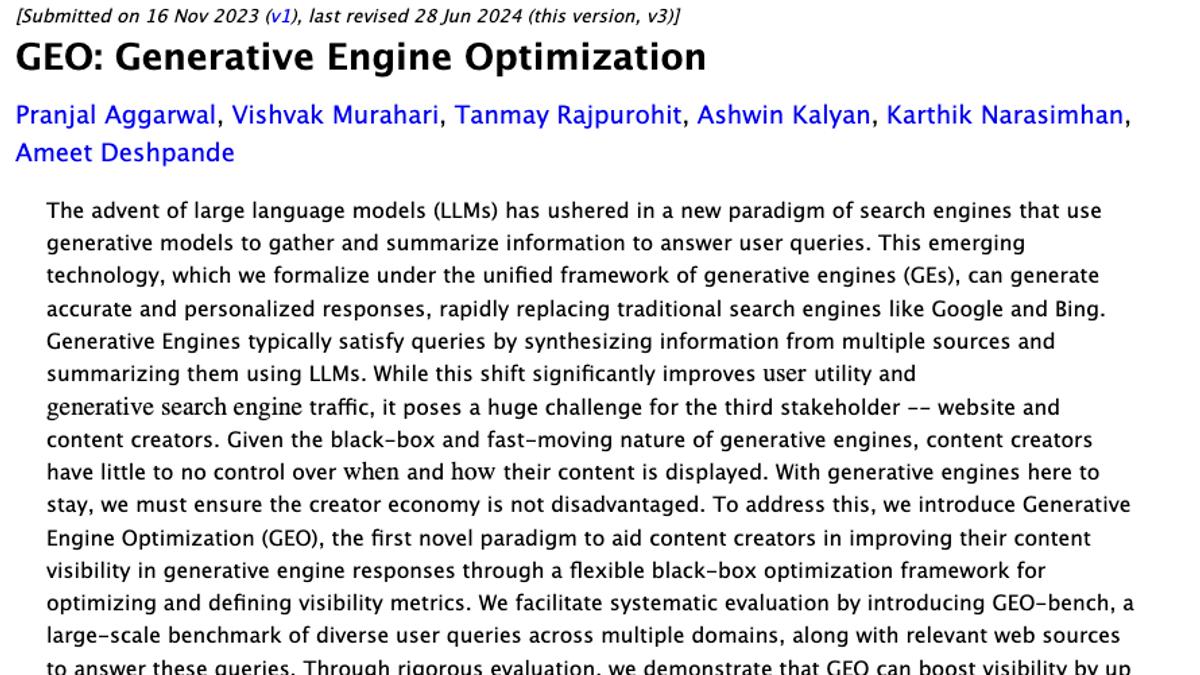
They built a benchmark of 10,000 queries and tested how changing a page affected its visibility in AI answers. The biggest gains came from adding statistics and quotations, along with citations to credible sources. Keyword stuffing, the old SEO shortcut, did poorly.
Before you quote the paper's numbers, keep two limits in mind. The tests ran on a research engine and on Perplexity as both worked in 2023, long before the retrieval systems engines use now. The paper also found that results varied by subject, so a tactic that lifted history pages might do nothing for your software pages.
What has held up is the idea underneath. Google's own guidance asks for non-commodity content, meaning content that adds value beyond common knowledge. If your page has a figure, a named source or a clear definition, an engine has something concrete to quote. A page that repeats every other result gives it no reason to pick yours.
The label has spread and splintered since then. Here's what US search volume did for the two main names:
| Search term (US searches a month) | Earlier | Later |
|---|---|---|
| generative engine optimization | About 6,600 in September 2025 | Around 3,600 in August 2026 |
| ai search optimization | 720 in December | 1,600 by summer |
So one name lost ground while "ai search optimization" roughly doubled over the same stretch. People still want the work done under whatever name, and our explainer on LLM SEO, GEO, AEO and AIO sorts the names out.
Google keeps it simpler. From Google Search's perspective, its May 2026 guide says, optimizing for generative AI search is still SEO.
How AI engines choose their sources
All the engines follow roughly the same routine. Your question gets rewritten into several searches, the engine retrieves pages for each one, and the answer is written from what it read. Google's name for those extra searches is query fan-out. Ask about fixing a weedy lawn, and it might also search for lawn herbicides and for ways to prevent weeds.
The engines differ on where the pages come from. Google's AI features use Google's own index. ChatGPT blends Bing, Google results and an index OpenAI builds itself, which our look at whether ChatGPT search uses Bing covers. That mix is why a good ranking won't guarantee you a citation. Ahrefs checked in 2025. Only 8% of ChatGPT's citations matched Google's top 10 for the same prompt.
The question type matters too. This month we sorted 308 citations by page type. On software buying questions, roundups took 71%. On services questions, explainers and service pages took about 70% between them, and our AEO content playbook maps each question type to the format engines cite.
See your first AI citation report in under 5 minutes.
No setup calls. No onboarding meetings. Connect your domain and see where AI mentions your brand right now.

What works, ranked by evidence
These are the levers with real evidence behind them, in roughly the order we'd work through them:
| Lever | Evidence | Where to start |
|---|---|---|
| Let AI search crawlers in | OpenAI says sites that block OAI-SearchBot won't be shown in ChatGPT search answers | Check robots.txt for OAI-SearchBot, PerplexityBot and Bingbot |
| Rank for the searches engines run | Google describes answers built from its core ranking systems and fan-out searches | Cover the head term and the related questions around it |
| Add specific facts, statistics and quotes | The GEO paper measured gains of up to 40% | Replace vague claims with numbers, dates and named sources |
| Keep key pages current | In our September check, cited pages carried a median date of 74 days, against 212 for top-10 pages engines skipped | Date your pages and update the ones that answer buyer questions |
| Earn genuine mentions | Ahrefs found web mentions correlated with AI Overview visibility at 0.664, against 0.218 for backlinks | Reviews, PR and honest community answers |
You probably pass the first one already. We fetched robots.txt from 161 sites that AI engines cited or Google ranked for B2B software questions. We could read 151 of those files, and 149 of them let OpenAI's search crawler in. Check yours anyway, because a blanket rule written to keep out AI training can shut out the search crawlers too.
The mentions lever is slow, and the evidence for it is a correlation, so start it early and let it run while you do the faster work.
What to skip
Google's May 2026 guide includes a section titled "what you don't need to do," and that one section wiped a lot of paid GEO work off people's plans. Aleyda Solis summed it up when the guide came out:
🚨 Google has published its official guidance on optimizing for generative AI experiences in Search, including AI Overviews and AI Mode 👇 Going through: 1. How SEO is still relevant for generative AI search: The best practices for SEO continue to be relevant because their https://t.co/CrSor7zGfW
 Aleyda Solis 🕊️@aleydaMay 15, 2026
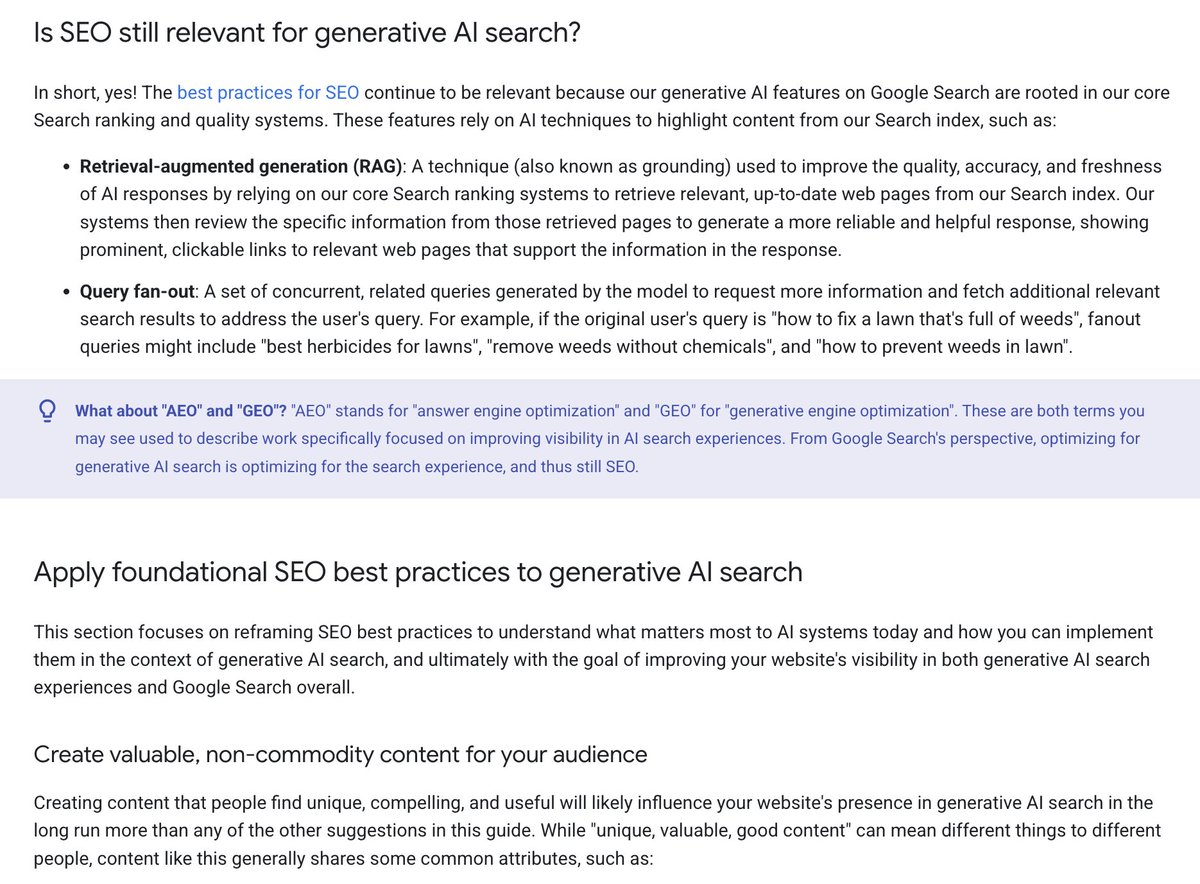
Google's list starts with llms.txt and other special AI files, plus splitting your content into chunks. Rewriting content just for AI systems is on it too, and so is chasing inauthentic mentions. The guide also warns against overfocusing on structured data, though ordinary schema still earns you rich results.
That guidance covers Google alone, but we haven't seen public evidence that other engines reward those tactics either. Manufactured mentions carry the most risk of the four, because spam systems exist to catch exactly that, and our piece on why GEO spam is coming looks at what happens to sites that do it at scale.
Your competitors are building backlinks while you read this.
Organic outreach, social mentions, and citations from Editorial Circle member sites, with managed backlinks available as an add-on. Grow your domain authority without running the campaign yourself.

The GEO remainder: the jobs SEO doesn't cover
Which leaves the obvious follow-up: once the SEO is done, what's still on the list? We call it the GEO remainder. Four jobs make it up, none of them huge, and we'd still argue each one matters more than GEO's skeptics admit.
Help Scout shows why the first job, fact consistency, matters. Engines pick up your prices, plans and claims wherever they find them, including app marketplaces and review sites. In our checks this month, AI answers repeated Help Scout's annual prices without saying they were annual, because the billing period sat in a toggle on the page.
Source gap analysis is the job SEO tools won't show you. Take each buyer question and list the third-party pages that engines cite in place of yours. Then decide, page by page, whether to earn a spot on it or publish something better.
Your rankings tell you where you stand on one search engine, and that's all. They won't show what ChatGPT or Perplexity told buyers about you this week, or what Claude, Gemini, Grok and Google's AI Mode said. Those answers change more often than rankings do, which is why answer monitoring across engines is the third job.
When an engine gets your pricing or your category wrong, the fourth job is correcting it. Trace the claim back to the page it came from, then fix that page or ask whoever owns it to, and report the answer to the engine. After that, recheck the same question every week and keep a dated record of what it said, so you'll know when the fix landed.
How to measure GEO
Measurement starts with a fixed list of 25 to 50 buyer questions. Run each one more than once on every engine you care about. For each answer, write down whether your brand was mentioned and whether your site was cited.
Keep those as two separate rates per engine, and track the same pair for your three closest competitors. One blended score would hide the useful part. Say your mention rate climbs while your citation rate falls: engines know your name, but they're quoting other people's pages about you, and that needs a different fix than the reverse. Our guide to tracking AI citations for free covers how many runs you need before a change means anything.
Attribution is the hard part. In September an agency owner posted in r/SEO that a client wanted proof the GEO work had driven their improvement. Content updates, new mentions and regular SEO had all landed in the same period. The best reply said to compare within the site rather than over time. Say you rewrote 12 pages and left 30 alone. Then check whether the 12 moved while the 30 stayed put.
Add a "how did you hear about us" field to your forms as well, because most AI mentions never produce a click you could track.
A 90-day GEO plan
Here's how we'd lay out the first quarter:
| Weeks | Focus |
|---|---|
| 1 to 2 | Crawler access, indexing and a baseline run of your question list |
| 3 to 6 | Fix facts on your own pages, then publish pages for your top buyer questions in the format each rewards |
| 7 to 10 | Source gap analysis, comparisons and refreshes of pages that rank but aren't cited |
| 11 to 13 | Second measurement run and a within-site comparison of changed and unchanged pages |
Mentions and reviews run in the background the whole time. When your list gets long, our guide to prioritizing AEO projects helps you decide what goes first.
By hand, the hours pile up. Publishing eight solid articles a month takes 16 to 24 hours. Checking 50 questions on seven engines takes about six hours a week. Both are rough estimates.
RankControl's content engine writes each article against the pages already ranking for its keyword and publishes it on your own domain. Our AI visibility tracking runs your 50 questions on seven engines every week and marks each one as mentioned, cited or both. We also record which competitors and sources each engine used.
A question list, a spreadsheet and your SEO team are enough to run a GEO program yourself. If you'd rather hand off the publishing and weekly tracking, RankControl's agents can take those while your team works on the remainder.
You're getting AI traffic. But do you know where it comes from?
RankControl credits every visit to the assistant that sent it: ChatGPT, Perplexity, Claude, Gemini, Copilot, or Grok. Full source attribution, next to your Google traffic.