In April, a marketer posted in r/DigitalMarketing that clients had stopped reading their monthly SEO reports. So they added AI citation tracking: how often each client's brand showed up in ChatGPT and Perplexity answers, for which questions, and whether competitors showed up instead. One client forwarded the report to their CMO.
added AI citation tracking to our monthly reports and clients are suddenly paying attention
clients wouldnt read the monthly SEO reports. id ask followup questions and they clearly hadnt looked at anything i sent. two years of that added AI citation tracking a few months back, how often their brand shows up in ChatGPT and Perplexi...
The post ended with the question most teams run into next. What are you actually tracking, since the methodology "feels kind of made up right now"?
This guide covers that methodology. It explains what to measure, why a single AI answer can't be trusted and how to build a question set. It then covers how often to check, which free reports help and how to turn results into work. Sources were checked on September 27, 2026.
What AI citation tracking measures
An AI answer can include your brand in two ways. It can mention you by name, or it can cite one of your pages as a source with a link. The two move separately, which our piece on mention tracking vs citation tracking covers in depth.
Most useful tracking records a few things per answer:
| Metric | What it tells you | What to watch for |
|---|---|---|
| Mention rate | Share of answers that name your brand | Varies between runs of the same question |
| Citation rate | Share of answers that link to your pages | Changes more between runs than mentions do |
| Competitor mentions | Which brands appear when you don't | Your real competitors in AI answers may differ from your list |
| Cited sources | Which pages engines use for your questions | Third-party pages you could earn a place on |
| Accuracy | Whether prices, plans and category are right | Errors copied from old or unclear pages |
Position in a list is missing on purpose. An AI answer that names you third today can name you first tomorrow, as the next section shows.
26 content formats. Published on your domain. Matched to your brand.
Guides, comparisons, listicles, case studies, and more. RankControl generates content that gets cited by ChatGPT, Perplexity, Claude, Gemini, Grok, Google AI Mode, and Google AI Overviews.

Why one AI answer tells you very little
In January, SparkToro published a study in which 600 volunteers ran 12 prompts through ChatGPT, Claude and Google's AI tools, 2,961 times in total. Across the tools, the odds of getting the same list of brands twice were under 1 in 100. Rand Fishkin shared it with a blunt question:
NEW research: https://t.co/yE1LogIFHO If you give ChatGPT the same request for product recommendations 100X, will you ever get the same list twice? And what does that answer mean for folks who try to track their brand presence in AI tools? Finally, some real answers 🧐 https://t.co/r8R7IMSJm5
 Rand Fishkin@randfishJan 28, 2026
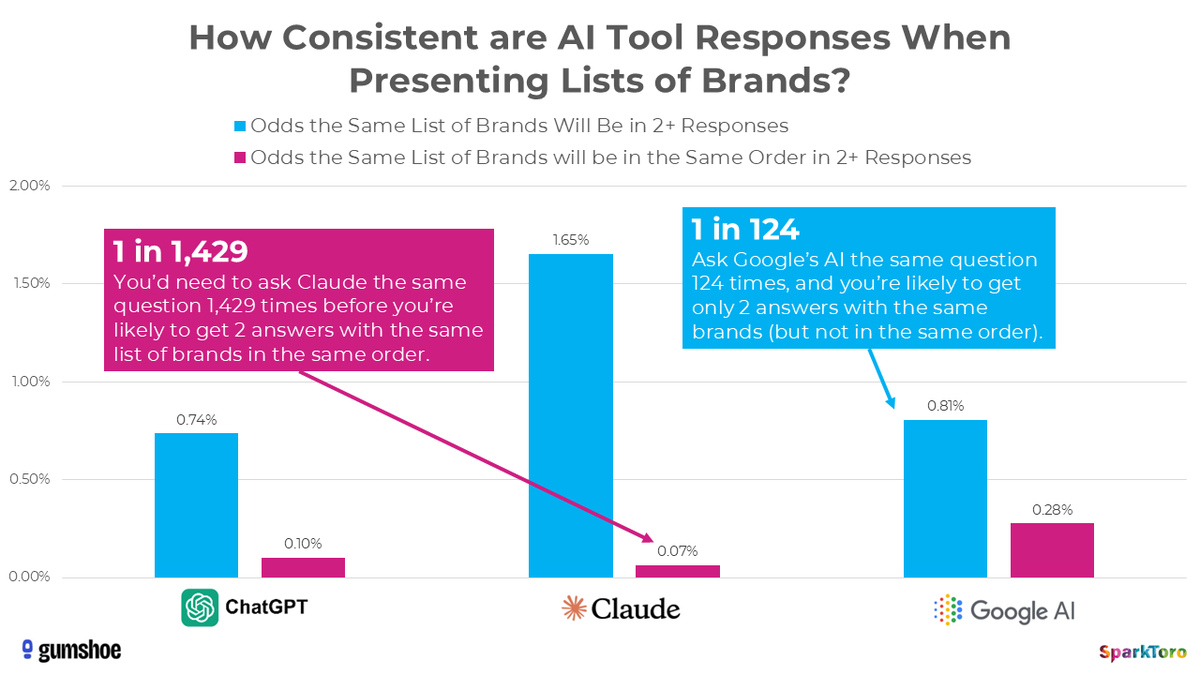
The study's conclusion was more useful than the headline. Ranking positions are unreliable, but how often a brand appears across many questions run several times is a reasonable metric.
We saw the same pattern on a smaller scale. On September 26, we ran five help desk buying questions three times through OpenAI's API with web search and twice through Perplexity's API. For each question, we listed every brand and source that appeared in any run, then counted how many appeared in every run:
| Engine | Brands named in any run | Named in every run | Sources cited in any run | Cited in every run |
|---|---|---|---|---|
| OpenAI (3 runs) | 48 | 26 | 29 | 5 |
| Perplexity (2 runs) | 30 | 24 | 43 | 34 |
Counts are summed across the five questions. Two things stand out. Brand mentions were much steadier than citations on OpenAI, where only 5 of 29 sources were cited every time. And the top pick moved. For the most affordable help desk with live chat, OpenAI's answers led with tawk.to twice and Tidio once. Perplexity led with Zoho Desk once and tawk.to once.
We call the brands an engine names every time for a question its stable core. Help Scout was in both engines' stable core for four of the five questions, and missing from every run of the fifth. The stable core is what winning looks like. Showing up in some runs but not others means you're in the churn around it, where one extra run can flip the result.
Treat this as one small snapshot. APIs aren't the consumer apps, and five questions in one category don't cover every market. But it's why a report built on one answer per question will swing week to week with nothing changing on your site.
Build a question set that holds up
Tracking is only as good as the questions. Aim for 25 to 50 that buyers actually ask, and keep them fixed so changes over time mean something.
| Question type | Example | Why it's there |
|---|---|---|
| Category | "best help desk for a small support team" | Shows whether you make the shortlist |
| Alternatives | "alternatives to Zendesk for a small business" | Catches buyers already looking to switch |
| Comparison | "Help Scout vs Front" | Shows how engines frame you against a rival |
| Problem-first | "how to stop missing support emails in a shared inbox" | Catches buyers before they know the category |
| Brand facts | "what does Help Scout cost and who is it for" | Checks whether answers describe you correctly |
Write them the way buyers talk, which is usually longer and more specific than a keyword. Our guide to using customers' exact words in AI content covers where to find that language.
One reply in an r/aeo thread from August suggested a check to run before any of this. Ask each engine who your company is, what it does and where it's based, then compare the answers. If the engines disagree on your category or merge you with a similarly named company, fix that first.
Your competitors are getting cited by AI. You're not.
Every day without citation tracking is a day your competitors pull ahead in ChatGPT, Perplexity, and Claude.
Choose engines and surfaces
AI search is no longer one engine. ChatGPT's share of visits to AI chatbot sites fell from 76.4% to 52.7% in the year to May 2026, while Gemini and Claude grew, as our AI search adoption statistics show. Checking ChatGPT alone now covers about half of that traffic.
A practical set is ChatGPT, Perplexity, Claude, Gemini, Grok and Google's AI Mode, with Microsoft Copilot covered by Bing's own report below. Track each one separately. Each engine picks sources differently, so a brand can be cited by one and missing from another.
The harder question is which version of each engine to test. In that same r/aeo thread, someone asked which ChatGPT and Claude models to check against:
How do you actually track AI visibility across ChatGPT and Claude?
I've been updating our product pages to try and earn more AI citations, and now I'm stuck on the tracking side. Google AI Overviews are easy enough. I can see whether we're mentioned, roughly where we rank, and whether we get a link. ChatGP...
The most upvoted reply argued for the default consumer version, signed out, since the app and the API aren't the same system. The app adds its own search layer and settings. API checks are easier to repeat at scale. Whichever you choose, keep it the same every week and note it in your reports, so a change in method doesn't look like a change in visibility.
How often to check, and how to read changes
Weekly is the right pace for most teams. Answers shift often enough that monthly checks miss real changes, while daily checks mostly record noise.
Because single answers vary, read results as rates across the whole question set. A 40-question set checked weekly gives you 40 data points per engine per week. Look for trends over three or four weeks before calling a change real. Our guide to tracking AI citations for free covers how many repeat runs you need when checking by hand.
Log anything that could explain a change: pages you published or updated, model updates announced by the engines and changes to your question set.
Add the free first-party reports
Engines now share some data directly, and it fills gaps that question tracking can't. Google added a Generative AI performance report to Search Console in June and rolled it out to all sites on August 31:
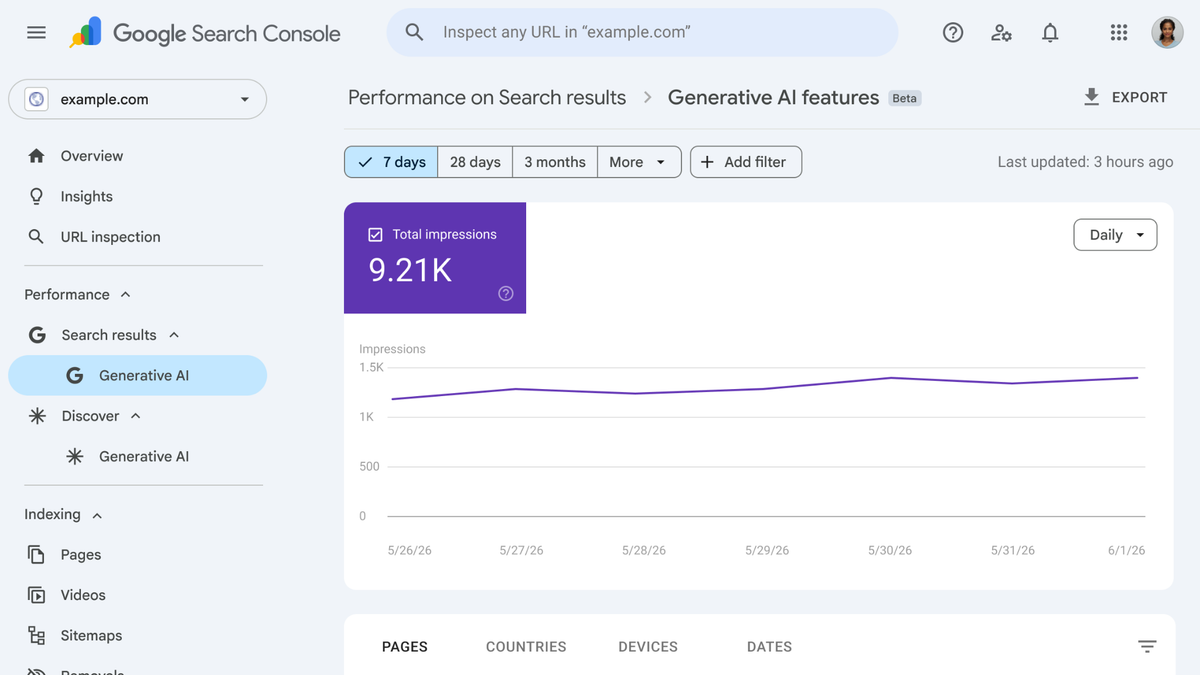
It shows how often your pages appeared in AI Overviews, AI Mode and AI features in Discover, by page, country, device and date. It counts impressions only, so it doesn't show which queries triggered them or whether anyone clicked.
| Source | What it covers | What it misses |
|---|---|---|
| Search Console Generative AI report | Impressions in Google's AI features, by page | Queries, clicks and every other engine |
| Bing Webmaster Tools AI Performance | Citations and grounding queries in Copilot and Bing's AI summaries | ChatGPT, Perplexity and the rest |
| Analytics referrals | Visits from chatgpt.com, perplexity.ai and similar | Visits that arrive with no referrer |
| Server logs | Visits from AI crawlers and user-triggered fetches | Whether the fetch led to an answer |
| "How did you hear about us" field | Buyers who found you through AI answers | People who never fill in a form |
Our GA4 guide to tracking AI referrals covers the analytics setup. None of these reports shows what ChatGPT or Perplexity say about you, which is why question tracking is still the core of the work.
Report results and act on them
A monthly report needs four things for each engine:
- Mention rate and citation rate, next to the same rates for your three closest competitors.
- The sources cited most often for your questions, with any new ones flagged.
- Wrong facts found in answers, with the page each one came from.
- What changed on your site, so movement can be tied to work.
Skip the blended visibility score. It hides which engine moved and whether mentions or citations changed, as our piece on why we track seven engines instead of one score explains.
Then match each result to a fix. If you're missing from answers entirely, you likely need pages for those questions or a place on the third-party pages engines cite. If you're mentioned but rarely cited, engines are quoting other people's pages about you, so improve the page that should answer the question. If an answer has your facts wrong, trace the claim to its source page and fix it there, as our Perplexity citation audit shows.
Done by hand, checking 50 questions on seven engines takes about six hours a week, and publishing eight solid articles a month takes 16 to 24 hours more. Those are rough estimates.
RankControl's AI visibility tracking runs your 50 questions every week on seven engines, marks each one as mentioned, cited or both, and records which competitors and sources each engine used. The content engine writes each article against the pages already ranking for its keyword and publishes it on your own domain.
You can run citation tracking yourself with a fixed question list, a spreadsheet and the free reports above. Or RankControl's agents can run the weekly checks and publishing while your team works on the fixes.
200+ SaaS teams already track their AI citations.
They know exactly when ChatGPT mentions their brand, and when it stops. Do you?