
In May, a Perplexity user posted in r/perplexity_ai that the assistant had pinned claims on sources that never mentioned them. When they pushed back, it apologized for "over-citing," meaning attributing claims to sources that didn't support them.
Numbered citations are the main reason many people trust Perplexity. They're also easy to over-trust, since a small number after a sentence looks like proof. It only tells you which page the answer drew on. Whether that page says what the sentence says is a separate question, and it's the one this guide is about.
We checked 19 cited claims from Perplexity answers saved on September 26 against the pages behind them. This guide covers what we found and why Perplexity citations go wrong, then how to run the same audit on answers about your own brand. Sources were checked on September 27, 2026.
What a Perplexity citation does and doesn't promise
Each bracketed number in a Perplexity answer points to one entry in that answer's source list. It means the page was retrieved and used. It doesn't guarantee the page contains the fact in that sentence.
Researchers have measured that gap for years. A 2023 Stanford study audited four generative search engines, including Perplexity. Only about half of the generated sentences were fully supported by their citations, and roughly a quarter of the citations didn't support the sentence they were attached to. Those were older versions of these tools, so the numbers have likely moved since.
Perplexity does better than most on tougher tests. In March 2025, the Tow Center for Digital Journalism gave eight AI search tools excerpts from news articles and asked each to name the source:
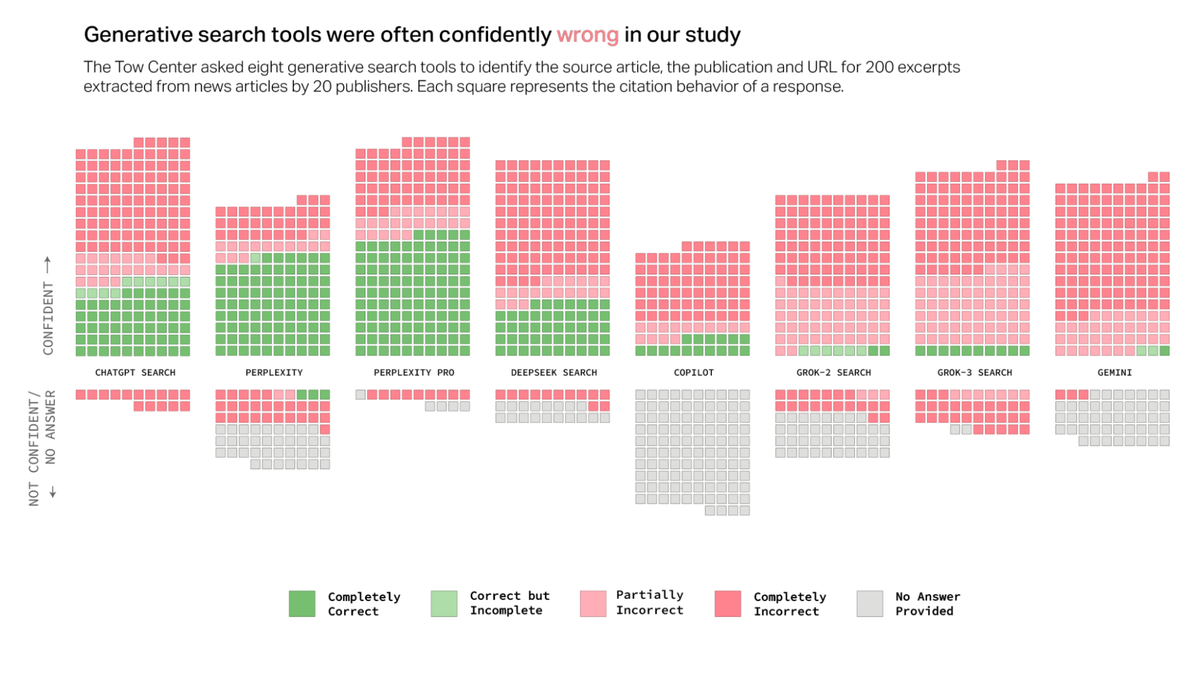
Across all eight tools, more than 60% of answers were wrong, with error rates ranging from Perplexity's 37%, the lowest, to Grok 3's 94%. Being the most accurate tool in that group still meant more than one wrong answer in three. Our roundup of AI hallucination rates in 2026 puts that study next to the newer leaderboards.
What we found checking 34 citations
So how often does the cited page actually contain the fact? For our check, we took saved Perplexity answers to buying questions about help desk software and small-business accounting. We pulled every sentence that stated a specific fact, such as a price or a form number, and picked 19 of them. Then we opened each cited page and searched it for the fact.
Those 19 claims carried 34 citations between them. Of those, 28 supported their sentence, one supported it in part and five didn't. Every claim had at least one citation that backed it up. Here's a sample:
| Claim in the answer | Citations | Supported the claim |
|---|---|---|
| Kruze Consulting handles accounting for over 800 startups | 1 | 1 |
| Help Scout's pricing page lists $25, $45 and $75 per user a month | 1 | 1, though those are annual-billing prices |
| Small businesses use Form 8974 and Form 941 to apply the credit to payroll taxes | 4 | 2 fully, 1 partly, 1 not at all |
| E-commerce bookkeeping runs $400 to $700 a month, or $700 to $1,500 for complex stores | 2 | 1 |
| Hiver works inside Gmail | 2 | 1 |
| Zendesk is generally not the easiest to set up | 3 | 2; the third was Zendesk's own page |
The Zendesk row is the one worth a second look. Two of its sources, a G2 guide and a crm.org review, said Zendesk can feel complex to set up. The third source was Zendesk's own small-business page, which says its reporting gives leaders clarity "without complex setup."
We call this citation padding: attaching several sources to one sentence when only some of them carry the fact. Three citations make a claim look well corroborated. In the Form 8974 example, two of the four sources did all the work.
A larger audit found the same pattern. In September, Haus Research checked 1,826 Perplexity citations attached to sentences with figures in them. It found that 34.7% led to a page that wouldn't open or didn't contain any figure from the sentence. Scored per claim instead, only 14.4% of claims failed. Treat it as one data point, since the same site also publishes rankings that name a winning vendor. We also ran this check on Perplexity and ChatGPT side by side in our Perplexity vs ChatGPT research comparison.
See your first AI citation report in under 5 minutes.
No setup calls. No onboarding meetings. Connect your domain and see where AI mentions your brand right now.
Why Perplexity citations go wrong
Padding was the most common problem in our sample, but it wasn't the only one. Four others showed up in our sample.
The source is an interested party
Across the 10 help desk answers we checked, 55 of the 80 cited URLs came from companies that sell help desk or customer support software. Intercom's roundup of help desk tools ranks Intercom's own product first. Help Scout's blog post on Zendesk alternatives was cited as evidence for which Zendesk alternatives are best.
The citation can be accurate in that case, since the page does say it. The problem is who's saying it. A reader who takes that sentence as an independent recommendation is getting Help Scout's view of its competitors.
People who use Perplexity for research run into this all the time. One thread in r/perplexity_ai asked how others decide which source to trust when two confident articles disagree:
When sources disagree, what’s your rule for deciding who to trust?
I keep running into the same problem: two confident articles, different conclusions, both sound plausible. Perplexity helps because it makes it easier to see what a claim is based on, but it still cannot solve “bad source in, bad conclusion...
The poster noted that Perplexity makes it easier to see what a claim is based on, but it can't fix a bad source feeding a bad conclusion. The most practical replies came down to checking who published the page and looking for the source's own source.
The number is right, but the context is missing
Help Scout's pricing page does list $25, $45 and $75 per user a month, but those prices apply to annual billing, and monthly billing costs more. The answer repeated the numbers without that detail. Another cited page, a tech.co guide, said in its text that ManageEngine starts at $10 per user a month and listed $13 in its own comparison table. The answer used the $10.
The page won't open for a check
Several cited pages, including Capterra and Gusto, blocked our scripted requests. We needed a real browser or a scraping service to read them. A person clicking through can usually open them, but anyone auditing at scale will hit the same wall, and Haus counted unreachable pages as failures.
Sources disagree with each other
One question asked what Help Scout costs. The sources Perplexity cited gave starting prices of $25 a user, $30 a month and $55 a month. The answer handled it reasonably, flagging that the figures probably reflected different billing contexts. Not every answer flags a conflict like that.
Your competitors are building backlinks while you read this.
Organic outreach, social mentions, and citations from Editorial Circle member sites, with managed backlinks available as an add-on. Grow your domain authority without running the campaign yourself.

How to audit Perplexity citations
You can run this audit with a browser and a spreadsheet. Expect the first 10 answers to take a few hours.
- Pick 10 to 20 questions that matter to your business, such as your category's buying questions and questions about your own pricing.
- Run each one and save the full answer with its numbered source list and the date. The numbers only map to that answer's list, so save the list with it.
- Split each answer into claims, one sentence with a specific fact per row. Skip opinions like "best for small teams," since no page can confirm or rule them out.
- Open every cited page for each claim and search it for the exact number or name. Mark the citation supported, partly supported, not supported or unreachable.
- Note who published each source, whether a vendor, a review site, a publisher or a forum.
- Score it two ways, per citation and per claim. A big gap between the two means heavy padding.
- Rerun the same questions monthly, since answers and their sources change between runs.
A simple sheet looks like this:
| Question | Date | Claim | Citation | Source type | Verdict |
|---|---|---|---|---|---|
| How much does [your product] cost? | Sept 27 | "Plans start at $25 per user a month" | [18] your pricing page | Your site | Supported, annual price only |
| Best [category] tools for small teams | Sept 27 | "[Competitor] offers a free plan" | [3] a competitor's comparison post | Vendor | Not supported |
Keep your sample honest. Answers vary from one run to the next, so a single run of a few questions won't tell you much. Our guide to tracking AI citations for free covers how many answers you need before a change means something.
What to do when an answer is wrong about you
The fix depends on where the error comes from.
If the claim cites your page and your page is unclear, rewrite it. Put the exact figure in plain text and say whether prices are monthly or annual. Date the page too. The Haus audit found that facts written down in one obvious place, such as headcount, passed its check 82% of the time, against 44% for current CEO names.
If it cites a third-party page that's wrong, ask the publisher for a correction and give them the right figure with a link. Review sites and app marketplaces often carry old prices. Help Scout's pricing page and two review sites gave different starting prices, which is how the answer ended up with a range of $25 to $55.
If no cited page says it at all, publish the correct fact clearly on your own site and watch whether the answer changes. Our guide to updating what ChatGPT and Perplexity say about your company walks through each case. For the broader causes, see why AI search engines cite the wrong sources.
Done by hand, checking 50 questions on seven engines takes about six hours a week, and publishing eight solid articles a month takes 16 to 24 hours more. Those are rough estimates.
RankControl's AI visibility tracking runs your 50 questions every week on seven engines, marks each one as mentioned, cited or both, and records which competitors and sources each engine used. The content engine writes each article against the pages already ranking for its keyword and publishes it on your own domain.
You can audit citations yourself with a browser and a spreadsheet. Or RankControl's agents can run the weekly checks while your team fixes the pages the answers draw on.
You're getting AI traffic. But do you know where it comes from?
RankControl credits every visit to the assistant that sent it: ChatGPT, Perplexity, Claude, Gemini, Copilot, or Grok. Full source attribution, next to your Google traffic.