The monthly check says your brand was cited in 14 answers last month and 8 this month. Someone screenshots it into the team channel with a question mark, and within an hour there's a plan to rewrite the pricing page.
Wait on that. Most citation drops have boring causes, and the boring ones are also the cheapest to rule out. This checklist runs in what we call the cheap-first order: start with the causes that take minutes and cost nothing to check, and only move to the expensive ones when the cheap ones come up empty.
The six checks at a glance
| Step | What you're ruling out | Time |
|---|---|---|
| 1 | Noise in the check itself | 10 minutes |
| 2 | Crawlers that can't reach the page | 20 minutes |
| 3 | A new model in the engine | 10 minutes |
| 4 | A change to your own page | 30 minutes |
| 5 | A competitor or new source taking your spot | An hour |
| 6 | A Google-side drop the AI engines followed | 15 minutes |
Stop at the first step that explains the drop. If a firewall rule changed last Tuesday, there's no need to audit competitors.
Step 1: Is it a drop at all?
AI answers change from run to run, so every citation count wobbles even when nothing has changed. The wobble is bigger than it looks. For two checks of 60 answers each, a mention rate near 50% can differ by about 18 points by chance alone. For a citation rate nearer 16%, the band is about 13 points. Our guide to AI visibility metrics has the math.
Run to run, it's worse. When we asked OpenAI's model for the best webinar platform for SaaS product demos five times in one day, it named one tool first twice and another three times. One brand in that test was cited through different pages in every one of five runs.
So before anything else, check three things:
- Did you compare like with like? Same questions, same engines, same number of runs, and signed out both times.
- Is the move bigger than about 15 points, or bigger than the swing you saw on a quiet week?
- Does it hold if you rerun the affected questions three more times?
If it doesn't hold, you're done. If you haven't measured a quiet-week baseline yet, our monitoring setup guide shows how, and the next dip will be quicker to judge.
Step 2: Can the engines still reach you?
Access problems are cheap to check and easy to miss, because the change is often made by someone outside the marketing team.
Start with robots.txt. OpenAI's crawler documentation is blunt: "Sites that are opted out of OAI-SearchBot will not be shown in ChatGPT search answers, though can still appear as navigational links." Look for rules naming OAI-SearchBot, PerplexityBot or Claude's crawlers, and for a blanket rule blocking all bots. If you fix one, OpenAI says "it can take ~24 hours from a site's robots.txt update for our systems to adjust."
Then check the layer above it. Google's guidance on AI features lists "ensuring that crawling is allowed in robots.txt, and by any CDN or hosting infrastructure" as a separate item, and for good reason. Your CDN can block a bot that robots.txt allows. Cloudflare changed its defaults on September 15, 2026. Its Block settings now also apply to mixed-use crawlers like Googlebot and Bingbot, and new domains block training and agent bots by default on pages that show ads.
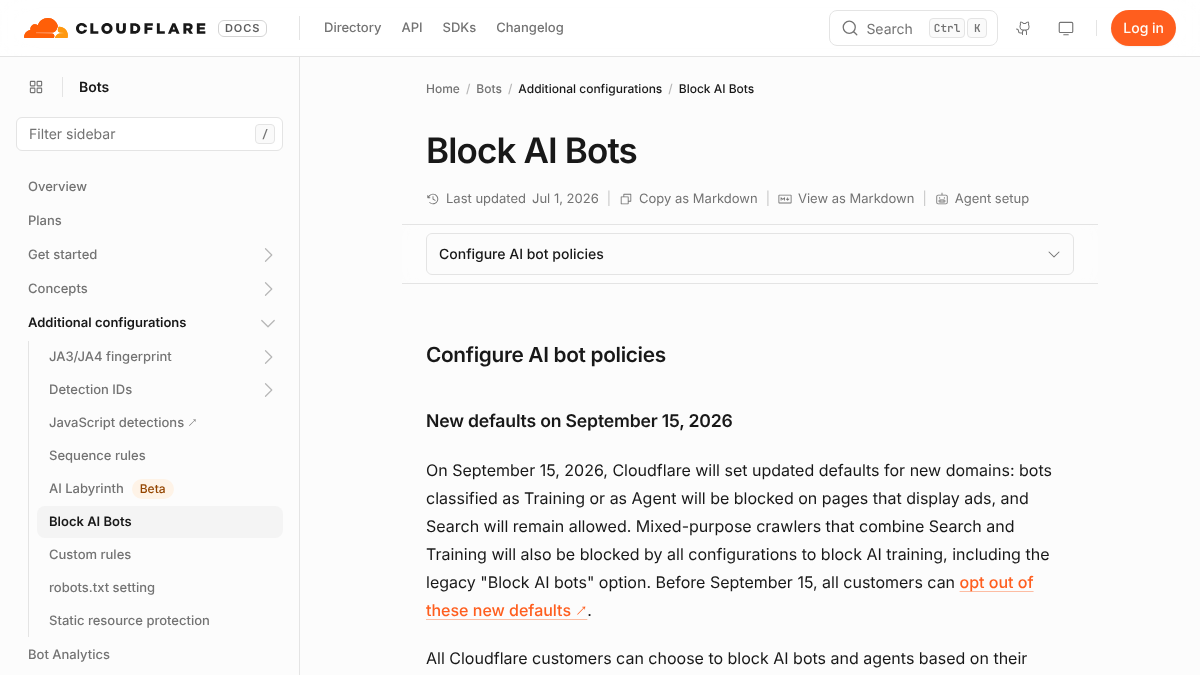
If your drop lines up with that date, or with any change to bot settings, start there. Our Cloudflare Bot Fight Mode guide covers the settings.
A quick test is to fetch your pricing page with a bot's user agent and compare it with a normal browser request. We ran that test on September 27 for 10 well-known SaaS sites, requesting each site's robots.txt and pricing page as a browser and as OAI-SearchBot, PerplexityBot and ClaudeBot. All 80 requests came back the same way for every user agent.
A clean result isn't proof, though. In an earlier check, Salesforce refused a request we labeled as OAI-SearchBot, yet ChatGPT had still cited that page, likely because Salesforce checks crawler IP addresses and not the label. Firewalls that block by IP can pass a test like this and still turn the real bots away. The reliable check is your server or CDN logs, filtered to verified AI crawler hits. Our guide to auditing AI crawlers in server logs walks through it.
Two more access causes are worth a minute each:
- JavaScript. A December 2024 study by Vercel and MERJ found that "none of the major AI crawlers currently render JavaScript," including OpenAI's, Anthropic's and Perplexity's. If a redesign moved your prices or answers into content that loads with JavaScript, view the page source to check the text is still there.
- Snippet controls. Google says that to limit what's shown from your pages in Search, including AI features, you use nosnippet, data-nosnippet, max-snippet or noindex. A tag added during a site update can quietly remove a page.
We'll show you exactly where your brand stands in AI search.
No commitment. $0 due today, cancel anytime. See how ChatGPT, Perplexity, Claude, Gemini, Grok, Google AI Mode, and Google AI Overviews talk about your brand today.

Step 3: Did the engine change?
Sometimes nothing about your site changed and the engine did. OpenAI's ChatGPT release notes are the place to look. On August 6, 2026, they said "GPT-5.6 Luna will become the default model for Free and Go users this week." Within days, trackers were reporting that Reddit had all but disappeared from ChatGPT's citations. Our post on what to do after the GPT-5.6 citation drop covers that one. Do the same check for whichever engine dropped you, since each one ships model changes on its own schedule.
The test is simple. Check whether a new default model shipped in the week your numbers fell, then check a couple of competitors in your own logs. If their citations moved at the same time, the engine changed, and your old baseline no longer compares like for like. Take a new baseline before judging anything else.
Step 4: Did your own page change?
Look at the pages that lost citations and ask what happened to them since they were last cited. The usual suspects:
- The URL changed, or now redirects somewhere less specific.
- A rewrite removed the passage the answers were quoting, like a plain statement of price or a comparison table.
- The page went stale. A price, plan name or year is out of date, and a fresher page now answers better.
Your CMS revision history, or an archived copy of the page, shows what it said when it was cited. If you find the change, restore the missing facts first. Our guide to content refreshes and reindexing covers getting the update picked up.
Step 5: Did someone else take your spot?
Open the answers you lost and read who's cited now. The replacement tells you what kind of fix you need.
If a competitor's new comparison or pricing page replaced yours, the answer found something more useful there. Read the two side by side for the fact theirs states and yours doesn't.
If a vendor's own page replaced a roundup that used to mention you, that fits how ChatGPT searches. Behind 12 buyer questions we asked in September, it ran 198 searches, and 135 of them included the word "official." And if a review site or forum thread took the spot, the fix may be getting covered there, not changing your own page.
Log the new sources either way. A drop you can explain is much easier to plan around than one you can't.
Know exactly what AI says about your competitors.
RankControl's Recon Agent monitors competitor citations across ChatGPT, Perplexity, Claude, Gemini, Grok, Google AI Mode, and Google AI Overviews. See where they show up and you don't.

Step 6: Did Google move first?
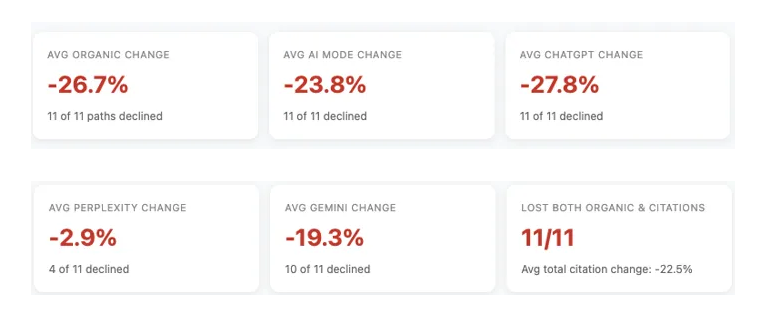
Several AI engines lean on search results, so a Google drop often shows up in AI citations too. Glenn Gabe shared Lily Ray's analysis of 11 sites that fell in Google during the volatility of late January and early February 2026. All 11 also lost AI search citations, with an average decline of 22.5%:
Drop in Google and drop in AI Search. That's something I have been saying for a long time (based on AI Search platforms scraping and leveraging Google results). Well, Lily just published an outstanding post covering this topic. She analyzed 11 sites that dropped heavily with https://t.co/nt2c3pNP9W
 Glenn Gabe@glenngabeFeb 18, 2026
Check Google's Search Status Dashboard for a core or spam update that overlaps your drop. There have been several in 2026, including a spam update that started on September 24. Then compare your Google rankings for the affected topics with the weeks before. If rankings fell first, you're solving a search problem, and our guide to diagnosing the August 2026 spam update is the better playbook.
Don't skip the Manual actions report in Search Console. Gabe also documented a site hit with a manual action for scaled content abuse, and its citations in AI Overviews and AI Mode dropped along with its rankings.
After the fix: how long to wait
Recovery takes longer than the fix. OpenAI's 24 hours is the time for its systems to read your new robots.txt. The page still has to be fetched again and picked for answers again.
Google is slower still. It says that after a change like this, "crawling can take anywhere from several days to several months, depending on how often our systems determine a page needs to be refreshed." You can ask Google to recrawl a page in Search Console. Its URL Inspection tool also shows the HTML Googlebot received, which confirms that a JavaScript or snippet fix landed.
Recheck the affected questions weekly for a month before deciding a fix didn't work.
Write down what you found
Whatever the cause, write a short note: the date you noticed, the step that explained it, the fix, and the date you'll recheck. After a couple of drops, that log shows which causes keep coming back for your site, and the next triage starts at the right step.
If you get through all six steps with nothing, go back to step 1 and keep running the checks for three more weeks. An unexplained drop that holds for a month is real. One that doesn't was noise.
Doing it yourself or handing it off
Run by hand, this checklist takes an afternoon the first time and less after that, since steps 1 and 3 get quicker once you have a baseline and a log.
The slow part is the checking. RankControl's AI visibility tracking checks up to 50 buyer questions every week across seven AI engines, marks each answer as mentioned, cited or both, and records every source it used, so you can see who replaced you. Our analytics log AI crawler visits to each page, which covers much of step 2. When the fix is new or better content, our content engine writes each article against the pages already ranking for its keyword and publishes it on your own site.
26 content formats. Published on your domain. Matched to your brand.
Guides, comparisons, listicles, case studies, and more. RankControl generates content that gets cited by ChatGPT, Perplexity, Claude, Gemini, Grok, Google AI Mode, and Google AI Overviews.