
A reseller on r/PublicRelations sent the company a screenshot: an AI answer recommending its product at a price it had retired eighteen months earlier. The reseller had already repeated that price to a customer. The company's own site, docs and listings all showed the current price, and the source turned out to be a roundup on a trade site that was never updated, plus a couple of aggregator pages that copied it.
You can't log into ChatGPT or Perplexity and edit what they say about your company. You can change what they read, report what they get wrong and shape what future models learn. Which of those works depends on where the wrong answer came from, so that's where to start.
First, work out where the wrong answer comes from
An AI answer about your company comes from one of two places. It's either built from a web search the engine just ran, or it comes from the model's memory: what it learned from the web before its training cutoff.
The difference decides how fast you can fix it. OpenAI's help page on ChatGPT search says ChatGPT "may search the web automatically when your question would benefit from current information," so it decides for itself. Perplexity is built around search, and its answers nearly always list sources.
The quickest test is to look for sources. If the answer lists citations, it came from a search, and the cited pages are your first suspects. If it has none, it probably came from memory. You can also ask the engine directly where it got the information.
That tip came up in an r/SEO thread where a head of marketing asked whether anyone checks how ChatGPT describes their company. The top reply suggested asking the model where it got its information, so it points you to the directory listings, articles or review pages it drew on, and then fixing those.
Anyone else checking how ChatGPT describes their company?
I’m the head of marketing of a growing startup and recently started asking ChatGPT about our company and our competitors to see what comes up.It got me wondering how other companies are handling this. Do you actually monitor how ChatGPT, Cl...
What we saw when we asked about five recent changes
On September 27, 2026, we picked five companies that had changed something checkable and asked about each change three ways: OpenAI's model through its API with no web search, the same model with web search on, and Perplexity.
| Company | What changed | Memory only | With web search | Perplexity |
|---|---|---|---|---|
| Grammarly | Parent company renamed Superhuman in October 2025 | Right | Right | Right |
| Hotjar | Owned by Contentsquare | Right | Right | Right |
| Loom | Billing moved to Atlassian for integrated workspaces | Right, with caveats | Right | Right |
| ConvertKit | Renamed Kit in 2024 | Right name, said the rename was in 2025 | Right | Right |
| Help Scout | Pro plan includes 10 shared inboxes | Said 25 | Said 10, citing a third-party pricing site | Said 10, citing Help Scout's pricing page |
The memory answers got two of five wrong in ways a buyer would notice, a wrong date and a wrong plan limit. Search fixed both. But look at where the right Help Scout answer came from: ChatGPT's search cited a third-party price-tracking site, while Perplexity cited Help Scout's own pricing page. Even when the answer was right, it depended on someone else's page staying right.
The 25 is the interesting part. In an earlier check, Google's AI Overview for "how much does Help Scout cost" also said the Pro plan includes 25 shared inboxes, and the only cited page carrying that figure was a third-party comparison site. Our guide to correcting false information in Google's AI Overviews traces that one in detail. The same wrong number turned up in two different engines.
We call that an echo page: one stale page outside your control that repeats an old fact into several AI answers. The Help Scout figure and the reseller's retired price both traced back to exactly that kind of page.
200+ SaaS teams already track their AI citations.
They know exactly when ChatGPT mentions their brand, and when it stops. Do you?

Fixes that can land within weeks
These work on answers that come from a search, which covers most of what Perplexity says and much of what ChatGPT says about current facts.
- State the fact plainly on your own site. Put the current price, plan limits or product name in the page's HTML text instead of inside an image or a script-loaded widget, and add a visible updated date.
- Publish a page about the change itself. A dated page that names the old fact and the new one gives a search something exact to find.
- Let the crawlers in. OpenAI's publishers FAQ says that for your content to appear in ChatGPT's summaries, you need to make sure you aren't blocking OAI-SearchBot, and its search help page adds that your host or CDN must allow OpenAI's published IP addresses. Check the same for PerplexityBot.
- Retire your own stale pages. Old pricing PDFs, outdated help articles and launch posts that list retired plans all get read. Update them, redirect them or add a clear note at the top.
- Chase the echo pages. Search your old fact in quotes, then email the comparison sites, directories and review profiles that still carry it, with the correct figure and a link to your source page. Update the profiles you control yourself, like G2 and Capterra, the same day.
The second step did the most work in our test. For the Loom question, ChatGPT's search and Perplexity both cited Atlassian's support article on Loom's pricing, billing and role changes, and ChatGPT's search answered the ConvertKit question from Kit's own post announcing the new name. One commenter on the r/PublicRelations thread suggested the same idea for prices: a pricing changelog that shows the old number next to the new one.
Our post on why AI search engines cite the wrong sources covers why a stale third-party page can outrank your own.
Report the wrong answer to OpenAI and Perplexity
Reporting won't fix an answer on its own, but it's free and it adds a signal. In ChatGPT, give the answer a thumbs down and follow the prompts. OpenAI's reporting page describes what can happen next.
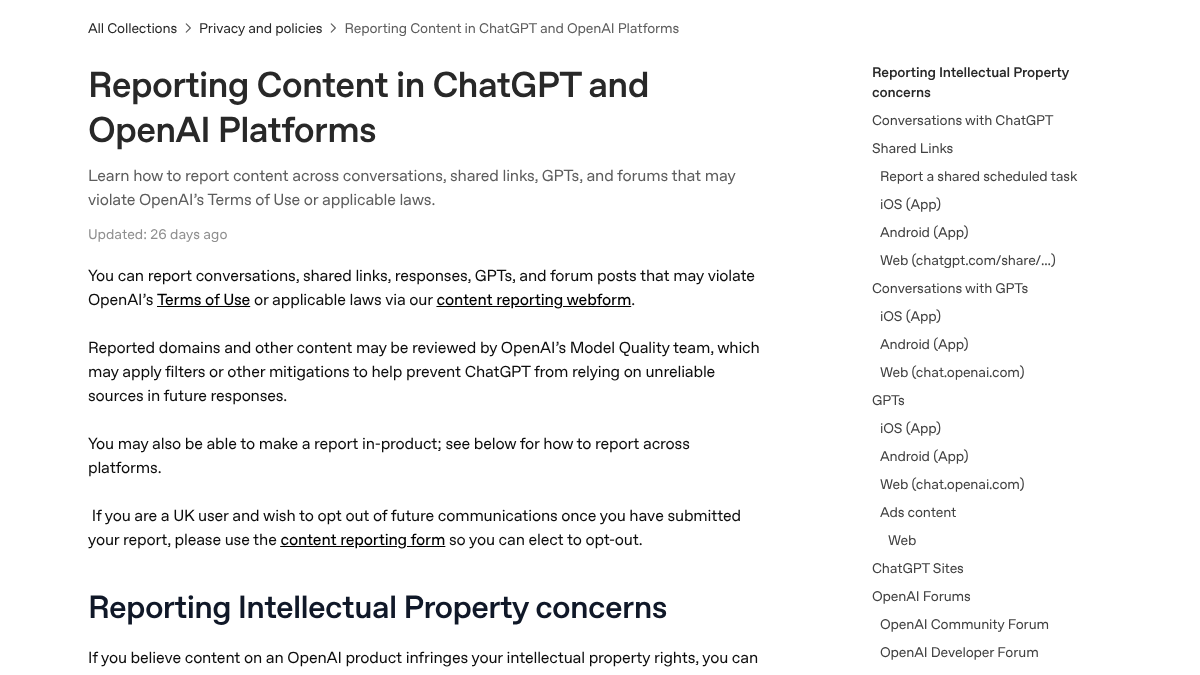
The useful line is that "reported domains and other content may be reviewed by OpenAI's Model Quality team" to help keep ChatGPT from "relying on unreliable sources in future responses." That makes reporting most useful when you can name the echo page. There's no promised timeline. For publisher issues, OpenAI's ChatGPT search announcement also gave an address: [email protected].
Perplexity's help article on reporting wrong answers says to use the flag icon below the answer or open a support ticket, and to include the URL of the query plus a description of the error and the expected result. It lists misinformation and outdated information among the issues it looks for.
One thing that won't help is ChatGPT's Memory setting. Memory stores what ChatGPT remembers about one user from their own chats, so correcting it only changes that person's answers.
Fixes that take months: answers from memory
If the wrong answer has no sources, you're dealing with what the model learned in training, and no page edit changes that model. Training cutoffs vary by model. OpenAI's release notes gave GPT-5.2 a knowledge cutoff of August 2025, for example, so anything that changed after a model's cutoff isn't in its memory.
What you can do is make sure the next model learns the right version:
- Get the correct fact onto the pages that describe you across the web: press coverage, directories, partner listings and, where you qualify, Wikipedia and Wikidata. Our guide to Wikipedia, Wikidata and AI recall covers that route.
- Decide deliberately about GPTBot. OpenAI's crawler documentation says GPTBot crawls content that may be used to train its models, while OAI-SearchBot powers search. Blocking GPTBot keeps your corrected pages out of future training data.
- Push buyers toward questions that trigger a search. Branded questions about current pricing or plans usually get a search in ChatGPT; broad "what is" questions often don't.
Our post on how long AI search takes to learn about a brand lays out the timing in more detail.
How often does ChatGPT mention your brand?
Most founders have no idea. The answer might surprise you.

Check that the fix holds
The reseller's company found its old price only because one person happened to send a screenshot. It had no idea how long the answer had been wrong or how many buyers saw it. That's the real problem: fixing an answer once is the easy part, and knowing when it goes wrong again is the hard part. Our response plan for wrong AI answers covers who should own an error like this and how to log it.
Write down the five to ten questions about your company that matter most, such as pricing, plan limits, what you integrate with and who owns you. Run them monthly on ChatGPT with search on and off, and on Perplexity. Record the answer and the cited sources each time, so a new echo page shows up in the source list before a buyer finds it. Our guide to LLM visibility monitoring turns this into a routine.
Doing it yourself or handing it off
By hand, the first cleanup is a few days of work: auditing your own pages, publishing change pages, finding echo pages and emailing their owners. After that it's an hour or two a month of rechecking.
Or RankControl can take on the checking. Our AI visibility tracking runs up to 50 buyer questions every week across seven AI engines, including branded questions like your pricing, and records every source each answer cited, so a stale page shows up where you can see it. For a quick first look at what ChatGPT says in your market, run the free AI visibility check.
15 hours a week manually. Or 15 minutes with RankControl.
Track citations, monitor competitors, and fix content gaps across every AI search engine. Automatically.