A marketer in r/SEO_for_AI described an AI answer that shows the whole problem. They were looking at an AI answer that recommended tools in a category, and it listed a feature page from one brand's website as a source. That brand never appeared in the answer. A competitor made the recommendation list instead, backed by a third-party comparison page.
So was the first brand visible or not? Mention tracking and citation tracking would give opposite answers, which is why AI citations and AI mentions need separate lines in any report. This comparison covers what each one measures, how often they split, what each is worth and which one to lead with. Sources were checked on September 26, 2026.
What mention tracking and citation tracking measure
The two signals answer different questions about the same answer. A mention means the engine wrote your brand's name in the answer text. A citation means it linked one of your pages as a source, whether or not it said your name. Between them sits the recommendation, where the answer names you as an option the buyer should consider.
| Signal | What the engine did | What it suggests | What it can send you |
|---|---|---|---|
| Mention | Named your brand in the answer | The model links your brand to the topic | Brand searches and direct visits later |
| Recommendation | Named you as an option to consider | You're on the shortlist | Buyers who remember you at demo time |
| Citation | Linked one of your pages as a source | Your page supports a claim in the answer | Clicks to that page |
| Linked mention | Named you and linked your homepage | Both at once, on ChatGPT since May | Homepage visits |
Don't confuse either one with web mentions, the unlinked references to your brand on other sites. Across 75,000 brands, Ahrefs found those correlate with AI visibility at 0.664, against 0.218 for backlinks, which suggests web mentions are one of the inputs behind AI mentions. Our comparison of brand mentions and backlinks covers that input side.
How often mentions and citations come apart
They split more often than they line up. In a June study, Semrush looked at 3,981 domain appearances across 115 prompts on four engines, three of them Google's, and found that 61.7% were citations with no brand mention. Kevin Indig calls these ghost citations: the engine uses your page, and the reader never learns your name.
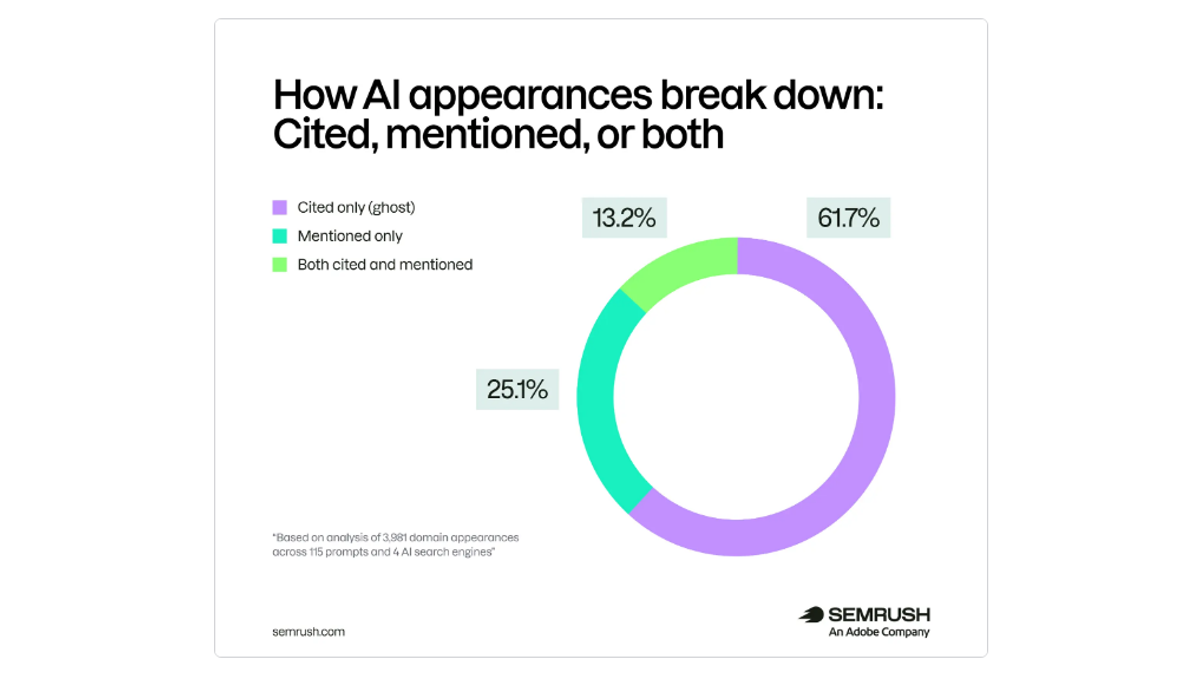
Only 13.2% of appearances were both cited and mentioned, and about a quarter were mentions with no link.
For a B2B team, the most useful finding is about question types. Informational questions produced the most ghost citations, while comparison questions produced about 2.4 times as many mentions.
A second study, from a link-building software company, tracked 12,000 AI responses for about 200 brands in July and reached a different split. Only 23.1% of mentions came with a citation, while 69.9% of citations included the brand's name, and category questions such as "best CRM for startups" had the weakest overlap of all, at 7.2%.
The two studies disagree on how often a citation carries the brand's name: fewer than one in five in the Semrush data, about seven in ten in the second study. They count different things. Semrush counted domain appearances of every kind, aggregators included, while the second study counted only citations that resolved to the 200 brands it tracked, so neither ratio transfers to your own brand until you measure it.
AI search traffic grew 835% this year. Is your content ready?
RankControl generates 26 content formats optimized for ChatGPT, Claude, and Perplexity. Published on your domain, matched to your brand.

Each engine splits them differently
Beyond picking different sites, the engines differ in whether they name brands at all. In the same Semrush data, Gemini mentioned brands in 83.7% of appearances but linked a source only 21.4% of the time, and ChatGPT did close to the reverse. Google's AI Overviews leaned toward citations, while AI Mode named brands at nearly twice ChatGPT's rate.
Kevin Indig, who advised on the study, pointed out that there was almost no overlap between the brands ChatGPT cited and the brands Gemini named for the same prompts.
The kind of site matters as well. Big consumer brands were named far more often than they were linked, with Google named 2.78 times for every 100 citations of a Google URL. Aggregators went the other way, and medium.com was cited 16 times without being named once.
Even for one brand on one prompt, the engines often disagree. Across 454 prompt-and-domain pairs, they split on whether to name the brand in 100 cases, or 22%. On Google's AI surfaces, Facebook was cited in nine of nine appearances and named only once, while Gemini named it every time it appeared.
For a B2B software brand without Google-sized name recognition, that means a Gemini mention and a ChatGPT citation are different wins that need different work.
Cited but not recommended
The split that hurts most is a citation without a recommendation. Lily Ray tracked 100 B2B "best [category] software" queries in Google AI Overviews on three dates this spring. Of the 80 that triggered an Overview, self-promotional listicles were cited 323 times, and in 224 of those cases Google cited a brand's own page without recommending that brand, as she reported in Search Engine Land.
Google is tweaking things, for sure "Rather than self-proclaimed gurus" 👀👀 Also this is a perfect example of how self-promotional listicles are working for *citations* but not *mentions* - in fact they appear to mostly help competitor mentions lately. The folks writing https://t.co/qB8i0CX2wC
 Lily Ray 😏@lilyraynycJun 8, 2026

Ahrefs ran a controlled test of the same pattern. It published 34 self-promotional lists across five domains and tracked 9,886 answers from ChatGPT, Gemini, Perplexity and Copilot. When an engine cited the list promoting Ahrefs' own conference, it still recommended a competing event in 43% of those answers.
The likeliest explanation is that a citation and a recommendation get filled from different places. The engine uses your page as evidence for a claim, and it builds the shortlist from what other sites say about who belongs in the category.
A post in r/SEO_for_AI suggested two causes: a lack of consensus, where only your own site says you solve the problem, and pages that never put the brand's name near their key claims. The suggested fix for the second is simple enough to test this week: write "according to [brand name]" in your research pages instead of "according to our research."
*Cited but not mentioned*
Businesses focus so much on citations that they forget about actual visibility. If you are cited but not mentioned, I'd look at two things here: A lack of LLM consensus (only you are saying that your business is solving those problems, and...
What a mention without a link is worth
Mentions are harder to value, because most of their effect never shows up as a referral. One AI visibility company ran a panel study of more than 2 million AI conversations, matched with the same users' browsing, from January to June 2026. After ChatGPT mentioned a brand, 6.39% of those users visited the brand's site within a week, against a 4.33% baseline.
Almost none of that traffic looked like AI traffic. More than 97% of the visits carried no AI referral tag, so they landed in analytics as direct or search visits. The study comes from a company that sells mention tracking, so treat the size of the lift with some care; the direction is the useful part.
ChatGPT has also started turning mentions into links. On May 7 it began linking brand names in its answers to their homepages, and Similarweb measured ChatGPT referrals jumping by more than 150% week over week. Homepages went from roughly 26% to 32% of ChatGPT referrals to about 60% afterward, a shift Search Engine Roundtable covered at the time.
That makes the linked mention a fourth outcome worth logging on ChatGPT. It sends clicks like a citation does, but it points at your homepage, not at the page that answered the question.
Mention tracking vs citation tracking, side by side
The two kinds of tracking differ in what they can tell you and in what moves them:
| Mention tracking | Citation tracking | |
|---|---|---|
| The question it answers | Does the engine think of us for this topic? | Does the engine use our pages as evidence? |
| Where the signal comes from | The model's picture of your brand, built from other sites | Retrieval of your pages for the question |
| What moves it | Reviews, roundups, community threads and press that name you | Pages that answer the question early, stay current and can be crawled |
| What it sends you | Brand searches and direct visits, mostly untagged | Clicks you can see in referral data |
| Blind spot | Says nothing about which page helped | Counts ghost citations as wins |
| Best questions to track it on | Category and comparison questions | Informational and how-to questions |
The last row is the practical one. Since comparison questions produce far more mentions and informational questions the most citations, a team that tracks only one signal on one kind of question gets a lopsided picture of where it stands.

Built by the team that got cited in 48 hours.
Content generation, backlink building, AI visibility tracking, and Google rankings. One platform, zero guesswork.
The four-box read
Reading the two signals together turns a score into a to-do list. We call it the four-box read: every tracked question on every engine falls into one of four boxes, and each box has its own fix.
| Box | What happened | What to do |
|---|---|---|
| Cited and mentioned | The engine named you and used your page | Keep the page current, since this is the goal |
| Cited only | Your page was evidence, but someone else got the credit | Put your brand name in the sentences engines quote, and earn third-party mentions |
| Mentioned only | The engine knows you but used another source | Publish a page that answers the question in its first lines |
| Neither | You're absent from this answer | Check crawl access first, then look at which sources won |
The mentioned-only box is where a lot of brands sit on category questions. One GEO platform's study of 28 retail brands found them mentioned in 44% of answers but cited in only 8%, with the engines linking to review sites instead of the brands' own pages.
A poster in r/SEO_LLM who had been counting uncited mentions as wins asked whether mentions and citations should be treated as two separate kinds of visibility. Nearly every reply said to track them separately, and one suggested splitting mentions further by whether the answer recommended the brand or only described it.
Are brand mentions without citations worth tracking?
I'm seeing our brand mentioned in some AI answers where there's no citation back to us. At first I counted that as a win because hey, the brand is in the answer. But now I'm wondering if mentions and citations should be treated as two compl...
Which one to report
For a B2B software company, lead with the mention rate on category and comparison questions, broken out by engine. That's the number that tells you whether you're on the shortlist when a buyer asks which tools to consider. Use the citation rate as the diagnostic underneath it, because it shows which pages are doing work and where a ghost citation means your content is helping a competitor. Our complete guide to AI citation tracking covers how to build the question set behind both rates.
Report both per engine, since the same brand can be named on one engine and cited on another, as our per-engine citation data shows. Keep the question set fixed and check it weekly. Pair it with a free-text "how did you hear about us?" field on your demo form, because most of the value of a mention arrives without a tag. Our guide to tracking brand mentions across AI engines walks through the setup. Our guide to tracking AI citations for free covers how many answers each check needs.
Tracking both without doubling the work
Logging two signals adds manual work. Checking 50 questions on seven engines takes about six hours a week, and recording mentions and citations separately adds to that. Publishing eight solid articles a month takes 16 to 24 hours more. Those are rough estimates.
RankControl's AI visibility tracking checks your 50 questions every week on seven engines and marks each question on each engine as mentioned, cited or both. Our tracking also records which competitors each answer names and which sources it cites, and notifies you when a new citation lands. The content engine then publishes articles on your domain for the questions where you're missing. For a quick first read, the free AI visibility checker shows who ChatGPT cites for three questions from your market.
You can keep a mention column and a citation column in a spreadsheet yourself. Or RankControl's agents can fill in both every week while you work on the pages and mentions that move them.
See your first AI citation report in under 5 minutes.
No setup calls. No onboarding meetings. Connect your domain and see where AI mentions your brand right now.