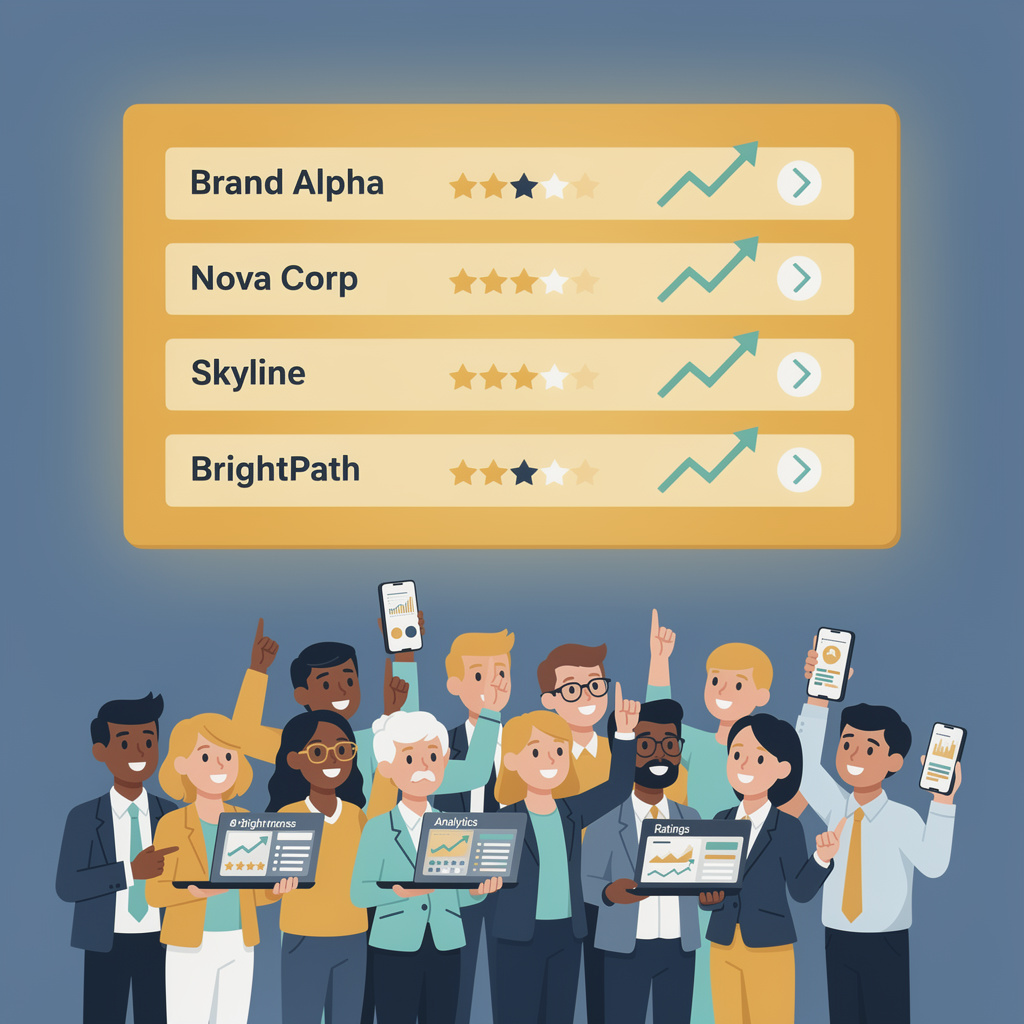
Your brand is being discussed in AI search right now. ChatGPT, Perplexity, Gemini, Claude, Copilot. Millions of people are asking these tools for product recommendations and buying advice. And none of that activity shows up in Google Analytics.
That's the blind spot. AI search engines generated over 1.1 billion referral visits per month in 2025, growing at 357% year-over-year. Those visitors convert at 4.4x the rate of traditional organic traffic. But most SaaS founders have zero visibility into whether their brand gets mentioned at all.
Here's how to fix that.
Why Your Analytics Dashboard Misses AI Search
Traditional analytics tools track clicks. Someone visits your site from Google, GA4 logs it. Simple.
AI search works differently. When ChatGPT recommends your product in a response, the user might never click through to your site. They got the answer. They trust the recommendation. They might google your brand name later, or they might go straight to your pricing page by typing the URL. Either way, the original AI citation that triggered their interest is invisible to your analytics.
Here's what makes this worse: only 2 in 10 ChatGPT brand mentions actually include a clickable citation link. Perplexity averages 5+ citations per answer, but brands appear in only 1 in 5 responses. The vast majority of AI brand exposure happens without generating a single trackable click.
So if you're measuring AI search by referral traffic alone, you're seeing maybe 10-20% of your actual AI visibility.
26 content formats. Published on your domain. Matched to your brand.
Guides, comparisons, listicles, case studies, and more. RankControl generates content that gets cited by ChatGPT, Perplexity, Claude, Gemini, Grok, and Google AI Mode.

Mentions vs Citations: Two Different Things
Before you start tracking, you need to understand what you're measuring. These terms get used interchangeably, but they mean different things.
A mention is when an AI model names your brand in its response. "RankControl is one of the tools that tracks AI citations" is a mention. The user sees your name. That's brand awareness.
A citation is when the AI model links to your URL as a source. Your content informed the answer AND the user gets a clickable path to your site. That's traffic potential.
Both matter, but they require different tracking approaches. Mentions tell you about brand awareness in AI. Citations tell you about content authority. And each platform behaves differently: our comparison of ChatGPT, Perplexity, Gemini, and Claude breaks down the citation rates per platform. A brand can have high mentions but low citations (the AI knows about you but doesn't use your content as a source), or the reverse.
Track them separately. The strategies to increase each one are different.
The Manual Tracking Method (Free, 30 Minutes)
You don't need a paid tool to get started. Here's the audit you can run this afternoon.
Step 1: Build your prompt list. Write down 20-30 questions your target customers actually ask when they're researching solutions in your space. Not your marketing keywords. The real questions. "What's the best tool for tracking AI citations?" "How do I monitor brand mentions in ChatGPT?" "Which citation tracking tools work with Perplexity?"
Step 2: Run each prompt across five platforms. Open ChatGPT, Perplexity, Claude, Gemini, and Copilot. Ask the same question in each one. Record whether your brand gets mentioned, whether it gets cited with a link, and where it appears in the response (first recommendation, middle of a list, or buried in a footnote).
Step 3: Score your baseline. For each prompt, mark: mentioned (yes/no), cited (yes/no), position (1st, 2nd, 3rd+, not present). Do the same for your top 2-3 competitors. Now you have a baseline.
Slight detour, but this matters. AI answers are not deterministic. Ask ChatGPT the same question 100 times and you'll get different results. One widely-shared test ran the same product recommendation prompt 100 times and got different brand lists every time. So a single check per prompt is a starting point, not a reliable dataset. You need repeated samples over time.
Time cost: 2-3 hours for the first audit, then 30-60 minutes weekly to re-check your core prompts.
Building an Automated Tracking System
Manual tracking breaks down fast. At 30 prompts across 5 platforms, you're running 150 individual queries per check. Weekly. That's 600 queries a month before you've touched competitor tracking. (We reviewed the 9 best AEO tools and compared eight tools built for tracking brand mentions if you want to skip the spreadsheet approach.)
The automated approach uses three components:
1. A defined prompt library. Start with 50-100 core prompts. Mix these categories: branded queries ("What is [your product]?"), category queries ("best [category] tools 2026"), comparison queries ("[your product] vs [competitor]"), and problem queries ("how to [solve problem your product solves]"). This is your measurement surface.
2. Scheduled monitoring. Run your prompt library weekly against ChatGPT, Perplexity, Claude, Gemini, and Copilot. Log every response. Track mentions, citations, and placement position. The key detail: capture what the user actually sees in the UI, not API responses. The front-end and API can return different results.
3. A scoring dashboard. Track these four metrics:
| Metric | Formula | What It Tells You |
|---|---|---|
| Inclusion Rate | Prompts where you appear / Total prompts | How visible you are overall |
| Citation Rate | Prompts with your URL cited / Total prompts | How much your content drives answers |
| Share of Voice | Your mentions / All brand mentions in answers | Your market share in AI search |
| Placement Score | Weighted position (1st = 3pts, 2nd = 2pts, 3rd+ = 1pt) / Max possible points | How prominently you appear |
Run this weekly. After 4-6 weeks, you'll see real trends instead of noise.
Your competitors are getting cited by AI. You're not.
Every day without citation tracking is a day your competitors pull ahead in ChatGPT, Perplexity, and Claude.
Six Strategies That Actually Increase AI Mentions
Tracking is half the problem. The other half is making the numbers go up. Here's what works, based on what we see across our AI visibility tracking.
1. Lead every section with a direct answer. AI models extract quotable statements from the first 30% of your page content. If your answer is buried in paragraph four, you're invisible to the extraction process. Start every H2 section with a clear, 30-50 word definition or answer.
2. Add FAQ schema to every key page. AI crawlers read structured data. FAQ schema gives them pre-formatted question-answer pairs they can cite directly. Four to five Q&A pairs per page, structured with FAQPage markup.
3. Build comparison content. "X vs Y for [use case]" is one of the highest-cited content types across AI platforms. AI search exists to answer comparison questions. If you don't have a page comparing your product to each major competitor, you're leaving citations on the table.
Now, this next one surprises people. Across AI models, the top citation sources by domain are Reddit (11.3%), LinkedIn (11.0%), Wikipedia (9.5%), YouTube (8.8%), and Medium (5.8%). Over 80% of AI answers pull from these trusted third-party sources, not from brand websites directly. Your own site matters, but your presence on platforms the AI already trusts matters more. (We broke down the Reddit citation effect in detail.)
So strategy four: get active on the platforms AI already cites. Answer questions on Reddit. Publish on LinkedIn. Create YouTube walkthroughs. That third-party footprint feeds directly into how AI models learn about your brand.
5. Unblock AI crawlers. Check your robots.txt right now. If you're blocking GPTBot, ClaudeBot, PerplexityBot, or Google-Extended, AI search engines literally cannot see your content. We've seen cases where unblocking crawlers had more impact than months of content optimization. (Our post on beginner's guide to getting cited covers the full technical checklist.)
6. Create an llms.txt file. Think of it as robots.txt for AI models. It tells AI crawlers which pages contain your most authoritative content and how your site is structured. It's a new, optional file: no engine documents using it for citations, so treat it as ten minutes of cheap insurance, not a lever.
Closing the Loop: Track, Fix, Re-Track
Here's the thing most tracking guides skip entirely. Knowing your citation rate is 12% is useless if you don't have a system to move it to 25%.
The loop looks like this:
- Track your baseline across all five platforms
- Diagnose the gaps: which prompts miss you? Which competitors appear instead? What content are they citing that you don't have?
- Create the missing content: comparison pages, FAQ-rich guides, and direct-answer articles targeting those specific gaps
- Publish to your domain with proper schema, AI-friendly structure, and unblocked crawlers
- Re-track after 2-4 weeks to measure the change
One practitioner documented this cycle publicly: their ecommerce brand went from 3.7% to 13.6% citation share across ChatGPT, Gemini, and Perplexity in four months. Their overall AI visibility (the percentage of relevant queries where they appeared at all) rose from 24% to 40%.
Doing this once is table stakes. The hard part is knowing when your numbers start dropping. AI models update their training data, competitors publish new content, citation patterns shift. What got you cited last month might not work next month.
That's why ongoing weekly monitoring matters more than any single audit. You need to see when your brand visibility changes so you can respond before it compounds.
You can do all of this manually. The tracking spreadsheet, the weekly prompt runs, the content creation, the re-monitoring. Budget about 15-20 hours for the first month, then 8-10 hours monthly to maintain.
Or RankControl's agents can do it for you, every month, while you focus on your product.
200+ SaaS teams already track their AI citations.
They know exactly when ChatGPT mentions their brand, and when it stops. Do you?