An SEO specialist in r/DigitalMarketing wrote this month that lately, every client call ends with someone asking why their "AI ranking" dropped in an AI visibility tool they pay for. They went looking for what the number meant and came back unsure it meant anything.
Part of the answer is that AI visibility isn't one number. Each AI engine cites its own mix of sources and forgets citations at its own speed. Even a single engine changes its answer from one run to the next. This roundup collects the per-engine citation data published this year and shows what a report built on it should track. Sources were checked on September 26, 2026.
Each engine has its own favorite sources
The most consistent per-engine picture comes from Ahrefs, which publishes a list of the 50 domains each AI assistant cites most, drawn from millions of US queries in its Brand Radar data. Its September 2 updates show the same few platforms near the top of most lists, in very different proportions:
| Engine | Most-cited domain | Runner-up | Worth knowing |
|---|---|---|---|
| ChatGPT | Reddit, 16.8% | Wikipedia, 7.0% | Consumer Reports is third |
| Perplexity | Reddit, 21.6% | YouTube, 20.8% | The two swapped places in September |
| Gemini | Reddit, 28.5% | YouTube, 14.6% | Reddit takes nearly twice YouTube's share |
| Google AI Mode | Reddit, 17.9% | YouTube, 17.8% | google.com is third at 12.5% |
| Google AI Overviews | YouTube, 22.9% | Reddit, 18.5% | Facebook is third at 10.1% |
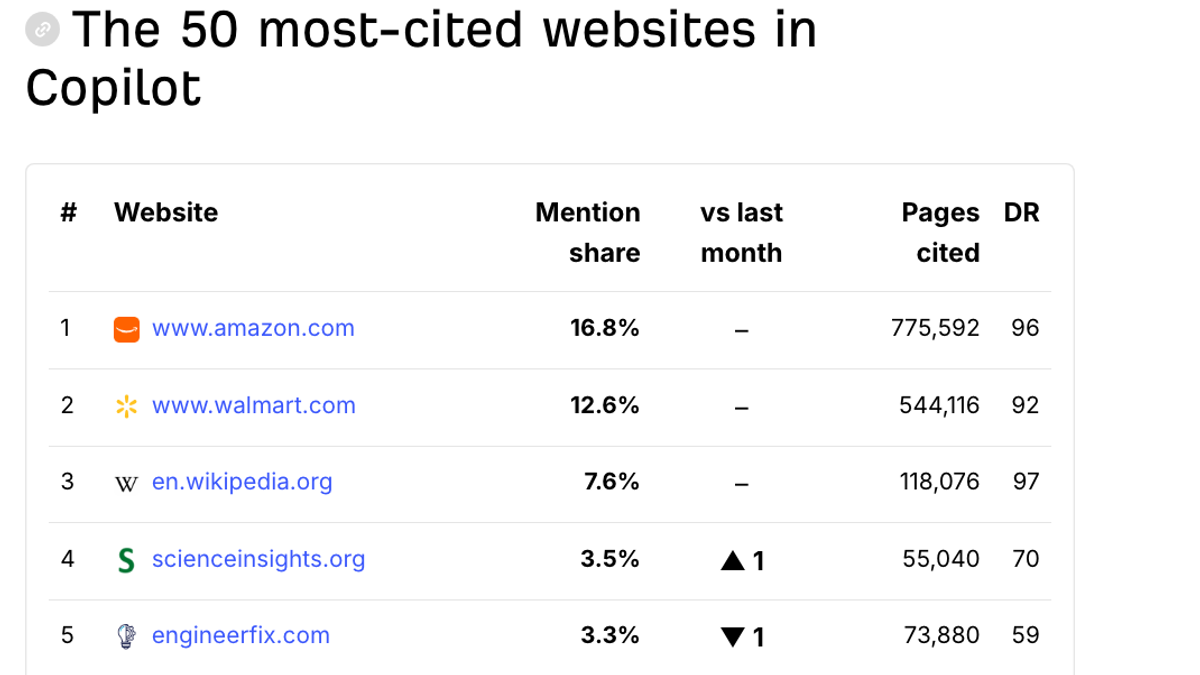
| Copilot | Amazon, 16.8% | Walmart, 12.6% | Reddit isn't in the top 50 |
| Grok (June list) | Reddit, 16.3% | YouTube, 15.1% | x.com ranks 12th at 1.4% |
Ahrefs' mention share is a domain's slice of the citations earned by the top 50 domains, not of every citation. The percentages describe the head of each list and say little about the long tail where most B2B sites get cited.
Copilot is the list that breaks the pattern. Its two biggest sources are retailers, and together they hold close to 30% of the top-50 citations, while Reddit, first on five of the other six lists, is missing entirely.
Claude isn't in the Ahrefs set, and it behaves differently again. An analysis of 379,321 Claude citations from June 2026 found that brand-owned domains took 64% of them and Reddit took none. That is close to the reverse of Perplexity, where Reddit leads. Claude's web search runs on Brave, and two separate 2026 studies found that close to 80% of the URLs it cites also sit in Brave Search's top 10.
How little the engines agree on sources
If the engines drew from one shared pool, a page cited by ChatGPT would usually turn up on Perplexity too. According to one 2026 study of 100,000 prompts, only about 11% of the domains the two engines cited overlapped.
The five-engine view is starker still. An AI visibility tracker that analyzed 127,198 citations between March and June 2026 counted 11,647 cited websites, and nearly 70% of them appeared on just one engine. Only 309 domains, under 3% of the total, were cited by all five.
Concentration differs as well, which changes how hard each engine is to break into. Aleyda Solis went through nine months of Semrush's AI Visibility Index data and found that in April 2026, ChatGPT needed 1,621 brands to reach 80% share of voice, against 299 for Google AI Mode. A brand chasing AI Mode is competing for a far smaller set of slots.
A later analysis of hers, covering 15 brands across three verticals, adds the part B2B teams should care about. The brand's own website was a minority of the cited sources in every vertical, and SaaS relied on outside domains the most, at about 82% of its top cited-source mix.
📊 AI Search Is a 3rd-Party Citation Problem With an On-Page Corroboration Base: The Data Across SaaS, Ecommerce and Finance 👇 But is this true across different verticals and AI platforms? How much weight should we give to digital PR vs social? To assess it, I analyzed the top https://t.co/B6ESOwLFAG
 Aleyda Solis 🕊️@aleydaAug 2, 2026

Within that data, AI Mode leaned hardest on social platforms and ChatGPT on written reviews and evaluations, with Gemini somewhere in between.
26 content formats. Published on your domain. Matched to your brand.
Guides, comparisons, listicles, case studies, and more. RankControl generates content that gets cited by ChatGPT, Perplexity, Claude, Gemini, Grok, and Google AI Mode.

One engine, many AI visibility numbers
Splitting by engine is only the first cut, because a single engine answers differently depending on the mode and the moment. Semrush and Kevin Indig ran 100 buyer-journey prompts through ChatGPT twice, once with minimal reasoning and once with high reasoning, and found that just 25.6% of the cited domains overlapped.
A buyer on the free default and a buyer using a thinking model can see two different shortlists for the same question. The high-reasoning runs also cited sources more often, in 68% of answers against 50%, and pulled nearly two more sources into each answer. Our look at how often ChatGPT searches the web breaks down that free vs paid gap.
Run-to-run noise sits on top of that. For a SparkToro study, 600 volunteers ran 12 identical prompts through three AI tools nearly 3,000 times, and the odds of getting the same list of brands twice were under 1 in 100.
A paper posted to arXiv in April, "Don't Measure Once", measured the same effect on sources across ChatGPT, Gemini, Google AI Mode and Perplexity. Roughly 65% of cited sources changed from one day to the next. The authors estimated that about seven repeated runs are needed before a brand's detection rate settles within a standard error of 0.10.
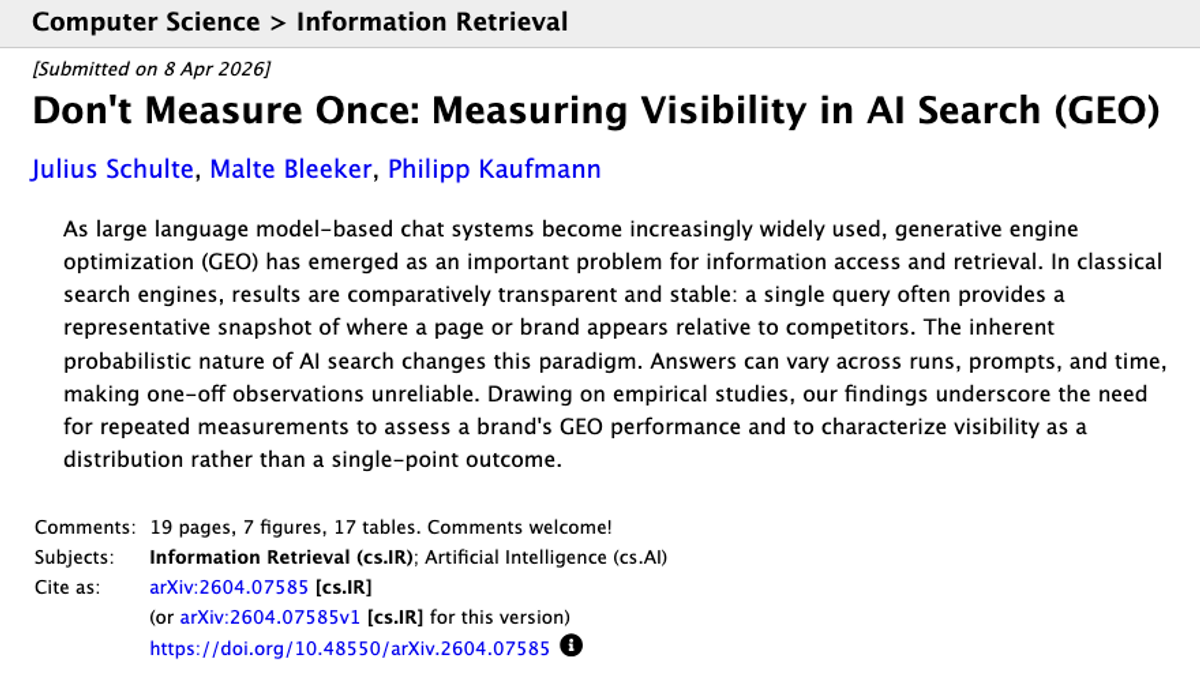
Both studies come from people with a stake in measurement. SparkToro ran its study with an AI visibility startup, and one of the paper's three authors works at a monitoring company. Their findings still argue against the simplest dashboards, the ones that report a single run as a rank. Our guide to reading AI search visibility benchmarks turns this into a noise band for each sample size.
A growth marketer in r/SEO_LLM asked the practical version of this question: if visibility moves from 28% to 33% after a content change, how do you know the change caused it? One reply suggested keeping an untouched control set of prompts running the whole time, because the noise floor itself drifts.
Before I trust an “AI visibility score”, I want to understand the noise floor. Is this measurement setup sane?
I'm a lifecycle/growth marketer, not a GEO vendor, and I'm trying to understand what a defensible AI-search baseline actually looks like before I trust one of these visibility dashboards. My current v0: 25 to 30 non-branded queries based on...
Citations fade faster on some engines
Engines also forget at different speeds. An analysis of 3.5 million citation events from September 2025 to March 2026 measured how many weeks it took half of a week's citations to drop out of rotation. ChatGPT was fastest at about 3.4 weeks and Perplexity slowest at about 5.8, while the three Google products in the study landed between 4.3 and 4.8 weeks.
On those averages, about half of the citations ChatGPT hands out in the first week of October will be gone by the end of the month. On Perplexity, half of that week's citations would hold on until about mid-November.
One caveat on this study is worth keeping. It was run with a content distribution network, and that network's own publishers came out ahead, with a half-life near 10 weeks. The per-engine gaps don't depend on that finding, but the headline about distribution does, so treat it as a claim from an interested party.
A monthly report misses most of this movement. A ChatGPT citation can arrive and fade between two reports without anyone seeing it, which is why the checklist in our AI search visibility guide for SaaS teams runs the question set weekly.
Your competitors are getting cited by AI. You're not.
Every day without citation tracking is a day your competitors pull ahead in ChatGPT, Perplexity, and Claude.
The denominator problem behind AI visibility scores
Every AI visibility number is a share of something, and the something changes from tool to tool. We call this the denominator problem, and it explains a lot of the disagreement marketers run into when they compare dashboards.
Reddit on ChatGPT is the clearest case. After GPT-5.6 became ChatGPT's default in August, one tracker saw Reddit's share of all ChatGPT citations fall from 3.83% to 0.52% in four days, the collapse covered in our GPT-5.6 piece. Ahrefs' September list, meanwhile, still puts Reddit first for ChatGPT. Both can be true, because one counts Reddit against every citation in one prompt set and the other against the top 50 domains in a different set of queries.
Gemini shows the same thing through query mix. Ahrefs, sampling broad US queries, gives Reddit 28.5% of Gemini's top-50 citations. Narrow the queries to local services and the mix flips. For those searches, a study of 14,472 Gemini citations published in August found that about 60% pointed to the businesses' own websites, with Reddit a distant second.
One r/SEO_LLM poster testing several AI visibility tools ran into this head-on. The numbers didn't line up at all, and one tool made a brand look healthy while another made it look nearly invisible.
Does anyone trust AI visibility scores between different tools?
Testing a few AI visibility tools right now and the numbers don't line up at all. I'm not even talking about small differences. One can make a brand look pretty healthy while another makes it look nearly invisible. I assume a lot comes down...
A blended score stacks one more denominator on top: a weighting of engines that the tool chose for you. Our post on why we track six engines instead of one score walks through what that blend hides.
What a per-engine AI visibility report tracks
The fix is to report AI visibility the way the data arrives, one line per engine, measured the same way each week. For each engine, a useful report records four things:
- The share of your fixed buyer questions where one of your pages is cited
- The share where your brand is named, with or without a link
- The competitors named in the same answers
- The outside domains the engine cited, which tell you where to pitch next
Then read each line against what seems to move that engine. The studies above point to different levers:
| Engine | What seems to move it |
|---|---|
| ChatGPT | Being in Bing's and OpenAI's indexes, a complete answer in the first lines of the page, current pricing and dates |
| Perplexity | Fresh pages, plus discussion on Reddit and YouTube |
| Gemini and Google AI Mode | Google rankings, YouTube, and for local searches your own service pages |
| Claude | Ranking in Brave Search's top 10, and clear pages on your own domain |
| Copilot | Bing indexing, plus retailer and marketplace listings |
| Grok | Community platforms such as Reddit, YouTube and Facebook |
These are patterns drawn from 2026 studies, and none of the engines publishes its ranking rules, so expect some rows to change after the next model update.
Turning per-engine data into work
Per-engine numbers earn their keep when they change what you publish. A page cited on ChatGPT but missing on Perplexity probably needs a fresher date and some community discussion behind it, while a page missing on Claude may simply not rank on Brave. A blended score would show both as the same small dip.
Done by hand, this is a lot of repetition. Checking 50 questions on six engines takes about five hours a week, repeat runs multiply that, and publishing eight solid articles a month takes 16 to 24 hours more. Those are rough estimates.
RankControl's AI visibility tracking runs your 50 questions every week on six engines, from ChatGPT to Google AI Mode, shows the results engine by engine with a citation history for each question, and notifies you when a new citation lands. The content engine plans and publishes articles on your domain for the questions where you're missing. For a first read, the free AI visibility checker shows who ChatGPT cites for three questions from your market.
You can build the per-engine report yourself with a spreadsheet and a protected hour each week. Or RankControl's agents can run it every week while you decide what to publish next.
200+ SaaS teams already track their AI citations.
They know exactly when ChatGPT mentions their brand, and when it stops. Do you?