A marketer in r/DigitalMarketing described their AI visibility process this spring: a Google Sheet of 47 prompts, run through each engine every Monday, searching the answers for the brand name. It took four hours a week, and then their manager asked for a dashboard.
Most SaaS teams know the tactics by now. What breaks is the routine, because the work is spread across SEO, content, PR and marketing ops and nobody owns the Monday check. This AI search visibility checklist is built for the team rather than the website: what to set up in week one, what to do every week, month and quarter, who owns each task and what to report upward. Sources were checked on September 26, 2026.
Week one: set up before you change anything
The first rule is to measure before you fix. A reply in an r/aeo thread asking for "a practical AI visibility checklist" put it plainly: baseline first, so you can watch the scoreboard move.
Is there a practical AI visibility checklist?
The website already has good original content so I'm not really looking for content advice. I just want a simple checklist of things I can go through one by one. I have ADHD so if I don't see progress I lose motivation pretty quickly. If yo...
Another reply in the same thread is the best argument for checking access early. The poster found GPTBot, ClaudeBot and PerplexityBot all blocked on their site by an old robots.txt rule nobody remembered adding. Since July 2025, Cloudflare has also blocked AI crawlers by default unless site owners allow them, so check the CDN as well as the file.
Work through these in the first week:
- Name one owner for the weekly check and the monthly report
- Write 30 to 50 buyer questions from sales calls, support tickets and demo notes
- Run each question on ChatGPT, Perplexity, Gemini and Google AI Mode, and record who's cited and named
- Check robots.txt and CDN rules for OAI-SearchBot, PerplexityBot and Claude-SearchBot
- Verify your site in Bing Webmaster Tools and Google Search Console
- Add an AI referral segment in analytics and a free-text "how did you hear about us?" field on the demo form
Then freeze the question set. We call this the frozen scoreboard: the same questions, asked the same way, for at least a quarter, so any change you see comes from your work and not from a new list. For the website side of setup, our AI search readiness checklist for B2B SaaS websites covers crawling, rendering and page structure in depth.
The weekly checklist
Weekly is the minimum useful cadence, because answers change between runs. When Ahrefs tracked the same AI Overviews over time, about 45% of the cited sources changed each time an Overview was regenerated. A single check shows you one draw, and the trend over several weeks shows you where you stand.
Keep the weekly routine short enough to survive a busy week:
- Run the frozen question set on each engine and log cited, named, competitors and sources
- Note any question where a competitor appeared for the first time
- Check any answer that describes your product wrongly, such as an old price or a retired feature
- Publish or refresh at least one page aimed at a question where you're missing
- Look at AI-referred sessions and signups next to last week's
What to log
The marketer with the 47-prompt sheet said they spent two hours trying to define "mentioned" versus "recommended" because leadership wanted clean metrics. Settle the definitions once, before the first report:
| Column | What it records |
|---|---|
| Cited | A link to one of your pages appears under the answer |
| Mentioned | Your brand's name appears anywhere in the answer text |
| Recommended | The answer names you as an option the buyer should consider |
| Competitors | Every other brand named in the same answer |
| Sources | The domains the engine linked, yours or not |
The last column is often the most useful one, because it shows you which review sites, publications and threads to pitch next. Our comparison of mention tracking and citation tracking explains why the first two columns need to stay separate.
The wrong-answer check matters more than it looks. A buyer who reads an outdated price in ChatGPT won't always visit your pricing page to correct it.
AI search traffic grew 835% this year. Is your content ready?
RankControl generates 26 content formats optimized for ChatGPT, Claude, and Perplexity. Published on your domain, matched to your brand.

The monthly checklist
Once a month, step back from single questions and look at the pages and sources behind them. Citations fade quickly: an analysis of 3.5 million citation events put the time for an AI citation to lose half its visibility at roughly four to five weeks. A page you don't touch for a quarter is likely to lose ground.
Run through these at the start of each month:
- Refresh the five pages that earn the most citations with new numbers, dates and examples
- List the third-party sites the engines cited for your questions and pitch the ones you're missing from
- Update your G2, Capterra and LinkedIn company profiles to match your current product and pricing
- Send the monthly report: citation rate per engine, trend, and AI-referred pipeline
Review profiles deserve a regular slot. One 2026 study of the B2B software ChatGPT recommends found that almost every tool it named had Capterra and G2 reviews, so a stale or thin profile is a gap an engine can see.
The quarterly checklist
Every quarter, question the scoreboard itself. Buyer questions change as your product and market do, and the engines change underneath you. When ChatGPT 5.6 shipped in August, Reddit's share of ChatGPT's citations fell by about 86% within days, according to tracking firms. A plan built around Reddit threads for ChatGPT stopped working overnight.
At the end of each quarter:
- Retire questions that no longer matter and add new ones from recent sales calls
- Review which engines changed behavior after model updates and adjust where you spend effort
- Compare the quarter's citation trend with pipeline from AI-referred and self-reported sources
- Decide whether to keep tracking by hand or hand the checks to a tool
Who owns what
A checklist without names stops running by the second month. Here's a split that fits most SaaS marketing teams:
| Role | Owns | Rough time per week |
|---|---|---|
| SEO or content lead | The weekly check, the frozen question set and page refreshes | 3 to 5 hours |
| Content writers | New and refreshed pages for missing questions | Varies with output |
| PR or comms | Pitches to the publications and roundups engines cite | 1 to 2 hours |
| Product marketing | Accuracy of pricing, features and review profiles | 1 hour |
| Marketing ops | AI referral tracking and the monthly report | 1 hour |
The time estimates are ours, and they assume manual checks. The weekly check is the task most likely to slide, because it produces no visible output on its own.
What to report upward
Leadership wants one number, and the honest version is a rate. Report the share of your frozen questions where you're cited, per engine, with the trend over the last eight weeks. Keep named mentions as a separate line, since a site can be cited often without its brand ever appearing in the answer text.
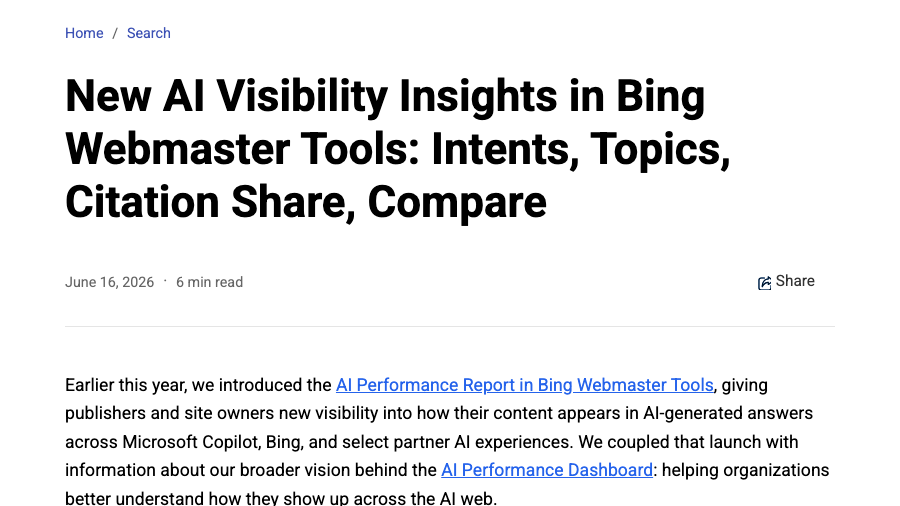
Add the first-party data the platforms now publish. Google's Search Console added generative AI performance reports in June 2026, showing impressions in AI Overviews and AI Mode. Bing Webmaster Tools went further in June with Intents, Topics, Citation Share and Compare, which show why your content was cited in Copilot and Bing answers and how your share compares with other sources.
Finish with pipeline. Semrush found that visitors from AI search converted at 4.4 times the rate of traditional organic visitors, so a small number of AI-referred demos can matter more than the session count suggests. Pair referral data with the free-text answers from your demo form, because many buyers who find you in an answer arrive later by typing your name.

Built by the team that got cited in 48 hours.
Content generation, backlink building, AI visibility tracking, and Google rankings. One platform, zero guesswork.
Keeping the checklist running
If the weekly check slips, the monthly report usually goes with it, and three months later nobody can say whether anything changed. The cheapest fix is to protect one hour every Monday and one report every month, even when the rest of the list waits.
Done by hand, the full routine is real work. Checking 50 questions on six engines takes about five hours a week, and publishing eight solid articles a month takes 16 to 24 hours more. Those are rough estimates.
RankControl takes the repetitive parts off the list. AI visibility tracking runs your 50 questions every week on six engines, keeps a citation history for each and notifies you when a new citation lands. The content engine plans and publishes articles for the questions where you're missing, and analytics shows AI-referred visits once you connect a traffic source. For a quick first read, our free AI visibility checker shows who ChatGPT cites for three questions from your market.
You can run the checklist yourself with a spreadsheet and a protected Monday hour. Or RankControl's agents can run it every week while your team works through the parts only people can do.
See your first AI citation report in under 5 minutes.
No setup calls. No onboarding meetings. Connect your domain and see where AI mentions your brand right now.