In August 2025, a paid search team paused the branded search ads of a B2B SaaS client in the schools and education space to settle an argument with the client's SEO agency. The plan was a month. They lasted two and a half weeks before the client asked for the ads back, and the team estimated the month would have ended with about 58% more leads had the ads stayed on.
The reason the test was worth running is that the textbook answer points the other way. That's what a good experiment does and a standard campaign doesn't: it tells you something about your own market that you couldn't have looked up. Below are ten marketing experiment ideas that teach more than a normal campaign, with what each one costs and what it tells you. Sources were checked on September 26, 2026.
What makes an experiment teach more than a campaign
A campaign asks "did this work?" An experiment asks "what caused this?", and the difference is in four pieces set up before launch: a hypothesis, a control that doesn't get the change, one metric that decides the result, and a written decision for each outcome.
We call that last piece the if-then card. Before you launch, write two lines: "If the metric moves by at least X, we do Y. If it doesn't, we do Z." Without the card, it's easy to reread the results until they tell the story you wanted.
Most of the experiments below can run on a small team with tools you already have. A few need a paid channel. None need a data scientist.
10 marketing experiment ideas worth running
1. Branded search holdout
This is the classic, and its answer depends on your market. In a large field experiment published in Econometrica in 2015, researchers at eBay found that its brand-keyword ads had "no measurable short-term benefits," because people searching for eBay reached it anyway.
The education SaaS team above got the opposite result. Its competitors were bidding on its brand name, and some of its landing pages converted poorly, so the brand ads were defending leads rather than buying free ones.
We decided to test turning off branded search for a month. That lasted about 2.5 weeks.
In August, we decided to test turning our branded search campaigns off in a client’s account (a B2B SaaS in the Schools/Education space) for a month. The client’s SEO agency claimed a dip in performance was because “paid is stealing organic...
Run it for two to four weeks, and check who bids on your name before you start. If nobody does, your result will probably look more like eBay's.
2. Painted-door pricing page
Before Buffer existed as a product, founder Joel Gascoigne put up a landing page, then added a pricing page between it and the email signup. Visitors clicked a plan before learning the product wasn't ready yet, which tested both demand and willingness to pay. He wrote that Buffer had its first paying customer within four days of launch.
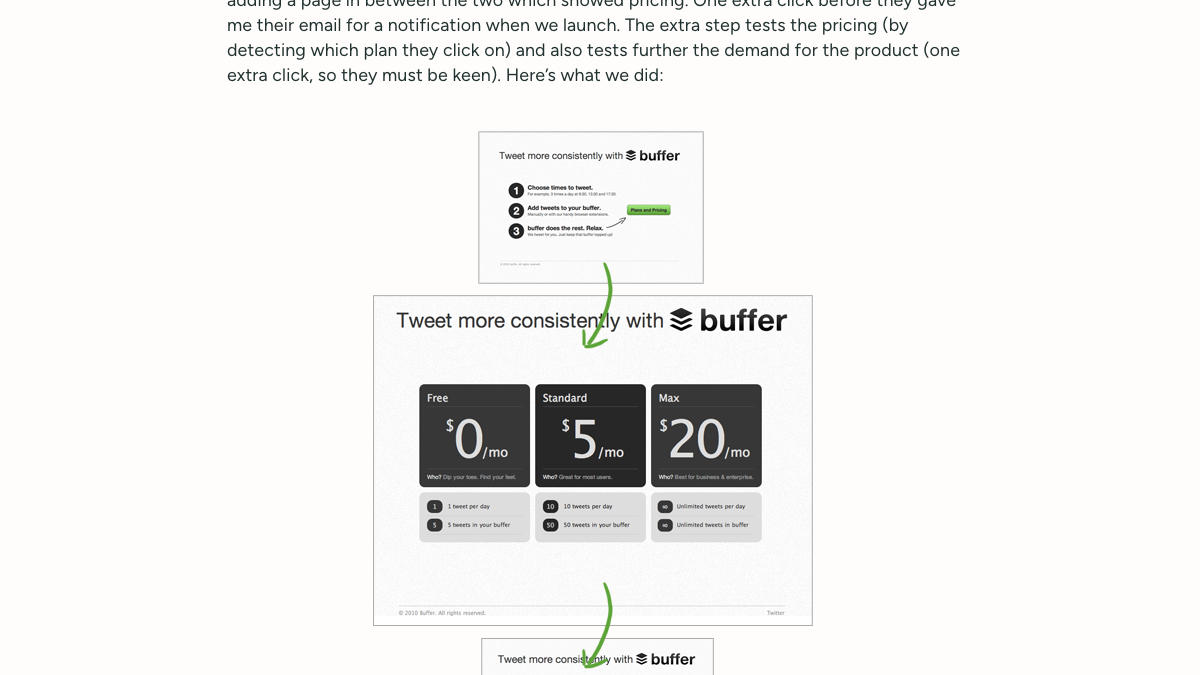
For a B2B team, the same test works for a new tier, an add-on or a price increase. Count clicks per plan, and treat a plan nobody clicks as your answer. Be straightforward on the page that follows the click: a short note that the plan isn't available yet, with an option to join a waitlist, keeps the test from costing you goodwill.
3. Geo holdout for a paid channel
When a channel's reported results look too good, split by region. Google researchers described the method in a 2011 paper on geo experiments: run ads in some regions, hold them back in comparable ones, and compare the outcome across the two groups. It works for LinkedIn ads, podcast sponsorships and anything else where you can't randomize individual people.
| Setting | Suggestion |
|---|---|
| Regions | Pairs matched on past sales or signups |
| Length | Four to six weeks |
| Metric | Pipeline or signups, not platform-reported conversions |
| Decision | Cut the channel if the held-out regions perform within your margin of error |
The paper's argument was that geo experiments are simple to design and hard to fool, because the regions don't know they're in a test. The practical catch for a B2B team is volume: you need enough signups in each region to see a difference, so the method suits channels with national reach.
4. Fixed-question AI answer test
AI answers change from one run to the next, so a single screenshot proves nothing. SparkToro and Gumshoe tested this in January and found the chance of an AI tool returning the same list of brands twice for the same prompt was under one in 100.
Pick 20 buyer questions and run each one five times on each engine before you publish a new page. Then repeat the same runs every week for six weeks after it goes live. The metric is the share of runs where you're cited, compared with the baseline. Our AI search visibility checklist covers how to log the runs, and RankControl's AI visibility tracking runs the same fixed check weekly on six engines.
5. Answer-first rewrite with a control group
A July 2026 study of 1,249 ChatGPT answers found the free tier usually works from a snippet of about 200 characters from the top of a page. That's a testable claim for your own site.
Take ten of your most commercial pages, split them into two matched groups of five, and rewrite only the first group so each page answers its question in the opening lines. Leave the other five alone. After six to eight weeks, compare citations and organic clicks between the groups. If the rewritten pages win, you have a rule for every new page, and our complete guide to answer engine optimization covers what else to change on them. If they don't, you've saved yourself a site-wide rewrite.
Your competitors are building backlinks while you read this.
Organic outreach, social mentions, and citations from Editorial Circle member sites, with managed backlinks available as an add-on. Grow your domain authority without running the campaign yourself.

6. Free-text attribution field
Add one required field to your demo form: "How did you hear about us?" Leave it as free text rather than a dropdown, since a dropdown with no AI option hides every buyer who found you in ChatGPT.
Run it for a quarter and compare the answers with what your analytics credits. After a month, group the answers into categories, since the words buyers use are often different from the channel names in your attribution model. The gap between the two is usually the lesson. G2's March 2026 survey found 51% of B2B software buyers now start research in an AI chatbot more often than in Google, and most of those first touches never show up as a referrer.
7. Replies, not posts
For six weeks, stop publishing posts in communities and spend the same time answering questions in threads where you have something useful to say. Don't link to yourself. Measure branded searches in Search Console and self-reported mentions from your demo form.
A thread in r/GrowthHacking this August asked for growth experiments that surprised people. One of the top answers said helpful comments on other people's threads brought more profile visits and conversations than the posts they'd spent hours writing.
What's one growth experiment that worked way better than you expected?
've tried a lot of things that sounded great on paper and did absolutely nothing. Then occasionally something small works surprisingly well. It could be SEO, Reddit, cold email, partnerships, content, referrals, paid ads, or something compl...
The AI angle adds a second reason. Perplexity still cites Reddit heavily even after ChatGPT cut its Reddit citations in August, so a genuine presence in the right threads can show up in answers too.
8. Five-second message test
Show your homepage to five people who don't work at your company for five seconds, then ask what you sell and who it's for. Jakob Nielsen found in 2011 that users often leave web pages within 10 to 20 seconds, and that a page has to communicate its value within ten seconds to hold them.
If fewer than three of the five can describe your product, rewrite the headline and test again with five new people. It costs an afternoon, and the same clarity helps AI engines describe you correctly. Run the test on your pricing page and one comparison page as well, because those are often the pages a buyer lands on after an AI answer.
9. Comparison page test
Publish a genuine comparison between your product and the incumbent your buyers already know, with real prices and a clear view of where each fits. Then run the fixed-question test from experiment four on questions like "X vs Y" and "alternatives to X."
Set expectations first. In an r/aeo discussion about AEO results this year, the top reply argued that engines mostly cite third-party comparisons, and a brand's own comparison page tends to confirm what the model already believes. The experiment tells you which of those two effects your page actually has. For a sharper read, pitch the same comparison to a neutral roundup in your category and see which of the two pages the engines end up citing.
10. Refresh versus new
Split your next month of content effort in two. Update ten existing pages with new numbers, examples and dates, and publish ten new pages on questions you haven't covered. Measure citations, rankings and signups for both sets over eight weeks.
AI citations fade quickly, which is why this test is worth running. An analysis of 3.5 million citation events put the time for a citation to lose half its visibility at roughly four to five weeks. If the refreshed set wins, your calendar should carry a standing refresh slot. RankControl's content engine can take the new-page half of the test off your plate.
You're getting AI traffic. But do you know where it comes from?
RankControl credits every visit to the assistant that sent it: ChatGPT, Perplexity, Claude, Gemini, Copilot, or Grok. Full source attribution, next to your Google traffic.
How to pick your first experiment
Start with the experiment whose answer would move the most money. If paid search is a large line in your budget, begin with the branded search holdout. If you're debating a price change, run the painted-door page. If nobody on the team knows how you show up in ChatGPT today, start with the fixed-question AI test, and if your attribution reports feel wrong, add the free-text field this week.
Run one experiment at a time on the same audience. Two overlapping tests muddy both results, and a clean answer in four weeks is worth more than two ambiguous ones.
What to write down
Each experiment needs a one-page record written before launch. Here's what one looks like for the branded search holdout:
| Field | Example |
|---|---|
| Hypothesis | Brand ads mostly buy clicks we'd get anyway |
| Control | The same weeks last quarter, plus a check on who bids on our name |
| Metric | Demo requests from people searching our brand |
| If-then card | If demos fall less than 10%, halve brand spend; if more, restore it |
| Readout date | Four weeks after launch |
Keep the records in one place, so that after a year you can see which channels and pages actually changed your pipeline.
Running experiments when your traffic is small
Most B2B sites can't detect a 5% lift, and that's fine. Test changes large enough to matter, such as a new pricing structure or a full rewrite of a page's opening, rather than button colors. Use holdouts by region or by time when you can't split traffic, and run tests longer rather than calling them early.
Qualitative signals count too. Sales-call notes, the free-text attribution field and the answers AI engines give about you all move before revenue does. Write them down each week alongside the main metric so a slow test still teaches you something.
Turning experiments into a habit
The teams that learn fastest run one experiment at a time, keep a simple log of hypothesis, if-then card and result, and review it every quarter. At one experiment a month, that's a dozen written decisions about your own market by this time next year.
Several of the tests above need the same thing: a steady weekly read of how AI engines answer your buyers' questions. Done by hand, checking 50 questions on six engines takes about five hours a week, and publishing eight solid articles a month takes 16 to 24 hours. Those are rough estimates. Our free AI visibility checker gives you a quick baseline before experiment four.
You can run all of these yourself with a spreadsheet and some patience. Or RankControl's agents can handle the publishing and the weekly AI checks while your team designs the experiments.
We'll show you exactly where your brand stands in AI search.
No commitment. $0 due today, cancel anytime. See how ChatGPT, Perplexity, Claude, Gemini, Grok, and Google AI Mode talk about your brand today.