
It's the Monday before a board meeting, and the CEO forwards a screenshot. Someone asked ChatGPT for the best tool in your category, it listed three companies, and yours wasn't one of them. The message underneath says "what's our plan here?"
We're a young company ourselves, and we spent much of September reading the pricing pages, help docs and terms of AI search tools for a comparison series on our blog. This is what we'd tell a startup CMO in their first 90 days, including a few things we only learned from that fine print.
Why this lands on startups first
An AI engine can only recommend a brand it can find written about. Big incumbents have years of reviews, roundups and forum threads behind them. A Series A startup might have a website, a launch post and a handful of G2 reviews, and that's thin material for an engine to build a recommendation from.
The buyers are already there, though. G2's 2026 Buyer Behavior Report, published in July, found that 82% of B2B software buyers had sourced software recommendations from an AI chatbot in the past two years. It's worth reading the fine print on that one: G2 also found only 9% would let an AI agent actually make the purchase. The chatbot builds the shortlist, and a human still picks from it, which is exactly why missing from the shortlist hurts.
Your team is small, too. At most startups the CMO is also the content lead and the person answering the board, so every plan below assumes you have a few hours a week rather than a department.
Week one: look before you spend
Before buying anything, find out what the engines say today. Pull 15 to 20 questions from real sales calls and support tickets, the ones a buyer types before they've heard of you, and run them through ChatGPT, Perplexity, Gemini and Claude. For each one, note who gets named and which pages get cited as sources.
Run each question more than once. SparkToro and Gumshoe tested this in January and found the odds of an AI tool returning the same list of brands twice for the same prompt were under 1 in 100. A single screenshot, including the one your CEO forwarded, is one roll of the dice.
If you want a quick first read, our free AI visibility checker asks ChatGPT three real buyer questions from your market and shows you who it cites.
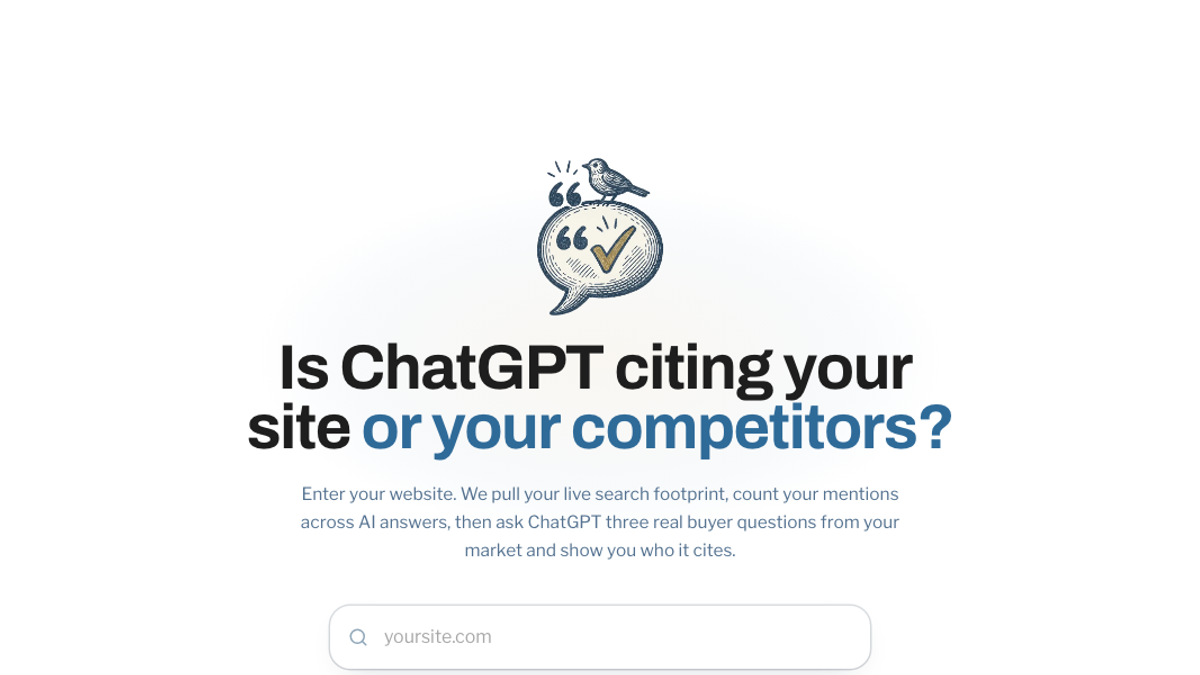
By Friday you'll have a list of the questions where you're missing, the competitors named instead, and the sources the engines trust. That list is your content plan for the next month.
See your first AI citation report in under 5 minutes.
No setup calls. No onboarding meetings. Connect your domain and see where AI mentions your brand right now.

The one number your board will ask for
Someone in r/analytics described this exact moment in September. Their CMO wanted one number for visibility in ChatGPT and Perplexity, and every vendor they looked at defined it differently: share of responses, position in the answer, or cited domains, all moving independently.
Why doesnt anyone agree on how to measure whether a brand shows up in AI answers
Our CMO wants one number for how visible we are in ChatGPT and Perplexity and I cannot find two vendors who define it the same way. One counts the share of responses we appear in, one counts position within the answer, one counts cited doma...
We'd give the board the fixed-question rate: the share of a fixed set of buyer questions where you're cited, per engine, checked weekly, with the trend line. It's simple enough for a board slide and hard to game, because the questions don't change. Mentions and cited sources go underneath as separate lines, since they tell you different things.
Traffic alone will undercount it. Pew Research found that when Google showed an AI summary, people clicked a traditional result in 8% of searches, compared with 15% when no summary appeared. Much of the value of being in the answer never shows up as a visit, so the board needs the citation number next to the traffic number.
Budget pressure makes this urgent. Gartner's 2026 CMO Spend Survey puts the average share of marketing budget going to AI at 15.3%, while only 30% of CMOs said their AI capabilities were ready to scale.
Fix what the engines get wrong about you
Your week-one list will probably turn up a few answers that name you and get it wrong: an old price, a feature you dropped, a description from before your last pivot. Fix those before chasing new citations, because a wrong answer does more damage than a missing one.
Buyers do check. TrustRadius surveyed 1,862 technology buyers for its 2026 Buying Disconnect Report and found that 63% had used AI during a purchase. Nearly all of that group, 94%, said they fact-check the AI's answers at least some of the time, and your own site and review profiles are among the first places they can check.
The fix is usually boring work. Update your own pages first, then the profiles engines tend to trust for software, such as G2, Capterra and your LinkedIn company page. Look at the sources the engines cited when they got you wrong, since an old launch article or a stale directory listing is often the culprit, and ask the owner to update it.
What to publish first
Here's the order we'd publish in, and yes, it's opinionated:
- A comparison page against the incumbent your buyers already know. "Your brand vs the big name" is a question buyers ask engines directly, and you want your own page in that answer.
- A pricing page with real numbers. After ChatGPT 5.6 shipped in August, Peec AI's data showed "pricing" rising sharply among the searches ChatGPT runs behind the scenes, so a page that hides its prices gives the engine nothing to quote.
- Pages that answer your buyers' exact questions, with the answer in the first few lines.
- Use-case pages for the two or three customer types you actually sell to.
The third item is where most startup sites fall down. A marketer in r/cms noticed it going back through their own pages: some technically covered the topic, but you had to read about 800 words before reaching anything useful. Engines quote passages, and a buried answer rarely gets quoted.
CMS for SEO and AI search
I used to pick a CMS based on how easy it was to publish and edit pages now I’m noticing a different problem a site can be easy to manage and still make SEO work annoying once you start caring about schema, internal links, titles structured...
Put those pages on your own domain. When we read LinkedIn's robots.txt for another post in September, it blocked Perplexity's crawlers from the whole site. On your own site, you're the one who sets those rules. RankControl's content engine is built for exactly this list: it plans titles from your tracked questions and publishes each article through the CMS you connect.
What we learned reading vendor fine print
For our comparison series we read the pricing pages, help centers and terms of more than a dozen AI search and SEO tools. A few patterns surprised us, and they're worth knowing before you sign anything.
Several tools tie the AI engines you get to the tier you pay for, so the entry plan tracks three engines and "all platforms" lives on custom pricing. Others sell a monthly balance of AI answers, where checking the same questions daily can cost eight times as much as checking them weekly. One help center answered the question "Will my data be deleted when I cancel my subscription?" with "That is correct." Another had no export for its AI visibility data at all.
None of that is a reason to avoid tools. It's a reason to ask four questions before you buy:
- Which engines does the plan you'd actually pay for cover?
- Does the price grow with prompts, credits or seats?
- Can you export your history, and what happens to it when you cancel?
- Who writes and publishes the pages the tool tells you are missing?
That last question matters most for a startup. If nobody on your team has time to write and publish, a dashboard will mostly confirm what the CEO's screenshot already showed. We'd put the first dollar into producing pages and the second into tracking them.
Your competitors are building backlinks while you read this.
Organic outreach, social mentions, and link exchanges, with managed backlinks available as an add-on. Grow your domain authority without running the campaign yourself.

Your first 90 days
| When | What to do | What to report |
|---|---|---|
| Weeks 1 to 2 | Run 15 to 20 buyer questions on four engines, several times each; list missing questions and cited sources | Baseline fixed-question rate per engine |
| Weeks 3 to 6 | Publish the comparison and pricing pages, then answer pages for the biggest gaps; fix anything the engines get wrong about you | Pages live, first citation changes |
| Weeks 7 to 12 | Keep publishing weekly, pitch the roundups and communities the engines cite, track the same questions every week | Trend line, questions won and lost |
Expect the first quarter to show movement rather than a finished result. New pages take weeks to get crawled and cited, and the weekly trend is what earns the next quarter's budget. Our guides for founders and for a VP of Marketing cover the same ground from their seats.
Where RankControl fits
Done by hand, this plan is a lot for a team of one or two. Writing and publishing 20 solid articles a month takes 40 to 60 hours, and checking 50 questions on six engines takes about five hours a week. Those are rough estimates, but they add up to more hours than most startup CMOs have spare.
RankControl runs that loop for $400 a month. It plans articles from your buyers' questions and publishes them on your site, then AI visibility tracking checks 50 of those questions every week on six engines, including Claude and Grok. You approve the pages, and auto-publish stays off until you turn it on.
You can run the first 90 days yourself with the plan above. Or RankControl's agents can run it every month while you get back to the board deck.

You're getting AI traffic. But do you know where it comes from?
RankControl credits every visit to the assistant that sent it: ChatGPT, Perplexity, Claude, Gemini, Copilot, or Grok. Full source attribution, next to your Google traffic.