
On September 26, a founder posted in r/SaaSMarketing that ChatGPT was sending them signups, and not random ones. They matched the ideal customer profile. The question was how to turn that into a repeatable acquisition channel.
ChatGPT is sending me ICP signups — how would you turn this into a repeatable acquisition channel?
That's the head of growth's version of AI search in one line. You don't need convincing that it exists. You need to know whether it's big enough to staff, whether you can measure it, and what to do first. This guide covers where to start with AI search for heads of growth, in the order I'd run it.
Size it like any other channel
Start with the public numbers. Conductor's 2026 benchmark across 13,770 domains put AI referrals at 1.08% of website visits. Semrush's tracked-traffic study found the average AI search visitor converting at 4.4 times the rate of an organic one.
So the channel is small in visits and large per visit. Some companies already see it at the top of their signups. Chatbase founder Yasser Elsaid posted in September that 37% of new signups come from LLM recommendations, and that they're the highest-converting signups the company gets.
37% of new @chatbase sign ups come from LLM recommendation. They're also the highest converting signups. There is a lot you can do for AEO but nothing better than just building a good product and letting the world know. https://t.co/osZyMGXdhT
 Yasser@yasser_elsaid_Sep 24, 2026

Not everyone's numbers look like that. Aaron Edwards, who runs DocsBot, dug through two summers of checkout data in September. Recognizable AI referrals were behind 4.7% of this year's checkouts, mostly from ChatGPT, while search's share had slipped from 48.5% to 40.6%. Your own ratio is the number that matters, and the next step is getting it.
Step 1: Fix the tracking before you judge the channel
GA4 added an AI Assistant channel on May 13, 2026, and Google confirms it covers ChatGPT, Gemini and Claude. Perplexity needs a custom channel rule. Our GA4 setup guide has the regex.
That catches the clicks that keep their referrer, and a lot of them don't. In r/SaaS this September, someone traced ChatGPT traffic all the way to signups using the utm_source tag ChatGPT adds to its links. The replies pointed at the gaps. Mobile apps often open links in an in-app browser that strips the tag, so those visits land as Direct. Other readers never click at all, and search your brand name later.
Finally got ChatGPT traffic tracked all the way through to signups. AI citations finally paying dividends.
40 years in the agency business, a few SaaS launches in there, building another one now. Not selling anything, sharing a setup because it took me longer than it should have. Everyone says you can't attribute signups to AI assistants. Turns...
So add a free-text "how did you hear about us" question to onboarding. Tally has tracked AI that way for a while. When ChatGPT started linking brand names in its answers in early May, co-founder Marie Martens posted that Tally's ChatGPT registrations rose 5x overnight. The same post says the self-reported number had always run well ahead of what referral tracking showed.
Early May, Tally's user registrations from ChatGPT increased 5x overnight. I saw Buffer reporting the same thing, mentioning ChatGPT started hyperlinking brand names directly in its answers, turning every mention into a clickable referral. We've been tracking AI as an https://t.co/VUAEkzmXz3
 Marie@MarieMartensMay 26, 2026

Report the three signals side by side: AI Assistant sessions, self-reported answers and branded search impressions. Each one undercounts, and together they give you a range you can defend. Our guide for demand gen leads goes deeper on HubSpot and pipeline attribution.
Step 2: Pick the questions and take a baseline
Write down 50 questions your buyers ask before they buy. Use sales call notes and support tickets, plus the objections that come up in demos. Mix category questions ("best X for Y"), comparisons with named competitors and pricing questions.
Then check where you stand. Run a sample of them in ChatGPT, Perplexity and Google AI Mode. Log whether you were named, who was named instead, and which pages each answer quoted. That last column is your target list for later.
The baseline matters more than the first reading. AI answers change from one run to the next, so a single check says little. A weekly check on the same 50 questions gives you a trend, and trends are what growth teams can act on.

Built by the team that got cited in 48 hours.
Content generation, backlink building, AI visibility tracking, and Google rankings. One platform, zero guesswork.
Step 3: Keep a holdout set
Growth people will recognize this part from any other experiment. I call it the holdout questions: 10 of your 50 tracked questions that you deliberately don't publish anything for during the test.
Tally's jump shows why you need them. Its ChatGPT signups rose 5x overnight, and Buffer reported the same jump. Both pointed to one cause: ChatGPT had started linking brand names in its answers. Without a control group, a jump like that looks like your own win in the next board deck.
The design is simple. Work on 40 questions and leave 10 alone for a quarter. If citations rise on the 40 and stay flat on the 10, your pages did it. If both rise together, an engine change probably did, and you shouldn't budget on it.
Step 4: Ship pages, then chase mentions
AI answers draw on two things you can influence: pages on your own site that answer the question, and other sites that mention you. Start with your own pages, because they're faster.
For each question where competitors get named and you don't, publish the page that answers it directly. That usually means a comparison, an alternatives page, a pricing explanation or a plain answer to an objection. Put the answer near the top, keep numbers and sources close to the claims, and link each page to the ones around it.
Then look at the sources the answers quoted in Step 2. Those are the sites the engines already trust for your questions. Pitch the ones that fit, starting with pages that list or compare tools in your category.
Volume matters here more than in most growth tests. One page per question won't move a trend line much. A steady weekly cadence over a quarter will show you whether the channel responds.
Step 5: Report it like a channel
Give AI search a row in the weekly channel report, next to paid and organic. Four numbers are enough:
- Citation share on the 40 worked questions, and on the 10 holdouts
- AI Assistant sessions and signups from GA4
- Self-reported AI answers from onboarding
- Branded search impressions from Search Console
Resist daily tracking. Answers move from run to run, and a daily chart invites you to react to noise. Weekly is frequent enough to show a trend and slow enough to ignore the wobble.
Decide who owns what
AI search falls between teams, which is how it ends up owned by nobody. The questions come from sales and support, the pages from content, the pitches from whoever does PR, and the numbers from analytics.
For the first quarter, keep the experiment with growth. You own the question list, the holdout, the tracking and the weekly report. Content owns the pages and the publishing schedule. If you have an SEO lead, they own the technical checks, starting with whether your CDN or firewall is blocking AI crawlers, since a blocked crawler makes every other step pointless. Once the test shows the channel responds, hand the running of it to whichever team produces the most of its inputs.
What to skip in the first quarter
A few things eat time without much evidence behind them. Ahrefs found in May 2026 that 97% of llms.txt files it studied were never fetched, so don't make one a project. Its March 2026 test of schema markup found no citation lift from JSON-LD on any AI platform. Keep schema for rich results, not for AI answers.
Skip rewriting old pages to "sound like AI answers," too. The Princeton GEO study behind much of that advice found its biggest lifts on pages that already ranked low. A later benchmark found most content edits did little once many sites made them.
Your first 90 days
| Weeks | What you do | What you report |
|---|---|---|
| 1 to 2 | Fix GA4, add the onboarding question, pick 50 questions | Baseline citation share and AI signups |
| 3 to 6 | Publish pages for the 40 worked questions, pitch the cited sites | Pages shipped, first movements |
| 7 to 12 | Keep shipping weekly, compare worked questions against the holdout | Lift on the 40 against the 10 |
At the end of the quarter, you'll know whether the channel responds to your work, which is the question a head of growth needs answered before hiring for it.
Where RankControl fits
RankControl runs most of that loop for $400 a month. We track your 50 questions every week on seven engines, including ChatGPT, Claude and Google AI Mode, and show who got named instead of you and which sources each answer quoted.
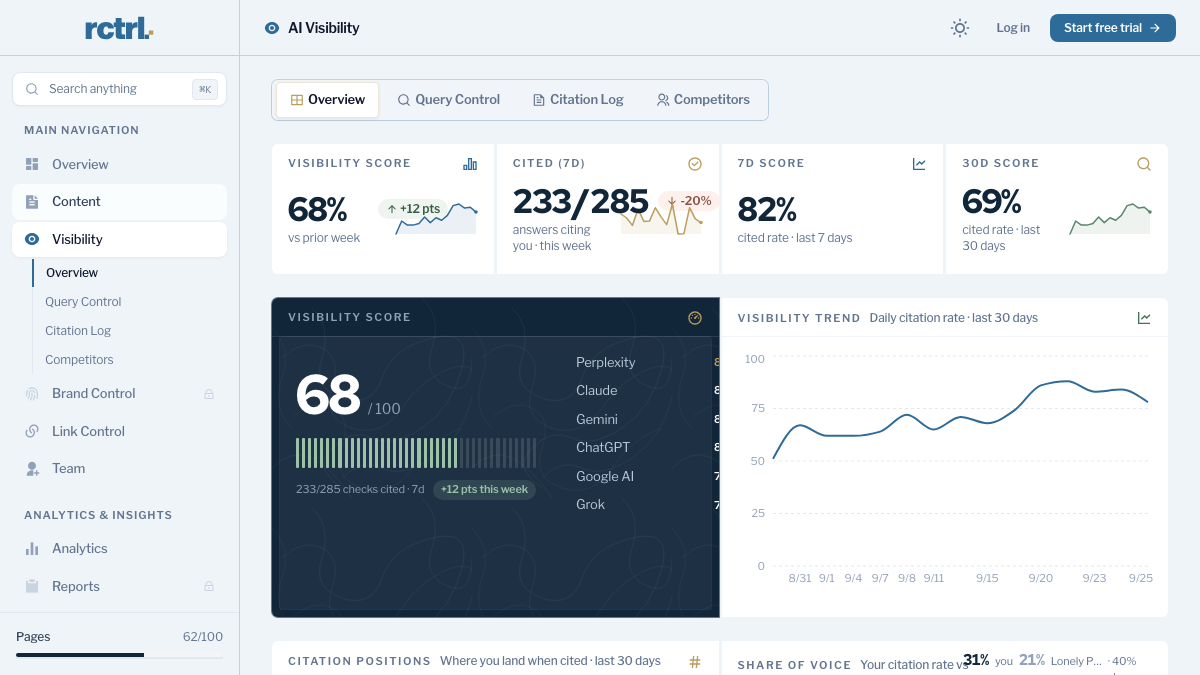
The content engine plans titles from the questions you're losing and publishes up to 100 pages a month on your own site, with auto-publish off until you turn it on. Link Control finds prospects for each article and pitches them from your own mailbox after you approve each email. RankControl's analytics sync Search Console daily and log AI crawler visits, so citation share, AI-referred visits and branded search sit in one place.
If you'd rather see where you stand first, the free AI visibility check shows who ChatGPT cites for three questions from your market. The full product has a 7-day free trial.
See your first AI citation report in under 5 minutes.
No setup calls. No onboarding meetings. Connect your domain and see where AI mentions your brand right now.

For the numbers behind the channel, our roundup of AI referral traffic statistics compares the studies side by side.
Your competitors are building backlinks while you read this.
Organic outreach, social mentions, and citations from Editorial Circle member sites, with managed backlinks available as an add-on. Grow your domain authority without running the campaign yourself.