
Search Google for "how to get cited by AI" and look at what ranks: forum threads, LinkedIn posts and vendor blogs. The AI Overview for that query cites a Quora thread, LinkedIn posts and YouTube shorts. Plenty of confident advice, and almost none of it tied to a date, a test or anything the engines themselves have said.
This guide takes the opposite approach. Every claim below comes either from an engine's own documentation or from one of about a dozen dated checks we ran in September 2026 across more than ten B2B categories, hospitality and small-vendor markets. Where we've written a deeper post on one piece, we link to it, so this page works as the map.
What counts as a citation
Three different things get called "being in the AI answer," and they're worth separating before anything else. A mention is your brand named in the text. A citation is a link to your site as a source. A recommendation is the answer telling the reader to pick you.
They drift apart more than people expect. When we ran 12 buyer questions through OpenAI's model with web search on, it cited the brand's own site for 47 of the 54 brands it named. With search off, it named 59 brands and cited none, because an answer from memory has no sources. Perplexity cited the brand's own site for 19 of the 36 it named. Our post on mention tracking vs citation tracking covers the vocabulary in depth.
Getting cited, then, depends on three gates we'll use to organize the rest of this guide. Can the engine read your page? Does the answer search at all? And when it searches, is your page the one it's looking for?
Gate 1: can the engine read your pages?
Every AI engine that cites the web runs its own crawlers, and most of them separate training from search.
| Company | Search or index crawler | Training crawler | User-triggered fetcher |
|---|---|---|---|
| OpenAI | OAI-SearchBot | GPTBot | ChatGPT-User |
| Anthropic | Claude-SearchBot | ClaudeBot | Claude-User |
| Perplexity | PerplexityBot | None (Perplexity says it doesn't train foundation models) | Perplexity-User |
| Googlebot (AI Overviews and AI Mode use the Search index) | Separate controls | Not applicable | |
| Microsoft | Bingbot (Copilot answers draw on Bing) | Not applicable | Not applicable |
The search crawler is the one that decides citations. OpenAI's crawler documentation is blunt about it: "Sites that are opted out of OAI-SearchBot will not be shown in ChatGPT search answers, though can still appear as navigational links." It also says a robots.txt change takes about 24 hours to take effect.
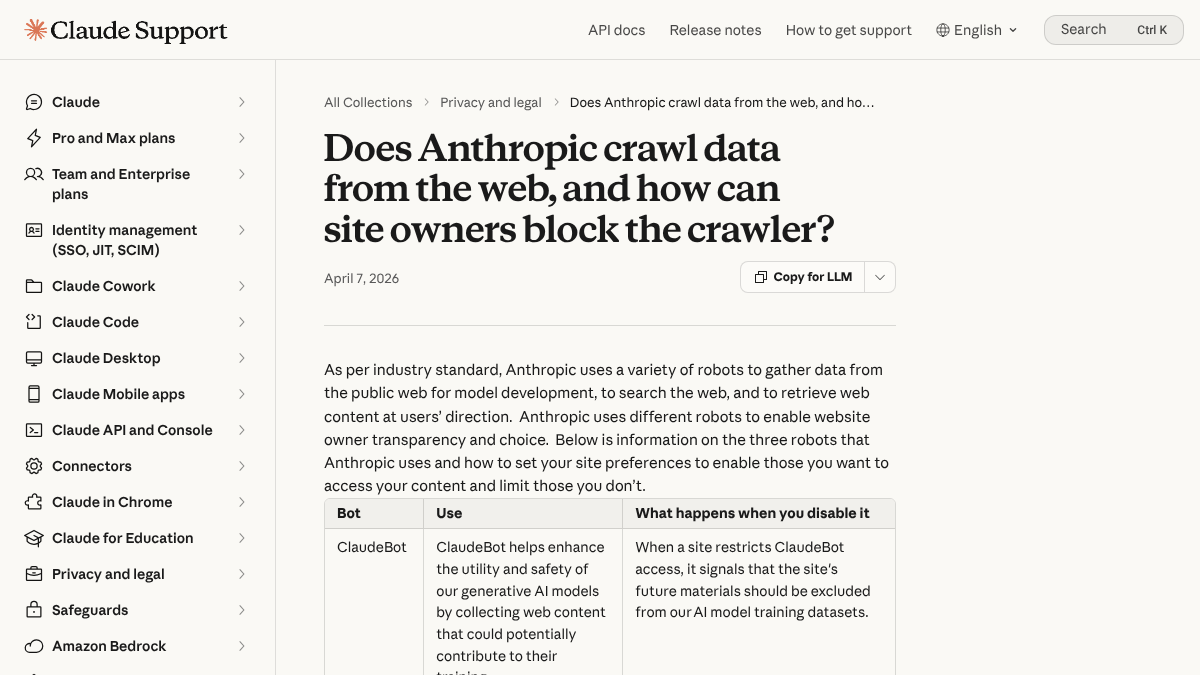
Anthropic's crawler page makes the same point for Claude, saying that disabling Claude-SearchBot "may reduce your site's visibility and accuracy in user search results." It also states that Anthropic's bots honor robots.txt directives.
Plenty of large sites already split the two jobs. In our check of the top 1,000 domains, 40 of the 68 sites that blocked GPTBot by name still left OAI-SearchBot open. That's a reasonable setup if you don't want your content in training data: refuse the training crawler, allow the search one. Our AI crawler access statistics have the full census.
Two technical details catch people out. A study of crawler traffic by Vercel and MERJ found that none of the major AI crawlers rendered JavaScript, so prices and specs that only appear after scripts run are invisible to them. And firewalls or CDN bot rules can block a crawler that robots.txt allows, so test with the crawler's user agent as well as reading your robots file.
One thing that isn't a gate: llms.txt. Google's guidance says you don't need "new machine readable files, AI text files, markup, or Markdown" to appear in its AI features, and no major AI search engine documents reading the file. Our explainer on what an llms.txt file is covers where it does help.
15 hours a week manually. Or 15 minutes with RankControl.
Track citations, monitor competitors, and fix content gaps across every AI search engine. Automatically.

Gate 2: does the answer search at all?
This is the gate most guides skip. An engine can only cite your page if it searched for something, and several engines decide for themselves whether to search.
OpenAI's help page says ChatGPT "may search the web automatically when your question would benefit from current information." Anthropic's documentation for Claude's web search tool says the same thing in its own words: Claude "determines when to search based on the prompt," and its examples of search-worthy questions include current prices and information about specific products that might have changed.
In practice, that means definitions and settled concepts often get no search. In our 90-day check of new SaaS blog posts, ChatGPT answered 6 of the 10 target questions from memory, mostly "what is" questions, so no page could have been cited. Memory answers can also be out of date. When we asked about five companies' recent changes without search, the model gave an old plan limit for one and the wrong year for another company's rename.
Google's AI Overviews have their own version of this gate. Google says they're shown only when its systems judge them "additive to classic Search," and they "often don't trigger." They appeared for all 12 of the ordinary B2B blog questions we checked, but for only 8 of 12 hospitality searches, where Google often showed a hotels pack or local pack instead.
Perplexity is the exception. It's built around search, and its answers nearly always list sources, which is part of why new pages show up there first. Google's Gemini app sits at the other end: its help page says plainly, "Not all responses include related links or sources."
The practical rule is to aim at questions that trigger a search: current prices, specific products, comparisons with named alternatives, integrations and anything tied to this year.
Gate 3: does your page match what the search looks for?
When an answer does search, it usually runs several searches, not one. Google's page on AI features and your website describes a "query fan-out" technique for AI Overviews and AI Mode, "issuing multiple related searches across subtopics and data sources." ChatGPT does something similar, rewriting the question into narrower searches.
What those searches look for differs sharply by engine.
| Engine | What it cited most in our checks | What that means for your pages |
|---|---|---|
| ChatGPT search | Vendors' own pricing, help and product pages. Of 94 pages cited across 12 buyer questions, one was a roundup | Build the exact page each requirement points to |
| Perplexity | Best-of lists. At least 86 of 130 sources for the same 12 questions were lists | Earn places on independent lists and review sites |
| Google AI Overviews | Blog posts for informational questions, about 60% of 96 sources. Google's own place cards for local searches, 71 of 120 | Publish reference posts, and keep your Business Profile complete |
| Claude | Third-party pages, in the one test we've run | Earn coverage on the comparison pages your buyers read |
| Copilot | Pages in Bing's index | Get indexed in Bing and watch its AI Performance report |
ChatGPT's searches are the most revealing. Behind those 12 buyer questions, it ran 198 searches. 135 included the word "official," 114 included "2026" and only 14 included "best" or "top." It shortlists vendors, then goes to their own pages to confirm prices and features. In a separate test across 10 fresh categories, the recommended brand's own non-list page was cited in all 10 answers.
That gives small companies a real opening. For "status page tool with pagerduty integration under $200 a month," Google's AI Overview cited four pages from Hyperping, a small self-funded company: its pricing page, two comparison pages and a blog post. None of them was a long guide. They answered one requirement precisely.
Perplexity rewards different work. Its sources for the same buyer questions were mostly best-of lists, including vendors' own lists ranking themselves first. In the 10-category test, the recommended brand's own non-list page appeared in only 2 of 10 Perplexity answers. Our post on why AI search cites fewer listicles has the full comparison.
Google sits in between. For informational questions, blog posts made up about 60% of AI Overview sources, rising to 79% for how-to questions and falling to 44% for definitions, where vendors' category pages won. Our guide to building a blog AI assistants can cite breaks that down by question type.
You can see Gate 3 for your own brand in a few minutes. Ask ChatGPT, with search on, a question a buyer would ask about your pricing, then open its Sources and note which of your pages it used. The answer is often not the page you'd expect.
When we asked about Livestorm's pricing five times, a help article on attendee-based pricing was cited in all five runs, while the main pricing page appeared once. That help article is the page doing the work, so it's the one to keep current.
AI search traffic grew 835% this year. Is your content ready?
RankControl generates 26 content formats optimized for ChatGPT, Claude, and Perplexity. Published on your domain, matched to your brand.

Engine by engine: where to put the effort
With the three gates in mind, here's the short version for each engine.
ChatGPT is a pricing-and-docs engine. Keep OAI-SearchBot open, make sure you're indexed in Bing too, since OpenAI names Microsoft among its search partners, and keep prices, limits and integrations in plain text. Search for "[your product] pricing official." If your own page isn't the first result, that's the gap. Our ChatGPT search SEO guide walks through the full checklist.
Perplexity is a lists-and-reviews engine, and the fastest to notice new pages. In our 90-day check, 7 of 10 new posts appeared among its sources within one to three months. Getting onto the independent roundups and review profiles in your category matters more here than anywhere else.
Google's AI Overviews and AI Mode run on the normal Search index. Google says "there are no additional requirements to appear in AI Overviews or AI Mode." Good SEO still wins here, along with reference posts that answer one question completely. For local and hospitality businesses, the Business Profile does more work than the website.
Claude decides for itself when to search, like ChatGPT, and leans on third-party pages when it does. A field study Orbit Media published in September 2026 found Claude named brands in 70% of answers but cited them in only 40%. Keep Claude-SearchBot open, and put effort into the comparison pages and publications your buyers read.
Gemini shows sources least often of all. The same Orbit Media study found it named brands in 72% of answers and cited them in 41%, the widest gap it measured. Google says some Gemini responses are grounded in Search results, so the Google advice above covers most of it.
Copilot runs on Bing. Bing Webmaster Tools launched its AI Performance report in public preview on February 10, 2026. It counts how often your pages are cited "across Microsoft Copilot, AI-generated summaries in Bing, and select partner integrations." It also lists grounding queries, the phrases the AI searched when it pulled your page. None of the other free reports shows the search behind a citation, so it's worth setting up even if Copilot isn't your priority.
For deeper profiles of each engine, our guides to how AI engines choose sources to cite and optimizing SaaS content for six AI engines go further, and our complete AEO guide covers the whole practice.
When AI gets your facts wrong
Being cited is only useful if the answer is right about you. Wrong facts usually come from one of two places: a memory answer that predates your change, or a stale page somewhere else that the search keeps finding.
The second kind spreads. Google's AI Overview for Help Scout's pricing said its Pro plan includes 25 shared inboxes, citing a third-party comparison site. When we asked OpenAI's model the same question without search, it said 25 too. Help Scout's own pricing page says 10. We call a page like that comparison site an echo page, because one stale source repeats into several engines.
The fixes are the same three gates in reverse: a dated page on your own site that states the new fact, crawlers allowed to read it, and a note to the sites still carrying the old one. OpenAI also says reported domains may be reviewed by its Model Quality team, and Perplexity takes reports through the flag under each answer. Our guide to updating what ChatGPT and Perplexity say about your company walks through each step.
How long it takes
The engines move at different speeds, which matters for how you judge the work. In our check of 10 posts that well-known SaaS companies had published one to three months earlier, Perplexity included 7 among its sources. Google's AI Overviews cited 3. ChatGPT cited none, largely because it answered most of those questions from memory.
So expect Perplexity first, Google's AI features over two or three months, and ChatGPT fastest on questions that trigger a search, like pricing and comparisons. Definition questions that ChatGPT answers from memory wait for a future model.
Getting cited isn't the finish line
A citation gets you considered. It doesn't mean you're chosen. Answers name a top pick, and that pick moves. When we asked for the best webinar platform for SaaS product demos five times, the answer picked Demio twice and Livestorm three times. ChatGPT and Perplexity agreed on the top pick for only one of six buyer questions.
Citations can also rise without pipeline following, most often because the tracked questions are definitions buyers don't ask when choosing. Google's AI Overview for "what is CRM software" cited Salesforce's own page. The overview for "best CRM software for small business" didn't mention Salesforce at all. Our post on why citations can rise while pipeline stays flat goes through seven causes and how to check each one.
Small business owners are asking the same question as enterprise teams. In an r/smallbusinessUS thread about getting cited in ChatGPT and Gemini, the practical replies came back to basics: get the SEO fundamentals right first, then write content that answers a real customer question in its first two sentences.
How to track it
Because answers vary between runs and between engines, one screenshot proves nothing. Run a fixed set of buyer questions at least three times each on every engine you care about. For each run, log whether you were named, cited or picked, and which pages were cited. Our guide to LLM visibility monitoring turns that into a spec with alert rules.
Add the free platform data too. Search Console's generative AI performance report, rolled out worldwide as of August 31, 2026, shows impressions from Google's AI features. Bing's AI Performance report shows Copilot citations and grounding queries. GA4's AI Assistant channel catches clicks from ChatGPT, Gemini and Claude, though it files Google's own AI Overviews under organic search.
A two-week starting plan
If you're starting from zero, this order gets the three gates covered quickly.
| When | What to do |
|---|---|
| Days 1 and 2 | Check robots.txt and your firewall for OAI-SearchBot, Claude-SearchBot, PerplexityBot and Bingbot, and verify your site in Bing Webmaster Tools |
| Days 3 to 5 | Write 20 buyer questions, run each in ChatGPT and Perplexity, and mark which answers searched and which came from memory |
| Week 2 | Fix or publish the three pages the searches kept looking for, usually pricing, one comparison and one integration or help page |
| Every month after | Rerun the same questions, three times each, and log what changed |
That's enough to see which gate is holding you back, which tells you where the next month of work should go.
Doing it yourself or handing it off
By hand, getting cited is a mix of one-time fixes and steady work: a crawler and firewall check, Bing Webmaster Tools, the pages each engine looks for, and a weekly or monthly check across engines. Expect a day for the setup and several hours a week after that.
Or RankControl can carry most of the ongoing part. Our AI visibility tracking checks up to 50 buyer questions every week across seven AI engines, marks each answer as mentioned, cited or both, and records every source each answer used. Our content engine writes each article against the pages already ranking for its keyword and scores it for how easily AI engines can quote it, with a fix list, then publishes it on your own site.

Built by the team that got cited in 48 hours.
Content generation, backlink building, AI visibility tracking, and Google rankings. One platform, zero guesswork.