A drop in visits from ChatGPT, Copilot or DuckDuckGo usually comes down to one of four causes. Your tracking changed, the engine had an outage, the index behind it changed, or your site stopped letting crawlers in. The checklist below works through them in the order that saves the most time.
Everything below about status pages, crawlers and past outages comes from the engines' own pages and posts, which I read on September 27, 2026.
Where each engine gets its pages
The three engines don't share one source, and that decides where you look.
| Engine | Where results come from | Crawler to allow | Where to check |
|---|---|---|---|
| ChatGPT | OpenAI's search features | OAI-SearchBot, ChatGPT-User | status.openai.com |
| Copilot | Microsoft's Bing search | Bingbot | Bing Webmaster Tools |
| DuckDuckGo | Links "largely" from Bing, plus its own crawlers | Bingbot, DuckDuckBot, DuckAssistBot | Bing Webmaster Tools, DuckDuckGo's X account |
OpenAI's crawler documentation is direct about the stakes. Sites that block OAI-SearchBot "will not be shown in ChatGPT search answers," though they can still appear as navigational links. DuckDuckGo's help pages say its traditional links come largely from Bing. Its Search Assist answers cite one or two sources, which its DuckAssistBot crawler fetches in real time.
The shared pipe
I call it the shared pipe: the index that several AI answers draw on at once, so one failure shows up everywhere downstream. For Copilot and DuckDuckGo, that pipe is Bing.
It has burst before. On May 23, 2024, a Microsoft outage linked to the Bing API took down Bing and Copilot. It also took down DuckDuckGo and ChatGPT's web search, as BleepingComputer and MacRumors reported that morning. DuckDuckGo posted about the problem at 08:21 UTC and said it was "coming back up" at 14:37 UTC, about six hours later.
Index changes can look the same without any outage. In r/bing this September, a site owner reported Bing impressions of 200 to 500 a day falling to zero on August 28, 2026. The pages were still indexed and crawled, and Google traffic was fine. Another owner replied that the same thing happened on August 31.
Anyone using the Bing Webmaster and had a recent drop in visibility?
We usually had anything from 200-500 impressions per day on bing with 10-30 clicks per day. On the 28.08.2026 out of nowhere everything plummeted to 0 and stays like that as well. No de indexing happened. All pages are still indexed and are...
So when Copilot and DuckDuckGo drop together, start with Bing, not with your content.
26 content formats. Published on your domain. Matched to your brand.
Guides, comparisons, listicles, case studies, and more. RankControl generates content that gets cited by ChatGPT, Perplexity, Claude, Gemini, Grok, and Google AI Mode.

The checklist
1. Confirm the drop is real
Many drops are measurement changes. Before touching the site, check whether your analytics changed:
- Consent. A new cookie banner or consent setting can cut counted sessions overnight.
- Tagging. A tag manager change or a new container can stop events firing.
- Referrers. Make sure your AI referral filter still matches chatgpt.com, copilot.microsoft.com, bing.com and duckduckgo.com.
- Third-party tools. A vendor can reclassify traffic between channels.
A consultant in r/GoogleAnalytics offered a quick test this September. Split the drop by country. If it's even worldwide, suspect tracking. If it's concentrated in the EEA and the UK, it's almost always consent.
Your GA4 traffic probably did not drop, your consent rate did
This one comes up constantly and it gets diagnosed as a tracking problem about nine times out of ten when it is not. The quickest way to separate them: look at the drop by country. If it is roughly uniform worldwide, it is usually tracking,...
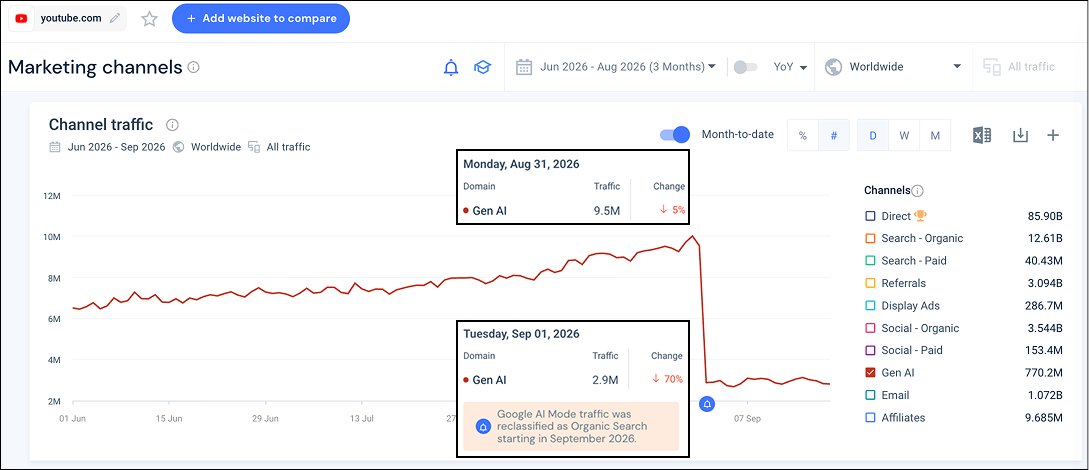
Watch the date, too. A drop that starts exactly on the first of a month, or the day a tool updated, is often a reporting change rather than lost visitors. Reclassification catches bigger players too. Aleyda Solis pointed out in September that Similarweb moved Google AI Mode traffic from its Gen AI channel to organic search on September 1. For big sites that looked like a 60 to 70% fall in Gen AI traffic overnight.
How much traffic Google AI Mode is referring to sites? @Similarweb reclassified its traffic from "Gen AI" to "Organic Search" on September 1st, and we can easily see how much Gen AI traffic drops on September 1st for any site. For many of the top sites of the web, also used as https://t.co/RPVvE2ky8u
 Aleyda Solis 🕊️@aleydaSep 23, 2026
Our GA4 guide to AI referral tracking covers setting up the filters.
2. Compare the engines
Next, see which engines dropped and which didn't.
| What dropped | Most likely cause | Check first |
|---|---|---|
| ChatGPT only | An OpenAI incident or an OAI-SearchBot block | OpenAI status, robots.txt |
| Copilot and DuckDuckGo together | Bing | Bing Webmaster Tools |
| DuckDuckGo only | A DuckDuckGo incident or its own crawlers | DuckDuckGo's X account, robots.txt |
| Every engine and Google too | Your site | Recent deploys, crawler access |
3. Check status pages
OpenAI's status page lists incidents by component, including Conversations and Search, and has an RSS feed you can subscribe to. It's busy: the feed logged 93 incidents between June 28 and September 25, 2026. Thirty affected ChatGPT conversations, seven listed the Search component, and three were regional, covering Europe twice and Asia-Pacific once.
Most are short. For the 25 incidents between September 10 and 25, the median ran under an hour from first report to resolved, and 21 cleared within three hours. The longest lasted about 11 hours. The September 3 incident, which hit ChatGPT and Codex, drew a thread in r/technology with about 25,000 upvotes. A one-day dip that lines up with an incident is usually nothing to fix, while a decline over two weeks is.
Regional incidents matter if your audience is regional. If most of your AI traffic comes from Europe, the two European incidents in September would show up as dips while US traffic held. Subscribe to the RSS feed so you can match dates without digging later.
Microsoft doesn't publish a public status page for consumer Copilot or Bing that I could find, so outage trackers and news reports are the fastest signal. DuckDuckGo has posted about search incidents on its X account, as it did in 2024.
4. Look at Bing
Open Bing Webmaster Tools and look at three things. Crawl errors show whether Bingbot can fetch your pages. Indexed pages show whether they're still in the index. The AI Performance report shows how often your pages are cited across Copilot and Microsoft's partner surfaces, with citation share over time. If impressions fall to zero while pages stay indexed, as in the r/bing thread, report it to Bing support with dates.
5. Check crawler access
A drop that starts the day of a config change is usually a block. Check:
- robots.txt for OAI-SearchBot, Bingbot, DuckDuckBot and DuckAssistBot. DuckDuckGo says a DuckAssistBot opt-out takes about 72 hours to apply, so a change shows up days later.
- Your firewall or CDN. Bot protection can return a 403 to crawlers while the site loads fine in a browser. Our guide to Cloudflare Bot Fight Mode and SEO covers the common case.
- Server logs. Look for the crawlers' user agents and the status codes they got.
- Allowlists. OpenAI publishes the IP ranges ChatGPT-User comes from, and DuckDuckGo publishes DuckAssistBot's. Use them if your firewall blocks by IP.
ChatGPT-User is a special case. OpenAI says it visits pages when a user asks ChatGPT something, not as an automatic crawler, so robots.txt rules may not apply to it the same way.
RankControl checks every day whether AI crawlers can reach your site, which catches a block before the traffic falls.
6. Check your own changes
List every change from the week before the drop:
- Deploys and theme updates
- Redirects and pages moved to new URLs
- A CMS or hosting migration
- New noindex or canonical tags
Then compare with Google Search Console. If Google traffic fell on the same day, the cause is almost certainly on your side. A migration can wipe out citations even when rankings survive. Our AI visibility migration checklist covers what to test.
7. Check citations as well as clicks
Clicks can fall while citations hold, if fewer people click through. Citations can also fall while clicks look normal for a few days. Re-run the buying questions that used to cite you, on each engine, and note which pages still appear. For how the two numbers relate, see ChatGPT citations vs AI referral traffic.
8. Decide whether to wait or act
By now you should know which bucket you're in, and each has a different next step.
- An engine outage. Note the dates, wait 48 hours and check again. Don't change pages while the engine is down, or you won't know what fixed it.
- A Bing index problem. Check Bing Webmaster Tools for messages, resubmit your sitemap, and contact Bing support if pages stay indexed but get no impressions.
- A crawler block. Remove it, confirm the crawler gets a 200 in your logs, and allow a few days for recrawling.
- Your own change. Roll it back or fix the redirects, then watch the same questions weekly until citations return.
Your competitors are getting cited by AI. You're not.
Every day without citation tracking is a day your competitors pull ahead in ChatGPT, Perplexity, and Claude.
Knowing before the traffic falls
The real problem isn't diagnosing one drop. It's knowing when citations start slipping, before the referral numbers show it. AI visibility tracking in RankControl checks your questions every week on six engines, including ChatGPT, and shows which sources each answer quoted. It doesn't cover Copilot or DuckDuckGo, so pair it with Bing Webmaster Tools for those. It notifies you when a new citation appears. A lost citation shows up in the dashboard, not as an alert, so it's worth a weekly look.
You can run that check by hand with a list of questions and a spreadsheet, or RankControl's agents can run it for you, with a 7-day free trial. Before you start, the free AI visibility check shows who ChatGPT cites for three questions from your market today.
200+ SaaS teams already track their AI citations.
They know exactly when ChatGPT mentions their brand, and when it stops. Do you?