Most "best LLM SEO tools" lists are lists of trackers. They tell you whether ChatGPT named you this week. That's useful, but it leaves out the harder question: why didn't it?
An r/GEO_optimization post from late August shows how unexpected the answer can be. One analyst checked 624 sites and then probed 14 that block an AI crawler at the server. Twelve of the 14 said nothing about AI crawlers in their robots.txt. The block came from "a security plugin or a host default," below anything robots.txt controls. Two sites explicitly allowed a crawler in robots.txt that their own server then refused.
I probed 14 sites that block an AI crawler at the server. Not one blocklist named a user-agent introduced in 2025 or later.
The standard advice now is "block the training bots, allow the search bots" - disallow GPTBot, ClaudeBot, CCBot, Google-Extended, allow OAI-SearchBot, Claude-SearchBot, PerplexityBot. Keep your work out of training, stay citable. Good advic...
This list covers eight tools that monitor AI search visibility and help with the diagnosis: which sources the engines cite, whether AI crawlers can read your pages, and what to fix on the page. For pure tracking, our list of tools that track brand mentions in AI search goes deeper. Every price and feature below was checked on the vendors' own sites on September 25 and 26, 2026.
The short list
| Tool | Starts at | Engines | Diagnostics beyond tracking |
|---|---|---|---|
| Semrush AI Visibility Toolkit | $99/mo per domain | 4 | AI competitor analysis, AI readiness site audit |
| Ahrefs Brand Radar | Prompts on paid plans; Index $199/mo | Up to 7 | Cited sources, prompt index |
| RankControl | $400/mo | 6 | Cited sources, page citability scores, AI crawler visits |
| Scrunch | $250/mo | 4 on Core, 9 on Enterprise | Bot feed, crawl health, content-gap audits |
| AthenaHQ | Free; Starter $295/mo | Up to 11 | Action agent for on-page and off-page fixes |
| Writesonic | About $99/mo | 3 on Starter, 10 on Enterprise | Blocked-crawler detection, impact-ranked actions |
| Search Atlas | $159/mo annual | 3 to 5 | Sentiment, citation position, alerts |
| Surfer SEO | $82/mo annual | 5 | Mention gaps, sources LLMs use |
What to look for in an LLM SEO tool
A tracker tells you where you stand. A diagnostic tool tells you what to do next. Four checks separate the two.
First, the sources behind each answer. If ChatGPT names a competitor, you want to see the pages it pulled from, whether that's a review site, a Reddit thread or the competitor's own comparison page. Those sources are your to-do list.
Second, AI crawler access. AI engines can only cite what their crawlers can read. Vercel and MERJ's crawler study found that none of the major AI crawlers render JavaScript, so a page that loads its content with scripts can look empty to them. And blocks are common. Cloudflare's July 2025 look at the top 10,000 domains found 312 disallowing GPTBot, against 61 that explicitly allowed it.
Along with their 'Pay per crawl' announcement, Cloudflare just published a post about the state of AI crawlers -> From Googlebot to GPTBot: who’s crawling your site in 2025 "Although GPTBot was the most blocked, it was also the most explicitly allowed, with 61 domains granting https://t.co/7tbaJqfYCX
 Glenn Gabe@glenngabeJul 1, 2025

Third, page-level fixes. A good tool points at a specific page and says what's missing, like a direct answer, a comparison table or the product facts engines look for. Fourth, the same questions checked on a steady schedule, so a change in the chart means something changed.
The 8 best LLM SEO tools for monitoring AI search visibility
1. Semrush AI Visibility Toolkit
Semrush's toolkit is the natural start for teams already in Semrush. It costs $99 a month per domain on annual billing and tracks 25 custom prompts daily across ChatGPT, Google AI, Gemini and Perplexity. The diagnostic side comes from its neighbors. You get AI competitor analysis and prompt research, plus a site audit for AI readiness, next to the keyword and backlink data your team already uses.
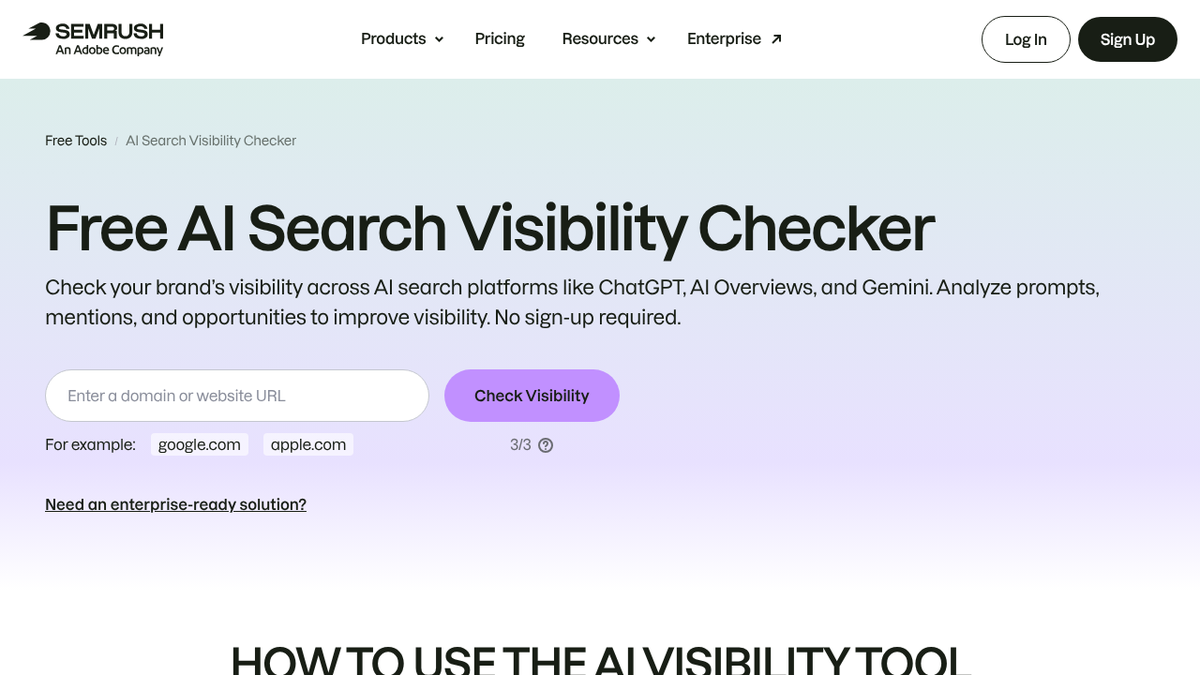
It doesn't cover Claude, Grok or Copilot, and acting on what it finds stays with your team. There's a 7-day free trial.
2. Ahrefs Brand Radar
Brand Radar has two parts. Custom prompts come with every paid Ahrefs plan, from five daily prompts on Lite to 20 on Advanced, and cover the main engines plus Claude. The AI Visibility Index starts at $199 a month and draws on more than 449 million prompts across AI Overviews, AI Mode, ChatGPT, Perplexity, Gemini and Copilot.
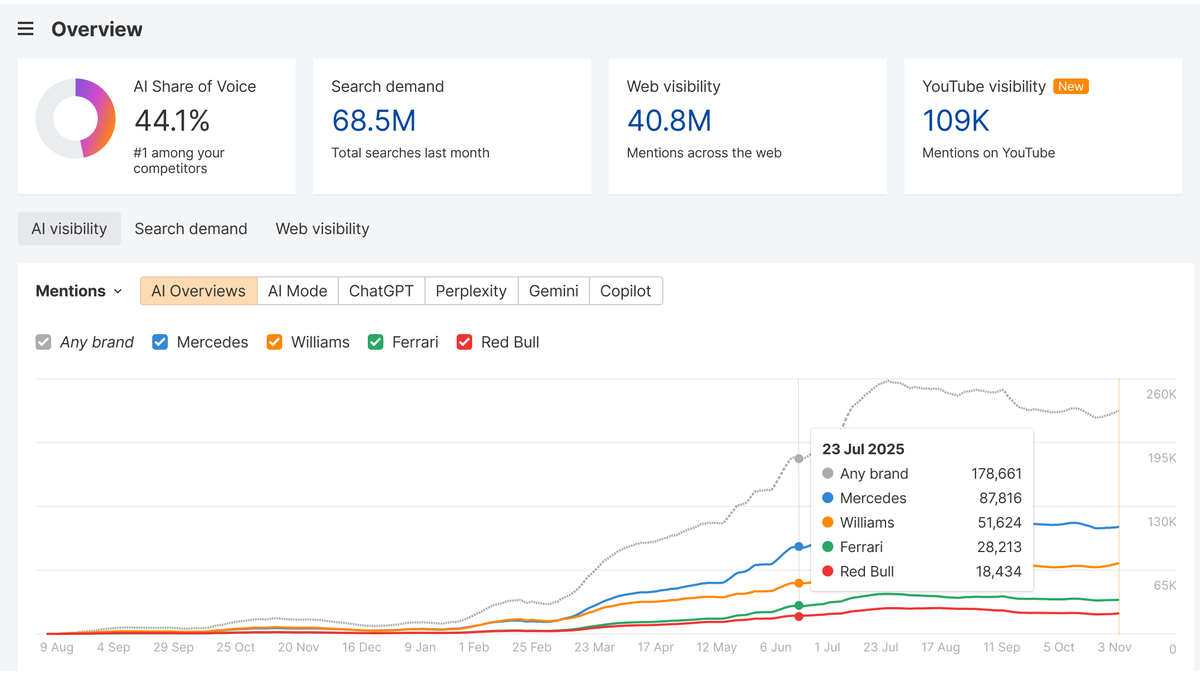
For diagnosis, the index is the strength. You can see which pages get cited for prompts you never thought to track, and then check those pages' backlinks in the same tool. Grok isn't covered.
3. RankControl
RankControl pairs the diagnosis with the work that acts on it. AI visibility tracking checks 50 of your queries every week on ChatGPT, Perplexity, Claude, Gemini, Grok and Google AI Mode. For each answer it records who got named, which competitors were named instead and which sources the engine quoted.
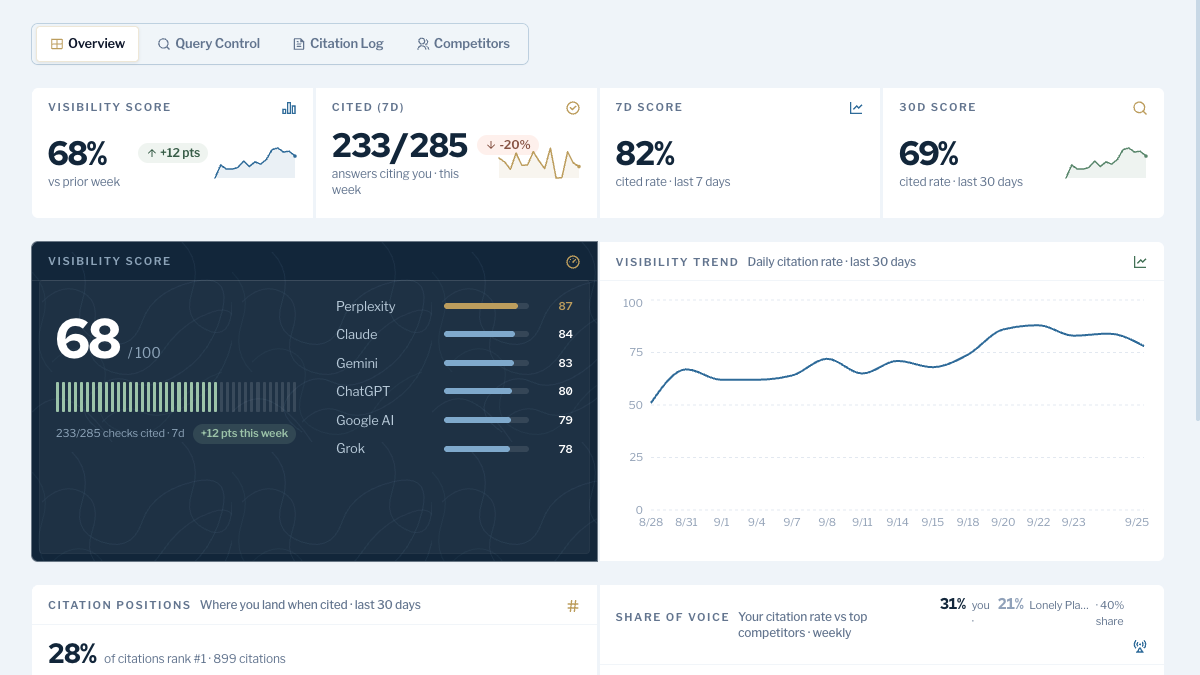
On the page level, the content engine scores every article it writes for how easily AI engines can quote it, with a fix list, before it publishes. Its analytics count visits from AI crawlers and from people who clicked through from an AI answer, next to your Search Console data.
Then it acts on the gaps. It plans titles from your buyers' questions, writes and publishes the articles to your CMS, and drafts link outreach from your own mailbox. It's one plan at $400 a month with a 7-day free trial, and it checks weekly rather than daily.

Your competitors are getting cited by AI. You're not.
Every day without citation tracking is a day your competitors pull ahead in ChatGPT, Perplexity, and Claude.
4. Scrunch
Scrunch leans the most technical. Its site lists a real-time bot feed with crawl health and error detection. That covers robots.txt problems, server errors and pages that depend on JavaScript. Its audits look for the facts "that AIs look for," like entities, claims, pricing and product specs. Enterprise adds AXP, which serves AI agents a compressed, machine-readable version of your pages.
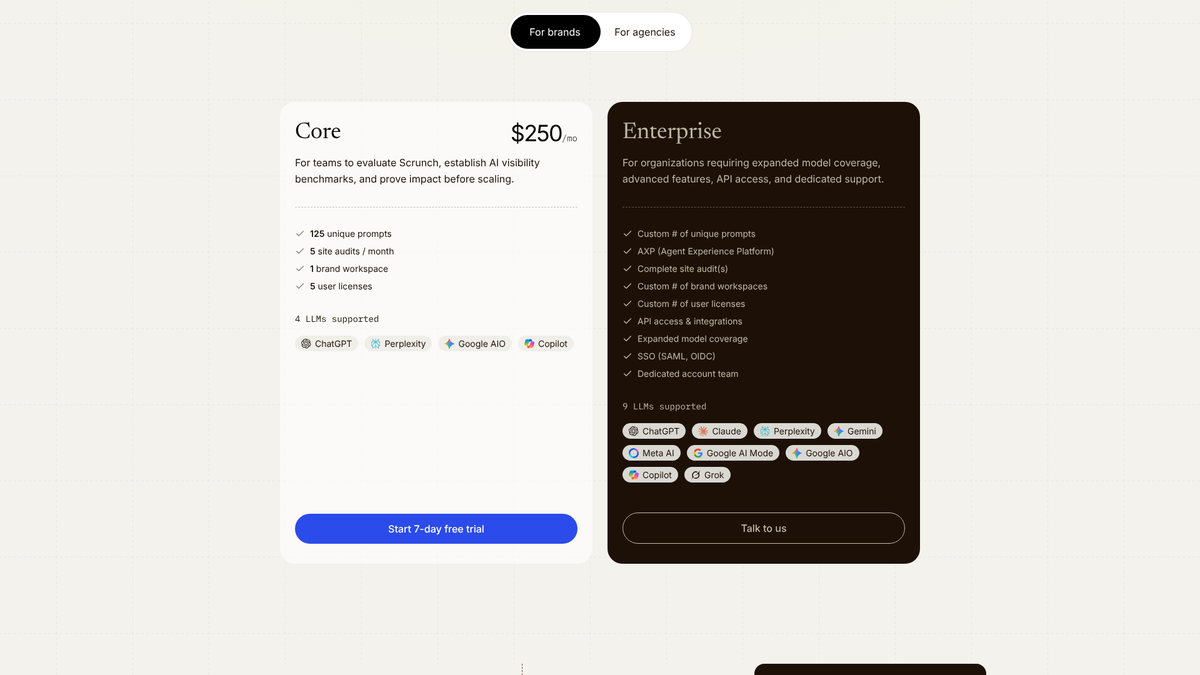
Pricing changed while we were checking. As of September 26, Core is $250 a month for 125 prompts, five site audits and four engines: ChatGPT, Perplexity, Google AI Overviews and Copilot. Claude, Gemini, Grok, Meta AI and AI Mode are on Enterprise, at a custom price. There's a 7-day free trial.
5. AthenaHQ
AthenaHQ covers the widest set of engines here, up to 11 models including Grok, DeepSeek, Meta AI and Mistral. Its content agent "identifies the specific gaps preventing your brand from being cited, then tells you exactly what to fix with on-page and off-page actions." An assistant called Ask Athena answers plain-language questions about your positioning using the data already in your account.
The free Essential tier comes with a small credit, Starter is $295 a month, and the Athena Citation Engine is limited to Enterprise. We covered moving off it in our guide to switching from AthenaHQ.
6. Writesonic
Writesonic has turned its Action Center into a ranked to-do list. It sorts fixes into content, citations and technical work, and scores each one by impact, confidence and effort. On the technical side, it says it detects blocked GPTBot, ClaudeBot and PerplexityBot "with the exact fix," and a separate AI Bot Analytics view shows crawler traffic.
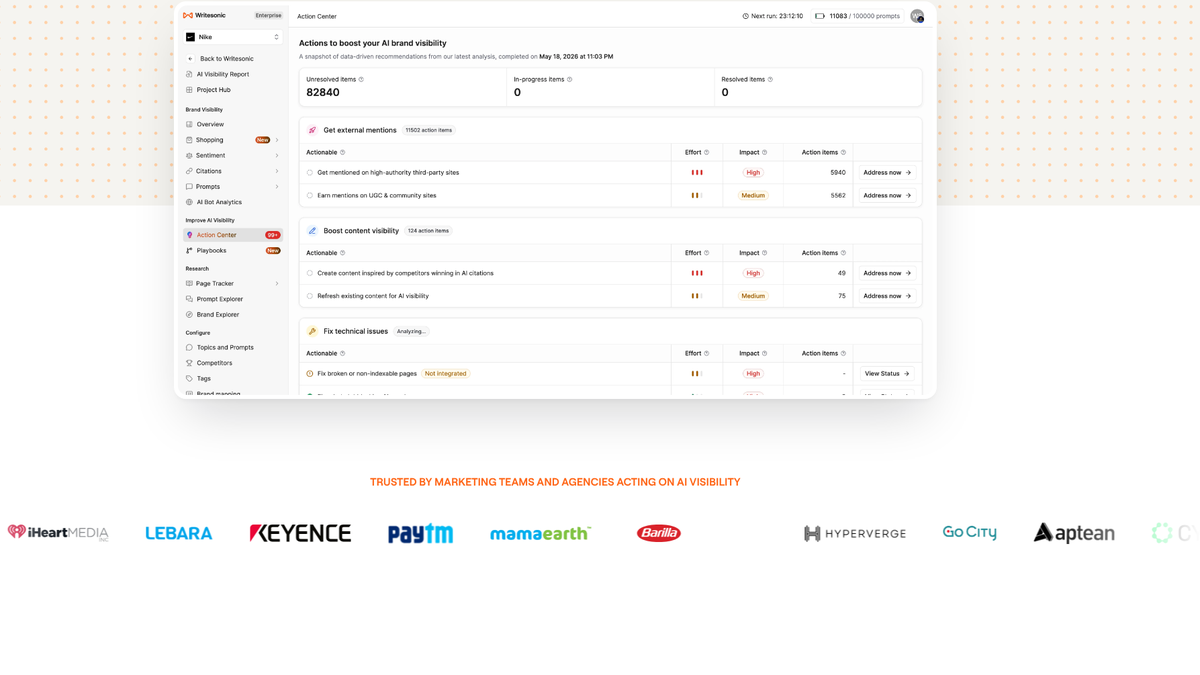
Starter costs about $99 a month and tracks ChatGPT, Gemini and Google AI Overviews daily. Growth, at about $499, adds sentiment and a limited Action Center allowance, and all ten platforms are on Enterprise. There's a 7-day trial with no card. We compared it with other options in our Writesonic alternatives roundup.
7. Search Atlas
Search Atlas's LLM Visibility tracks mentions, sentiment and share of voice. It also records where in the answer you appear, first, last or skipped. Its Coworker agent pushes citation gains and losses to Slack, Teams or ClickUp, which turns the diagnosis into alerts your team sees without logging in.
Growth is $199 a month, or $159 on annual billing, and covers ChatGPT, Gemini and Google AI Mode. Pro at $399, or $319 annually, adds Copilot and Perplexity. The entry Starter plan doesn't include LLM visibility. More detail is in our Search Atlas alternatives list.
8. Surfer SEO
Surfer's AI Tracker is built for content teams. Its Mention Gap view shows where competitors are cited and you aren't, and it identifies "the exact sources LLMs trust" so you can build an outreach list. Findings feed straight into Surfer's content editor, so the fix is a rewrite in the tool you already use.
The tracking-only plan starts at $82 a month on annual billing for 50 prompts checked daily across ChatGPT, Gemini, Google AI Overviews, AI Mode and Perplexity. Claude and Grok aren't covered, and we didn't find a crawler-access check on the AI Tracker page. Our RankControl vs Surfer SEO comparison goes through the plans.
200+ SaaS teams already track their AI citations.
They know exactly when ChatGPT mentions their brand, and when it stops. Do you?
Diagnostics side by side
| Tool | Cited sources | AI crawler access | Page-level fixes |
|---|---|---|---|
| Semrush | Yes | AI readiness site audit | Not a focus |
| Ahrefs Brand Radar | Yes, plus a prompt index | Not listed | Not a focus |
| RankControl | Yes | Counts AI crawler visits | Citability score and fix list per article |
| Scrunch | Yes | Bot feed, crawl health, errors | Content-gap audits |
| AthenaHQ | Yes | Not listed | Action agent |
| Writesonic | Yes, ranked by domain rating | Blocked-crawler detection | Impact-ranked actions |
| Search Atlas | Yes, with citation position | Not AI-specific | Alerts and content tools |
| Surfer SEO | Yes, mention gaps | Not listed | Content editor |
A diagnostic checklist you can run by hand
Before you buy anything, run these five checks yourself. They take about an hour.
- Ask your ten most important buyer questions in ChatGPT, Perplexity and Gemini, logged out, and note who gets named.
- Open the sources each answer cites, and list the ones that name a competitor and not you.
- Load your most important page with JavaScript turned off. If the main content disappears, AI crawlers probably can't see it either.
- Read your robots.txt for rules naming GPTBot, ClaudeBot or PerplexityBot, then ask your host whether a security plugin or firewall blocks them.
- Compare your page with the one the engine cited. Look for a direct answer near the top, a comparison table and current facts.
One r/SEO commenter in September added a useful case. If one engine cites you often and another never does, check that engine's crawler rules first, because the engines don't share an index or a crawler.
Which LLM SEO tool fits your team?
| If you... | Pick |
|---|---|
| Already pay for Semrush | Semrush AI Visibility Toolkit |
| Already pay for Ahrefs | Ahrefs Brand Radar |
| Want the diagnosis and the work that acts on it | RankControl |
| Suspect a technical or crawler problem | Scrunch |
| Need the widest engine coverage | AthenaHQ |
| Want a ranked list of fixes | Writesonic |
| Already use Search Atlas | Search Atlas |
| Fix gaps by rewriting in a content editor | Surfer SEO |
The pick for LLM SEO
For monitoring alone, start with the suite you already pay for. Semrush and Ahrefs put AI visibility next to the keyword and backlink data you use every day.
Diagnosis is only half the job, though. Every tool here can tell you that a competitor gets cited for "best X for Y." Closing that gap takes a page that answers the question, published on your domain, and links from the sites engines trust.
You can do that by hand: write the pages, publish them, pitch the links and check six engines every week. Or RankControl's agents can run the loop every month while you focus on your product. Curious where you stand today? Run a free check of your brand in AI answers.
How often does ChatGPT mention your brand?
Most founders have no idea. The answer might surprise you.