
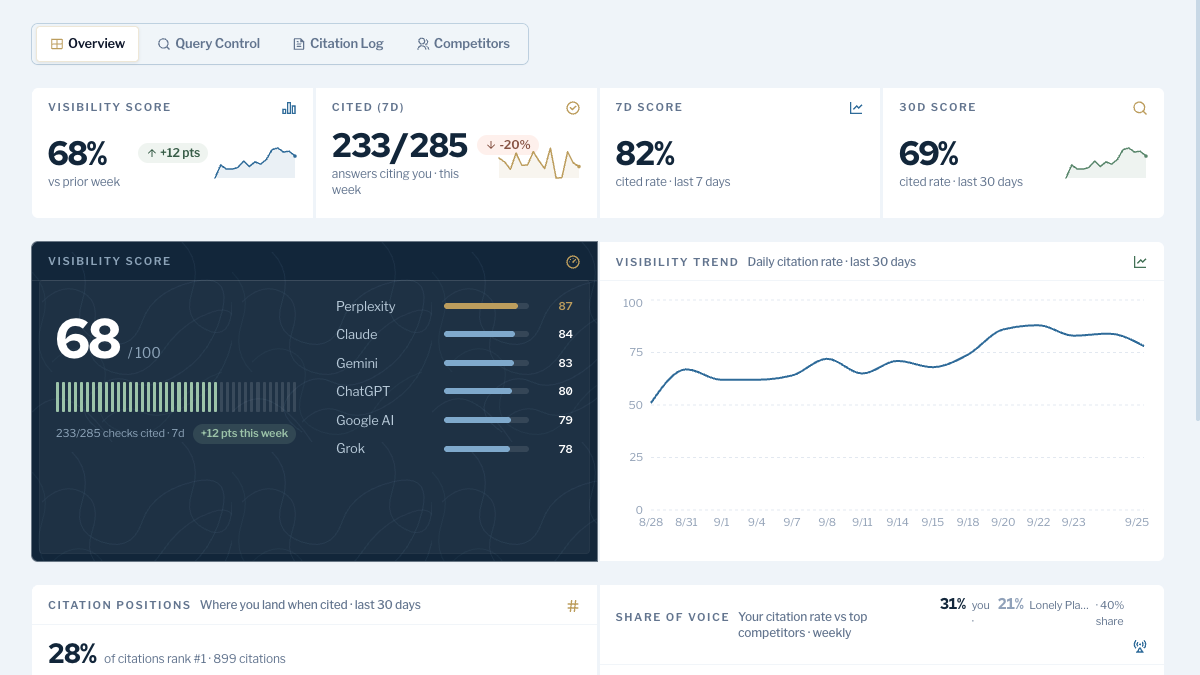
Ask Search Atlas which AI engines its LLM Visibility tracks and you'll get three answers. The pricing page says three on Growth and five on Pro. The dashboard's trend chart shows six, including Grok and AI Overviews. And a Search Atlas blog post from September 25 lists four, with Claude in the mix, which neither of the other two mentions.
That's a small thing, but it's the kind of thing that makes people shop around. Most teams who look for Search Atlas alternatives bought it for one part of a very big suite, and for a lot of them that part is AI search. This list is for them. Every price and engine list below was checked on the vendors' own sites on September 25 and 26, 2026. For a direct comparison, see RankControl vs Search Atlas.
The short list
| Tool | Starts at | AI engines tracked | Publishes to | Best for |
|---|---|---|---|---|
| RankControl | $400/mo, one plan | 7: ChatGPT, Perplexity, Claude, Gemini, Grok, Google AI Mode, Google AI Overviews | 9 CMS destinations | Teams that want the work done |
| Writesonic | $99/mo ($79 yearly) | 3 below Enterprise | WordPress plus 1-click export to four more | Daily tracking |
| Frase | $49/mo ($39 yearly) | 2 to 5 by plan, no Grok | WordPress, Webflow, Sanity, Wix | Brief-and-editor writers |
| Surfer SEO | $59/mo | Up to 5 on Pro, no Claude or Grok | WordPress | Editing by score |
| SE Ranking | $129/mo ($103.20 yearly) | 4 with the AI Search add-on | Not its focus | Rank tracking and audits |
| Scalenut | $59/mo list | 2 to 3 by plan | WordPress, Shopify | Tight budgets |
Why teams look past Search Atlas
The first reason is where AI visibility sits in the price list. Starter, at $99 a month, has zero LLM Visibility projects. Growth at $199 gets you ChatGPT, Gemini and Google AI Mode across 100 queries, and Copilot and Perplexity only arrive on Pro at $399.
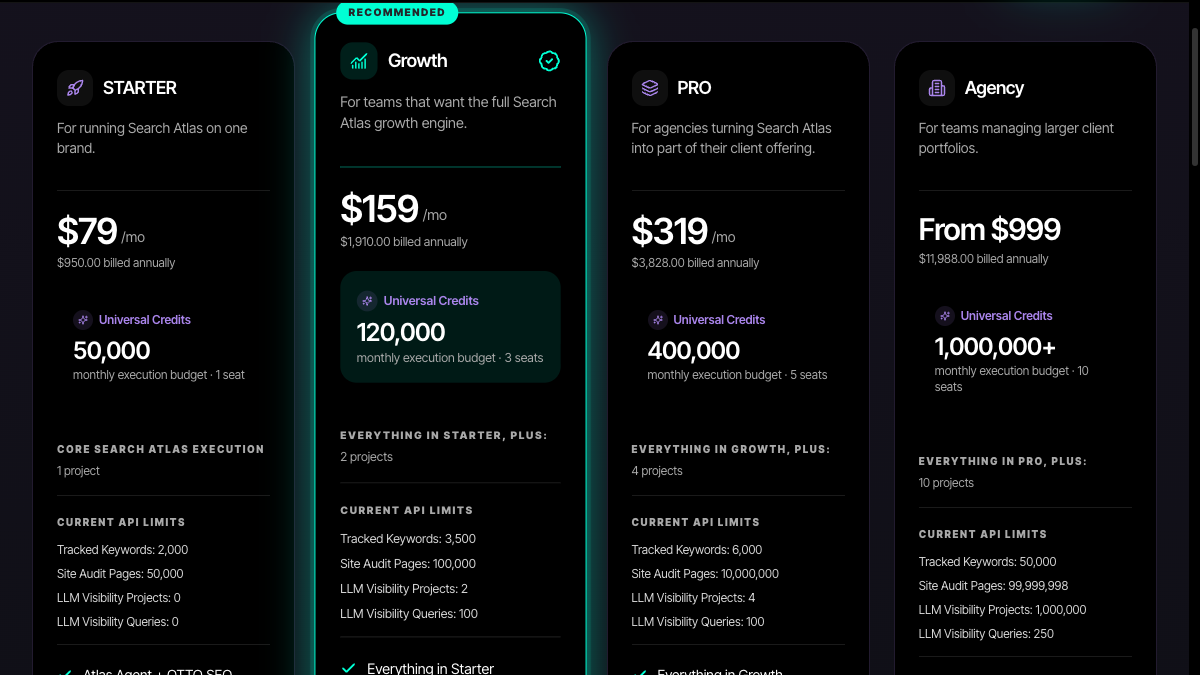
Then there's the credit system. Almost everything draws on a monthly budget of Universal Credits, link building included. That budget runs from 50,000 credits on Starter to 1,000,000+ on Agency. Press releases run on a second currency called Hyperdrive Credits. A reply in a February r/WebsiteSEO thread put it mildly: "the credit system takes some getting used to, especially if you're managing multiple clients."
Search Atlas vs Semrush: which one would you keep?
If you had to delete one from your life today, what are you keeping and why? Not looking for generic “Semrush is bigger.” I mean actual day-to-day value: research, audits, content workflow, client reporting, competitor insights, AI monitori...
The refund policy is tight. Monthly plans get 48 hours from the first purchase, requested through live chat only, and only if you've used less than 10% of any tool's quota. On annual plans it's 72 hours and half your money back at most.
Reviews are polarized. Search Atlas holds 3.9 out of 5 on Trustpilot across 354 reviews, with 65% five-star and 26% one-star. Recent one-star reviews focus on cancelling and billing, and one from September reads: "I was still having to contact Search Atlas again to stop future billing."
The last reason is technical. OTTO, the agent that applies fixes to your site, installs through a JavaScript pixel or through Cloudflare DNS. Vercel and MERJ's crawler study found that none of the major AI crawlers render JavaScript, which is the problem a reply in a May r/Agentic_Marketing thread raised: pixel changes "wont make it to what actually matters: crawlers and AI agents." The r/WebsiteSEO reply above said the plugin now works server-side, so check which install you're on.
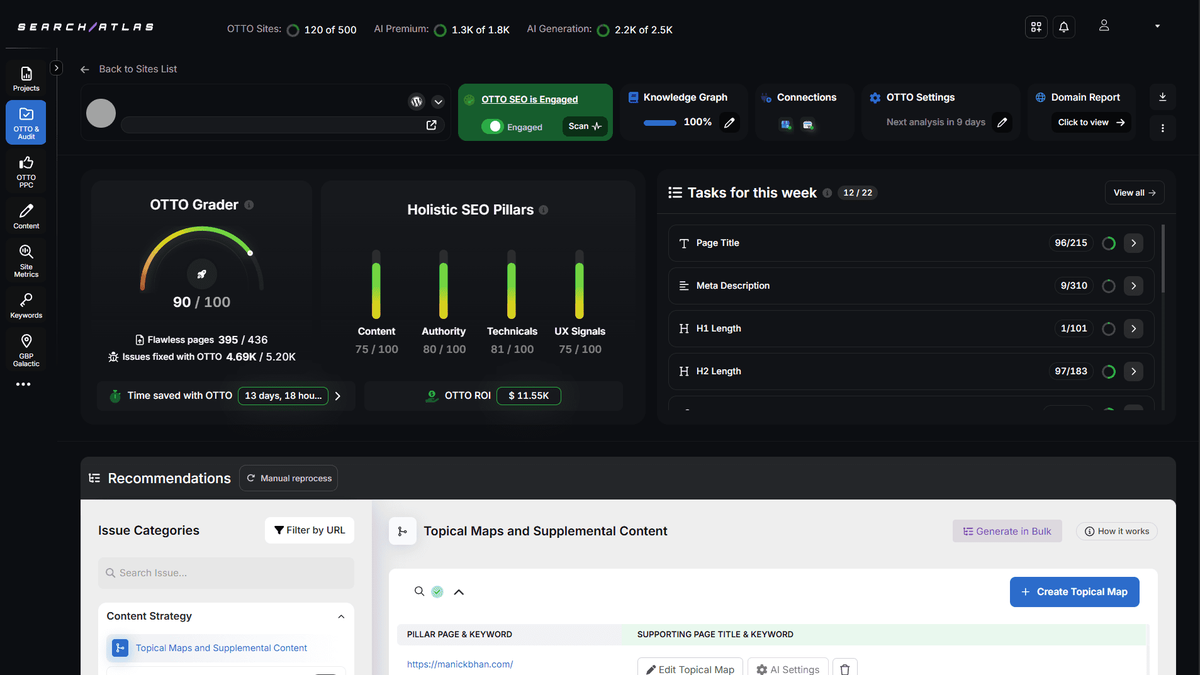
Where Search Atlas goes further than anything on this list is breadth. OTTO fixes titles, schema and internal links across a whole site, local SEO tools come with every plan, and agencies get white-label dashboards from Pro. If those are what you use, you're shopping for a different kind of replacement.
See your first AI citation report in under 5 minutes.
No setup calls. No onboarding meetings. Connect your domain and see where AI mentions your brand right now.

The 6 best Search Atlas alternatives for AI search visibility
Two names you won't see ranked below are Semrush and Ahrefs. They're full SEO suites, and they're the natural swap if you mostly used Search Atlas for keyword data, backlinks and audits. Both now sell AI visibility tracking as well, through Semrush's AI Visibility Toolkit and Ahrefs Brand Radar. The six tools below are ranked for the job most people bought Growth or Pro for: showing up in AI answers.
1. RankControl
RankControl is one plan at $400 a month that does the whole loop. We plan titles from the questions your buyers search, write each article against the pages already ranking, and publish it as a native post through one of nine CMS destinations. Then we check whether the engines cite you.
AI visibility tracking checks all seven engines in the table above for 50 queries every week. There's no tier where Perplexity or Grok switch on, because there's only one plan. A weekly email sums up new citations, ranking moves and visits that came from AI answers.
The plan includes 100 pages a month across 26 content formats, and Backlinks finds prospects for each published article and drafts outreach from your own mailbox. If you want links handled for you, Managed Backlinks adds five a month from DR 25+ sites for $350.
2. Writesonic
Writesonic has turned itself from an AI writer into an AI search visibility platform, and its homepage now leads with winning customers from AI search. The standout detail is cadence. Every plan tracks daily, where most tools in this category check weekly.
The catch is engine coverage. Starter ($99 a month, $79 yearly) tracks ChatGPT, Gemini and Google AI Overviews for 50 prompts. Growth at $499 ($399 yearly) raises that to 200 prompts and adds sentiment, but it's still three engines. All ten AI platforms it supports are Enterprise-only.
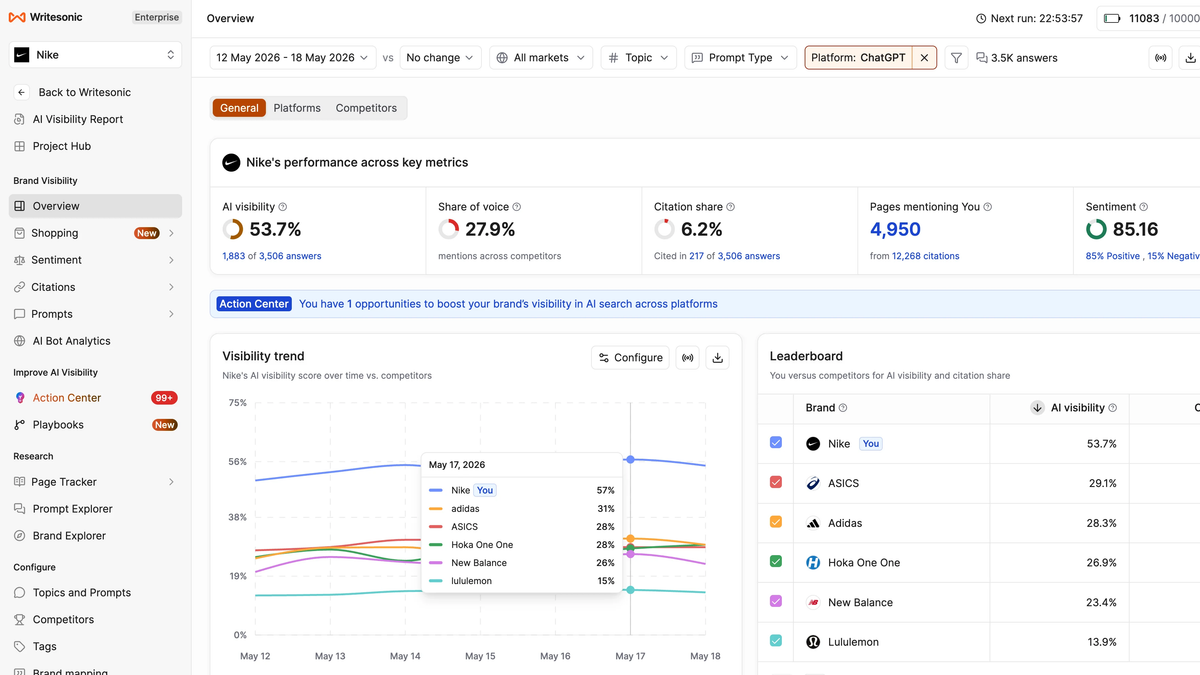
Its Action Center finds Reddit threads, YouTube videos and listicles that cite your competitors, and drafts the outreach. On Growth that's capped at five off-page actions a month. The article writer exports to WordPress, and its feature page adds one-click pushes to Webflow and Ghost among others. It also offers an open API and an MCP server, and there's a 7-day trial with no card.
3. Frase
If Content Genius was the part of Search Atlas you used most, Frase is the closest match. It starts from research, builds a brief, and gives you an editor with two separate scores: one for SEO and one for GEO. It publishes to WordPress, Webflow, Sanity and Wix, and it can draft link outreach too.
AI tracking is gated by plan. Starter at $49 a month ($39 yearly) covers ChatGPT and Google AI. Professional at $129 adds Perplexity, and Claude and Gemini need Scale at $299. Grok isn't on any tier. The trial runs seven days and doesn't ask for a card. Our Frase alternatives roundup compares its plans in more depth.
4. Surfer SEO
Surfer calls itself Positive Surfer on its own site now, and it has moved its pitch toward AI visibility. The editor is still why most people pay for it: a live 0 to 100 content score against the top pages, with one-click optimization from Standard up.
Its AI Tracker follows five models, and Claude and Grok aren't among them. Discovery at $59 a month tracks nothing. Standard at $119 checks 25 prompts weekly in ChatGPT only, and all five models need Pro at $219 or the tracking-only AI Search Analytics plan at $95. Publishing runs through a WordPress integration. We covered the rest in our Surfer SEO alternatives list.
5. SE Ranking
SE Ranking is the pick for people who mostly used Search Atlas as an SEO suite. It's a rank tracker and site audit tool first, and Core costs $129 a month, or $103.20 billed yearly.
AI search comes two ways, which gets confusing. Inside the main platform there's an AI Search add-on at $89 a month ($71.20 yearly) covering AI Overviews, AI Mode, Perplexity and ChatGPT. Separately, SE Visible is a standalone tracker from $99 a month for 200 prompts, with Gemini added and Claude listed as coming soon. SE Visible has a 10-day trial. If AI tracking is all you need, its $99 Basic plan costs about half of Search Atlas Growth and reads two more engines, Perplexity and AI Overviews.
6. Scalenut
Scalenut is the budget bundle. It writes what it calls GEO articles, has a content optimizer with a live score, and tracks prompts weekly. The list prices are $59, $89 and $199 a month, and a 60% promotion on its pricing page when we checked brought them to $24, $36 and $80.
Tracking stays light. Starter and Plus cover ChatGPT and Google's AI answers, and Perplexity arrives on Professional with 100 prompts. Auto-publishing to WordPress and Shopify starts on Plus. Above Professional, a VIP service adds a strategist and a team of writers, priced on request. We put it side by side with RankControl in RankControl vs Scalenut.
Your competitors are building backlinks while you read this.
Organic outreach, social mentions, and citations from Editorial Circle member sites, with managed backlinks available as an add-on. Grow your domain authority without running the campaign yourself.

Before you cancel Search Atlas
Leaving takes a little planning, mostly because of OTTO. When it runs through the pixel or the DNS layer, its changes to titles, schema and internal links are applied as the page is served, not saved in your CMS. Search Atlas offers a feature it calls OTTO Deep Freeze to "keep all OTTO optimizations live forever," which suggests they don't stay by default. Ask support how that works on your plan before you remove anything.
Articles you published through Content Genius are a different story. They went to your CMS as normal posts, so they stay on your site whichever tool you pick next.
Keyword and rank history is the part people forget. Export the tracked keywords and positions you care about while you still have access. The new tool starts its own history from day one, and your old numbers are the only way to show a trend across the switch.
Our step-by-step guide to switching from Search Atlas covers the OTTO export and refund window in detail.
If you're a small business
Search Atlas is a full suite, which is a lot to run for a small business. Simpler options here: Frase from $49/mo if you want to write yourself, Scalenut from $59/mo for writing plus light tracking, and RankControl at $400/mo if you want articles written, published and tracked with no SEO team. For a small business with no one to do SEO, the best pick is RankControl. Our RankControl vs Search Atlas for small businesses post tests which local searches each one helps with.
Which alternative fits your Search Atlas setup?
Match the swap to the part of Search Atlas you used most, since no single tool below replaces all of it.
| If you mainly used Search Atlas for | Look at |
|---|---|
| LLM Visibility on Growth or Pro | RankControl, or Writesonic for daily numbers |
| Content Genius drafts | Frase or Surfer SEO for editing, RankControl if you want them published too |
| Rank tracking and site audits | SE Ranking, or Semrush and Ahrefs |
| A cheap all-in-one start | Scalenut |
One more thing before you move. Write down where you stand on your top 10 queries in each engine today. Search Atlas's numbers won't carry over to another tool, so keep a plain list of which engines named you for each query and which of your pages they quoted.
The pick for AI search visibility
For AI search visibility, we'd pick RankControl. We track all seven engines on one plan, including Grok and Claude, neither of which Search Atlas's pricing page lists at any tier. We also do the work behind the numbers: writing and publishing the pages you want cited, then drafting the outreach that earns links to them.
Doing that by hand takes real hours. Fifty queries on seven engines is 350 answers to read every week, before you've written or published a single page. You can run that loop yourself with a spreadsheet and a lot of tabs. Or RankControl's agents can run it every month while you focus on your product.
Want a starting point first? Run a free check of your brand in AI answers and see which engines name you today.

You're getting AI traffic. But do you know where it comes from?
RankControl credits every visit to the assistant that sent it: ChatGPT, Perplexity, Claude, Gemini, Copilot, or Grok. Full source attribution, next to your Google traffic.