
Diib's homepage makes three promises for its AI Visibility Score, and the third one is the promise that matters here: it "tells you what to publish to get cited next." Now go a few clicks into Diib's knowledge base, where an article answers the question you'd ask next. Diib, it says, "no longer provides direct, hands-on SEO services," and members who want the work done get pointed to partner agencies.
That gap, between hearing what to publish and having it published, is what the whole RankControl vs Diib comparison turns on. Diib costs $30 a month and tells a small business where it stands. RankControl costs $400 a month and does the publishing. Below I go through the engines and prompts, who does the work and what a month really costs you, and then give my verdict. I checked Diib's homepage, pricing page and knowledge base on September 26, 2026.
RankControl vs Diib: the short answer
If you run a small business and want to understand how your website is doing, Diib is made for you. It hooks into Google Analytics, Google Maps, YouTube and Facebook, and it benchmarks your site against businesses like yours. On Pro you also get an AI Visibility Score with an action plan.
RankControl does a different job, as a publishing pipeline for AI search. We plan articles from the questions your buyers ask, write them and publish them on your site, and every week we check 50 of your own questions on seven AI engines. So what Diib hands you is a score and an action plan, and what RankControl hands you is the published pages that plan asks for.
Side by side
| RankControl | Diib | |
|---|---|---|
| What it is | Publishing pipeline with AI tracking | Website growth dashboard with an AI score |
| Price | $400/mo or $4,000/yr | Free, or Pro at $30/mo |
| Getting started | 7-day trial | Free plan, no card |
| AI engines | 7, weekly: ChatGPT, Perplexity, Claude, Gemini, Grok, Google AI Mode, Google AI Overviews | 3: ChatGPT, Gemini, Perplexity |
| Prompts | 50 questions you choose | 50+ prompts per industry, weekly |
| Content | Articles written and published to your CMS, up to 100 pages a month | Action plan and "what to publish" suggestions |
| Rank tracking | Google and Bing positions for each page we publish | Up to 250 keywords on Pro; full dashboard refresh weekly |
| Competitors | Up to 10 named competitors, share of voice in AI answers | Benchmarking against similar businesses across 614 industries |
| Hands-on work | Outreach drafted from your mailbox; Managed Backlinks optional | Partner agencies; paid Boosts such as LocalBoost |
| Asking questions | MCP server and CLI with 80+ tools | diibAssist and Dash, its AI analyst |
15 hours a week manually. Or 15 minutes with RankControl.
Track citations, monitor competitors, and fix content gaps across every AI search engine. Automatically.

What Diib is in 2026
Diib's newest feature is Dash, an "AI growth analyst" that scans your site and lists SEO wins and AI search gaps. By Diib's own count, more than 800,000 businesses have used it, across 614 industries. Here's how the two plans split, going by Diib's pricing page and help docs:
| Diib plan | What you get |
|---|---|
| Free | A health scan with a daily health score; keyword, backlink and competitor data; the Weekly Snapshot email; a full dashboard refresh monthly |
| Pro, $30 a month | The AI Visibility Score with an action plan; diibAssist for questions about your own data; daily live help sessions called diib Live; Google Analytics data daily and a full dashboard refresh weekly, plus a set number of manual refreshes each month |
The refresh line is worth reading before you judge any number on the dashboard, since how fresh the data is depends on which plan you're on.
Diib also does one job RankControl doesn't. For $30 a month it benchmarks your site against similar businesses in 614 industries and pulls your Maps, YouTube and Facebook data into the same view. RankControl has no industry benchmarking and no social analytics.
Industry prompts or your buyers' questions
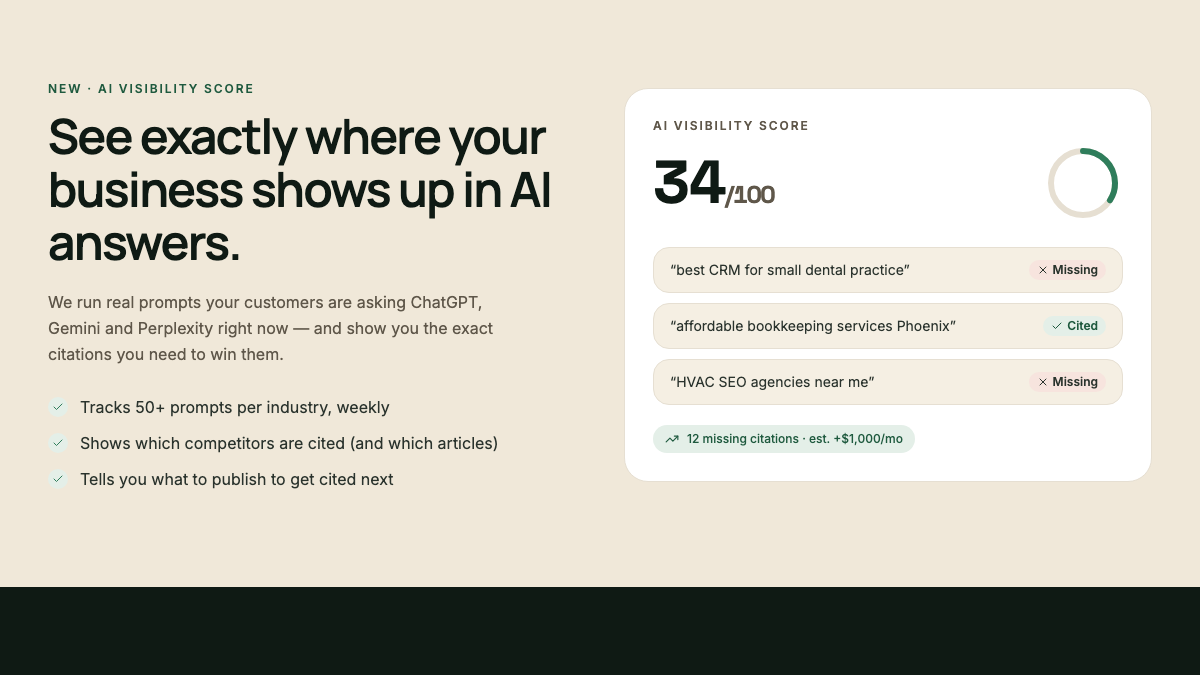
Before you compare scores, look at whose questions each tool is asking. Diib's AI Visibility Score works from a prompt set written for your industry. In the homepage's words it runs "real prompts your customers are asking ChatGPT, Gemini and Perplexity right now," and it tracks 50+ prompts per industry each week. You see which competitors get cited, and with which of their articles, and the gaps become your action plan.
Industry prompts will catch what businesses like yours usually get asked, and for a $30 product that's a fair default. Your own buyers won't always ask those questions, though, and Diib's help doc warns that the citation list sometimes turns up sites that seem unrelated to your industry.
With RankControl you write the list yourself. You pick the 50 questions, ideally ones real customers typed, and AI visibility tracking checks each one every week on seven engines, with share of voice against up to 10 competitors you name. Two of those engines, Claude and Grok, aren't among Diib's three.
Diib's dollar figures deserve a second look. Its sample widget puts an estimated "+$1,000/mo" next to 12 missing citations. The homepage headline makes the same kind of promise, to find "the next $1,000/month hiding in your website." A model produced those numbers, and nobody measured that revenue, so use them to decide which task comes first and don't plan around them as a forecast.
RankControl's analytics count the visits themselves. Once you connect a traffic source, they separate out the ones that arrive from AI engines, so when a citation starts sending you people, you see it as real traffic.
Advice or output
Diib is built to explain. Dash finds opportunities, and diibAssist answers your questions in plain English. What both of them produce is a to-do list, and Diib's help doc makes it clear that the doing happens somewhere else.
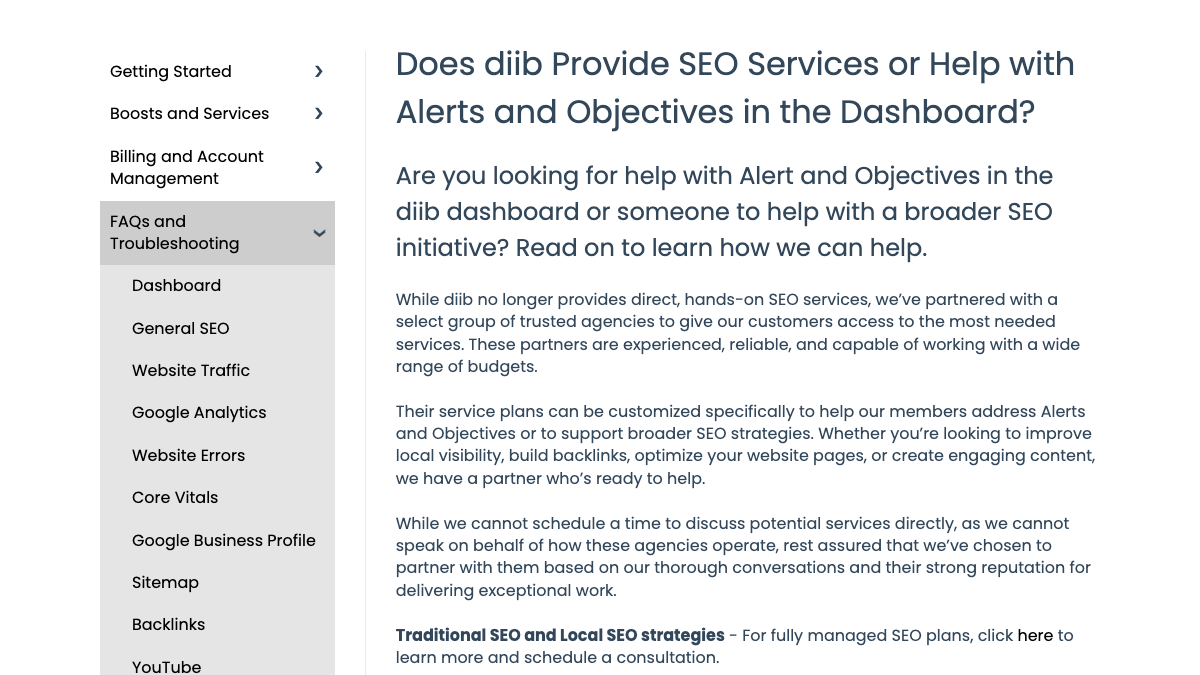
Diib does sell Boosts for specific jobs. LocalBoost, which only Pro members can buy, has Diib's growth experts create 25 to 50 new local listings for you. Anything broader, like content or links, goes to partner agencies, and Diib says it can't speak for them.
RankControl picks up the to-do list and does the content part for you. The content engine plans titles from your tracked questions and writes each article against the pages already ranking for its keyword. Every article publishes as a native post through the CMS you connect, and auto-publish stays off until you turn it on. For links, Link Control finds prospects for each published article and drafts the outreach from your own mailbox.
This summer a small business owner in r/smallbusinessUS asked which AI SEO tool to pick after years of paying for Semrush and Ahrefs. One of the more useful replies said the tool matters less than what feeds it. It listed your website copy and your Google Business Profile, then review sites and directories, and then any third-party page that describes what you sell.
What is the Best AI SEO tool for businesses?
Hi all- I heard there a lot of newer AI powered SEO tools these days! I have traditionally paid Semrush and Ahrefs! Have you all checked these out? If so, what is the Best AI SEO tool for businesses? Thanks in advance
That reply is the practical argument for output. An AI engine can only cite a page that exists, and the clear page on your own site that answers your buyer's exact question is the piece every tool assumes someone else will write.
AI search traffic grew 835% this year. Is your content ready?
RankControl generates 26 content formats optimized for ChatGPT, Claude, and Perplexity. Published on your domain, matched to your brand.

Where local AI answers get their sources
Suppose someone asks an AI engine "who does same-day water heater replacement in South Austin?" If your site is a homepage, a services page and a contact form, the engine finds very little on it to quote. Most of Diib's members are small, local businesses, so it's worth knowing what the engines cite when a question like that comes in.
Steady Demand has numbers on this, from the 14,472 Gemini citations it went through in August 2026. On local and service queries, about 60% of them pointed at businesses' own websites. Directories, review platforms and forums got less than that put together.
Directory listings, the thing LocalBoost builds, do still show up in those answers. But the largest single source was the business's own site, and in particular pages that spell out what the business does and where it does it, and for whom. Diib's action plan will point you at that page and leave the writing to you, while RankControl writes and publishes it, one tracked question at a time.
A month on each, week by week
Over a month, the real difference is where your own hours go. With Diib you spend them producing pages, and with RankControl you spend them approving the pages we produced. Here's how the month runs on each:
| Diib Pro | RankControl | |
|---|---|---|
| Start of the month | The Weekly Snapshot email and the refreshed dashboard arrive | Week one is setup: connect your CMS, let us build a brand profile from your site, add your 50 questions and name your competitors |
| Planning | The AI Visibility Score shows which industry prompts cite competitors, and the action plan turns those gaps into tasks | Titles for the month land on a calendar for you to approve |
| Doing the work | You write, hire a writer or book a partner agency | Articles arrive for review ahead of their dates, and each publishes as a native post once approved |
| Seeing results | Wait for the next weekly refresh to see whether anything moved | The weekly check runs on all seven engines throughout |
That last row is where I'd look. Since RankControl's check runs on all seven engines every week of the month, you end it with a record of which questions started citing which pages.
What $30 and $400 buy in a month
The prices sit far apart, so comparing the two sticker prices straight across tells you little. The useful comparison is the whole month, counting the work neither dashboard does:
| Job | With Diib Pro | With RankControl |
|---|---|---|
| Tracking AI answers | Industry prompts on 3 engines, included | Your 50 questions on 7 engines, included |
| Deciding what to publish | Action plan, included | Titles planned from your questions, included |
| Writing 8 articles | You, or a partner agency | Included |
| Publishing to your site | You | Included, as native posts |
| Local listings | LocalBoost, sold separately | Not offered |
| Backlink outreach | Partner agency | Drafted from your mailbox |
| Monthly cost | $30 plus your time or an agency's fee | $400 |
Most of the real cost on Diib is your time. These are rough estimates, but writing and publishing even eight solid articles by hand takes a small business owner 16 to 24 hours a month, and checking a set of questions on seven AI engines by hand takes another few hours every week. Those are the hours a $30 dashboard leaves with you.
A partner agency can take that work off your plate at its own price, and that's before anyone tracks whether ChatGPT started citing the pages.
Reporting and asking questions
You'll get a weekly email from either one. Diib's Weekly Snapshot covers growth and rankings, and it also flags opportunities and problems across the platforms you've connected. RankControl's email sticks to new citations and ranking gains, and the fuller picture lives on the Reports screen, where citations, rankings and Search Console data sit side by side.
For questions, Diib keeps you inside its own app with diibAssist and Dash. RankControl's MCP server connects to Claude, ChatGPT or Cursor, so from wherever you already work you can ask which engines cited you this week, or plan your next titles. Anything that would publish is held as a dry run until you confirm.
If you're moving from Diib
Save your data before you change anything, because we found no export feature in Diib's knowledge base. Downgrading from Pro to Free cuts keyword tracking from 250 keywords to 5, and it removes the citation list behind the AI Visibility Score, so capture both first. Our guide to switching from Diib goes through what to save and how to cancel on the right day, and it shows how your Weekly Snapshot emails can stand in as your history.
Which wins AI search visibility?
The hard part of AI search visibility comes after the diagnosis. Engines cite pages, so somebody has to write and publish those pages every month.
If you want that work done, RankControl wins. We publish pages that answer your own buyers' questions and check every week whether seven engines have started citing you, for $400 a month with a 7-day trial.
You can keep working through Diib's action plan on your own, one page at a time, or let RankControl's agents run the loop every month while you approve what goes live.

Built by the team that got cited in 48 hours.
Content generation, backlink building, AI visibility tracking, and Google rankings. One platform, zero guesswork.