
SEOmonitor's CEO, Cosmin Negrescu, has a clear view on how to track AI search. "If you rank for the main keyword, you'll be cited and mentioned across long-tail variations with the same intent," he says on the company's AI tracking page. "You don't need to track 50 times your keywords."
It's a tidy theory, and it's the core difference between SEOmonitor and RankControl. SEOmonitor starts from the Google keywords you already track and checks how they do in AI answers. RankControl starts from the questions buyers ask AI engines. Ahrefs looked at 15,000 queries in 2025 and found that only 12% of the URLs AI assistants cited ranked in Google's top 10 for the same prompt. Every SEOmonitor detail below comes from its site, help center and terms, checked on September 26, 2026.
RankControl vs SEOmonitor: the short answer
For AI search visibility, we'd pick RankControl. SEOmonitor is an agency SEO platform that tracks thousands of Google keywords a day and runs its traffic forecasts and client reports on that data. On top of that it added Google AI Overview tracking for every plan and ChatGPT, Gemini and Perplexity tracking as a Pro add-on. Its AI Content Writer publishes to your CMS.
RankControl, built for AI search visibility, plans titles from buyer questions, writes and publishes articles on your domain and drafts link outreach, all on one plan at $400 a month. Each week it checks 50 queries on six AI engines, including the ones SEOmonitor doesn't cover, and every query is a question buyers ask, where SEOmonitor starts from the keywords they type into Google.
Side by side
| SEOmonitor | RankControl | |
|---|---|---|
| Built for | Agency SEO: rank tracking, forecasting, reporting | AI search visibility |
| Price | €99/mo Starter, €299/mo Pro, add-ons extra | $400/mo or $4,000/yr, one plan |
| AI engines | Google AI Overviews; ChatGPT, Gemini, Perplexity on Pro add-on | ChatGPT, Perplexity, Claude, Gemini, Grok, Google AI Mode |
| What it tracks | Your Google keywords | Up to 50 buyer questions |
| AI tracking cadence | AI Overviews daily; other engines weekly | Weekly on all six |
| Google rank tracking | Daily, top 100, 1,000 to 200,000 keywords | Weekly, for pages it publishes |
| Content | AI Content Writer, 10 articles on Starter | 100 pages/mo across 26 formats |
| Publishing | WordPress, HubSpot, Webflow, Shopify, API | 9 destinations, native posts |
| Links | Not offered | Outreach from your mailbox; Managed Backlinks $350/mo |
| MCP server | Read-only beta on Pro | Included; plans, writes and publishes with confirmation |
| Seats | Unlimited | 5 |
| Trial | 14 days, no card | 7 days, card up front, $0 today |
What SEOmonitor is
Cosmin Negrescu runs SEOmonitor out of Bucharest, and the company made its name with agencies. We'd call it an agency tool first and an AI tool second. The rank tracker sits in the middle, and traffic forecasting and content audits are built around it, along with a dashboard that watches each client's health. Seats are unlimited on every plan.
The AI pieces came one at a time. Google, AI Overviews and ChatGPT landed in one tracking view with an October 2025 update. Content Writer 2.0, an agent that plans, writes and publishes, followed in February 2026. Two newer features are flagged on the site too, a free AI Visibility Index and a read-only MCP server.
Classic rank tracking is where SEOmonitor is ahead of RankControl. It tracks up to 200,000 keywords a day across desktop and mobile, then builds traffic forecasts and portfolio-wide client reports from them. RankControl's rank checks cover the pages it publishes.
Know exactly what AI says about your competitors.
RankControl's Recon Agent monitors competitor citations across ChatGPT, Perplexity, Claude, Gemini, Grok, and Google AI Mode. See where they show up and you don't.

Keywords or questions
SEOmonitor's AI Search tracking reuses your Google keywords. You choose how many of your tracked keywords to run through ChatGPT, Gemini and Perplexity, at €19 per 1,000 a month, and it checks them weekly. The company argues this covers dozens of prompt variations for each keyword without tracking each one.
That holds up only as far as AI answers follow Google, and often they don't. An Ahrefs study from August 2025 measured how often the URLs each assistant cited overlapped with Google's top 10:
| Assistant | Cited URLs overlapping Google's top 10 (Ahrefs, August 2025) |
|---|---|
| ChatGPT | Only about 8% of the time |
| Gemini | 8.6% |
| Perplexity | 28.6%, the closest |
The assistants search variations of the question, so a page can be cited without ranking for the keyword at all.
AI visibility tracking in RankControl works from the other end. You track up to 50 questions written the way buyers ask them, such as "What's the best CRM for a 10-person sales team?" Each one is checked every week on all six engines, and you see which engines named you and which competitors they named instead, along with the sources they pulled from.
Engines covered
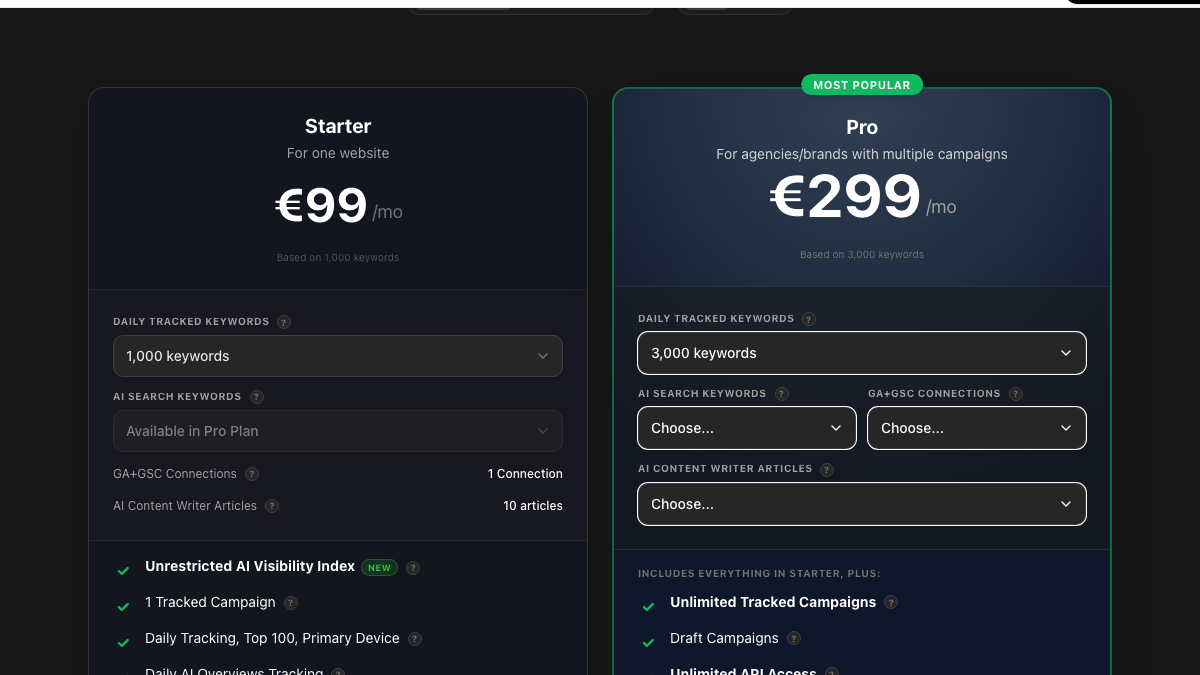
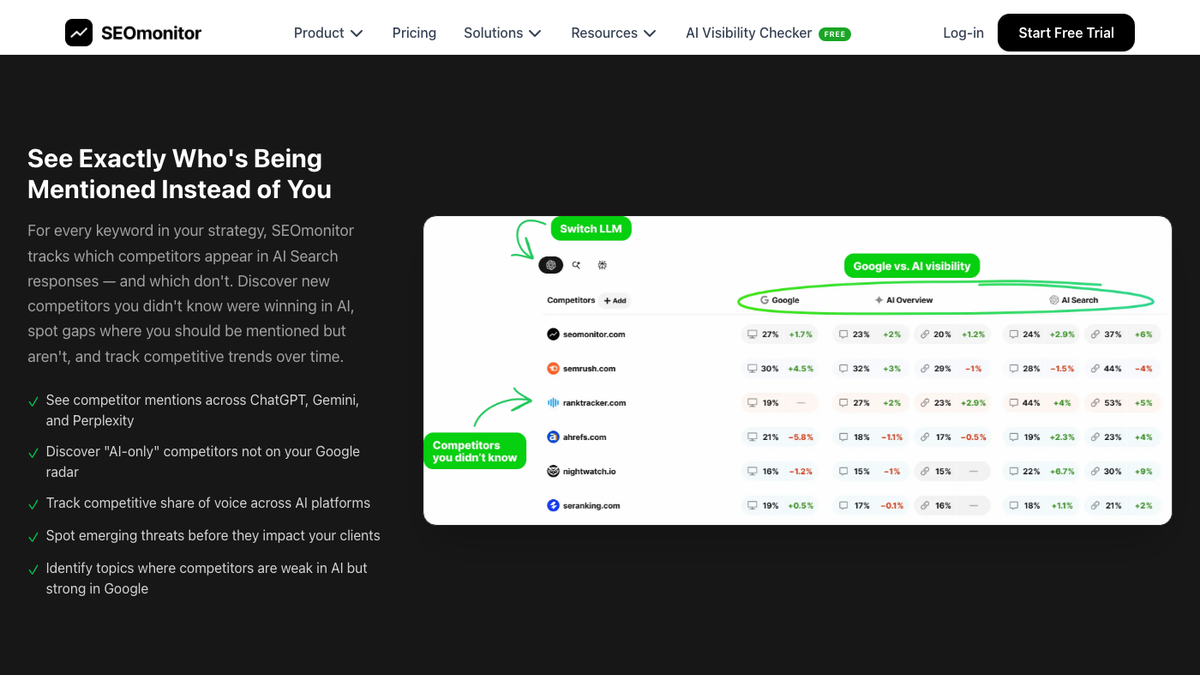
SEOmonitor covers four AI surfaces. Google AI Overviews are tracked daily on every plan, with mentions and citations reported separately. ChatGPT, Gemini and Perplexity need the Pro plan plus the AI Search add-on.
Three engines aren't on the list: Claude, Grok and Google's AI Mode. RankControl checks all three every week, along with ChatGPT, Perplexity and Gemini, on its one plan. Its weekly rankings check also records whether an AI Overview appeared and cited your page.
How each one reports an AI answer
SEOmonitor's AI Overview tracking separates two things: whether your brand is named, and whether your URL is listed as a source, along with its position among the sources. It stores a daily snapshot of each AI Overview and picks up competitors that appear in them automatically. For ChatGPT, Gemini and Perplexity, the same keywords get a weekly reading.
RankControl reports per query and per engine. For each of your 50 questions, you see which of the six engines cited you that week, which competitors were named instead, and which pages the engines quoted. RankControl's analytics add visits from AI crawlers and from people who clicked through from an AI answer, next to your Search Console data. So you can see whether a new citation sent anyone to your site.
Writing and publishing
Both tools now write. SEOmonitor's Content Writer runs from topic discovery to a brief, a draft in your writing style, a fact-check and publishing. It publishes to WordPress, HubSpot, Webflow, Shopify or a custom CMS through its API. Starter includes 10 articles, and a Writer-Only plan starts at €25 a month. Its own page reports that 80% of its articles rank for their target keywords, a company-reported figure.
RankControl's content engine plans titles from your buyers' questions and writes each article against the pages already ranking. It scores every article for how easily AI engines can quote it, with a fix list. Articles publish natively through the destination you connect, and auto-publish stays off until you turn it on. The plan covers 100 pages a month across 26 content formats.
The difference is what happens around the article. RankControl's Link Control finds prospects for each published article and drafts outreach from your own mailbox, and each article becomes drafts for eight social platforms. SEOmonitor doesn't list link building.
26 content formats. Published on your domain. Matched to your brand.
Guides, comparisons, listicles, case studies, and more. RankControl generates content that gets cited by ChatGPT, Perplexity, Claude, Gemini, Grok, and Google AI Mode.

Working from an AI assistant
Each tool has an MCP server now, but the two servers are built for different jobs. SEOmonitor's is a beta that comes with the Pro plan, and its FAQ is blunt about the limit: "it is read-only, so it cannot change anything in your account." From Claude you can ask it about rankings, AI Overviews or traffic. The public listing for that server shows 49 tools, and every one of them reads data.
RankControl's MCP server and CLI are part of the plan and carry 80+ tools. In one conversation you can ask how your AI visibility changed, have titles planned, then get an article written and published. Anything that would publish sits as a dry run until you confirm it.
Your first month with each
The two settle in differently, and this is a rough week-by-week view of the first month on each.
| Week | SEOmonitor | RankControl |
|---|---|---|
| 1 | Set up campaigns and keywords; daily ranks and AI Overview readings start | Setup reads your site; you correct the brand profile and add queries |
| 2 | Add the AI Search add-on on Pro; first weekly ChatGPT, Gemini and Perplexity readings | First titles planned; you approve them |
| 3 | Queue articles in Content Writer; review and publish | Articles publish; outreach drafts arrive |
| 4 | Forecasts and client reports built on the new data | Fourth weekly check on six engines |
By the end of week four, SEOmonitor has mostly given you data: rank tables and AI Overview snapshots, with forecasts built on them. RankControl's month ends in finished work, since articles and outreach go out from the second week.
Questions to ask before you choose
Most of this comes down to a few questions, and the one about engines can decide it by itself. If your buyers go to Claude, Grok or Google's AI Mode for recommendations, SEOmonitor won't show you those answers, and no add-on changes that.
Decide what counts as progress, too. A ranking is Google's view of one page, while a buyer's shortlist shows up when you put their questions to the AI engines. Negrescu's argument assumes the two move together, and they don't always.
Then there's the work. Who on your team will write the pages that change those answers, and who'll earn the links that point at them? If nobody has the hours, a tracker on its own won't shift a single answer.
As for the bill, SEOmonitor's is the plan plus the AI Search add-on plus any extra connections. RankControl's is the one plan.
What each one costs
SEOmonitor is modular, so the bill grows with the keywords you track and the add-ons you switch on. RankControl is one plan.
| SEOmonitor | RankControl | |
|---|---|---|
| Plans | Starter at €99 a month; Pro at €299 a month | One plan at $400 a month |
| Included | Starter: 1,000 daily keywords with AI Overview tracking and 10 Content Writer articles. Pro: 3,000 keywords | 100 pages a month, 50 tracked queries on six engines, five seats, publishing, social drafts and outreach drafts |
| Extra charges | AI Search tracking on Pro at €19 per 1,000 keywords; extra Google Analytics connections at €10 each | Managed links $350/mo |
| Paying yearly | 17% off | $4,000 a year |
On SEOmonitor, the AI engines beyond Google are where the cost climbs, because they need Pro and a per-keyword add-on. Used in full, RankControl's plan comes to $4 a page with the tracking included.
| What you need | SEOmonitor | RankControl |
|---|---|---|
| Google AI Overview tracking | Included from €99/mo | Included |
| ChatGPT, Gemini, Perplexity | Pro €299/mo plus €19 per 1,000 keywords | Included |
| Claude, Grok, Google AI Mode | Not offered | Included |
| Articles written and published | 10 on Starter; more on Pro | 100 pages/mo |
| Link outreach | Not offered | Included; managed links $350/mo |
What people say
SEOmonitor displays a 4.8 out of 5 G2 badge on its own site. Capterra's picture is thinner and older, at 4.5 out of 5 across eight reviews. All of them date from 2023, before the AI features launched, and what those reviewers praise is the daily rank tracking and the forecasting.
We found no Reddit or X threads from the past year that discuss SEOmonitor by name. That's less odd than it sounds for a tool with a long agency history, since most of that conversation happens in agency circles, away from public forums.
Which wins AI search visibility?
For AI search visibility, the verdict is RankControl.
SEOmonitor is a rank tracker first, and its AI tracking follows your Google keywords. It reads four AI surfaces, needs the Pro plan and an add-on for three of them, and skips Claude, Grok and AI Mode. Its content writer publishes, but it doesn't build links.
RankControl is built around AI answers. It tracks the questions buyers ask on all six engines, plans and writes the articles that answer them, publishes on your domain and drafts the outreach. In the first month you get a calendar of titles, articles going live on your schedule and four weekly readings of where you stand.
You can run the loop yourself: write the pages, publish them, pitch the links and check six engines every week. Or RankControl's agents can run it every month while you focus on your product. Already on SEOmonitor? Our guide to switching from SEOmonitor covers what to export inside the 30-day window.
Want a baseline first? Run a free check of your brand in AI answers.

Your competitors are getting cited by AI. You're not.
Every day without citation tracking is a day your competitors pull ahead in ChatGPT, Perplexity, and Claude.