
Wellows' homepage opens with a line most AI search teams will recognize: "Ask AI about your category and a competitor comes back. Not you." Of all the tools in this comparison series, Wellows comes closest to RankControl's job. It tracks citations daily, finds the pages you should write, drafts them with a writing agent, and finds contacts at the sites that already get cited.
So this comparison comes down to the last steps and the fine print: who publishes the page, and what the engine list and the price look like for the questions you care about. Wellows' homepage, pricing page and feature pages were checked on September 26, 2026.
RankControl vs Wellows: the short answer
Wellows is a citation tracker with production tools attached. It measures where you're cited on five engines every day, ranks the gaps, drafts pages in its editor and hands you outreach contacts. You pay for a monthly balance of AI answers.
RankControl is a publishing pipeline. We plan articles from the questions your buyers ask, then write and publish them on your own site. After that we draft outreach from your mailbox and check 50 questions every week on seven engines, all for one flat $400 a month. For AI search visibility the difference is the last mile, since with RankControl the page ends up live rather than in an editor.
Side by side
| RankControl | Wellows | |
|---|---|---|
| What it is | Publishing pipeline with AI tracking | Daily citation tracker with drafting and outreach tools |
| Price | $400/mo or $4,000/yr, flat | $29 to $497/mo for a balance of 1,800 to 36,000 AI answers |
| Trial | 7 days | 7 days |
| AI engines | 7, weekly: ChatGPT, Perplexity, Claude, Gemini, Grok, Google AI Mode, Google AI Overviews | 5, daily: ChatGPT, Gemini, Perplexity, AI Overviews, AI Mode |
| Questions tracked | 50 buyer questions | Unlimited prompts, limited by the answer balance |
| Content | Articles written and published to your CMS, up to 100 pages a month | KIVA drafts pages in an editor; WordPress integration |
| Outreach | Prospects found for each published article, emails drafted from your mailbox | Pages citing competitors, verified contacts, templates or export |
| Projects | One brand, five seats | Unlimited projects on one balance, white-label dashboards |
| Done-for-you | Managed Backlinks at $350/mo | Managed service after a scoping call |
Know exactly what AI says about your competitors.
RankControl's Recon Agent monitors competitor citations across ChatGPT, Perplexity, Claude, Gemini, Grok, Google AI Mode, and Google AI Overviews. See where they show up and you don't.

What Wellows is in 2026
Wellows calls itself "the result crafter for AI search," and its product is built around one metric, the Citation Score. It runs two checks on every answer. An explicit citation is when the engine names your brand, and an implicit one is when your domain appears inside the pages it cites without your name in the answer. Wellows says it collects this from the engines' user interfaces rather than their APIs, and snapshots it every 24 hours.
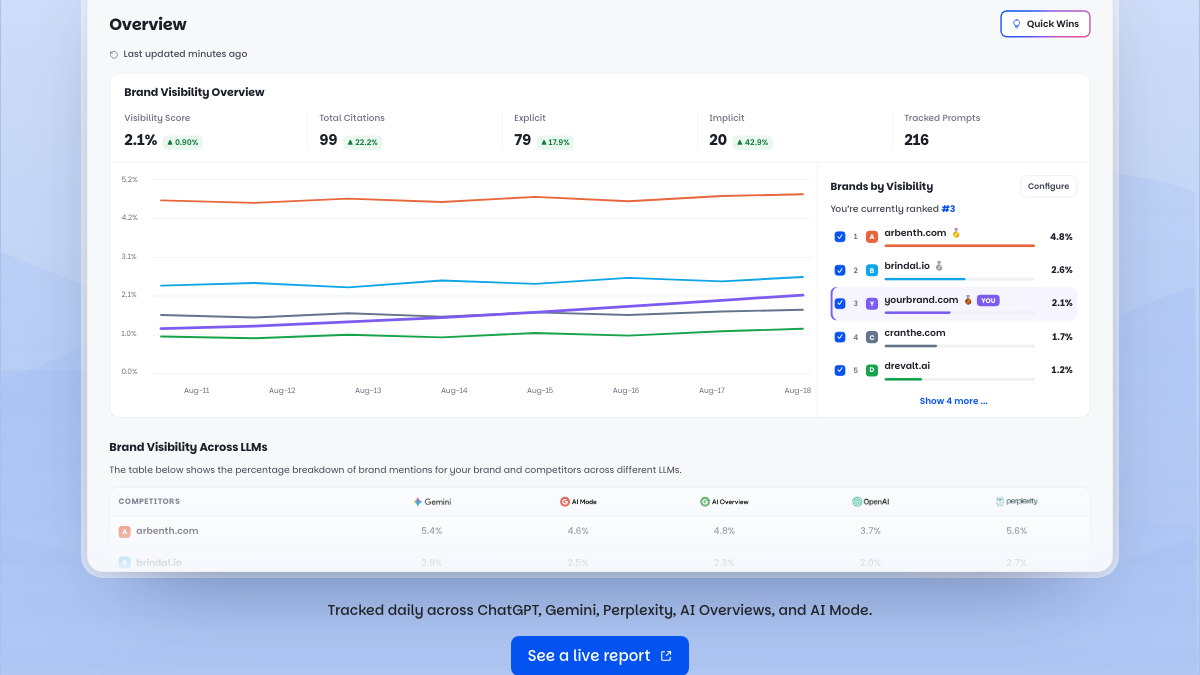
Around that metric sit the tools that act on it. Content Opportunities ranks pages you haven't written, and KIVA drafts them against your Search Console data. Outreach lists third-party pages that cite competitors along with verified contacts. For teams that want the work done, Wellows also sells a managed service, month to month with 30 days' notice, priced after a scoping call.
The homepage backs this up with case studies, such as a recruitment platform whose Citation Score rose from 3.8% to 21.6% in 68 days. Those are worth reading with one caveat in mind: each one is measured on Wellows' own metric, over a prompt set the customer chose, so the numbers show movement inside Wellows rather than a figure you can compare across tools.
Wellows also does something RankControl doesn't. It tracks every prompt daily, runs unlimited projects on one balance and gives agencies white-label dashboards per client, while RankControl checks one brand's questions once a week.
A balance of answers or a flat plan
Wellows prices by the answer. One prompt, asked on one engine, on one day, spends one answer from your monthly balance, and every plan includes all five engines.
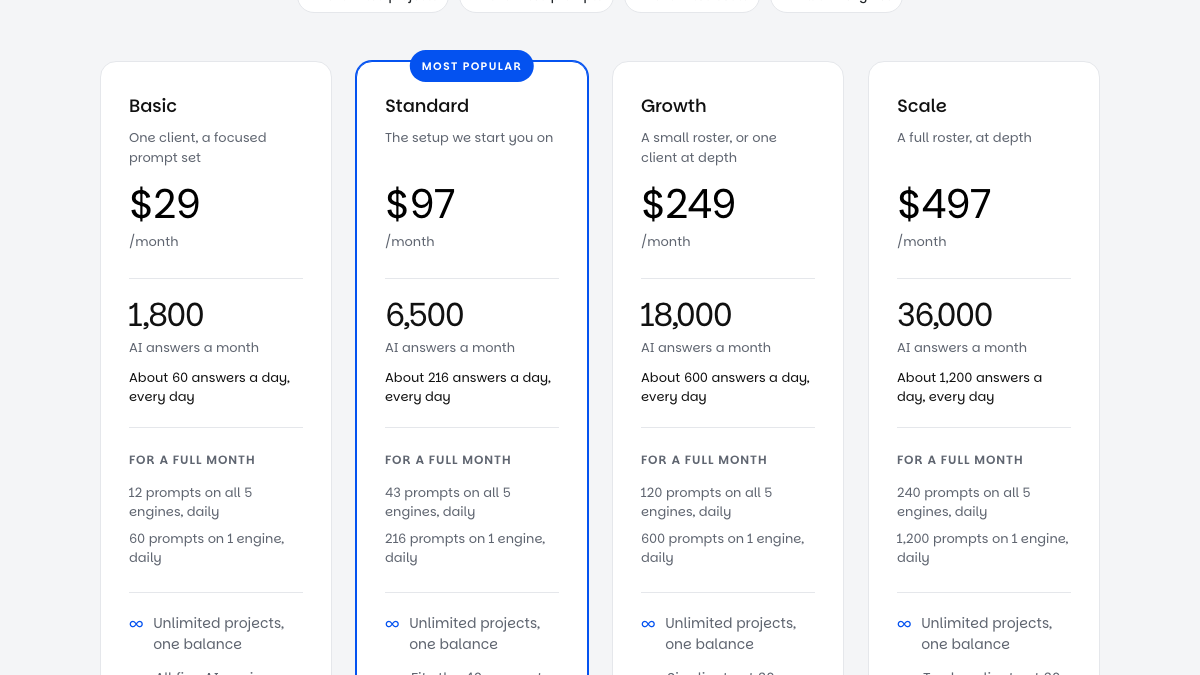
The math is worth doing for your own list. Fifty prompts on five engines every day spends about 7,500 answers a month, which is more than Standard's 6,500 and lands you on Growth at $249. The same 50 prompts checked weekly spend about 1,075, which fits inside Basic at $29. Wellows' own FAQ says weekly costs roughly a seventh of daily, and it's candid that unused answers don't roll over and that collection pauses if the balance runs out mid-month.
Call it the cadence tax: the part of the bill that pays for checking the same questions more often. RankControl doesn't meter checks at all. Our $400 covers 50 questions weekly on seven engines plus up to 100 published pages, so the money goes to the work that changes the answers rather than to measuring them more often.
Cited, named, or both
Wellows' explicit and implicit split points at a real problem. Being a cited source doesn't mean the answer names you. An SEO consultant made the same point in r/SEO_for_AI this month: businesses focus so much on citations that they forget about visibility, and the goal should be to be the answer itself as well as its source.
*Cited but not mentioned*
Businesses focus so much on citations that they forget about actual visibility. If you are cited but not mentioned, I'd look at two things here: A lack of LLM consensus (only you are saying that your business is solving those problems, and...
One reply in that thread added a practical detail. Engines cite a page for one passage, and the brand gets named only if the name sits inside that passage.
That's an argument for owning the page. A page on your own domain, written to answer the buyer's exact question in your brand's voice, is the kind of source where your name and the answer sit together. RankControl's content engine writes those pages from your tracked questions, and AI visibility tracking checks each question weekly on seven engines, keeping a citation history per engine with the sources the answers used.
Who publishes the page, and who sends the email
Wellows' content creation page describes building a brief from AI queries, social discussion and People Also Ask data, then generating and editing the draft "before publishing." The integration list covers Search Console and WordPress, so a WordPress team can move drafts across and everyone else copies them into their CMS.
RankControl publishes. Each article goes out as a native post through the CMS you connect, whether that's WordPress, Webflow, Shopify, Ghost or a headless site, and auto-publish stays off until you turn it on.
Outreach follows the same split. Wellows surfaces the pages citing competitors, finds verified contacts and gives you templates, or lets you export the contacts to run the campaign in another tool. A marketer in r/AskMarketing described doing that step by hand: pasting cited URLs into a sheet, resolving each author and guessing who is worth contacting.
How are you turning AI answer citations into an outreach list?
RankControl's Link Control runs that loop for each article we publish. Link Control finds prospects and drafts personalized emails and follow-ups from your own mailbox. If you'd rather hand links off entirely, Managed Backlinks places five a month from DR 25+ sites for $350.
26 content formats. Published on your domain. Matched to your brand.
Guides, comparisons, listicles, case studies, and more. RankControl generates content that gets cited by ChatGPT, Perplexity, Claude, Gemini, Grok, Google AI Mode, and Google AI Overviews.

Which engines, and why it matters
Wellows published the strongest argument for checking engines separately. Its study of 22.7 million citations from January to June 2026 found that Perplexity never cited 89.1% of the sites ChatGPT cited for the same questions, and that only 0.31% of sources appeared on all five engines it tracks.
The study has one limit worth noticing: it only covers the five engines Wellows tracks, so it says nothing about Claude or Grok. If the engines disagree that much among themselves, the two it leaves out are unlikely to match them either.
RankControl's seven engines include Claude and Grok, which Wellows leaves out. For a B2B brand whose buyers use Claude, or a consumer brand whose audience lives on X, that's the difference between seeing a channel and not.
Reporting and working from Claude
Wellows' reporting is built for agencies: white-label client dashboards, per-project reports, date-to-date comparisons with a prompt-level citation diff, and exports by project and date range. An API with project-level keys pushes data into other tools.
RankControl's Reports screen puts citations, rankings and Search Console data side by side, and a weekly email lists new citations and ranking gains. Our MCP server has 80+ tools, so you can ask Claude, ChatGPT or Cursor which engines cited you this week, plan the next titles and publish, with publishing held as a dry run until you confirm.
The same month, priced both ways
Wellows' pricing page says every plan ships the whole product, content work and outreach included, so the plan you need depends on how often you check. Here's a month of AI search work for one brand tracking 50 questions:
| Job | With Wellows | With RankControl |
|---|---|---|
| Tracking 50 questions | Growth at $249 for daily checks on five engines, or Basic at $29 for weekly | Included, weekly on seven engines |
| Drafting 20 articles | KIVA, included | Included |
| Publishing 20 articles | Your team, about 20 hours | Included, as native posts |
| Outreach | Contacts and templates; your team sends | Drafted from your own mailbox |
| Monthly cost | $29 to $249, plus your team's hours | $400 |
Read the first row carefully. The cheapest Wellows plan that tracks 50 questions weekly costs $29, and the daily version costs more than eight times as much for the same questions. The bigger cost in both columns is the publishing row, since that's where the hours go.
A month on each, week by week
On Wellows, the day starts with Quick Wins, which the homepage describes as "one card each morning": the page to write today and the outreach to send today. You open the opportunity, build the brief in KIVA, generate and edit the draft, then move it to WordPress or paste it into your CMS. For outreach, you pick a template, personalize it and send it from your own tool, and the next morning's snapshot shows whether anything moved.
On RankControl, titles for the month land on a calendar for you to approve, drawn from your tracked questions. Articles arrive for review ahead of their dates and publish as native posts once approved. Outreach drafts appear for each published article, and the weekly check on seven engines shows which questions started citing which pages.
The hours land in different places. Moving a finished draft into a CMS, adding images and internal links, and publishing it takes about an hour a post, so 20 posts a month is 20 hours before anyone writes an outreach email. Those are rough estimates, and they're the hours a drafting tool leaves with your team.
Moving from Wellows
Wellows documents both an export and an API, so most of your history can come with you. Our guide to switching from Wellows covers exporting citation history by date range, saving your prompts and content opportunities, and cancelling before the balance resets.
Which wins AI search visibility?
Wellows stops a step short of a published page. Publishing on your site and running the outreach still land on your team or on its managed service.
RankControl wins for teams that want those last steps done. We publish the pages that answer your buyers' questions and run outreach from your own mailbox. Then we check seven engines every week, Claude and Grok included, for one flat price with no answers to budget.
You can keep turning Wellows' opportunities into pages by hand. Or RankControl's agents can run the month for you while your team approves what goes live.

Your competitors are getting cited by AI. You're not.
Every day without citation tracking is a day your competitors pull ahead in ChatGPT, Perplexity, and Claude.