Dageno is an AI search data platform, so RankControl vs Dageno is a choice between deep research and a pipeline that does the work. Dageno tracks your prompts every day across nine AI engines and adds market research on demand, competitors, shopping and ads, from $49 a month. RankControl's agents plan, write, publish and pitch on one $400 plan, and check six engines every week.
Both want your brand named when buyers ask AI. Dageno shows you the market in detail, and RankControl changes your place in it.
Everything below about Dageno comes from its own pricing page, product docs, terms and refund policy. I read them on September 27, 2026. If you're already leaving, our Dageno switch guide covers the exports and the cancellation terms.
RankControl vs Dageno at a glance
| RankControl | Dageno | |
|---|---|---|
| Price | $400/mo or $4,000/yr | $49, $199 or $410/mo; about 15% off yearly |
| AI engines | 6: ChatGPT, Perplexity, Claude, Gemini, Grok, AI Mode | 9: ChatGPT, Grok, Gemini, Perplexity, AI Mode, AI Overviews, Copilot, Brave, Dola |
| Cadence | Weekly | Daily |
| Tracked questions | 50 | 50, 250 or 600 prompts, counted per engine and region |
| Content | Up to 100 articles a month, written and published | Content Writer agent drafts; you publish |
| Outreach | From your mailbox after approval | Backlink opportunity lists; no sending |
| Market research | None | Market Intelligence: demand, segments, shopping, ads |
| MCP / API | 80+ MCP tools | MCP from Growth; API and exports on Scale |
| Trial | 7 days, card up front, $0 today | 7 days on Starter |
What Dageno is in 2026
Dageno is run by DINGX LLC, and its terms are governed by Delaware law. Its about page says the team started as a data and engineering shop that supplied data to other GEO and SEO tools. Its founder posts on X as Tim. In April, Tim wrote that Dageno officially launched on March 28, 2026, and it finished fourth on Product Hunt that month. The same post says the team has built data software since 2020 and has supplied GEO and SEO tools with data since 2024.
The product has two layers. Dageno Visibility follows one brand. It covers mentions, positions and sentiment, plus the sources each answer cites. It also shows gaps against competitors and AI crawler visits from your server logs. Dageno Market Intelligence looks at a whole category instead. It maps demand, buyer intent and market segments, along with shopping results and ads inside AI answers. The pricing page claims data on 12,000+ market segments across 86+ countries and regions.
The first week on each tool
Dageno's Starter plan comes with a 7-day free trial. You enter your website, pick regions, languages and AI engines, and confirm the prompts it suggests from your brand profile. Its docs say the first report arrives within 15 to 20 minutes, and prompts join a daily tracking cycle. You can also upload prompts in bulk from a CSV file.
RankControl's trial runs 7 days, with the card up front and $0 charged today. Setup reads your site and drafts your brand profile, products, buyers and competitors for you to correct. You connect a CMS, add up to 50 questions and 10 competitors, and the first weekly check runs across six engines. Meanwhile the planner builds a calendar from the questions you're losing, and the first articles start drafting that week.
26 content formats. Published on your domain. Matched to your brand.
Guides, comparisons, listicles, case studies, and more. RankControl generates content that gets cited by ChatGPT, Perplexity, Claude, Gemini, Grok, and Google AI Mode.

RankControl vs Dageno on AI visibility
On raw measurement, Dageno collects more. It runs every prompt daily, covers nine engines including Copilot, Google AI Overviews and Brave, and can split results across more than 86 countries and regions. Each finding links back to the original answer and the pages it cited.
Claude is the notable gap. It isn't among the nine engines on Dageno's pricing page, though an older FAQ page on its site lists it. RankControl includes Claude in its weekly checks and shows which sources each answer quoted. It doesn't cover AI Overviews, Copilot or Brave.
Daily runs matter because AI answers vary from one run to the next. Milton Resendes, who runs a B2B agency, put it this way in July: most AI visibility dashboards are "rank trackers wearing a costume." A single run is a coin flip, so a useful tool samples often and reports a rate, per engine. Dageno's daily cadence gives it more samples per prompt than a weekly check.
Hot take: most "AI visibility" dashboards are rank trackers wearing a costume. LLMs sample. Ask the same question 5 times, get 5 different answers, with different sources, different brands, different order. The web behind an AI answer rotates constantly. So when a tool runs
 Milton Resendes@milton_resendesJul 24, 2026
The prompt divisor
I call it the prompt divisor: the number you divide a tracker's prompt limit by once each engine and region counts on its own. Dageno's pricing FAQ is clear about the rule. "Monitoring the same prompt across different AI platforms / models and countries / regions counts separately toward usage."
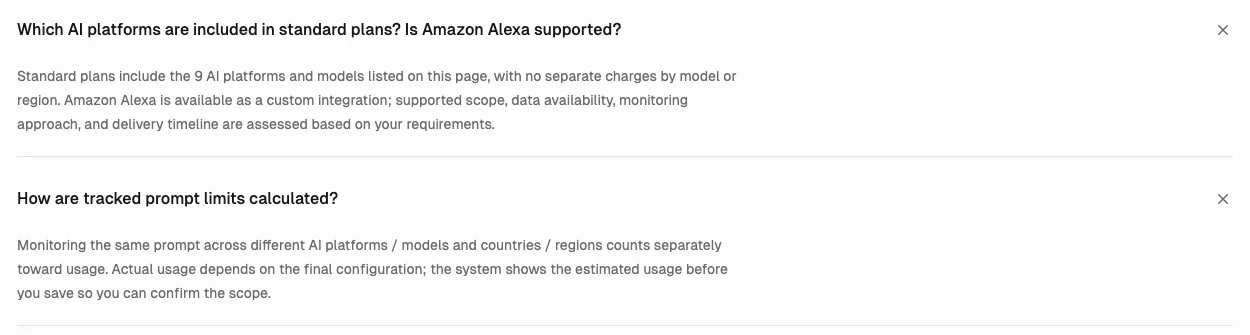
So Starter's 50 tracked prompts, watched on all nine engines in one country, cover five questions. Growth's 250 cover 27, and Scale's 600 cover 66. Add a second country and each figure roughly halves. The app shows the estimated usage before you save, which helps.
Tracking 50 questions on the five engines both tools share takes 250 slots. That's Dageno's Growth plan at $199. That buys daily checks rather than weekly ones, so it's a lot of data for the money. What it doesn't buy is anything written, published or pitched.
Choosing which questions fill those slots is the harder part. In r/aeo this June, someone asked how teams pick prompts to track. The replies suggested long, conversational Search Console queries, adding buying context such as budget or team size, and keeping the set stable for weeks so trends mean something.
How do you choose prompts to track if you're getting mentioned?
Hey guys, not sure if this is a topic you've covered in the subreddit, but I've been wondering, what are some practices that you use to select prompts to track? I am specifically thinking about some practices that I might be missing. For ex...
Content and publishing
Dageno does write. Its Content Writer agent turns a content opportunity into an article, brief or FAQ draft, using the brand materials, product notes and past articles you upload. Other agents summarize your gaps, mine high-demand prompts and audit your site. Each task keeps its own history, so you can come back and revise.
Publishing is where the two tools part. Dageno's pricing FAQ says its MCP and API connect data to your workflows, but "neither automatically modifies websites, publishes content, or performs optimizations." That's a deliberate choice. In April, Tim posted that the new Content Writer builds an evidence pack, shapes a brief and audits its own draft in three to five minutes. Another post that day explained where Dageno stops. Tim wrote that automation has become cheap, and users "do not need another standalone automation tool," naming article writing and content publishing.
I’d like to share a quick update and continue introducing https://t.co/Q3v50NGBee, officially launched on March 28, 2026. While our team has focused on SaaS development from Since 2020, with deep expertise in data and automation. We have built multiple successful data
 Tim@tim_geo_seoApr 30, 2026
RankControl takes the opposite view. Its content engine plans titles from the questions you're losing, researches the pages already ranking and writes articles across 26 content types, with images and internal links. It publishes up to 100 a month as native posts through one of nine destinations. Auto-publish stays off until you turn it on, so you can read every article first.

Your competitors are getting cited by AI. You're not.
Every day without citation tracking is a day your competitors pull ahead in ChatGPT, Perplexity, and Claude.
Links and outreach
Dageno's opportunities page lists backlink targets: domains AI engines cite often that don't yet link to you. It also flags social posts that AI cites without mentioning you, and its managed service includes third-party source and Reddit community work. On the self-serve plans, the asking stays with you.
That asking is what moves visibility, according to most people doing the work. In r/DigitalMarketing in September, an agency asked what moves AI visibility week to week. One reply said most of its citations traced back to other people's listicles and Reddit threads, not its own pages. Another said the fastest route onto those lists is plain outreach.
What are you actually doing to increase AI visibility?
We've been tracking AI visibility across ChatGPT, Google AI Overviews, Gemini, etc. for several months and have seen some pretty significant improvements across a number of client sites. But we're curious what other SEOs are actually doing...
Link Control in RankControl finds prospects and contacts for each published article and sends the pitch from your own mailbox once you approve it. Follow-ups stop when someone replies. Managed Backlinks adds five links a month from DR 25+ sites for $350.
Market research, shopping and ads
Dageno measures a lot that RankControl doesn't. Market Intelligence maps demand, buyer intent and competitive sets across a category, with benchmarks by engine and region. Growth adds AI Shopping data, showing which products appear in shopping answers, and Scale adds AI Advertising data. Prompt Volumes estimates which questions carry real demand, and BotSight reads AI crawler activity from server or CDN logs.
For a brand entering a new market, an ecommerce team or an agency pitching clients, that research is useful, and RankControl doesn't offer it.
Agencies
Dageno's Scale plan covers five brands with cross-brand comparison, batch setup and monthly market reports. Its partner program covers agencies, white label and client referrals, and a managed GEO service puts its own team on diagnosis, content planning and third-party sources.
RankControl runs one workspace per plan with five seats. For an agency tracking several client brands, Dageno's structure fits better.
Price
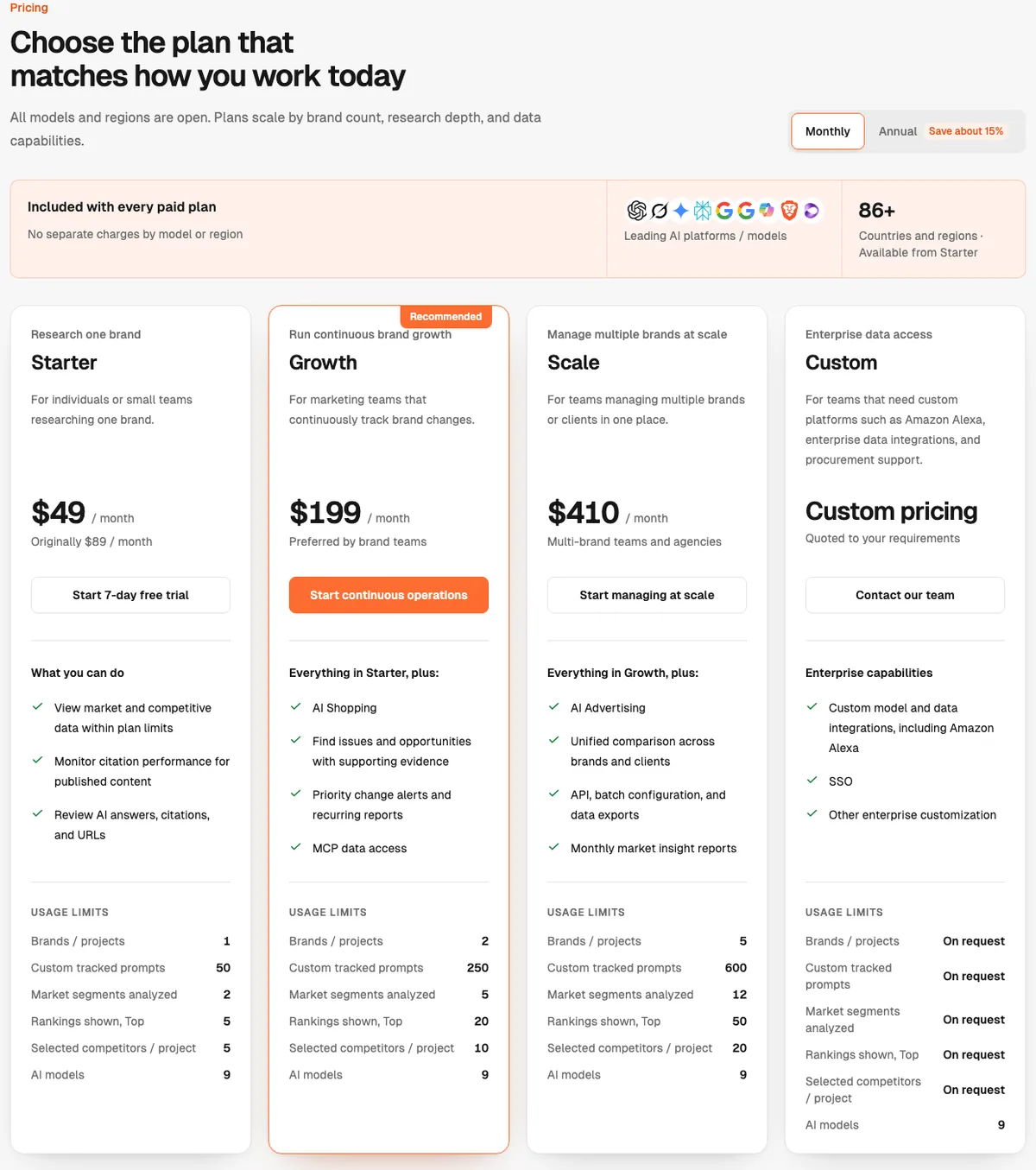
Dageno's Starter plan costs $49 a month, marked down from $89, with a 7-day free trial. Growth costs $199 and Scale $410, and yearly billing saves about 15%. Every plan includes all nine engines and 86+ regions with no per-engine charge; the limits are on brands, prompts, market segments and competitors. Custom plans add Amazon Alexa, SSO and other integrations. Starter shows only the top five brands in its rankings and allows five competitors, against 20 and 10 on Growth.
RankControl costs $400 a month or $4,000 a year, with tracking, up to 100 published articles, outreach and five seats in one plan.
Working from Claude
Dageno's MCP data access starts on Growth, so you can query its data from Claude or other AI tools. The API, batch setup and data exports start on Scale. RankControl's MCP server has 80+ tools covering tracking, planning, writing and publishing, and publishing through it stays a dry run until you confirm.
Contracts and cancelling
Dageno bills in advance in US dollars through Stripe and renews automatically. Its refund policy says you can cancel at any time, from Settings, then Subscription, or by email. Cancelling takes effect at the end of the billing period, and your data is kept for 30 days afterwards. Renewals, partial months and "promotional pricing, discounted plans, or special offer subscriptions" aren't refunded, which would seem to cover Starter's marked-down price.
Price changes need 30 days' written notice and apply at your next renewal.
Two clauses read oddly for a tool built around competitors. The terms bar using the service "for competitive analysis without permission," and bar monitoring competitors "without their consent (unless permitted by law)." Disputes go to binding arbitration in Delaware, with no class actions. If any of that matters to your team, ask Dageno how it applies before you sign.
RankControl's trial runs 7 days with nothing charged today. Cancelling takes effect at the end of the billing period, with no pro-rated refunds, and your articles stay in your CMS.
RankControl vs Dageno: which wins AI search visibility?
For AI search visibility, RankControl wins because it spends your budget on the work that changes answers. It publishes up to 100 articles a month on your own site and pitches the sites AI engines already cite from your mailbox. Every week it shows which answers named you across six engines, Claude included.
Dageno is the better research tool if understanding the market is the job. It checks daily, covers nine engines and many regions, and adds demand, shopping and ad data from $49. But research shows where the gaps are, and closing them still takes pages and mentions. For how the two kinds of tool fit together, see our guide to SEO platforms vs AI visibility trackers.
You can run that loop by hand, or RankControl's agents can run it for you, starting with a 7-day free trial. Before you decide, the free AI visibility check shows who ChatGPT cites for three questions from your market today.
200+ SaaS teams already track their AI citations.
They know exactly when ChatGPT mentions their brand, and when it stops. Do you?