
Profound's homepage now plays a demo that says a lot about where the category went this year. An AI marketer rewrites nine pages that are losing citations, stages every one as a draft in the CMS, and waits for a colleague to review the copy before anything goes live. One of the best-known names in AI visibility doesn't sell itself as a dashboard anymore.
That changes the RankControl vs Profound question. Both now plan content, write it, and push it to your site, and both track what AI engines say afterwards. The real differences are in which engines each one covers, how the content work is paid for, and who each product is sized to serve. Profound's pages were checked on September 26, 2026.
RankControl vs Profound: the short answer
Profound is an enterprise AI marketing platform. Answer Engine Insights tracks prompts daily across up to nine answer engines, and Prompt Volumes shows what people ask AI tools. An AI Marketer with credit-based Agents researches, drafts and publishes approved content to your CMS. Brands buy it through an Enterprise quote after a free seven-day trial.
RankControl is a pipeline for AI search visibility on one flat plan. We plan articles from the questions your buyers search and write them in your brand's voice. Then we publish them as native posts on your site, draft backlink outreach from your mailbox, and check 50 queries every week across seven AI engines. The plan costs $400 a month, with up to 100 pages included.
So which wins AI search visibility? RankControl, for teams that want the whole loop run for a price they can see today. We publish more content per dollar than a credit budget usually allows, we track Grok, and a team can start the same afternoon without a sales call.
Side by side
The specifics sit in the table. The sections below explain which rows change the outcome.
| Profound | RankControl | |
|---|---|---|
| What it is | Enterprise AI marketing platform with AEO tracking and agents | Pipeline for AI search visibility and Google rankings |
| Price for brands | Free 7-day Trial, then custom Enterprise pricing | $400/mo or $4,000/yr, one plan |
| Content production | Agents that draft and publish approved content, billed in credits | Up to 100 pages a month, included |
| AI engines tracked | Up to 9 on Enterprise; 3 on the Trial | 7 |
| Grok | Not listed | Tracked |
| Tracking cadence | Daily | Weekly, 50 queries |
| Prompt-volume data | Prompt Volumes | Not offered |
| Publishing | Agents publish approved content to your CMS | Native posts on WordPress, Webflow, Shopify, Ghost, Notion, Wix, Framer or a headless site |
| Backlink outreach | Not listed on its pricing page | Drafted from your own mailbox, included |
| AI crawler analytics | Agent Analytics through CDN and host integrations | AI crawler log for pages RankControl publishes |
| Exports | CSV, JSON and API on Enterprise; none on the Trial | API, CLI and MCP server, included |
| Seats | Unlimited | 5 |
| Claude integration | Official Claude connector | MCP server for Claude, Cursor and Codex |
Know exactly what AI says about your competitors.
RankControl's Recon Agent monitors competitor citations across ChatGPT, Perplexity, Claude, Gemini, Grok, Google AI Mode, and Google AI Overviews. See where they show up and you don't.

What Profound is in 2026
Profound started as an AI visibility tracker, and tracking is still its core. Answer Engine Insights measures visibility, sentiment and citations per prompt, and a FactCheck tab lists what AI engines get wrong about your brand along with the sources behind each claim. In July it became an official Claude connector, so a team can query that data from a Claude chat.
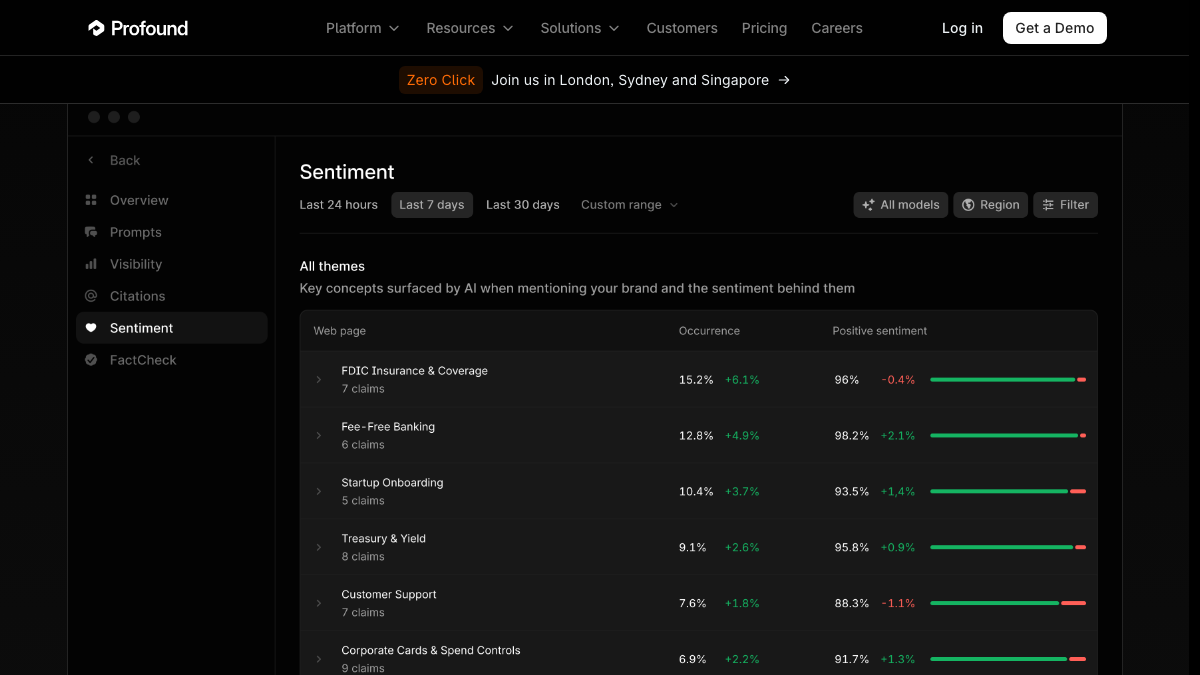
Around the tracking, Profound built a marketing layer. The AI Marketer suggests work, such as a comparison page for a rising prompt, and hands it to Agents. Agents are no-code workflows that research, write and publish, and Profound says every run includes an approval step before anything goes live. Context Manager holds the brand kits and knowledge bases the Agents draw on.
Profound has the deeper data. Its Enterprise tier checks prompts every day across up to nine engines, and Prompt Volumes estimates how often people ask AI tools about a topic, which RankControl doesn't offer.
Which engines each one tracks
Engine coverage looks lopsided on paper, and the details are more even. Six engines appear on both lists, including ChatGPT, Claude, Google AI Mode and Google AI Overviews. Profound adds Copilot, DeepSeek and Exa Search, and RankControl adds Grok.
RankControl also tracks AI Overviews from the rankings side. For every tracked keyword, our Google rank check records whether an AI Overview appeared and whether your page was one of the sources. The Rankings tab shows that result right next to your Google position.
The gap that matters for some buyers is Grok, which isn't on Profound's list. Grok leans heavily on user-generated platforms: in Ahrefs' June 2026 study of 1.9 million queries, Reddit, YouTube and Facebook were its three most-cited sites. If your buyers live on X or in consumer communities, that's an engine worth watching.
The Trial is narrower still. Profound's free week covers ChatGPT, Gemini and AI Overviews, runs a recommended prompt set you can't edit, and lists no exports or history. RankControl's 7-day trial runs on the same plan you'd pay for, with your own 50 queries.
Daily checks against weekly checks
Profound checks every tracked prompt daily, and RankControl checks your 50 queries once a week. Daily data shows more movement, and much of that movement is noise. Ahrefs found that a Google AI Overview persists for about two days on average. Each time it regenerates, close to half its citations swap, while the meaning of the answer stays nearly the same.
For a team deciding what to publish next, the useful signal is the trend on a fixed set of questions. It shows which ones you've started winning, which a competitor still owns, and which ones slipped. A weekly check on the same 50 queries shows that without asking anyone to read a daily chart. RankControl sends a notification when a new citation lands, and a lost one shows in the dashboard's citation history.
Who does the work, and how it's paid for
Both products can now take a buyer question and end with a published page. The difference is the meter.
Profound's Agents run on credits. Its pricing FAQ says each run consumes credits relative to its complexity, so multi-step agents cost more, and larger credit packages require an Enterprise deal. When a team runs out, the account is set either to bill overage or to pause. That makes the monthly cost of content hard to forecast, especially for a small team.
RankControl includes up to 100 pages a month in the $400 plan. Our content engine plans titles from buyer questions and writes each article against the pages already ranking for its keyword. Every article gets a score for how easily AI engines can quote it, with a fix list. The article then goes out as a native post through the CMS you connect. Auto-publish is off by default, so you approve each article until you trust the output.
Count the hours the flat plan takes off a team. An editor-finished article runs two to three hours after the first draft, covering fact-checks, links, images and CMS formatting. Twenty a month is 40 to 60 hours. Those are estimates, but they show why the meter on the content side matters more than the meter on the tracking side.
26 content formats. Published on your domain. Matched to your brand.
Guides, comparisons, listicles, case studies, and more. RankControl generates content that gets cited by ChatGPT, Perplexity, Claude, Gemini, Grok, Google AI Mode, and Google AI Overviews.

RankControl vs Profound pricing
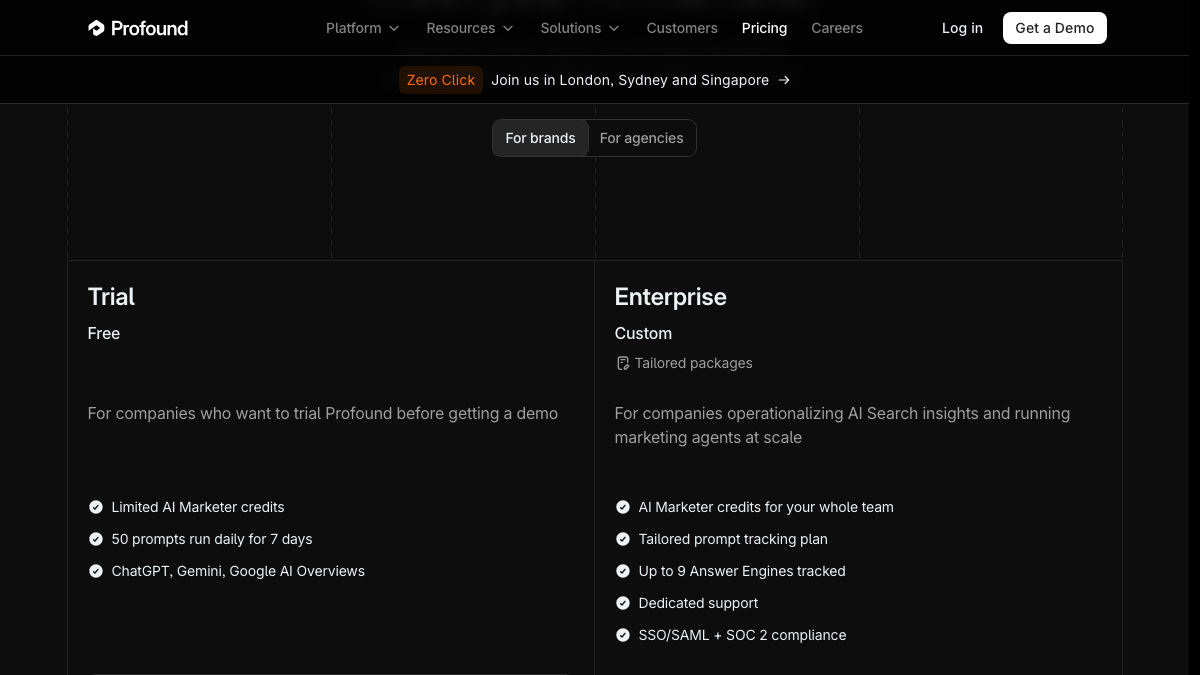
Profound's pricing page for brands has two options. The Trial is free for seven days with limited AI Marketer credits. Enterprise is custom, with tailored prompt tracking and credits for the whole team. It adds up to nine engines, SSO and dedicated support. For agencies, Profound lists client workspaces as an add-on at $399 a month each.
That agency figure is a useful yardstick. One Profound client workspace costs about the same as RankControl's entire plan. That plan covers 100 pages a month and 50 tracked queries on seven engines, with publishing, outreach drafting and five seats included. RankControl costs $400 a month or $4,000 a year, and two add-ons exist for teams that want people on top: a Dedicated Strategist at $1,500 a month and Managed Backlinks at $350.
| The job | Profound | RankControl |
|---|---|---|
| Tracking AI answers | Daily, up to 9 engines, Enterprise quote | Weekly, 50 queries on 7 engines, included |
| Writing and publishing content | Agents, billed in credits | Up to 100 pages a month, included |
| Backlink outreach | Not on the pricing page | Included; managed links are a $350/mo add-on |
| Trying it | 7 days, fixed prompts, 3 engines | 7 days on the full plan |
| Buying it | Demo and Enterprise quote | Checkout on the website |
What practitioners say about Profound
Most of the public discussion we found is about price against use. In an r/aeo thread started by a B2B SaaS user who liked the platform, one reply questioned whether the pricing made sense for prompt tracking. Another asked whether the ROI beat a cheaper tool with similar coverage. One agency that runs Profound for its clients said it doesn't lean on the prompt-volume numbers and prefers deploying hundreds of topic prompts to collect its own data.
On X this month, a user who moved off Profound said the dashboard had slowed down and they were digging through a lot of interface for the few numbers they used. None of these posts question the accuracy of Profound's data. They question how much of the platform a team uses for what it pays.
Getting started with each
Profound's pricing FAQ says setup is instant. The free Trial comes with a recommended prompt set based on your industry, which you can't edit, and moving to Enterprise goes through a demo and a quote.
RankControl starts from your website. A setup wizard scans your site to build the brand profile, you connect your CMS and pick your queries and competitors, and the 7-day trial runs on the plan you'd pay for. Connecting a CMS such as WordPress or Webflow means installing the plugin or pasting a site token, so most teams finish setup in an afternoon.
Links and mentions
AI engines weigh what other sites say about you, and earned mentions carry as much weight as your own pages when an engine builds a shortlist. Profound's AI Marketer can suggest tasks like pitching publishers, but its pricing page doesn't list an outreach feature.
RankControl's Backlinks finds prospects and contacts for each published article and drafts personalized outreach that goes out from your own mailbox. Follow-ups go only when nobody replies, and Managed Backlinks adds five links a month from DR 25+ sites if you'd rather not handle it.
Which wins AI search visibility?
For AI search visibility on your own site, RankControl wins for teams that want the work done at a price they can plan around. We publish up to 100 pages a month without a credit meter, track Grok and draft the outreach that earns mentions, and you start with a self-serve trial instead of a sales cycle. If your team is one to three people, our Profound comparison for small marketing teams works through the weekly hours as well as the price.
If you're on Profound now, our Profound migration guide covers the Export buttons in Answer Engine Insights, what dashboards and Context Manager can't export, and how to time the move. If you're still comparing tools, our Profound alternatives roundup looks at the wider field.
You can run the loop yourself with a tracker, a writer and a spreadsheet of prompts. Or RankControl's agents can run it every month, and your team can drive it from Claude through the MCP server if that's where you already work.

Your competitors are getting cited by AI. You're not.
Every day without citation tracking is a day your competitors pull ahead in ChatGPT, Perplexity, and Claude.