
At $399 a month, Search Atlas's Pro plan costs a dollar less than RankControl, and that's where the similarity ends. Pro buys 400,000 Universal Credits, four projects, five seats, 6,000 tracked keywords and AI tracking on five engines. RankControl buys one loop built for AI answers. So RankControl vs Search Atlas comes down to what you want $400 a month to do.
We call Search Atlas's pricing model the credit ledger. Most of the platform draws on one shared pool of Universal Credits, while press releases and paid link placements use a second currency, Hyperdrive Credits. RankControl has no credits, just 50 tracked queries and 100 pages a month.
Everything about Search Atlas below comes from its own pricing, product and help pages and its public MCP repository. I checked them on September 26, 2026.
RankControl vs Search Atlas at a glance
| Search Atlas | RankControl | |
|---|---|---|
| What it is | All-in-one SEO suite: technical fixes, content, links, local, ads and AI tracking | Plans, writes, publishes and tracks articles for AI search, plus outreach |
| Price on monthly billing | $99, $199 or $399/mo; Agency from $999 | $400/mo, or $4,000/yr |
| How usage is counted | Universal Credits (50,000 to 1M+) plus Hyperdrive Credits | 50 tracked queries, 100 pages a month |
| AI engines | Growth: ChatGPT, Gemini, AI Mode; Pro adds Copilot and Perplexity | ChatGPT, Perplexity, Claude, Gemini, Grok, Google AI Mode, Google AI Overviews |
| AI queries | 100 on Growth and Pro; none on Starter | 50, checked weekly |
| Content | Content Genius, 1-click WordPress publishing | Articles planned from AI gaps, published through 9 destinations |
| Technical fixes | OTTO, site-wide, through a pixel or DNS | Not offered |
| Links | Outreach, a paid placement marketplace and an exchange network | Outreach drafted for each article, from your mailbox |
| MCP server | 112 tools, including actions | 80+ tools, publishing as a dry run until you confirm |
| Trial | 7 days | 7 days, card up front |
What Search Atlas is
Search Atlas is the widest suite in this comparison, and it's grown quickly without much outside money. Its founder has written that it went from $2 million to $30 million in annual revenue profitably. It also won Best AI Search Software Solution at the 2025 Global Search Awards.
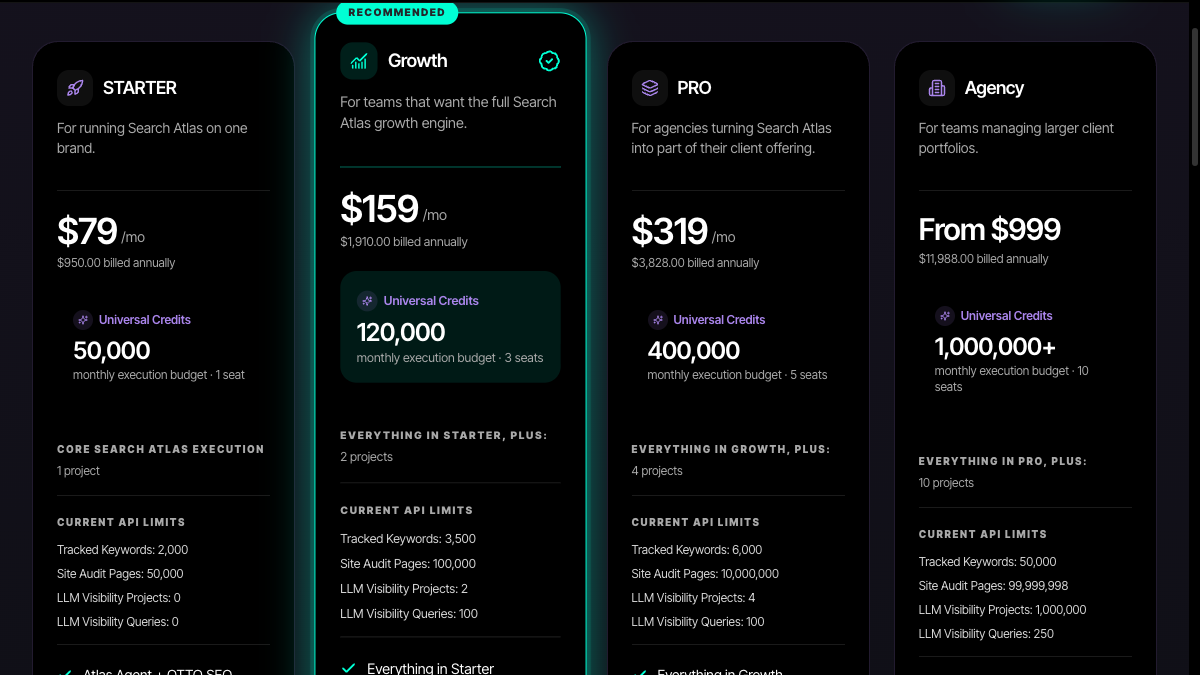
Under one login you get OTTO for technical fixes and Content Genius for articles, plus a rank tracker and site audits. Local SEO tools, an ad studio and several link products sit alongside LLM Visibility, its AI tracking. Starter is $99 a month with no AI tracking at all. Growth at $199 adds LLM Visibility, and Pro at $399 adds more engines, more projects and white-label dashboards.
Here's the one area where Search Atlas clearly does more. OTTO works across an entire site, fixing titles, schema and canonical tags as well as headings, alt text and internal links. The suite covers local SEO and paid ads too. RankControl doesn't touch pages you already have or run ads, so a team that needs those will want a technical tool as well.
15 hours a week manually. Or 15 minutes with RankControl.
Track citations, monitor competitors, and fix content gaps across every AI search engine. Automatically.

How each one tracks AI answers
Search Atlas's pricing table is the clearest statement of its engines. Growth tracks ChatGPT, Gemini and Google AI Mode across 100 queries, and Pro adds Copilot and Perplexity for five in total. Starter has none. Pro doesn't raise the query count, though. It stays at 100 while projects go from two to four, and only Agency lifts the cap, to 250 queries.
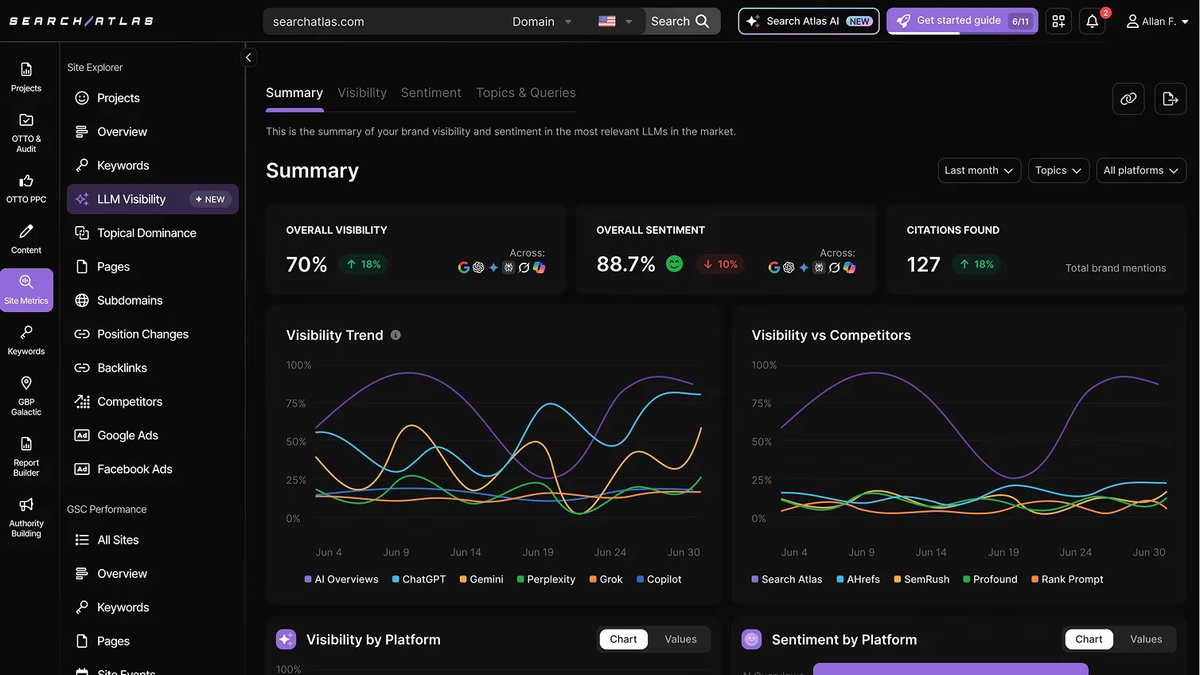
Other pages tell a different story. The product screenshot on the LLM Visibility page shows AI Overviews and Grok in its chart legend, and a Search Atlas blog post mentions Claude. I'd trust the pricing table, since it's the page you buy from, and ask sales before counting on Claude or Grok. The refresh cadence isn't stated anywhere I could find, and Search Atlas's own how-to post suggests checking the dashboards once a week.
The reports cover brand mentions, sentiment and share of voice. They also show where in an answer you're cited, first, last or skipped. Where it's strongest is alerts. Its Coworker agent posts citation gains and losses to Slack, Teams or ClickUp, and can apply a fix with an approval step.
RankControl's AI visibility tracking checks seven engines every week on one plan, Claude and Grok among them. Each answer keeps its cited pages, so you can see which source an engine picked instead of you.
The credit ledger
Search Atlas prices the suite in Universal Credits, from 50,000 a month on Starter to more than a million on Agency. Content Genius, audits and most other tools draw from that pool, and the pricing page doesn't break out a per-article cost.
Press releases and Link Lab placements run on Hyperdrive Credits instead. An AI-written press release costs 1 credit, and each distribution channel costs another 10 to 35, across more than 130 outlets. For a suite this broad, credits make sense, but they also mean the cost of a busy month depends on which tools your team leaned on.
RankControl's plan is the same every month: 50 tracked queries checked weekly, 100 pages written and published, outreach included. There's nothing to top up.
Content Genius vs RankControl's writer
Content Genius produces full articles with headings, images and suggested internal links. It adds schema for articles, FAQs, how-tos and products. It publishes to WordPress in one click, and Search Atlas says every plan "connects and publishes to any CMS," with its help center naming Wix, Next.js and GoHighLevel as well.
The product has moved fast. A conversational version arrived in December 2025, and a September 2026 update added translation inside the workflow. A separate Content Planner builds topic clusters and an editorial calendar, but I didn't find scheduled publishing, so each article goes out when someone clicks.
RankControl's content engine starts from the AI answers you're missing. The content engine plans articles from your tracked queries onto a calendar. Each one is written against the pages already ranking for its keyword, and the draft is scored for how easily AI engines can quote it. Before any of that, Brand Kit reads your site and drafts your voice, products, buyers and competitors, so drafts start in your brand's voice once you've corrected that profile. The content engine writes 26 content types in 23 languages and publishes through one of nine destinations once you approve, with auto-publish off by default.
AI search traffic grew 835% this year. Is your content ready?
RankControl generates 26 content formats optimized for ChatGPT, Claude, and Perplexity. Published on your domain, matched to your brand.

What a month looks like on each
Say your team tracks 20 buyer questions and competitors get cited on eight of them. On Search Atlas Pro, LLM Visibility shows those eight gaps across its five engines. Someone then opens Content Genius for each one, generates a draft, edits it and publishes it to WordPress. The same person sets up an outreach campaign for the new pages and keeps an eye on the credit balance while they do it.
On RankControl, the eight gaps land on the content calendar as planned articles. Drafts arrive written against the pages already ranking, you read and approve them, and they publish to your CMS. Outreach drafts for each article wait for your approval too, and the next weekly check shows which engines picked the new pages up.
Neither tool writes a perfect page every time, so the difference is who does the middle steps. With Search Atlas, it's a person working through a very capable suite. With RankControl, the steps run on their own and the person approves the output.
Plans, seats and projects
Search Atlas scales by projects and seats. Starter covers one project and one seat, Growth two projects and three seats, and Pro four projects and five seats with white-label dashboards. Agency starts at $999 a month with ten projects, ten seats and client portals, which is where agencies with many client sites usually land.
RankControl's plan covers one site with five seats. Agencies run one workspace per client, each on its own plan, and each one gets the full loop rather than a share of a credit pool. Search Atlas is built for a portfolio of sites under one roof, and RankControl for doing the AI search work on each site properly.
Three link products vs one
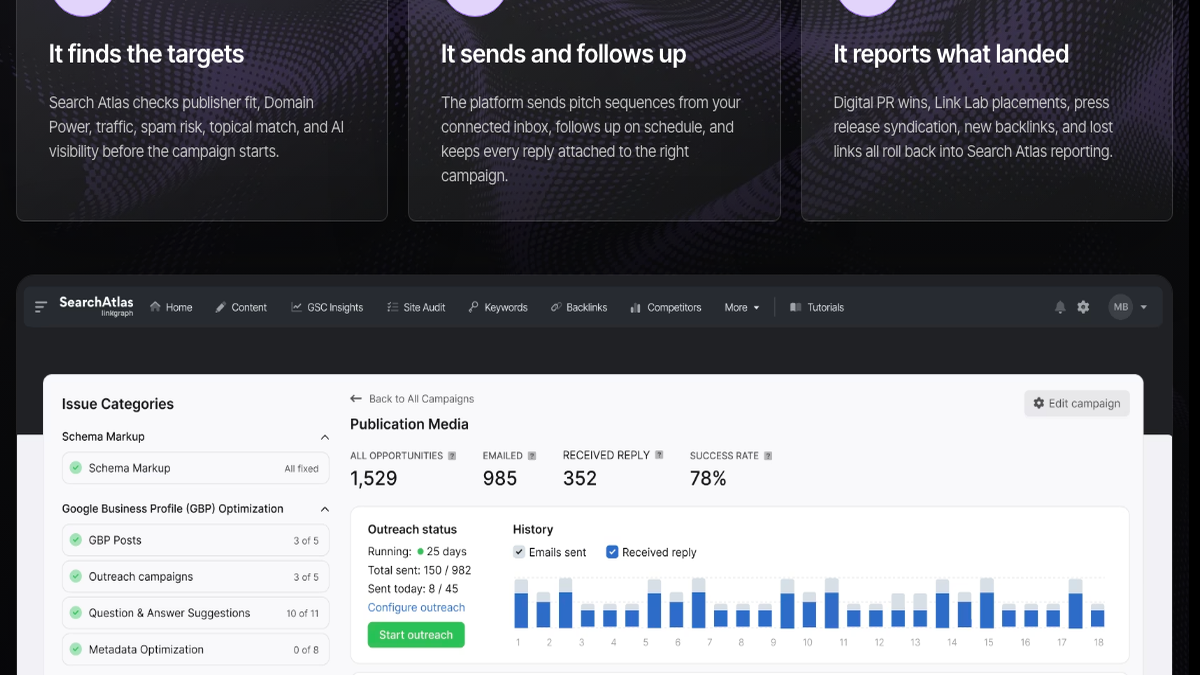
Search Atlas's link building is really three products. The outreach tool finds publishers, writes pitch sequences, sends them from your connected inbox and tracks replies. Link Lab is a marketplace where you buy vetted placements with Hyperdrive Credits. WILDFIRE is an exchange network where links you give to sites in the network earn links back, and it requires OTTO on the project.
RankControl's Backlinks does the outreach part for each article we publish. Backlinks finds prospects, finds contacts and drafts emails that go from your own mailbox once you approve them. For teams that would rather not run outreach at all, the optional Managed Backlinks add-on is $350 a month for five links from DR 25+ sites.
OTTO and the pixel question
OTTO matters for AI search in a way its dashboard doesn't show. Search Atlas's help center says OTTO usually serves its changes through the OTTO Pixel, "injected into the page as it loads," rather than writing them into your CMS. A 2024 study by Vercel and MERJ found that none of the major AI crawlers, GPTBot, ClaudeBot and PerplexityBot among them, render JavaScript.
So a title OTTO swaps in through the pixel may never reach the crawlers that feed AI answers, while the same fix saved in your CMS would. OTTO can also run through Cloudflare or a CMS connector, so check which install you have. We covered what happens to those fixes when you leave in switching from Search Atlas.
Trials, refunds and leaving
Search Atlas offers a 7-day trial with a free onboarding call, and a trial that isn't cancelled turns into a paid plan. Its refund policy opens with "Search Atlas has a no-refund policy," with narrow exceptions requested through live chat. Monthly plans get 48 hours with under 10% of any tool's quota used, and annual plans get 72 hours and at most half back.
RankControl has a 7-day free trial with the card taken up front, and cancelling stops the plan at the end of the period you've paid for. If you're moving from Search Atlas, the part to plan is OTTO, since its pixel-served fixes need moving into your CMS first.
Both run inside Claude
Search Atlas has an official MCP server with 112 tools across 12 product areas, authenticated with an API key. Its tools take actions as well as reading data: its public repository lists OTTO deployments, Content Genius publishing and press release distribution among them.
RankControl's MCP server has more than 80 tools and comes with the plan. The server can plan titles, check citations and publish, and publishing stays a dry run until you confirm it, so an agent can't put a page live by itself. With any MCP server that can publish or spend credits, give it the narrowest key you can.
RankControl vs Search Atlas: which wins AI search visibility?
Search Atlas's pitch is breadth: one login for technical fixes, local listings, ads, content and links. For comparing it with other suites, our Search Atlas alternatives list covers six of them, and our small business comparison looks at the $99 Starter plan and local searches.
For AI search visibility specifically, RankControl does more with the same $400. We track seven engines weekly, including Claude and Grok, which Search Atlas's pricing table doesn't list. Every gap turns into a written, published article with outreach behind it, with no credits to watch and no pixel between your fixes and the crawlers.
You can run that loop by hand: read the dashboard, brief a writer, publish, pitch and re-check every engine each week. Or RankControl's agents can run it every month for $400, with a 7-day free trial, while your team decides what goes live.

Built by the team that got cited in 48 hours.
Content generation, backlink building, AI visibility tracking, and Google rankings. One platform, zero guesswork.