
Nudge is an AI visibility platform built for commerce brands, so RankControl vs Nudge comes down to where your problem sits. Nudge works the product side: which SKUs AI shopping answers name, whether agents can read your product pages, and the landing pages that turn those visits into orders. RankControl's agents plan, write, publish and pitch on one $400 plan, and check six AI engines every week.
Both want your brand in the answer when a shopper asks an AI what to buy. They start from different ends of that answer.
Everything below about Nudge comes from its site, its platform pages and its master subscription agreement, which I read on September 27, 2026. If you're already leaving, our Nudge switch guide covers what to ask for before your order form ends.
RankControl vs Nudge at a glance
| RankControl | Nudge | |
|---|---|---|
| Built for | Any business that sells to buyers who ask AI | Commerce brands on Shopify, Shopify Plus or headless |
| Price | $400/mo or $4,000/yr | Not published; quoted after a demo |
| AI tracking | 6 engines, weekly, 50 questions | Brand and SKU mentions; engine list and cadence not published |
| Content | Up to 100 articles a month, published | Shoppable guides, comparisons and landers |
| Product pages | Not covered | Catalog enrichment and personalized PDP variants |
| Conversion | Tracks AI-referred visits | Funnel experiments and revenue attribution |
| Outreach | From your mailbox after approval | Not described |
| MCP / API | 80+ MCP tools | None documented |
| Terms | Cancel at period end | Order form; fees non-cancellable and non-refundable |
What Nudge is in 2026
Nudge launched its AI commerce platform in June 2026. Co-founder Kanishka Thakur announced it as an Agentic Commerce Platform for consumer brands, alongside a $1.1 million pre-seed round from s16vc, Antler and operators from Shopify, Nutanix and Postman.
Today we're launching the Agentic Commerce Platform built for consumer brands to win the new shopping journey! Shopping is becoming a conversation & winning this era takes two things at once: showing up in AI answers and converting shopper intent into revenue. @nudgenowdotcom https://t.co/vN5tcBzPBd
 Kanishka Thakur@kanishk_11Jun 24, 2026

It sells three pieces. AI Visibility tracks how AI answers describe your brand and products, down to the SKU. Catalog Enrichment scores your product pages for how shopping agents read them. Shoppable Funnels generate product pages, category pages and landers matched to the intent behind each visit, then test variations against your control page.
Nudge's site still carries its earlier product, in-app engagement tools for apps: stories, gamification, scratch-card rewards and surveys. Those pages sit next to the new ones, and its one published case study, Supertails, describes 120 in-app campaigns built with modals and tooltips. So the proof for the AI product so far is the launch claim its investor repeated: early customers saw 4x growth in AI visibility and a 24% lift in orders.
The first week on each tool
Nudge starts with a demo and a quote, and its landing page builder promises founder-led onboarding with a dedicated success manager. After that, you create a workspace, connect your store and catalog, and define a few high-value shopping prompts. Its FAQ says you'll see how your products appear in AI answers within days. Nudge also runs a partner program for Shopify agencies, who connect client stores and launch post-click pages matched to each ad's message and audience.
RankControl's trial runs 7 days, with the card up front and $0 charged today. Setup reads your site and drafts your brand profile, products, buyers and competitors for you to correct. You connect a CMS, including Shopify, add up to 50 questions and 10 competitors, and the first weekly check runs across six engines. Meanwhile the planner builds a calendar from the questions you're losing.
You're getting AI traffic. But do you know where it comes from?
RankControl credits every visit to the assistant that sent it: ChatGPT, Perplexity, Claude, Gemini, Copilot, or Grok. Full source attribution, next to your Google traffic.
RankControl vs Nudge on AI visibility
Nudge tracks at the product level, which matters when AI answers recommend a specific item rather than a brand. Its dashboard shows a visibility score over time, your rank against competitor brands, and for each product the number of mentions and its share of the answers.
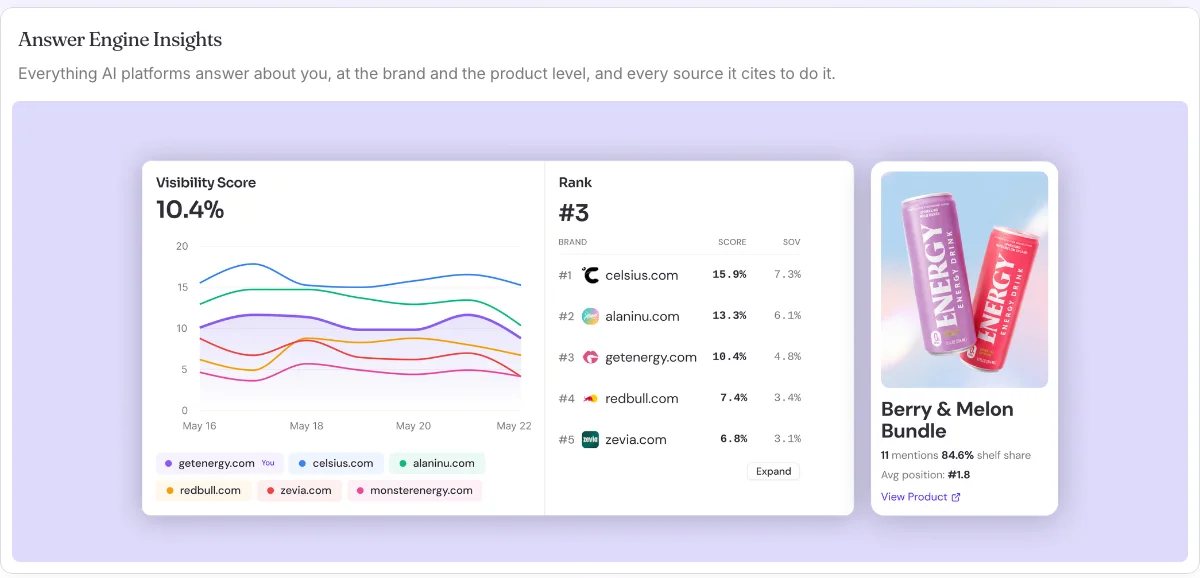
The site shows ChatGPT, Perplexity and Google's AI in its graphics and mentions Amazon's Rufus in its FAQ. It doesn't publish a full engine list or a check schedule, so ask for both on the demo.
RankControl checks your questions every week on six engines, including Claude, Grok and Google AI Mode. It works at the question level, like "best running shoes for flat feet," rather than per SKU. Each check shows which competitors got named instead of you and which sources the answer quoted.
Getting named is harder than it looks for smaller stores. In r/shopify this September, someone ran about 20 buyer questions per niche through ChatGPT and Gemini for three Shopify brands. The mention rates came out at 30% for swimwear and 20% for skincare and artwork. They put the gap down to off-site citations. The skincare brand lost to bigger, established players, and the artwork brand got lost among similar shops.
I checked how ChatGPT & Gemini talk about 3 random Shopify stores. The results were rougher than I expected.
Recently been thinking about how shopping now starts with "ChatGPT, what's a good..." instead of Googling. So I ran a quick test, I asked ChatGPT and Gemini buying questions across three different niches (skincare, swimwear, and artwork) to...
The two gates
I think of an AI shopping answer as having two gates. The first is getting named: the answer has to know your brand, and that depends on your content and on other sites writing about you. The second is getting bought: once you're named, an agent or a shopper has to read your product page, trust the price and check out.
Nudge's product sits mostly at the second gate. Catalog enrichment, PDP variants and funnel experiments all make the page work harder once someone arrives. That gate is real. In r/shopify_growth this June, someone ran 17 large Shopify DTC brands through an agent-readiness check, and only 5 came out ready. The common failure was product pages written for people, with none of the structured specs an agent needs to compare you.
I tested 17 of the biggest Shopify brands to see if an AI agent could actually buy from them. Only 5 were ready.
With Shopify rolling out agentic storefronts, I got curious how ready stores actually are — not "is the feature on," but can an AI agent actually read your products, see real price and stock, add to cart, and find your return policy. So I r...
RankControl sits at the first gate. It publishes the buying guides and comparison articles that answer your shoppers' questions, and it pitches the sites that AI answers already cite. A store with perfect product pages still loses if it never makes the shortlist.
Content and pages
Nudge's content tool publishes guides, comparisons, Q&A pages and listicles with shoppable product cards, each aimed at a citation you're losing. Its funnels personalize the page by source, so a visitor from an ad, an AI answer or an email lands on a version built for that intent. Its site doesn't say where the generated pages are hosted, whether in your theme, through a script or on another domain.
Nudge does several things we don't, and for some stores they matter more. If your traffic is healthy but your product pages don't convert or can't be read by agents, SKU-level tracking, catalog scoring and PDP experiments are the right tools. RankControl doesn't edit product pages, run conversion experiments or attribute revenue to page variants.
The content engine in RankControl plans titles from the questions you're losing, researches the pages already ranking for each keyword and writes the article across 26 content types. It publishes up to 100 articles a month as native posts through one of nine destinations, including your Shopify blog, with auto-publish off until you turn it on.
We'll show you exactly where your brand stands in AI search.
No commitment. $0 due today, cancel anytime. See how ChatGPT, Perplexity, Claude, Gemini, Grok, and Google AI Mode talk about your brand today.
AI traffic on your own store
Nudge's Agent Analytics looks at AI visits to your store rather than answers. It sorts every AI request by intent, from crawlers indexing your catalog to live fetches made while a shopper is in a conversation, and it breaks that down to the SKU. For a store with thousands of products, that shows which items the assistants read most, and which they skip.
RankControl's analytics log AI crawler visits on your own domain and sync Search Console daily. They also track Google and Bing positions for each published article. A weekly email sums up new citations, ranking moves and visits from AI answers, so you can see an article move in search before any AI engine quotes it.
Links and outreach
Nudge's site doesn't describe link building or outreach. Its answer-engine view lists the sources AI answers cite, and what you do with that list is up to you.
Link Control in RankControl finds prospects and contacts for each published article and sends the pitch from your own mailbox once you approve it. Follow-ups stop when someone replies. Managed Backlinks adds five links a month from DR 25+ sites for $350, and the social agent drafts replies to live Reddit and X threads where one of your articles answers the question.
Price and contracts
Nudge doesn't publish prices. Its FAQ says pricing depends on the optimization opportunities you get each month, the number of prompts you track and usage, and a comparison page on its site lists 15 opportunities a month. You get a quote after the demo, and the deal runs on an order form.
The master subscription agreement behind that order form is strict. Fees are non-cancellable and non-refundable, neither side can terminate without cause unless both agree in writing, and renewals run at Nudge's rates at the time. Nudge only returns or deletes your data after the agreement ends if you ask in writing.
Invoices are due within 30 days, late balances carry 1.5% a month in interest, and Nudge can suspend accounts that are 30 or more days overdue. It also can't name you as a customer in its marketing without your written consent each time, and you can withdraw that consent later by written notice.
RankControl costs $400 a month or $4,000 a year. Its trial runs 7 days with nothing charged today, cancelling takes effect at the end of the billing period, and your articles stay in your CMS.
Who each one fits
Nudge fits a Shopify or headless brand with a large catalog, healthy traffic and a conversion problem. If AI answers already name your products and you want the landing page, the product data and the experiment program to catch that demand, it's built for that job. Its sales-led process also suits teams that want onboarding help and a named success manager. Before you sign, ask where its generated pages are hosted, since that decides what stays on your store if you leave.
RankControl fits a brand that isn't named yet, or is named less than its competitors. That's most smaller stores and nearly every B2B company. The work there is publishing pages that answer buyers' questions, earning mentions on the sites AI engines trust, and watching the answers change each week.
A store could run both, with Nudge on product pages and RankControl on articles and outreach. If you do, agree who owns buying guides and comparisons, since both tools can publish them.
Working from Claude
Nudge doesn't document an API or MCP server. RankControl's MCP server has 80+ tools covering tracking, planning, writing and publishing, and publishing through it stays a dry run until you confirm. You can ask Claude which questions you lost this week and have it plan the articles.
RankControl vs Nudge: which wins AI search visibility?
For AI search visibility, RankControl wins for most stores because it works the first gate. It publishes up to 100 articles a month on your own site and pitches the sites AI engines already cite from your mailbox. Every week it shows which answers named you across six engines.
Nudge is the better pick for a commerce brand whose problem is conversion: AI already names you, and your product pages lose the sale. But most smaller stores aren't named yet, and product pages can't fix a shortlist you're not on.
You can run that loop by hand, or RankControl's agents can run it for you, starting with a 7-day free trial. Before you decide, the free AI visibility check shows who ChatGPT cites for three questions from your market today.
Know exactly what AI says about your competitors.
RankControl's Recon Agent monitors competitor citations across ChatGPT, Perplexity, Claude, Gemini, Grok, and Google AI Mode. See where they show up and you don't.