
NeuralText is a content brief and writing tool, so RankControl vs NeuralText comes down to whether you want help writing or want the writing done. NeuralText builds briefs from Google's results, clusters keywords and scores drafts, from $19 a month. RankControl's agents plan, write, publish and pitch on one $400 plan, and check six AI engines every week.
Both want your pages to rank and get read. They sit at different points of the job, and at very different prices.
Everything below about NeuralText comes from its own site, docs, API reference and terms. I read them on September 27, 2026. If you're already leaving, our NeuralText switch guide covers the export and the renewal terms.
RankControl vs NeuralText at a glance
| RankControl | NeuralText | |
|---|---|---|
| Price | $400/mo or $4,000/yr | $19, $49 or $119/mo; annual by email |
| AI engines | 6, weekly | None |
| Tracked questions | 50 | None |
| Content | Up to 100 pages a month, written and published | 5 to 100 briefs a month plus an AI writing assistant |
| Publishing | Native posts on 9 destinations, auto-publish off | HTML download or read-only share link |
| Keyword work | Planner picks titles from the questions you're losing | Keyword discovery and clustering |
| Search Console | Daily sync, Google and Bing positions per page | Performance views for 1 to 5 properties |
| Outreach | Finds contacts, sends from your mailbox after approval | None |
| MCP / API | 80+ MCP tools | API for writing and content analysis |
| Terms | Cancel at period end, no pro-rated refunds | Non-refundable; renewal needs 30 days' notice |
What NeuralText is in 2026
NeuralText is made by Atmos Media, a company in Turin, Italy. It does four jobs. It plans with keyword discovery and clustering, and researches with briefs built from the top Google results. It helps you write with an AI assistant, and it reports on your Search Console data.
The briefs are the core. You enter up to three keywords and pick a language, a location and a search engine. About 30 to 45 seconds later you get the topics, headings and questions from the pages ranking now. SERP analysis works in 17 languages, and keyword research covers 92 languages across 213 countries.
The homepage quotes Orit Mutznik, SEO Director at Forbes Advisor, calling it "a tool I use and love." Its status page showed every service online on September 26, 2026, although the blog's last post dates from April 2024.
The first week on each tool
NeuralText's trial runs 5 days, capped at 5,000 AI words, 3 SERP analyses, 1,000 keyword suggestions and 1,000 cluster credits. You start in a Default Project, set its language and country, run a SERP analysis and write in the editor. Press Tab to get an autocomplete suggestion and Enter to accept it.
RankControl's trial runs 7 days, with the card up front and $0 charged today. Setup reads your site and drafts your brand profile, products, buyers and competitors for you to correct. You connect a CMS, add up to 50 questions and 10 competitors, and the first weekly check runs across six engines while the planner builds a calendar from the questions you're losing.
15 hours a week manually. Or 15 minutes with RankControl.
Track citations, monitor competitors, and fix content gaps across every AI search engine. Automatically.

What each NeuralText plan buys
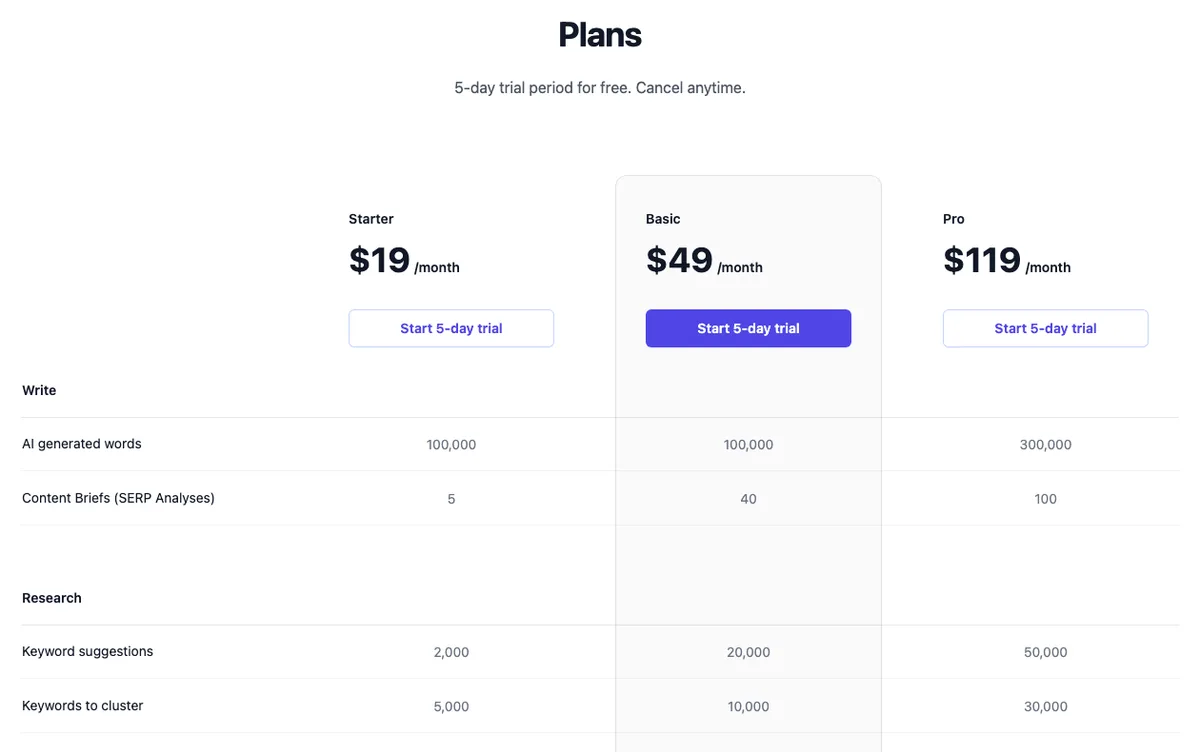
The pricing table rewards a close look. Starter and Basic both include 100,000 AI words a month, so the $30 step up buys briefs, not words: 35 more of them, plus 18,000 more keyword suggestions. Per brief, Starter works out to $3.80, Basic to about $1.23 and Pro to $1.19.
The words outlast the briefs on every plan. At 2,000 words an article, 100,000 AI words would cover 50 full drafts, but Starter only gives you 5 briefs to write them from. For most teams the brief count is the real limit, and the $49 plan is the one to compare. Seats are tight as well. Starter and Basic include one seat each and Pro includes three, so a team with several writers ends up on Pro.
RankControl's $400 includes up to 100 pages a month, written and published, which is $4 a page if you use them all. Tracking on six engines, link outreach and five seats come in the same plan.
RankControl vs NeuralText on AI visibility
NeuralText doesn't track AI answers. Its briefs read Google's results, its content score measures coverage of the topics found there, and its reports come from Search Console. No page on its site or in its docs mentions ChatGPT, Perplexity or AI Overviews.
Search Console won't fill that gap on its own. In r/DoSEO this September, someone asked what people do with Google's new generative AI report, which shows impressions but no clicks or queries. Replies said the AI Overview and AI Mode clicks are folded into the normal web totals. Some admitted they use the report as a vanity chart for clients.
the Generative AI report in GSC gives you impressions and no clicks. what are people actually doing with it?
been looking at the beta report on a client property and im not sure how to use it. it gives impressions, pages, countries, devices. no clicks, no queries. so i can see we appeared in ai experiences 252 times over 3 months, and i have no id...
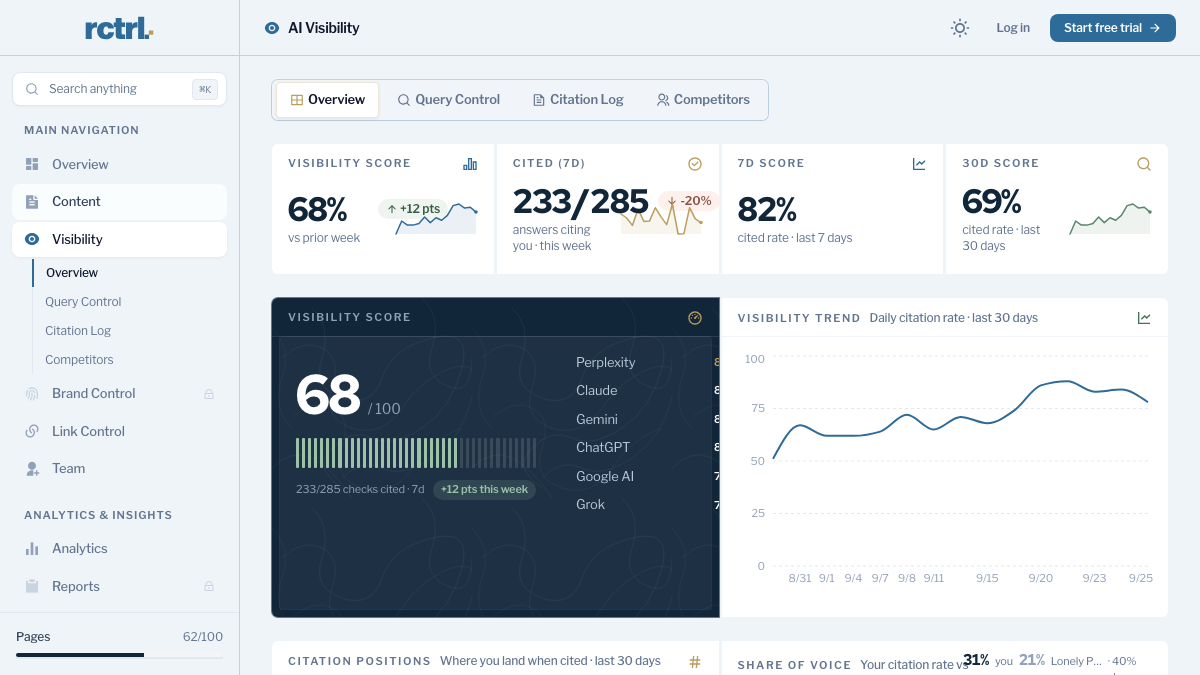
RankControl checks your questions on six engines every week, including Claude, Grok and Google AI Mode. Each check shows which competitors got named instead of you and which sources the answer quoted. You get a notification when a new citation appears, and the weekly brief lists what you gained.
The brief gap
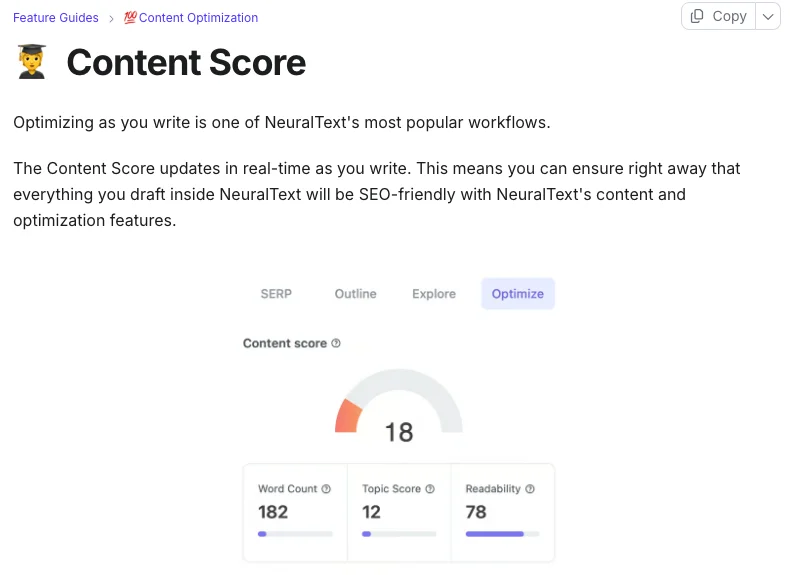
I call it the brief gap: the hours between a finished brief and a published article. NeuralText closes the research half well. The topics, headings and questions are ready in under a minute, and the score tells you how much of that ground your draft covers.
Everything after that is still yours. Someone writes the draft, adds images and internal links, downloads the HTML and pastes it into the CMS. With writers on staff, that's a normal workflow and the brief makes it faster. Without them, the briefs pile up in the editor and the site doesn't change.
The gap is also where AI visibility gets decided. A brief can say what the ranking pages cover. It can't publish the page, and it can't get another site to mention you.
Content and publishing
NeuralText's writing assistant autocompletes as you type. Select a passage and it can expand it, shorten it or rephrase it, among other edits. There are 40+ AI Prompts templates for shorter copy, and bulk brief creation turns a list of keywords into a set of briefs in one go. A bulk article generator is still listed as coming soon.
NeuralText is far cheaper than we are, and it does a few things we don't. If you have writers who want a SERP brief and a score beside them, $49 buys 40 briefs a month. Its clustering groups thousands of keywords from a CSV by the pages they share in Google, and its keyword data covers 92 languages. RankControl doesn't sell a standalone brief or a clustering tool.
The content engine in RankControl uses that kind of research inside the writing step. It plans titles from the questions you're losing, researches the pages already ranking for each keyword and writes the article across 26 content types. It publishes up to 100 pages a month as native posts through one of nine destinations, with auto-publish off until you turn it on.

The research layer is getting cheaper for everyone. In August, Grant O posted a step-by-step for building a keyword tool on DataForSEO and Claude "for pennies instead of paying $99/mo." The same post admits it isn't better than Semrush, and says it covers most of what you need.
Build your own keyword research tool for pennies instead of paying $99/mo. DataForSEO + Claude. Here’s the whole build: 1Sign up at https://t.co/yrWNFE6QaX and grab your API login and password. It’s pay-as-you-go, so keyword volume and difficulty calls run fractions of a cent
 Grant O@2whazzuupAug 29, 2026
AI search traffic grew 835% this year. Is your content ready?
RankControl generates 26 content formats optimized for ChatGPT, Claude, and Perplexity. Published on your domain, matched to your brand.

Search Console and reporting
NeuralText's Performance section reads your Search Console property. It shows impressions, clicks and CTR, lists your queries and pages with a 28-day trend, and sends queries to clustering with one click. Starter and Basic connect one property, and Pro connects five.
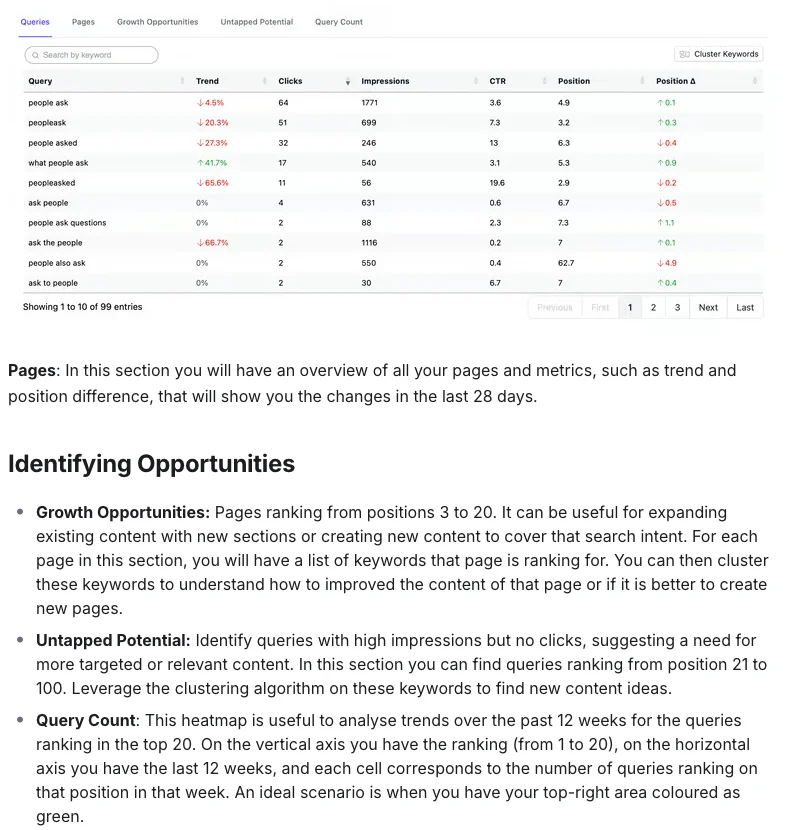
Its opportunity views filter by position. Growth Opportunities lists pages ranking 3 to 20, Untapped Potential lists queries ranking 21 to 100, and a heatmap tracks your top-20 queries over 12 weeks. That position filter is a starting point, not a decision. In r/SEO_Xpert this July, one reply warned that a page at "position 12 with 300 impressions" isn't always worth touching.
Here is my experience and some observations using GSC with AI
Understanding what to optimize or write next is the most impressive thing I have used with AI so far, not any complex setup, just export the data from GSC and give it to AI, and ask questions about what to optimize and what to write next. W...
RankControl's analytics sync Search Console daily and track Google and Bing positions for each published page. They also log AI crawler visits on your own domain. A weekly email sums up new citations, ranking moves and visits from AI answers.
Links and outreach
NeuralText doesn't do link building or outreach, and nothing in its docs points at sites to pitch.
Link Control in RankControl finds prospects and contacts for each published article and sends the pitch from your own mailbox once you approve it. Follow-ups stop when someone replies. Managed Backlinks adds five links a month from DR 25+ sites for $350, and the social agent drafts replies to live Reddit and X threads where one of your articles answers the question.
Working from Claude
NeuralText has an API with endpoints for writing, summarizing (in beta) and content analysis, plus a free call that checks your API units. Writing costs one unit per 200 tokens, and the API docs' welcome page shows its last update three years ago. It doesn't document an MCP server.
RankControl's MCP server has 80+ tools covering tracking, planning, writing and publishing, and publishing through it stays a dry run until you confirm. You can ask Claude which questions you lost this week and have it plan the articles. If you're weighing another SERP editor, our RankControl vs NeuronWriter comparison covers one that added AI tracking.
Trials, refunds and cancelling
NeuralText's trial runs 5 days, and cancelling inside it means you aren't charged. After that, its terms say the subscription isn't refundable. Plans renew for the same period unless you ask to terminate at least 30 days before the term ends. After termination, your data stays retrievable for 30 days.
Annual billing isn't a checkout option. You email NeuralText to set it up, and it saves up to 15%. Cancelling also removes any discount or coupon on the account, and the terms say it won't come back if you resubscribe.
RankControl's trial runs 7 days with nothing charged today. Cancelling takes effect at the end of the billing period, with no pro-rated refunds, and your articles stay in your CMS.
RankControl vs NeuralText: which wins AI search visibility?
For AI search visibility, RankControl wins because it covers the part a brief can't. It publishes up to 100 pages a month on your own site and pitches the sites AI engines already cite from your mailbox. Every week it shows which answers named you across six engines, and NeuralText tracks none.
NeuralText is a cheap, fast brief for a team that writes its own articles. But AI answers change when pages get published and other sites mention you, and a brief is only the first step of that.
You can run that loop by hand, or RankControl's agents can run it for you, starting with a 7-day free trial. Before you decide, the free AI visibility check shows who ChatGPT cites for three questions from your market today.

Built by the team that got cited in 48 hours.
Content generation, backlink building, AI visibility tracking, and Google rankings. One platform, zero guesswork.