
Sight AI has a mode called Autopilot that will push as many as 30 articles a day into your CMS, and a new WordPress connection sends each one live as soon as it's done. That's the feature I'd think hardest about, because in most other respects Sight AI reads like RankControl on paper. It watches how five AI engines mention your brand, has a crew of writing agents, and prices the whole thing in credits starting at $99 a month.
Where Sight AI and RankControl really part company is in their defaults. Sight AI is built to publish a lot, quickly. RankControl's cap is 100 pages a month, and every article waits for you until you decide to switch auto-publish on.
I took the Sight AI details below from its pricing page, docs and terms on September 26, 2026. If you're already on your way out, the Sight AI switch guide explains exporting and cancelling.
RankControl vs Sight AI at a glance
| RankControl | Sight AI | |
|---|---|---|
| Price | $400/mo or $4,000/yr | Pro $99 to $999/mo in six credit sizes; Enterprise from $2,500/mo |
| Trial | 7 days, card up front, $0 today | 7 days, card required, 1,500 credits |
| AI engines | 7, checked weekly, including Google AI Mode and Google AI Overviews | 5, with a per-prompt model picker |
| Tracked questions | 50 | 500 on the $99 size, more on larger sizes |
| Content | 100 pages a month, 26 content types | About 100 credits per article; 3 article formats |
| Publishing default | Auto-publish off until you turn it on | Autopilot 1 to 30 a day; WordPress publishes immediately |
| CMS destinations | 9 | 6, one active per site |
| Outreach | Sends from your own mailbox after approval | Sends from a separate outreach domain |
| MCP | 80+ tools; publishing is a dry run until confirmed | 60 tools |
| Refunds | Cancel at period end, no pro-rated refunds | Fees non-refundable |
What Sight AI is in 2026
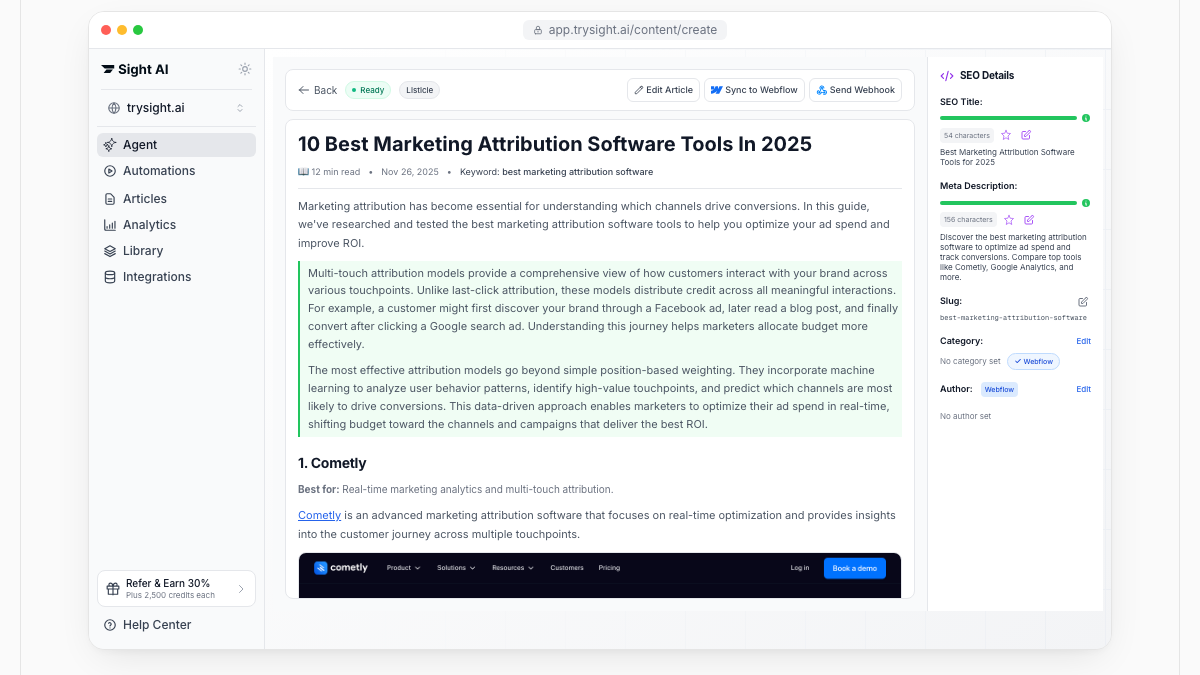
Sight AI used to be called IndexPilot AI, and indexpilot.ai still redirects to it. Grant Cooper announced it in October 2025. He also founded the attribution company Cometly, and he pitched the new tool as a way of automating the organic playbook behind Cometly's revenue growth. Today it's run from Newtown, Pennsylvania, by a company called Global Linked Affiliates LLC.
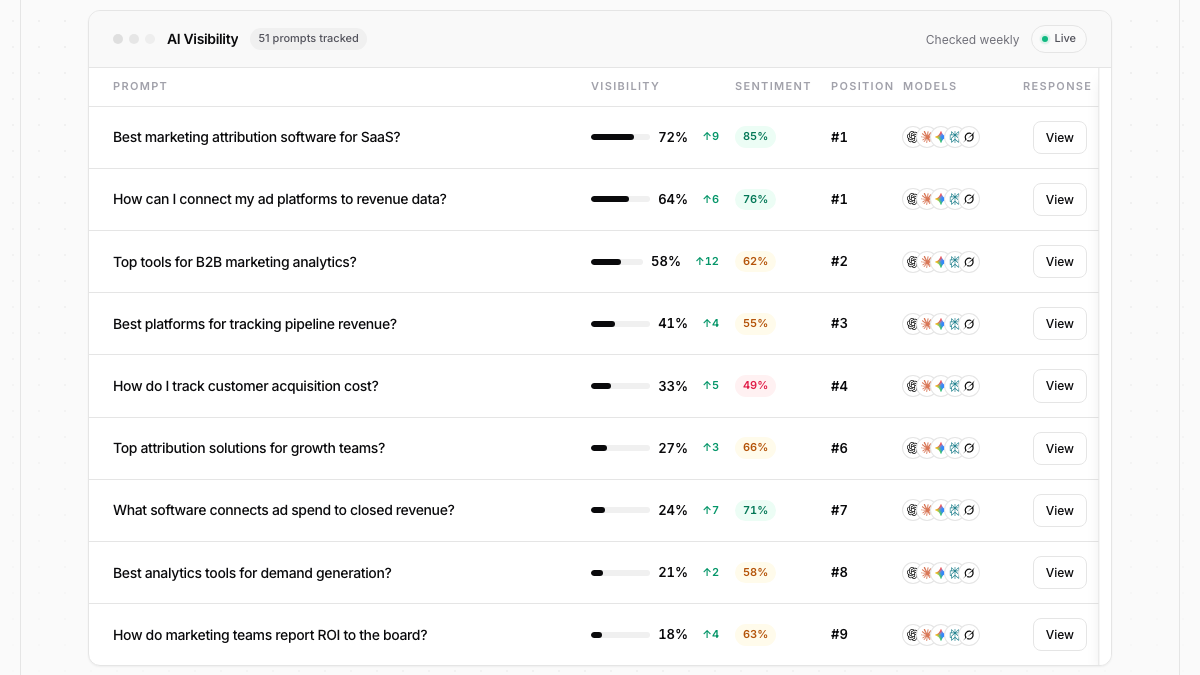
There are three pieces to it. An agent suggests what to write, from the dashboard or from Slack, while visibility tracking watches the AI answers and the article engine does the writing. In the visibility table, each prompt gets a visibility score, a sentiment reading and an average position, along with the five models it was checked on. Sight AI runs its own site on the engine, too, and roughly 4,900 blog URLs appear in its sitemap.
The first week on each tool
Sight AI's trial comes with 1,500 credits. An article costs about 100, so after some prompt checks draw on the same balance you're looking at roughly a dozen articles, and until you pay you can't add sites or top up credits. Setup is light. Each site gets one CMS connection and a publish mode, and the agent proposes keywords from its list of opportunities.
RankControl's trial begins with your site being read and a draft of your brand profile, products, buyers and competitors put in front of you to correct. After you've connected a CMS and added up to 50 questions and 10 competitors, seven engines get their first weekly check, and the planner starts a calendar from the questions you're losing.
The credit math
Sight AI has one Pro plan in six credit sizes. The two ends look like this:
| Pro size | Billed monthly | Billed yearly (20% off) | Sites | Seats |
|---|---|---|---|---|
| 5,000 credits | $99/mo | $79/mo | 1 | 1 |
| 65,000 credits | $999/mo | $799/mo | 10 | 6 |
| Add-ons | Extra site $59/mo | Extra seat $29/mo |
Extras are sold on top, as the last row shows, and credits then get spent at rates that Sight AI's own pages don't agree on:
| What it costs | Credits | Where it's stated |
|---|---|---|
| One article | About 100 | Pricing FAQ |
| One prompt checked on every platform | About 31 | Pricing FAQ |
| The default check | 8 | Another page of the docs |
| 50 prompts checked weekly, for a month | Somewhere from 1,700 to 6,700 | Depends which page you believe |
That's enough to price RankControl's plan in Sight AI's currency:
| RankControl's plan, bought as Sight AI credits | |
|---|---|
| 100 articles plus 50 prompts checked weekly | Roughly 11,700 to 16,700 credits a month |
| Pro size that covers it at either rate | 20,000 credits, $349 a month, three seats |
| With two extra seats, to match RankControl's five | $407 a month |
So at that volume the two cost about the same, and the argument moves to what becomes of the articles.
15 hours a week manually. Or 15 minutes with RankControl.
Track citations, monitor competitors, and fix content gaps across every AI search engine. Automatically.

RankControl vs Sight AI on AI visibility
Sight AI runs your prompts on ChatGPT, Claude, Gemini, Perplexity and Grok, and you choose the model for each platform. The price moves with the model: a small Claude model costs 1 credit, and OpenAI's largest costs 25. Weekly checks are the default in the docs, with daily and monthly as options, although the feature page describes a 24-hour refresh cycle.
Google is handled another way. Because Google keeps AI Overview and AI Mode data out of the Search Console API, the docs explain, the Google AI tab estimates the clicks you lost from falls in click-through while your ranking held steady. There's also a CSV import for Google's own AI report. At no point are your prompts put to Google's AI surfaces.
RankControl checks your questions weekly on seven engines, and Google AI Mode and Google AI Overviews is reported on its own line beside Grok and the chat assistants. Every check shows the competitors named in your place and the sources the answer quoted, and a new citation sends you a notification.
Where Sight AI pulls ahead is in how many prompts you can track and which models you check them on. Its llms.txt file lists 500 tracked prompts on the $99 size. On the $999 size, that rises to 10,000, and the visibility data can be exported as a CSV. For a team whose whole job is watching hundreds of prompts on hand-picked models, that's far more room than RankControl's 50.
The unread post
Autopilot keeps a buffer of 90 keywords for each site. It takes one, writes the piece and pushes it to your CMS, and it can do that anywhere from 1 to 30 times a day. The articles come in three formats with minimum lengths:
| Autopilot format | Minimum length |
|---|---|
| Explainer | 2,500 words |
| Step-by-step guide | 3,000 words |
| Listicle | 4,500 words |
Any new WordPress connection starts on "Publish immediately."
The docs are open about the reason. Customers were most often confused by articles that showed as synced while their blog stayed empty, so going live became the default. Draft mode still exists, and it leaves each article sitting as a draft in your CMS.
I call the result the unread post, meaning an article that's live on your site before a single person on your team has read it. Sight AI's defaults make that the ordinary route, and at 30 a day nobody reads them all.
In 2026 that carries more risk than it used to. In September a junior SEO wrote in r/SEO that their boss wanted 10 to 50 AI articles a week, barely edited. Their blog folder then picked up a manual action for scaled content abuse, and the most practical reply said to delete the whole blog and start over.
[pls help]nForced by management to publish scaled AI content -> Got a Manual Action. Need help recovering a site with 3M impressions (Junior SEO)
Major spam problems Description Pages on this site appear to use aggressive spam techniques such as scaled content abuse, cloaking, scraping content from other websites, and/or repeated or egregious violations of Google's spam policies for...
An r/Blogging thread that month compared three routes to growing a blog, and one was an AI plugin that produces long articles with images and links and posts them to WordPress with no one involved. The top reply had seen people burn through domains like that, getting a brief lift in traffic before the site was flagged.
More blog content = more organic traffic? I’m getting conflicting advice
I’m trying to understand the best possible approach to blogging for SEO, and I’ve been getting very different opinions from people. Here are the four approaches I’ve come across: Person A:The more blog content you publish, the more opportun...
AI answers take the hit as well. Glenn Gabe dug into a site with a section of more than 850,000 AI-generated local news pages, all of it deindexed after a manual action, and followed what then happened to its ChatGPT citations. He described it as one more case of where scaling with risky tactics leads.
My latest case study is a great example of "Mt. AI" in action (and its impact on ChatGPT citations) -> When “Mt. AI” crumbles, ChatGPT can follow [Case Study] There was a big manual action applied recently after Futurism published an article about https://t.co/qoe1kJ77IK and its https://t.co/yydiSQ2CPg
 Glenn Gabe@glenngabeApr 20, 2026

Lily Ray has been watching the effect of scaled AI content on hundreds of domains for months, and in May she asked outright whether scaling it is risky for SEO. It's exactly the kind of risk a human reviewer should catch before anything goes live.
Can scaling AI content be risky for SEO? I've been monitoring the impact across hundreds of sites for the past few months. Check out my recent research and findings in my latest Substack: https://t.co/nY4XO08uBG https://t.co/NUcvIGUe6O
 Lily Ray 😏@lilyraynycMay 13, 2026

RankControl writes with AI as well, so the gap is in the defaults. Our content engine turns the questions you're losing into titles and studies what already ranks before writing each article, across 26 content types. As many as 100 pages a month reach your site as native posts, each through one of nine destinations, and nothing publishes on its own until you enable auto-publish.
AI search traffic grew 835% this year. Is your content ready?
RankControl generates 26 content formats optimized for ChatGPT, Claude, and Perplexity. Published on your domain, matched to your brand.

Links and outreach
Sight AI's outreach looks at which sources the AI answers in your industry rely on, and gives each one a domain rating and a verified author email. An Outreach Agent writes the pitches and sorts the replies. Mail goes out from an outreach domain you register for the purpose, kept apart from your main brand domain, and only during a weekday morning window, Monday to Friday. Check the tier before you count on it, since the pricing page includes outreach on every Pro size while the docs reserve the agent for a higher one.
RankControl's Link Control handles each published article from prospect to sent email. Link Control finds the prospects, digs up a contact and writes the pitch, and once you approve it the email leaves your own mailbox, with follow-ups that end as soon as someone answers. For $350 a month, Managed Backlinks brings in five links a month from DR 25+ sites, and the social agent writes replies for live Reddit and X threads that one of your articles answers.
Working from Claude
You can drive either tool from an assistant. Sight AI's MCP server has 60 tools, most of them matching its REST API, and article generation through the API or MCP is capped at 10 a day for each team. RankControl's MCP server goes past 80 tools, spanning tracking, planning, writing and publishing, and any publish through MCP stays a dry run until you give the go-ahead.
Analytics
Sight AI's dashboard shows Search Console data beside its visibility tracking. Its docs say nothing about logging AI crawlers on your site or measuring the visitors an AI answer sends you.
RankControl pairs AI visibility tracking with analytics that record AI crawler visits on your own domain and pull in Search Console data daily. Each published page has its Google and Bing positions tracked, so a new article's climb shows up before an AI engine ever quotes it.
Trials, refunds and cancelling
Sight AI's 7-day trial takes a card and gives you 1,500 credits. Pay before day seven and 2,500 bonus credits are added. Unused monthly credits disappear rather than carrying over. The terms say "Fees are non-refundable except where required by law," and a cancelled account is locked down to the point where you can't create or publish articles. On data retention its pages contradict each other, with answers that run from "preserved" to 30 days to 90.
RankControl's trial is also 7 days, and we take a card while charging $0 today. Cancelling ends the plan when the billing period closes, and pro-rated refunds aren't offered. With either tool, anything you've already published is a native post in your CMS, so it stays put.
RankControl vs Sight AI: which wins AI search visibility?
For AI search visibility I'd choose RankControl, which gets right the things that decide whether a site keeps earning citations. Unless you say otherwise, a person reads every article before it's live. Pitches go out from your own mailbox with follow-ups looked after, and seven engines, Google AI Mode among them, are checked every week for one $400 plan.
Buying RankControl's volume in Sight AI credits costs roughly the same. The trade is that you'd lose the review step, any direct check on Google's AI surfaces and outreach that comes from your own address.
There's a manual version of all this: write pages people would actually read, publish them on your own domain, pitch the sites the engines already cite and look at every engine weekly. RankControl's agents can take that on for you instead, beginning with a 7-day free trial. Before you choose, the free AI visibility check shows you who ChatGPT cites right now for three questions from your market.

Built by the team that got cited in 48 hours.
Content generation, backlink building, AI visibility tracking, and Google rankings. One platform, zero guesswork.