
BlogSEO sells an autopilot blog for $97 a month. You drop in your URL, and it researches keywords, writes 30 articles a month, publishes them to your site and trades backlinks with other members in your niche. It's one of the cheapest ways to keep a blog publishing without anyone on the team writing.
RankControl vs BlogSEO comes down to what happens after the articles go live. BlogSEO added AI visibility tracking in September 2026, but as a separate subscription at $89 a month per website. Its links come from an exchange between customers rather than from outreach to sites you choose.
Everything below about BlogSEO comes from its own site, docs and terms. I read them on September 26, 2026. If you're already moving, our guide to switching from BlogSEO covers the hosted-blog deadline and the exports.
RankControl vs BlogSEO at a glance
| BlogSEO | RankControl | |
|---|---|---|
| Price | $97 a month (limited-time), plus $89 for AI Visibility | $400 a month or $4,000 a year |
| Articles | 30 a month | Up to 100 pages a month |
| AI visibility tracking | Separate $89 add-on, 30 prompts | Included, 50 queries |
| Engines | 7 included; Grok and Mistral extra | 7, Grok included |
| Check frequency | Google daily; assistants every 3 days | Weekly |
| Backlinks | Member exchange, up to 15 a month | Outreach from your mailbox; 5 managed links for $350 |
| Publishing | 19 integrations plus a hosted blog | 9 destinations, as native posts |
| Trial | 3 days, card up front | 7 days, card up front, $0 charged |
What BlogSEO is in 2026
BlogSEO is built in Paris and says it has more than 750 customers. The pitch on its homepage is "Drop your URL and get your SEO blog article in 2 minutes." It crawls your site to learn its structure and voice, builds a keyword list from your existing pages, and can expand a single seed keyword into as many as 450 variations, each scored for search volume and competition.
The keyword table is the part SEO-minded users tend to live in. It shows a 12-month volume trend, a competition score from 0 to 100 and an opportunity rank that blends the two, and once Search Console is connected, your current Google position. Keywords you star get scheduled first at the start of each billing cycle.
From there it writes and publishes on a schedule, with internal links and generated images, to a long list of destinations. Its docs cover the common CMSs, from WordPress and Webflow to Shopify and Ghost, along with a string of headless systems and a custom webhook. For sites with no usable publishing API, it offers a hosted blog on your own subdomain.
In early September it added AI Visibility, a tracker that asks your prompts on each AI assistant and records who gets mentioned and cited. It launched as its own product with its own price rather than as part of the article plan.
Week one on each tool
A BlogSEO trial lasts three days and takes a card up front. You paste your URL, approve the keyword list, connect your CMS in a couple of minutes, and the first articles start publishing while the trial runs. During the trial BlogSEO writes roughly an article a day; paid plans can go up to five a day until the monthly 30 are used.
If you also want to know whether AI engines mention you, AI Visibility is a second checkout. You add up to 30 prompts, the first answers arrive on the next daily cycle, and from then on the dashboard fills in day by day.
RankControl's trial runs seven days, with a card up front and $0 charged that week. Setup starts from your website, where Brand Control drafts your products, buyers and competitors for you to correct, and the first check across all seven AI engines runs during setup. The planner then puts titles on a calendar from the questions you're losing, and articles arrive in your review queue with auto-publish off by default.

Your competitors are getting cited by AI. You're not.
Every day without citation tracking is a day your competitors pull ahead in ChatGPT, Perplexity, and Claude.
The price gap
BlogSEO is far cheaper on paper. The article plan is $97 a month and AI Visibility adds $89, so even with both you pay $186 a month, less than half of RankControl's $400.
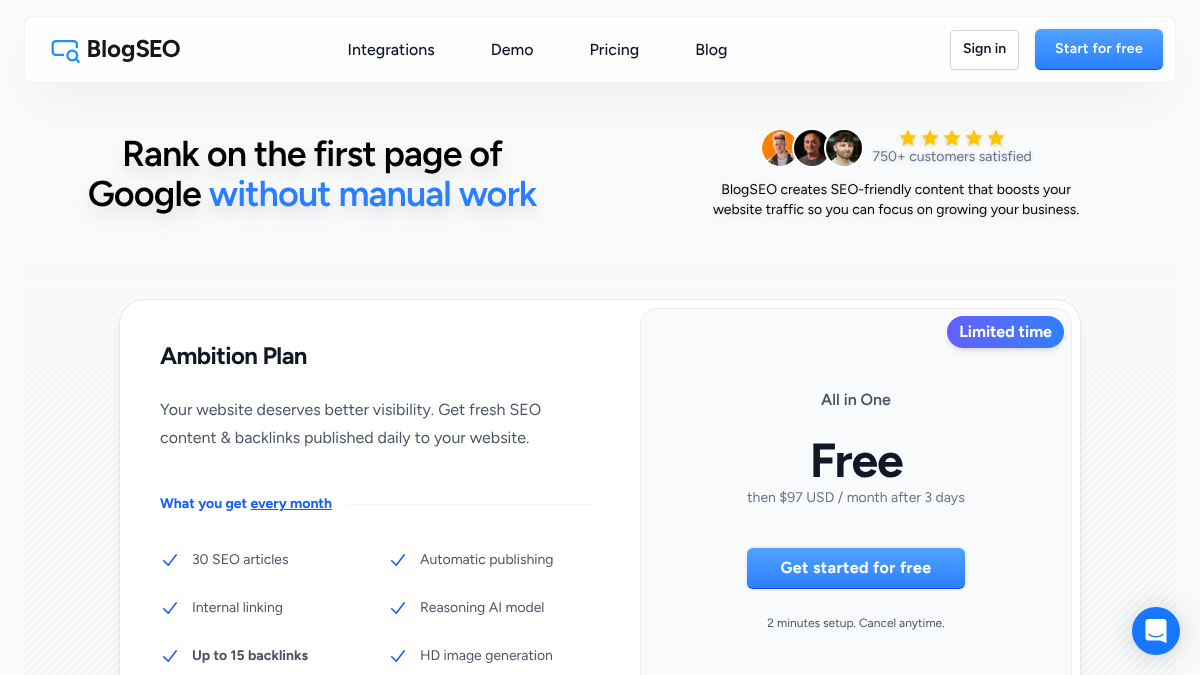
The $97 is shown as a limited-time price, set against a crossed-out $194, and BlogSEO's pricing has moved more than once this year, so check it on the day you sign up. The two bills also cover different volumes. BlogSEO writes 30 articles a month and tracks 30 prompts, while RankControl's plan covers up to 100 pages and 50 tracked queries, which works out to about $4 a page against roughly $3.23 on BlogSEO's article plan.
RankControl vs BlogSEO on AI visibility
BlogSEO's tracker is well specified. Its docs list five assistants, ChatGPT and Claude among them, plus Google AI Overviews and AI Mode. Grok and Mistral are available as paid add-ons. ChatGPT and Copilot answers are collected from the real consumer interfaces, and each tracked answer is scored for sentiment on a 0 to 100 scale.
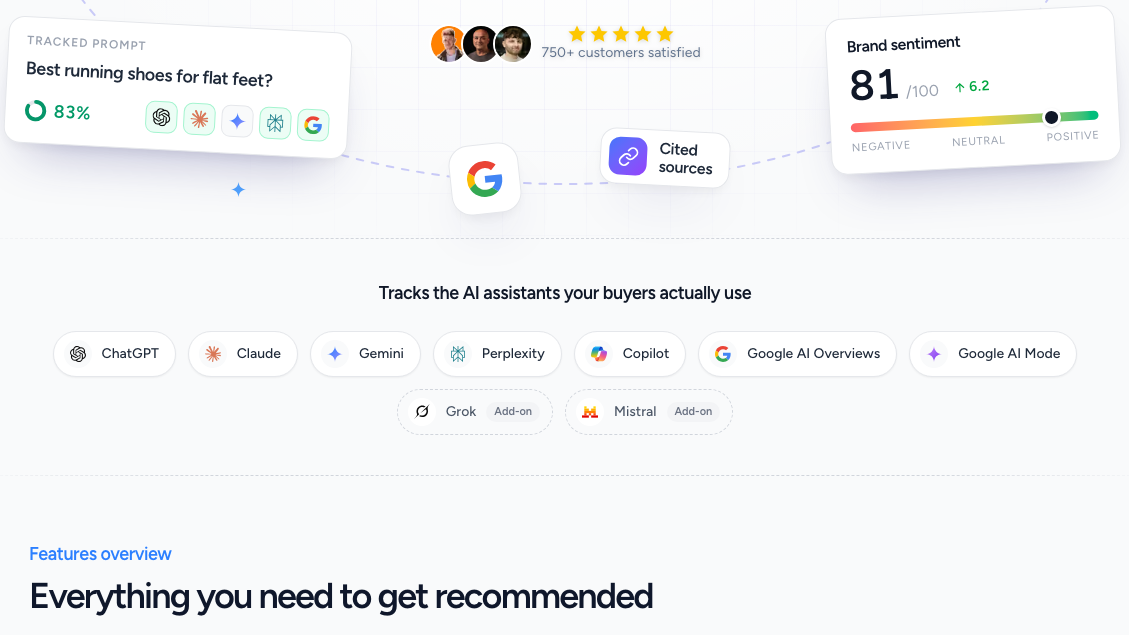
The cadence claim needs a closer look. The page description says "Refreshed daily," and the dashboard does update every day. The docs explain how: Google's two surfaces are checked daily for every prompt, while the AI assistants run "on a rolling 3-day cycle," with about a third of your prompts refreshed each day. Every assistant answer is at most three days old, which is a reasonable design, though it means ChatGPT sees each of your prompts about every third day.
One detail matters for anyone who edits their prompt list. The docs say "deleting a prompt deletes its answer history permanently," while pausing keeps it, so pause rather than delete when you rework the list.
The way it counts mentions is worth knowing too. A mention is "an exact, case-insensitive match" of your brand name in the answer text, which is simple and predictable. It also means an answer that misspells your name, or splits a one-word brand into two, won't count unless you ask support to add the variant, so check a few raw answers in your first week.
Sentiment is scored per mention. Each one gets a 0 to 100 score, and once at least three answers mention you, an AI model reads the last 30 days of them and lists up to seven recurring strengths and seven recurring caveats, each with a quote from a real answer.
RankControl's AI visibility tracking is part of the one plan. We check 50 queries weekly on seven engines, with Grok included and Google AI Mode reported on its own, and up to 10 competitors in your share of voice. A new citation triggers a notification, and the questions you're losing feed the titles the planner puts on your calendar.
The two-way street
BlogSEO's backlinks come from an exchange among its own customers. It matches members in the same niche, and its homepage says the AI "automatically inserts links to your website in their articles." Links are paid for in credits equal to the linking site's Domain Rating, with a floor of 10, and the plan card promises up to 15 a month.
An exchange is a two-way street. The same system that places your links in other members' articles can place other members' links in the articles it publishes on your site. BlogSEO designs the exchange to avoid simple reciprocal pairs. Its docs say the links placed for you stay live after you cancel, and the links inside your own posts stay until you edit them. Before you judge the program, open a sample of your own BlogSEO posts and look at where their outbound links go.
RankControl takes a different route to links. Link Control finds prospects for each article you publish, finds a contact at each site and drafts the pitch, then sends it from your own mailbox once you approve it, with follow-ups that stop when someone replies. RankControl's social agent finds Reddit and X threads where one of your articles answers the question and drafts a comment for you to post. For links placed for you, Managed Backlinks adds five a month from DR 25+ sites for $350.
200+ SaaS teams already track their AI citations.
They know exactly when ChatGPT mentions their brand, and when it stops. Do you?

Publishing and the hosted blog
BlogSEO's integration list is long, and most teams will find their CMS on it. WordPress sites can connect through BlogSEO's plugin, which WordPress.org lists at 70+ active installs, or through an application password with no plugin at all.
The one to think about is the hosted blog. BlogSEO serves it on a subdomain you point at its servers, and its docs say that if the subscription is cancelled or a payment fails, the hosted blog "is scheduled to go offline 7 days later." The docs also say you can export your articles as Markdown at any time, so the content can move, but the pages themselves depend on the subscription.
RankControl has no hosted option. The content engine writes each article against the pages already ranking for its keyword, scores it for how easily AI engines can quote it, and publishes it through one of nine destinations as a native post in a CMS you control, WordPress and Webflow among them. If you ever leave, the articles stay exactly where they are.
Working from Claude
BlogSEO offers an MCP connection that lets Claude, ChatGPT or Cursor read and manage your BlogSEO account, signed in with OAuth rather than an API key. It doesn't document a separate public API.
RankControl's MCP server comes with the plan and has more than 80 tools covering tracking, planning, writing and outreach. Publishing through the MCP server stays a dry run until you confirm it, so an assistant can't push a post live on its own.
Trials, refunds and cancelling
BlogSEO's refund terms depend on which page you read. The billing docs allow a full refund "within 36 hours of a payment," while the refund policy page gives first-time subscribers 48 hours and a seven-day window if you've generated five articles or fewer. Either way the window is short, and backlinks already placed aren't refundable.
To cancel, BlogSEO's docs send you to Settings → Billing → Manage subscription in the dashboard. A cancelled trial ends at once, and a paid plan runs to the end of its cycle. There's also a pause option that stops billing and keeps your account and articles. Unused credits don't carry over after you cancel.
RankControl's trial is seven days with a card up front and $0 charged during the week. Cancelling takes effect at the end of the paid period, and unused time isn't refunded.
RankControl vs BlogSEO: which wins AI search visibility?
For AI search visibility, RankControl wins for teams that want the whole loop under one plan. BlogSEO will keep a blog publishing for very little money, and for another $89 it will show you how seven engines talk about you. What it won't do is pitch the sites you'd choose, and its links come from whoever else is in the exchange.
RankControl tracks seven engines weekly, plans articles from the questions you're losing, publishes up to 100 pages a month as native posts in your CMS and sends outreach from your mailbox after you approve it. The weekly brief lists the citations you gained.
You can run the missing parts by hand next to BlogSEO: pick the sites you want links from, write to each one, and check what the engines say every week. Or RankControl's agents can run that loop every month for $400, with a 7-day free trial. Before you decide, the free AI visibility check shows who ChatGPT cites for three questions from your market.
How often does ChatGPT mention your brand?
Most founders have no idea. The answer might surprise you.