
Frase used to be the tool you opened to build a content brief. Now it calls itself "the content operating system for AI search." Its site describes one loop that runs from research and writing into publishing, hosting and backlinks, with AI visibility tracking alongside.
That makes Frase the closest match to RankControl in this series. Either one will plan an article, write it, publish it and check whether AI engines cite it. The differences only show up once you read past the feature lists.
We make RankControl. Everything about Frase below comes from Frase's own pages and help docs, including its Terms of Service, which I read on September 26, 2026. If you're comparing more tools, our list of Frase alternatives covers seven.
RankControl vs Frase at a glance
| Frase | RankControl | |
|---|---|---|
| Price | $49, $129 or $299/mo; $39 to $239 billed yearly | $400/mo, or $4,000/yr |
| AI engines | ChatGPT and Google AI on Starter; Perplexity from Professional; Claude and Gemini on Scale | ChatGPT, Perplexity, Claude, Gemini, Grok, Google AI Mode on the one plan |
| Tracking | 50, 200 or 500 prompts, checked daily | 50 queries, checked weekly, up to 10 competitors |
| Articles | 10, 40 or 100 a month | Up to 100 pages a month |
| Publishing | WordPress, Webflow, Sanity, Wix or FraseCMS | Native posts on 9 destinations, including Shopify and Ghost |
| Outreach | Drafts emails you copy and send yourself | Drafts emails and sends them from your mailbox after approval |
| Page fixes | Content Guard watches pages for Google decay | Not the focus |
| MCP | Every plan | Included, 80+ tools |
| Trial | 7 days, no card | 7 days, card up front |
What Frase is in 2026
Frase sells three self-serve plans, and it marks Professional as the most popular one.
| Plan | Price | What you get |
|---|---|---|
| Starter | $49/mo | 1 seat, 1 site, 10 articles |
| Professional | $129/mo | 3 seats, 5 sites, 40 articles |
| Scale | $299/mo | 100 articles across up to 10 domains |
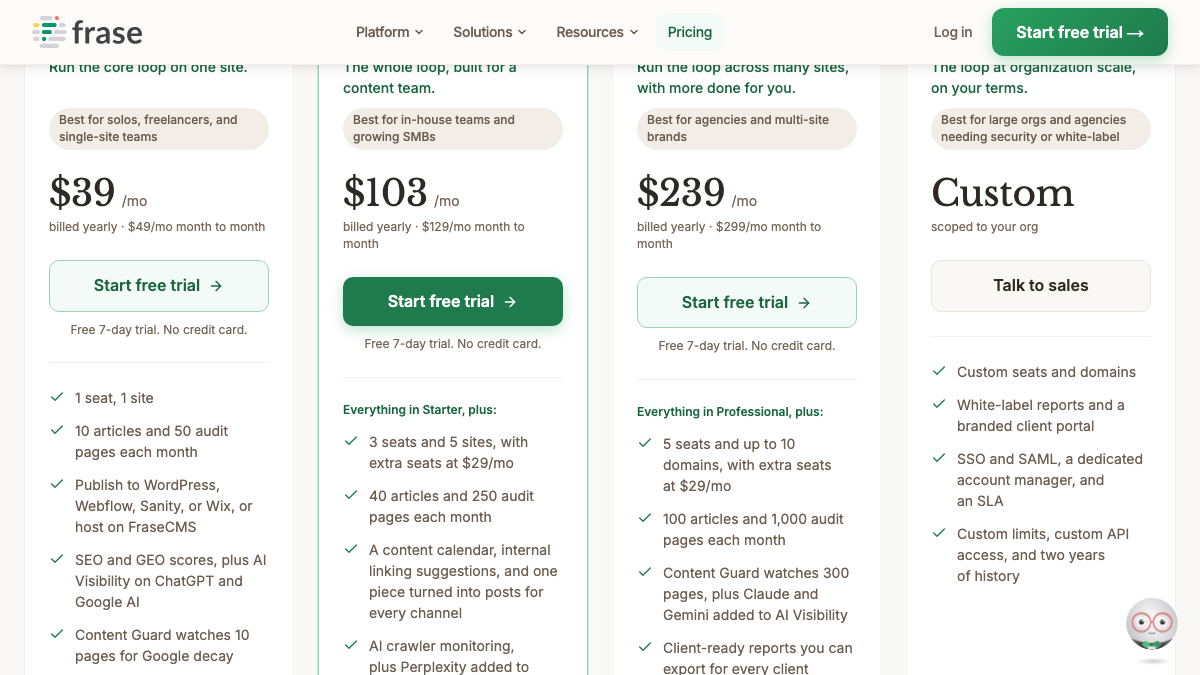
Each plan comes with an agent that drafts articles and, if you let it, publishes them. The pricing page says the agent publishes "on every plan, on any content type, whenever you switch it on." Your monthly article allowance is the only cap. You also get an MCP server, a command-line tool and an API on every plan, even during the trial.
Frase's own posts describe the product as a relay that hands work from research to publishing, and AI visibility tracking is one of the steps. The newest piece is Frase Answers, released on June 24. It's a widget on your site that answers visitors' questions from your published content. It also records each question in the visitor's own words. Frase treats those questions as the first step of its loop.
Week one on each tool
Neither tool asks you to write a brief by hand anymore. For Frase, that's a long way from where it started. Setup begins in its Brand Hub. Since a May 21 update, running the site analysis builds a brand voice profile and a view of your competitors, with no manual setup. The research flow Frase released in April brings AI visibility into every research session.
RankControl's first week follows a similar path. Brand Control reads your site and drafts your voice, products, buyers and competitors, and you correct whatever it got wrong. Then the planner turns your tracked questions into titles on a calendar.
The first citation check runs across all six engines while you're still setting up the workspace. I like that order. You start with a reading before the first article is written.
AI visibility: engines and cadence
Frase checks your tracked prompts every day and sends alerts. The engines depend on your plan:
| Frase plan | Prompts tracked | Engines |
|---|---|---|
| Starter | 50 | ChatGPT and Google AI |
| Professional | 200 | Adds Perplexity |
| Scale | 500 | Adds Claude and Gemini |
Frase's docs treat Google AI as a single group, so AI Overviews and AI Mode aren't split out. No plan names Grok or Copilot.
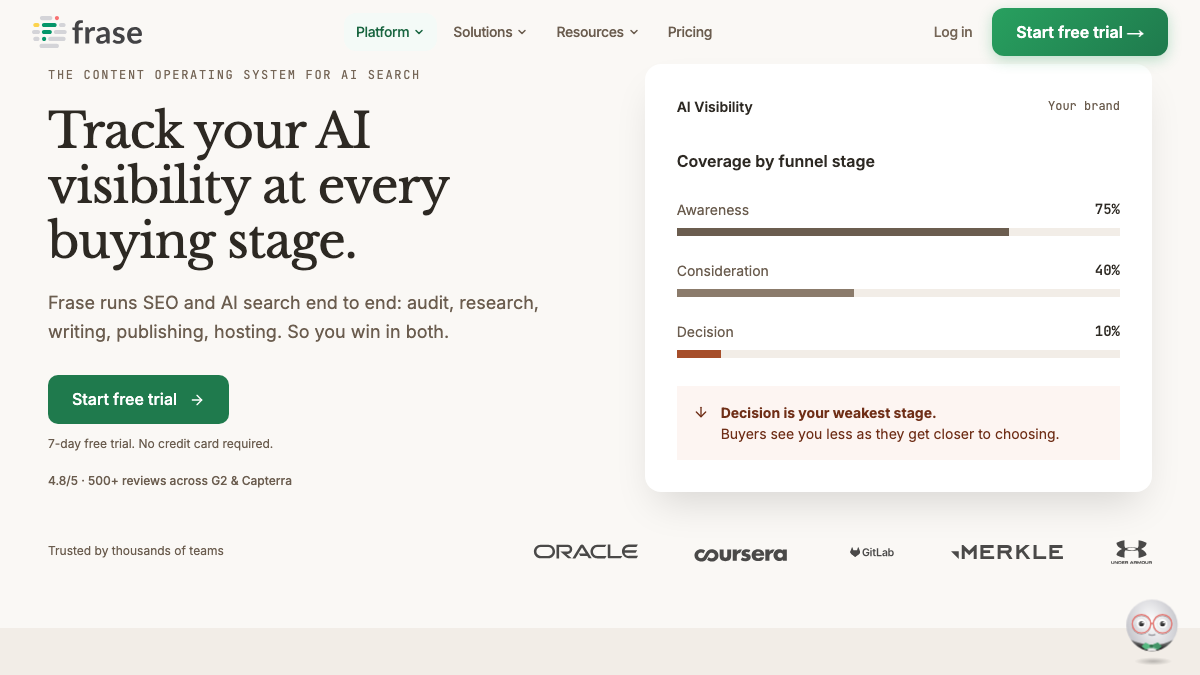
The reports go further than whether you showed up. Frase sorts each prompt into awareness, consideration or decision and gives you a score at every stage. It records which of your URLs got cited and in what position. It compares your citation rate with your industry's median, and it lets you target each prompt to one of more than 40 countries.
Frase's own writing draws a line I find useful: being missing from AI answers is one problem, and showing up but losing to competitors is another, with a different fix.
RankControl reads fewer answers but covers more engines, all on its only plan. Your 50 tracked queries run every week on six engines, and Grok and Google AI Mode each get reported on their own. A new citation triggers a notification, and the dashboard shows who each engine cites and how you compare with up to 10 competitors. If your buyers use Claude, Frase means paying for Scale. If they use Grok, no Frase plan will show it to you.
Writing, publishing and Content Guard
Both tools write in your brand's voice, and both publish without anyone copying and pasting. Frase publishes to WordPress, Webflow, Sanity and Wix. RankControl's content engine plans each article from the questions you're losing. It publishes to one of nine destinations, with Shopify, Ghost and headless sites among them. Auto-publish starts off, so articles wait for your approval until you change that.
Blog posts are only part of the output on either side. Frase's May update brought 16 content types, each with its own GEO scoring. FraseCMS can also give alternatives pages, reviews and FAQs their own index pages and feeds. RankControl writes 26 content types, comparisons and glossaries among them, and it covers 23 languages across 33 markets. If you sell in several countries, that means one workspace per site in the local language.
The Frase feature I'd point to first is Content Guard. It watches your published pages for rank decay in Google and drafts better titles, headings and internal links. If you allow it, it applies the safe fixes on its own.

You're getting AI traffic. But do you know where it comes from?
RankControl credits every visit to the assistant that sent it: ChatGPT, Perplexity, Claude, Gemini, Copilot, or Grok. Full source attribution, next to your Google traffic.
The landlord test
Frase also has a publishing option of its own: FraseCMS, a hosted blog. It's free on a Frase subdomain. Pay $19 a month and it moves onto your own domain or a subdirectory like yoursite.com/blog. On a custom domain, Frase handles the SSL certificate and DNS for you.
The docs explain how the subdirectory version works. The setup "uses a reverse proxy connection between your website and Frase CMS." Readers see the pages on your domain, but Frase's servers still hold and serve them. To get posts back out, the docs describe per-article downloads and an API, with no bulk export button. They don't say what happens to those URLs if your subscription ends.
I call this the landlord test: whose server holds the article your AI citations point at? RankControl has no hosted blog. It publishes ordinary posts into your own CMS, so they stay where they are if you leave. Frase passes the same test when it publishes to WordPress or Webflow, which leaves FraseCMS as the only place the question applies. I'd ask it before a year of articles goes there. Our guide to switching from Frase covers getting FraseCMS content out.
Links and outreach
An independent SEO consultant on r/seogrowth once asked whether brief and optimization tools like Frase help with AI citations. The top reply said no tool can game them. Engines cite pages that are well structured and answer the question clearly, on sites with topical authority, and part of that authority comes from other sites mentioning you.
What are your experience using content optimization tool?
Does anyone find content optimization tools like Frase, Surfer SEO, or Clearscope help with AI citations? A bit of context: I work as an independent SEO consultant, and the briefs I prepare for content writers consistently help us rank well...
Frase's Backlinks module looks for prospects in competitor gaps and adjacent products, spots unlinked mentions and drafts a personalized email for each prospect. Then the docs get direct: "prospect outreach must be copied and sent outside of Frase." You get one scan per billing period, and it covers the 1,000 highest-ranked referring domains.
In RankControl, Link Control works one article at a time. For each article it publishes, it finds sites worth pitching and a contact at each one. It drafts the email and sends it from your own mailbox once you approve. Follow-ups stop as soon as someone replies. If you'd rather not run outreach at all, Managed Backlinks adds five placements a month from DR 25+ sites for $350.
History and reporting
How far back you can look in Frase depends on your plan:
| Frase plan | History you can see |
|---|---|
| Starter | Current data only; AI Visibility keeps its own 30 days |
| Professional | Three months |
| Scale | A year |
| Enterprise | Two years |
So on Starter you see today's numbers plus 30 days of AI Visibility history. AI crawler monitoring starts on Professional, and Scale adds reports you can export for clients. Frase can also connect to GA4 to count the visits AI assistants send you. It logs AI crawler activity through a snippet you add to your site.
RankControl keeps its history on the one plan. Its analytics show AI-referred visits by source and which AI crawlers read your pages, and paying workspaces get a weekly email brief of what changed.
Pricing and what the difference buys
Frase costs less on every plan. The closest comparison is Scale, since that's where Claude and Gemini come in. Scale costs $299 a month, or $239 billed yearly, and RankControl is $400.
So what does the extra $101 a month get you? It buys Grok, plus Google AI Mode reported on its own line. It also buys outreach that gets sent instead of drafted, and publishing to nine destinations with no hosted layer in between. Drop to Frase's lower plans and the engine gap widens, since Starter covers ChatGPT and Google AI only.
Both tools include an MCP server on every plan. Frase's can publish after Claude checks with you the first time it uses each tool. RankControl's MCP server runs its publish step as a dry run until you confirm.
We'll show you exactly where your brand stands in AI search.
No commitment. $0 due today, cancel anytime. See how ChatGPT, Perplexity, Claude, Gemini, Grok, and Google AI Mode talk about your brand today.

Trials, cancelling and refunds
| Frase | RankControl | |
|---|---|---|
| Trial | 7 days, no card; Professional features for up to 3 seats, capped at 5 articles and 25 AI prompts | 7 days, card up front, $0 charged during the week |
| Changing plans | Upgrades prorated on the spot; downgrades wait for the next billing cycle | One plan |
| Refunds | None, per its Terms of Service | None for unused time |
| Term | One-year initial term that renews unless either side gives 30 days' notice | Cancelling takes effect at the end of the paid period |
Frase's trial is the easier one to start, since it doesn't ask for a card. The part I'd read twice is the Terms of Service. They say "all fees paid are final, and we do not provide any refunds," and they describe a one-year initial term that renews unless either side gives 30 days' notice.
Yet the pricing page talks about switching between monthly and yearly billing at any time. The public docs don't explain how that squares with a one-year term, so if you're about to pay for Frase, ask which one applies to you.
RankControl doesn't refund unused time either. Cancelling takes effect at the end of the paid period.
RankControl vs Frase: which wins AI search visibility?
Both tools run the same loop, so I'd judge them on the parts of it that decide whether AI engines cite you.
Start with the engines. RankControl tracks all six of its engines on its one plan, and Frase's lower plans narrow that list. Then look at where the articles end up: RankControl's go into your own CMS as native posts, but anything on FraseCMS sits on Frase's servers. Outreach is the last gap, because Frase's stops at a draft and RankControl sends what it drafts. For teams that want those three covered without adding another tool or another person, RankControl wins AI search visibility.
You can close those gaps yourself by pairing Frase with a separate tracker and someone to send the outreach. Or RankControl can run the whole loop every month for $400, with a 7-day free trial. Before you decide, the free AI visibility check shows who ChatGPT cites for three questions from your market.
Know exactly what AI says about your competitors.
RankControl's Recon Agent monitors competitor citations across ChatGPT, Perplexity, Claude, Gemini, Grok, and Google AI Mode. See where they show up and you don't.