
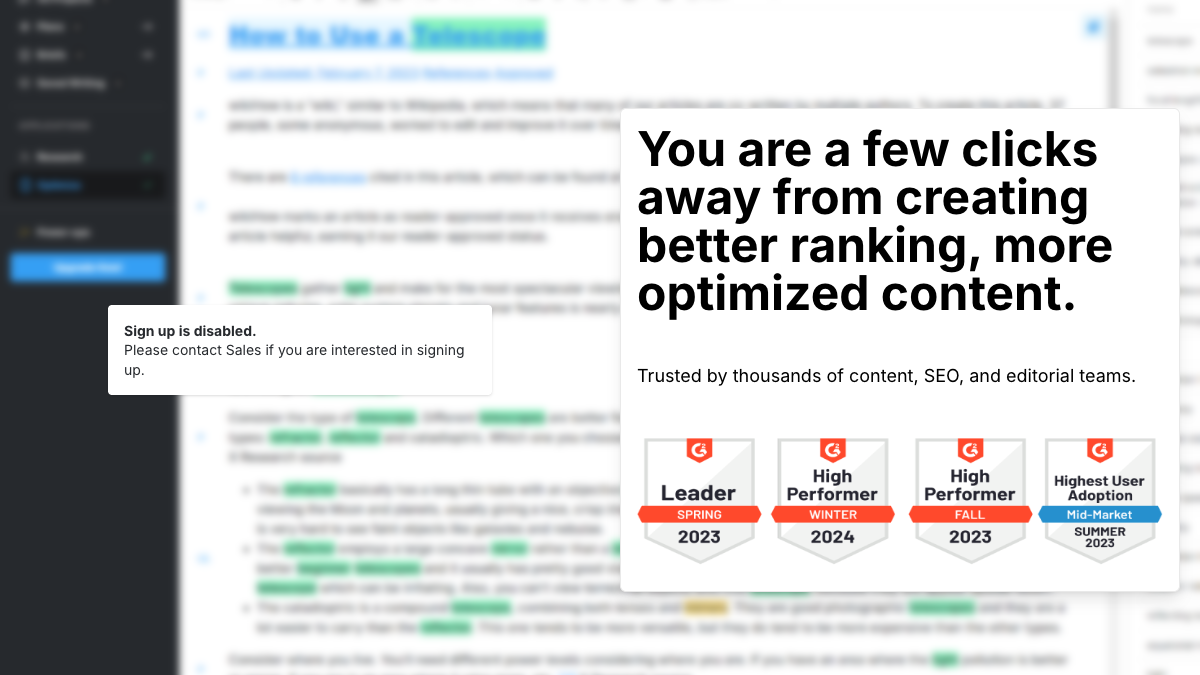
We tried to sign up for MarketMuse on September 26 so we could check its current plans. The signup page answered with a single line: "Sign up is disabled. Please contact Sales if you are interested in signing up." The pricing page lists four tiers, and every one of them ends in a Book a demo button with no price attached.
That's a strange spot for a tool so many content teams learned SEO on. MarketMuse still does what it's known for, which is topic research, content briefs and a map of where your site has authority. It's been owned by Siteimprove since late 2024.
What it hasn't done is follow its users into AI search: none of its product pages mention ChatGPT, Perplexity or Google's AI Overviews. If your question has moved from "what should we write?" to "will AI answers quote us?", these are the seven MarketMuse alternatives we'd look at, with RankControl first.
The short list
Every price below comes from each vendor's own site, checked on September 26, 2026.
| Tool | Best for | Starting price | AI engines tracked | Publishes to your CMS |
|---|---|---|---|---|
| RankControl | Teams that want articles written, published and tracked | $400/mo, one plan | 6, all included | Yes, 9 destinations |
| Frase | A brief, an editor and a GEO score in one tool | $49/mo ($39 yearly) | 2 on Starter, 5 on Scale | WordPress, Webflow, Sanity, Wix |
| Surfer SEO | Editing to a content score | $59/mo ($49 yearly) | None on Discovery, 5 on Pro | WordPress only |
| NeuronWriter | Tight budgets | $23/mo ($19 yearly) | Up to 4, small quota | WordPress, plus Shopify on Gold |
| SurgeGraph | Agencies running AEO for clients | $39/mo | 2 to 5, by plan | WordPress only |
| Search Atlas | Agencies that want one SEO suite | $99/mo ($79 yearly) | None on Starter, 5 on Pro | Yes |
| AirOps | Enterprise teams buying a managed program | Not published | 1 on Solo, "7+" on Pro | Yes |
Why teams go looking for MarketMuse alternatives
The first reason is buying friction. With no public prices and self-serve signup switched off, every evaluation starts with a sales call, and the numbers floating around online are guesses. One Reddit roundup this year put MarketMuse at $99 a month; the company's own page doesn't confirm that or any other figure.
The second reason is that a brief costs almost nothing to make now. In March a thread on X with nearly 29,000 views walked through building one for free: open the top five ranking pages, paste them into Claude or ChatGPT, and ask for every heading, entity and question they share. The author put the job at about ten minutes.
A July thread on r/SEO asked the same thing from the other side, wondering whether people still write briefs at all or just ask an AI for the outline, and whether paid tools catch anything the chatbots miss.
Do you guys still make a content brief or does chatgpt, claude or gemini just do that now?
Curious how other SEO/content folks handle this. Before writing something that needs to rank, do you still plan it first? check what's ranking, people also ask type questions, headings? Or is it just "AI (gpt/claude/geminoi) give me an outl...
MarketMuse's topic modeling does still run deeper than a pasted prompt, and we compare the two approaches head to head in RankControl vs MarketMuse. Personalized Difficulty scores how hard a topic is for your site specifically, and the Strategy tier offers nine brief types across 10,000 tracked topics.
The third reason is the one that matters for this list. Ahrefs looked at 863,000 keyword results for a March 2026 study and found that just 37.1% of the pages cited in Google's AI Overviews also ranked in the top 10 blue links. A brief built from the top five results tells you how to rank. It says little about whether an AI answer will quote you, and MarketMuse doesn't measure the answers at all.
Know exactly what AI says about your competitors.
RankControl's Recon Agent monitors competitor citations across ChatGPT, Perplexity, Claude, Gemini, Grok, and Google AI Mode. See where they show up and you don't.

The 7 best MarketMuse alternatives for AI search visibility
We ranked these by how much of the job each one takes off your plate, from planning through to knowing whether AI engines cite the result.
1. RankControl
MarketMuse hands you a plan and a brief, and then your team does the rest. RankControl picks up where that stops. You name up to 20 pillar topics. It keeps a scored backlog of content ideas drawn from the questions your buyers actually search and puts titles on a calendar. Then its content engine writes each article in your brand's voice against the pages already ranking for the keyword, scores it for how easily AI engines can quote it, and links it into pages you already have.
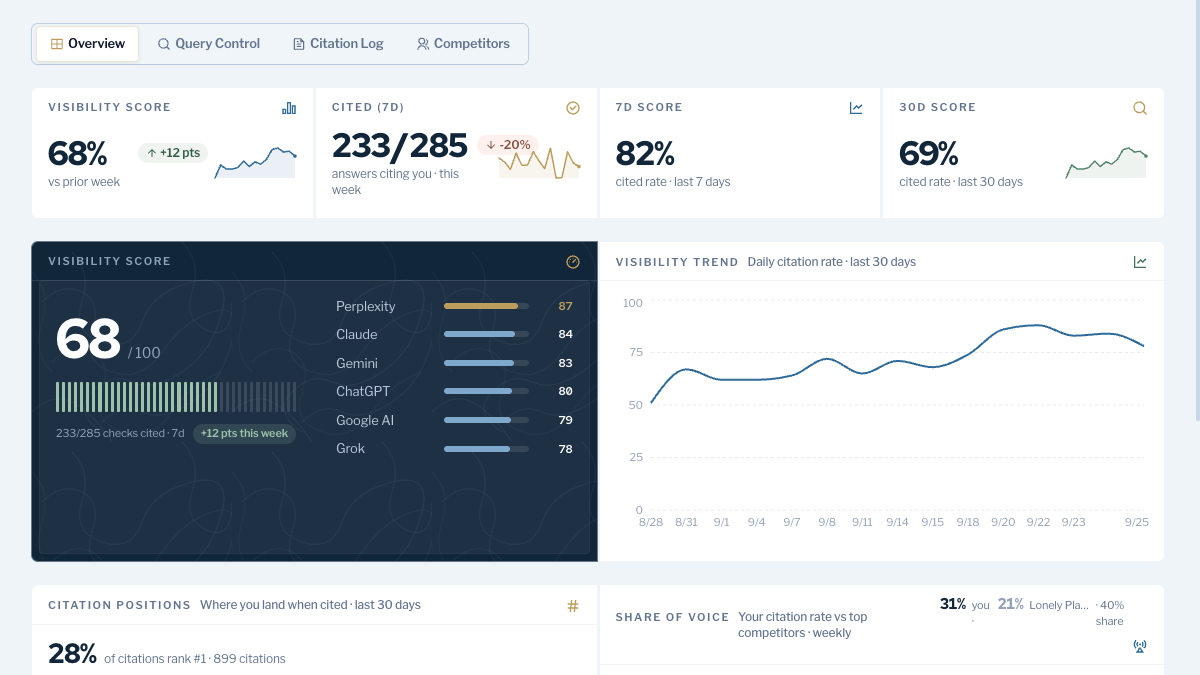
Articles go out as native posts through the destination you connect, WordPress, Webflow and Shopify among them. AI visibility tracking then checks 50 queries every week across six AI engines, Claude and Grok included, and Link Control drafts backlink outreach from your own mailbox.
It's one plan at $400 a month, or $4,000 a year, covering 100 pages a month and five seats. There's a 7-day free trial, and auto-publish stays off until you switch it on.
2. Frase
| Frase | |
|---|---|
| Price | Starter $49/mo ($39 yearly), Professional $129/mo ($103 yearly), Scale $299/mo ($239 yearly) |
| AI engines | ChatGPT and Google AI on Starter; Perplexity added on Professional; Claude and Gemini only on Scale |
| Publishing | WordPress, Webflow, Sanity and Wix |
| Trial | 7 days, no credit card |
Frase is the closest thing to a MarketMuse replacement that also moved into AI search. It still starts from research that ends in a brief, but the editor now shows separate SEO and GEO scores, and it can publish and draft link outreach too.
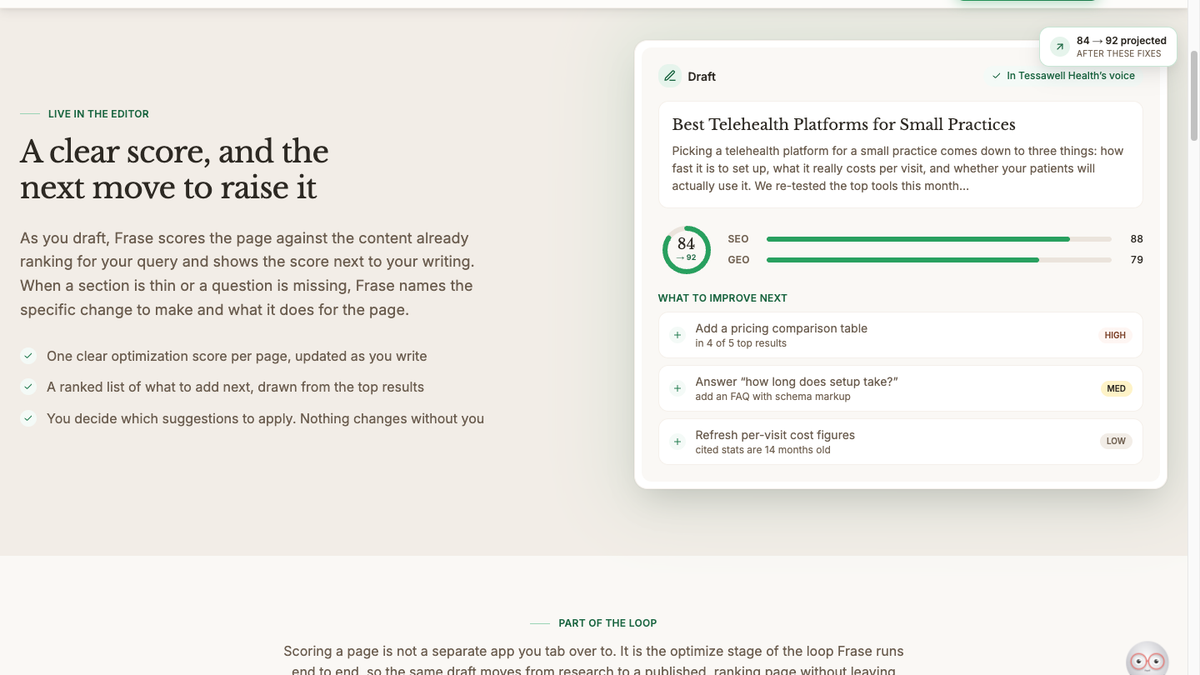
The catch is the engine gating. Full five-engine tracking waits on the $299 Scale plan, and Grok isn't on any tier. We covered its plans in more depth in our Frase alternatives roundup.
3. Surfer SEO
Surfer now calls itself Positive Surfer on its own site, and the pitch has shifted from content scores to AI visibility. The editor is still the reason most writers pay for it: a live 0 to 100 content score benchmarked against the top pages, an outline builder for briefs, and one-click optimization from the Standard plan up.
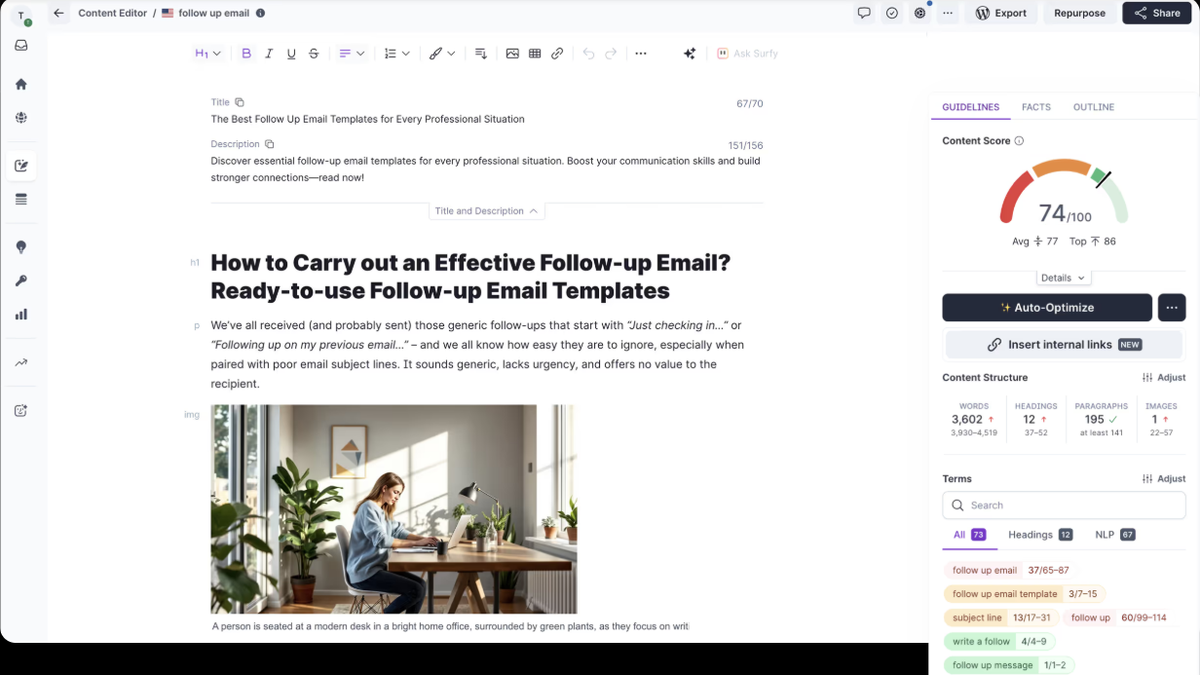
The AI Tracker follows five models, and Claude and Grok aren't among them. Coverage depends on the plan. Discovery at $59 a month tracks nothing, Standard at $119 checks 25 prompts weekly in ChatGPT only, and all five models need Pro at $219 or the tracking-only AI Search Analytics plan at $95. Publishing runs through its WordPress integration, and no other CMS gets a native push. Our Surfer SEO alternatives list has the full breakdown.
4. NeuronWriter
NeuronWriter is the budget pick. Bronze costs $23 a month, or $19 billed yearly, for two projects and 25 content analyses. The editor suggests terms from the top Google results and scores your draft against them, and the Gold plan adds a content plan with new ideas.
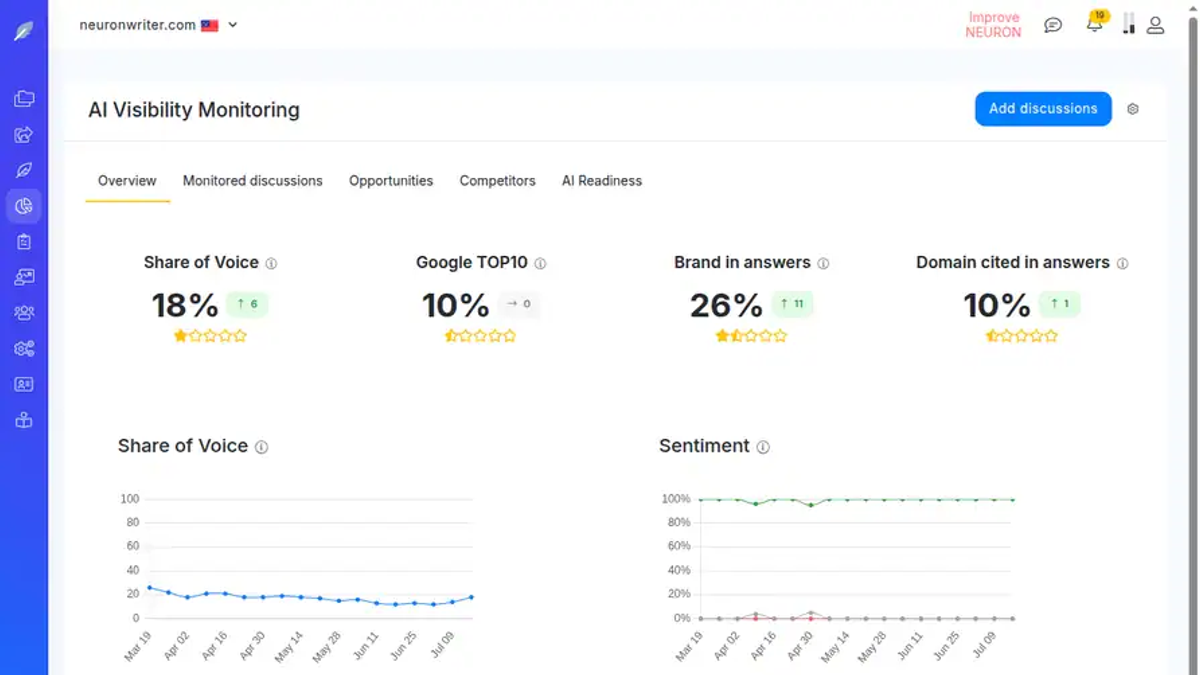
AI monitoring is included, but the quota is small: five questions on Bronze, 20 on Diamond at $117 a month, with a paid add-on from $9 for ten more. It covers ChatGPT and Perplexity plus Google's AI Overviews and AI Mode. The 7-day trial unlocks Gold features and doesn't ask for a card.
5. SurgeGraph
SurgeGraph has repositioned hard. Its homepage now calls it an AEO ranking engine for agencies, and the plans are priced by client load: Spark at $39 a month, Scale at $79 and Signature at $129.
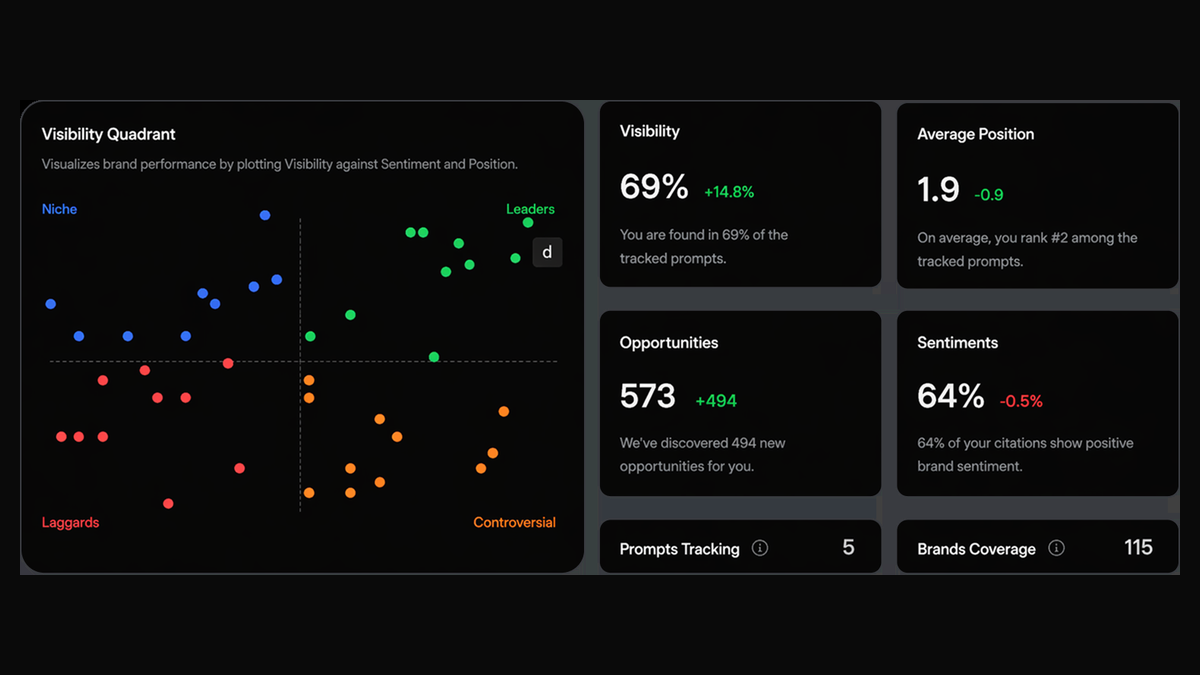
For MarketMuse users, the familiar parts are topic coverage maps and bulk generation from a keyword list. The AI tracking is gated tightly. Spark checks ChatGPT and Google AI Overviews every five days, Scale adds Perplexity on a three-day cycle, and only Signature adds Gemini and Google AI Mode with daily updates.
Its FAQ says it tracks "four AI engines directly" while the rest of the page says five, so ask which count applies before you sign. Publishing is WordPress only, and there's no free trial, just a 14-day money-back guarantee. We go deeper on its credits and engine gates in RankControl vs SurgeGraph.
6. Search Atlas
Search Atlas is a full SEO suite, so it replaces more than MarketMuse ever did: technical fixes through its OTTO agent, rank tracking, an AI writer called Content Genius, and separate link-building products. Every plan publishes to your CMS, WordPress, Shopify and Webflow included.
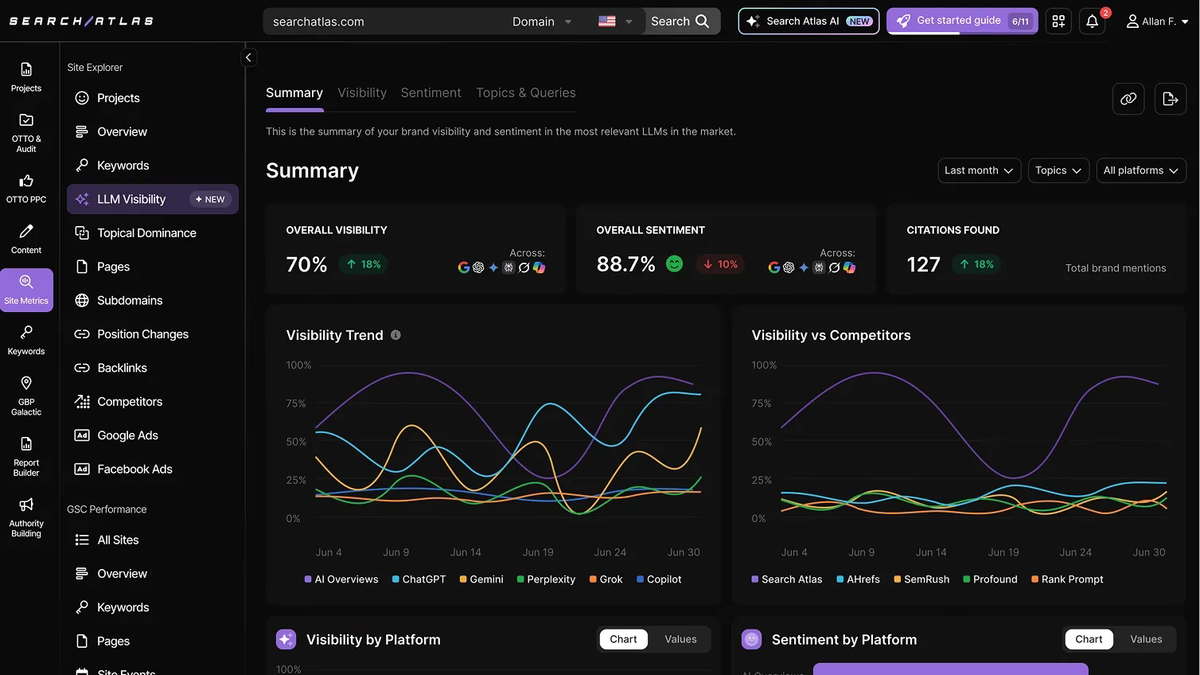
LLM Visibility is where the price climbs. Starter at $99 a month ($79 yearly) has none. Growth at $199 ($159 yearly) tracks ChatGPT, Gemini and Google AI Mode, and Pro at $399 ($319 yearly) adds Copilot and Perplexity. There's a 7-day trial with an onboarding call.
7. AirOps
AirOps is the other sales-led option here, and it goes further than MarketMuse on hiding prices. Its pricing page lists Solo, Pro and Enterprise without a single dollar figure, and most paths end at "Work with us". Solo includes ChatGPT insights only, Pro promises insights across "7+ answer engines", and Enterprise adds custom prompts, regions and languages.
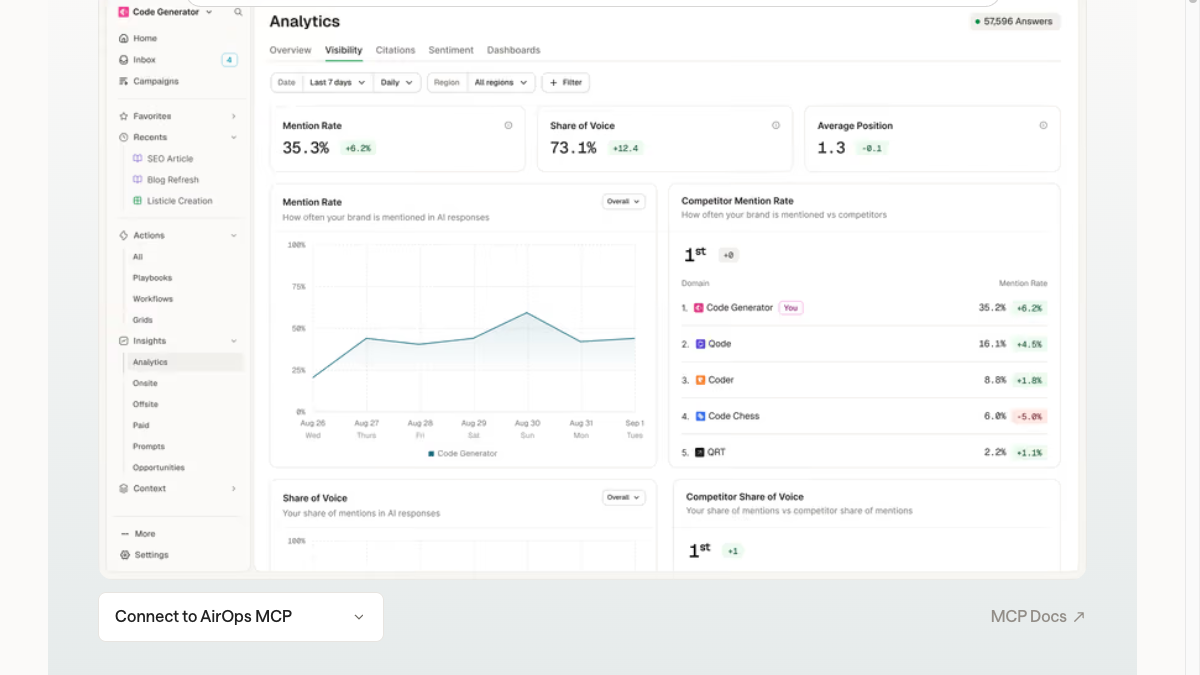
What you get is a content workflow platform with a hands-on team attached. It connects to WordPress and Webflow along with Shopify, Contentful, Sanity and HubSpot, it runs brand kits and knowledge bases for production, and its team does placement work on third-party sites. You can start free without a card, but the real price only appears in a sales conversation, which is the same friction that sends people away from MarketMuse.
26 content formats. Published on your domain. Matched to your brand.
Guides, comparisons, listicles, case studies, and more. RankControl generates content that gets cited by ChatGPT, Perplexity, Claude, Gemini, Grok, and Google AI Mode.

What a brief leaves out
A brief is the first hour of a piece of content. Here's roughly what the rest takes when a tool stops at the brief, per article:
- Write the draft from the brief: three to four hours.
- Edit it against your product and brand, and add sources: about an hour.
- Add internal links, images, a meta description and FAQ markup: about an hour.
- Publish it in your CMS: 20 minutes.
- Pitch a few relevant sites for a link or a mention: two to three hours.
That's seven to nine hours after the brief is done. At eight articles a month you're looking at 55 to 75 hours of work that a planning tool never touches. These are our estimates, and your numbers will differ.
Then comes the part no brief covers. Once a page is live, somebody has to check whether ChatGPT, Perplexity and Google's AI Mode cite it, and whether they still do two months later. Across 50 queries and six engines, that's 300 answers a week to read.
You can do all of this by hand: build the brief, write and publish the page, pitch the links, and reread the answers every week. Or RankControl's agents can run it for you every month, starting from a brand profile built from your own site, while you focus on your product. It sends a notification when a new citation lands, and a lost one shows in the citation history on your dashboard.
If you also need AI citation tracking
MarketMuse plans content. It doesn't tell you whether ChatGPT cites what you published. Surfer SEO adds an AI Tracker for five engines on higher plans. Search Atlas includes LLM visibility from its $159/mo Growth plan, and SurgeGraph has plan-gated AI tracking. RankControl writes and publishes, then checks 50 queries weekly on six AI engines, for $400/mo. For planning plus citation tracking in one tool, the best pick is RankControl.
Which MarketMuse alternative fits your team?
If a sales call for every tool has worn you out, start with the ones that show a price and a trial.
- You want the articles written, published and tracked across six AI engines: RankControl.
- You want a brief and an editor with a GEO score, and you'll write yourself: Frase.
- Your writers already work to a content score: Surfer SEO.
- The budget is under $50 a month: NeuronWriter.
- You're an agency reporting AEO to clients on WordPress: SurgeGraph.
- You want technical SEO, content and ads in one suite: Search Atlas.
- You're an enterprise team that wants a vendor's staff on the program: AirOps.
Before you leave MarketMuse, export what you've built. Its help center says exports work module by module, from Topic Navigator and SERP X-Ray through Heatmap, Connect, Optimize and Newsroom, and every file comes out in Excel format. Our guide to switching from MarketMuse walks through each module, plus briefs and cancelling.
The pick for AI search visibility
For AI search visibility, we'd pick RankControl.
MarketMuse is still a thoughtful planning tool, and Frase and Surfer both do the brief and the editor well. But the brief was never the expensive part. The hours sit in writing, publishing, earning links and checking the answers every week. RankControl runs all of that for one flat price with six engines included from day one. Frase comes closest on the loop, but its Claude and Gemini tracking waits on the $299 Scale plan.
Not sure where you stand yet? Run a free check of your brand in AI answers, then use the 7-day trial to see a month of planned titles before you pay anything.

Your competitors are getting cited by AI. You're not.
Every day without citation tracking is a day your competitors pull ahead in ChatGPT, Perplexity, and Claude.