
Type a keyword into NeuronWriter and you get a score for your draft, measured against the pages ranking on Google, plus a list of terms you haven't used yet. Few good content editors cost less. Since late 2025 it has tracked AI visibility too, which is why a buyer in 2026 might put it next to RankControl.
They want different things from you, though. NeuronWriter hands you a number to write toward, and if you like tuning every draft yourself, you'll probably enjoy that. RankControl does the writing. We publish the pages on your site and pitch them to other sites, and seven AI engines get checked every week. RankControl is meant for teams that want the articles planned and written, then published and followed up, without anyone sitting in an editor seat.
For NeuronWriter I relied on its own pricing page, feature pages and help FAQs, which I went through on September 26 and 27, 2026. If you've already decided to move, the NeuronWriter switch guide covers the exports.
RankControl vs NeuronWriter at a glance
| RankControl | NeuronWriter | |
|---|---|---|
| Price | $400/mo or $4,000/yr | $23 to $117/mo; $19 to $97 yearly; lifetime from $179 |
| AI engines | 7, weekly, including Claude, Gemini and Grok | Google AI Overviews and AI Mode; ChatGPT and Perplexity by add-on |
| Tracked questions | 50 | 5 to 20 included; up to 1,000 with the add-on |
| Content | Up to 100 pages a month, written and published | An editor and score; Content Designer drafts on Gold+ |
| Publishing | Native posts on 9 destinations, auto-publish off | WordPress on Gold+ |
| Outreach | Finds contacts, sends from your mailbox after approval | None |
| MCP | 80+ tools; publishing is a dry run until confirmed | About a dozen tools on Gold+ |
| Refunds | Cancel at period end, no pro-rated refunds | First plan refundable within 30 days |
What NeuronWriter is in 2026
Conti, the company behind NeuronWriter, is based in Zamość, Poland. The product built its reputation as the low-cost alternative to Surfer, and AppSumo sold a lot of it as a lifetime deal. Its center is still the editor. Give it a keyword and it pulls terms from up to the top 30 Google results, then gives your draft a content score out of 100 and flags any term you've leaned on too hard.
You can add up to five competitor URLs of your own. Language support looks huge at 170, but entity suggestions only cover 19 languages.
The past year piled quite a bit on top of that editor:
| When | What NeuronWriter added |
|---|---|
| November 2025 | The AI Score and the AI visibility module, together |
| May 2026 | An MCP server |
| June 2026 | A single Optimization tab |
The lifetime deals haven't gone away either. NeuronWriter sells them from its own site now, from $179 up to $895, and its AppSumo listing shows every tier sold out. In an April r/SEO thread about Surfer alternatives, one user who had tried NeuronWriter years ago called it a cheaper Surfer clone that seemed to have pivoted to AI.

The first week on each tool
Both trials last seven days, and NeuronWriter's mostly answers one question: do you like writing to a score? It needs no card and opens Gold features, but with a cap of three analyses, so spend them on keywords you actually plan to publish. Each query is also pinned to one Google country and language, which is worth settling before you use up an analysis on the wrong market.
Once a project is set up and a keyword queried, you write or paste a draft and watch the score move. For AI visibility you add up to 10 brand or product names and pick the questions it should monitor.
On our side, the first week is mostly correcting rather than typing. We take the card at signup and charge $0 that day. RankControl reads your site and drafts your brand profile, products, buyers and competitors, and your part is fixing what we got wrong. Once your CMS is connected and you've added up to 50 questions and 10 competitors, the first weekly check runs across seven engines while the planner builds a calendar from the questions you're losing.

Built by the team that got cited in 48 hours.
Content generation, backlink building, AI visibility tracking, and Google rankings. One platform, zero guesswork.
The price gap
NeuronWriter's five plans cost far less than ours, but look at where the useful parts start:
| NeuronWriter pricing | What you pay |
|---|---|
| Monthly plans | $23 to $117 a month, about 17% less billed yearly |
| Gold (WordPress publishing, Search Console, API and MCP, plagiarism checks, team sharing, Content Designer) | $69 a month |
| Lifetime plans, paid once | $179, $537 or $895 |
| Advanced add-on for ChatGPT and Perplexity | $9 a month for 10 questions, $43 for 50, $769 for 1,000 |
Gold is the plan I'd price against, since below it you get no publishing and no Content Designer. Analyses don't roll over from month to month, either.
The bigger jump comes with answers from outside Google. ChatGPT and Perplexity arrive only through the add-on, so 50 questions on those two engines on top of Gold puts you at about $112 a month, with Claude, Gemini and Grok still unwatched.
RankControl is one plan at $400 a month, or $4,000 if you pay for the year. That covers 50 questions checked weekly on seven engines and up to 100 pages a month written and published, with link outreach and five seats included.
RankControl vs NeuronWriter on AI visibility
If you're on any NeuronWriter plan, you already have what it calls AI Visibility Standard. It watches Google's AI Overviews and AI Mode for 5 to 20 questions, depending on the plan, and nothing else. ChatGPT and Perplexity cost extra through the Advanced add-on, while Claude, Gemini and Grok answers aren't tracked at all. The one place Claude does turn up is as ClaudeBot, in a crawler-access check.
That check belongs to an AI Readiness audit, which tests whether GPTBot, ClaudeBot and PerplexityBot can reach your site. For the answer tracking you hand NeuronWriter up to 10 brand or product names. Checks then run "typically every 24–48 hours," to use its own phrase. Every question you monitor comes back with a visibility score and a sentiment reading.
You also get a list of opportunities, and some carry an "earn mention" label. Those are pages AI already cites where your brand could get a mention, and each one sits in a to-do status that you move along by hand.
RankControl checks less often and asks more engines. Your questions go out once a week to seven engines: ChatGPT, Perplexity, Google AI Mode and Google AI Overviews, plus the three NeuronWriter leaves out, Claude, Gemini and Grok. For each check you see which competitors were named where you weren't and which sources the answer quoted. A new citation sends you a notification as well.
The score ceiling
In NeuronWriter you're pushing two numbers up. One is the content score, which checks how well your draft covers the terms Google's top results use. The other is the AI Score. Each check of it costs 100 AI credits, and it grades six parts of the draft, among them topic coverage, how dense your facts and sources are, and whether your opening answers the question.
Both scores stop at the draft. They grade what you wrote, and neither can see whether any engine cites the page once it's out there, a gap I call the score ceiling. You could get a draft to 100 on both and still never find it in an AI answer, because readiness is all they measure. A citation needs the page live on your site and other sites mentioning it. It also depends on which questions buyers ask in the first place.
For hands-on editing, NeuronWriter does go further than RankControl. Its score updates while you type, with term ranges and internal link suggestions next to it, and you get plagiarism checks and read-only share links for clients. If a writer does the final pass anyway, the AI credits on Gold ($69) stretch to roughly 56 Content Designer drafts a month.
Content and publishing
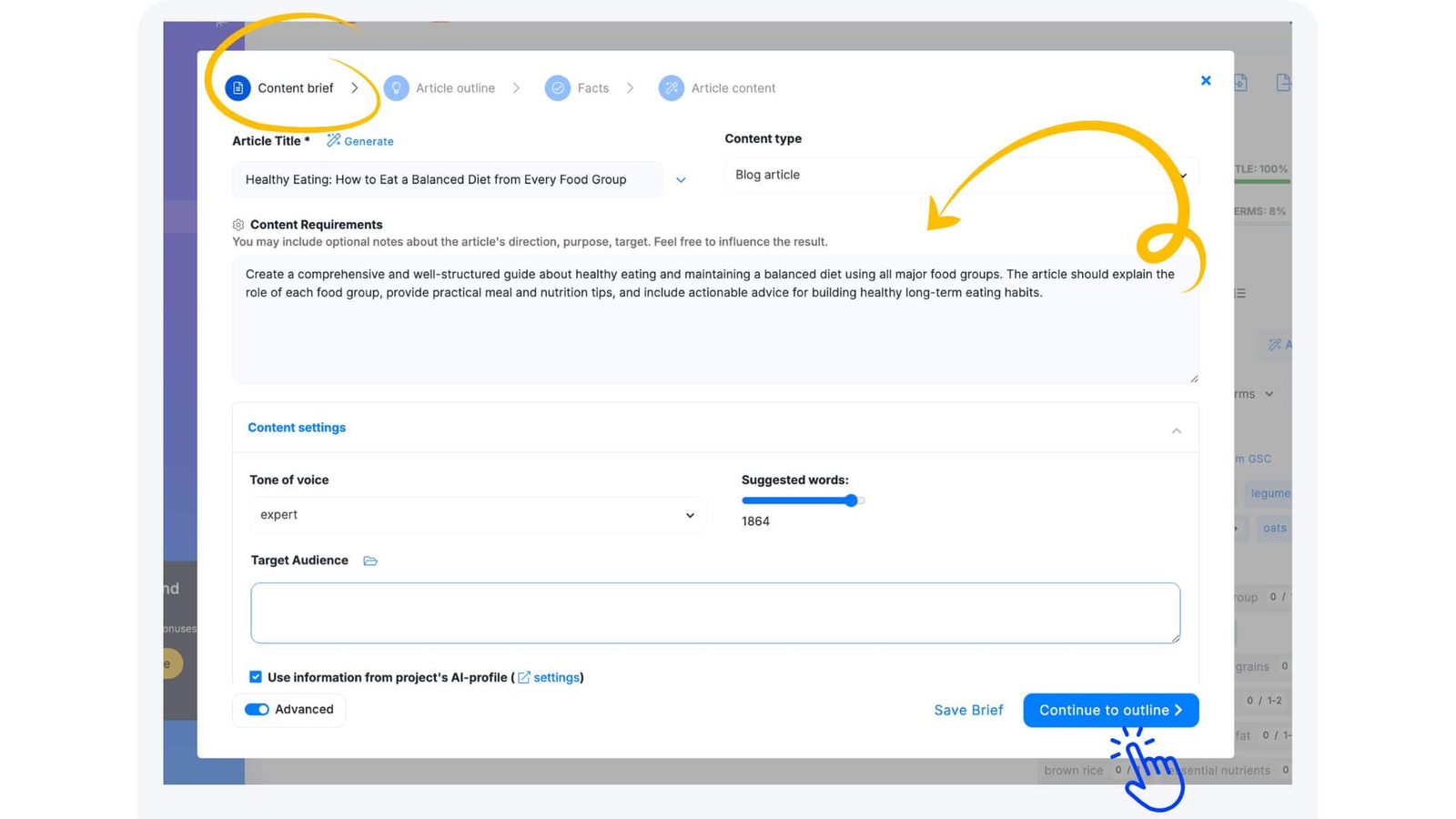
The Content Designer is NeuronWriter's drafting tool, on Gold and above. It takes an article through four steps, from a brief and outline to facts and the finished article, and you can hand it up to five URLs or three documents to work from. Budget about 800 AI credits for a 1,500-word article. Each run writes one article inside one query, with models it picks for you.
Publishing stops at WordPress, which NeuronWriter reaches through an application password from Gold up. Shopify and Google Docs show up on the pricing page too, but that support is a Chrome extension that shows suggestions while you write in those editors. NeuronWriter's own Shopify page says you can paste content in "even without a direct integration."
So for most teams NeuronWriter ends up as one step in a longer chain. A French founder laid out that setup in November: SE Ranking for keywords and position tracking, NeuronWriter for each article's structure and ChatGPT for the writing. Backlinks were bought separately, and over 30 articles the positions climbed slowly.
@LePublivor SeRanking - trouver les mots clés/suivre les positions NeuronWriter - donne la structure SEO d'un bon article ChatGPT - écrit l'article en se basant sur la structure + vos insights perso. Getfluence - achat de backlinks J'en suis à 30 articles pour mon site, les positions
 Mehdi@mehdichekkalNov 10, 2025
A July post in r/WebsiteSEO showed the same thing. Someone shared ten SEO tools they'd bookmarked for their own use, with NeuronWriter in the content optimization slot, and one reply suggested adding an AI visibility tracker for ChatGPT and Perplexity mentions on top.
A list of SEO tools I bookmarked for my own use, figured it might help someone else here
Keyword Research => SemrushStrategy Creation => NotionContent Writing => ClaudeFact Checking => PerplexityContent Optimisation => NeuronWriterLocal Citations => BrightLocalLinkbuilding => QwotedTechnical SEO Audits => Screaming FrogCrawling...
In RankControl, the content engine handles that chain in one place. The content engine plans titles from the questions you're losing and writes each article against the pages already ranking for its keyword, across 26 content types. Posts publish natively through one of nine destinations, and auto-publish stays off until you turn it on.
See your first AI citation report in under 5 minutes.
No setup calls. No onboarding meetings. Connect your domain and see where AI mentions your brand right now.

Planning and internal links
In NeuronWriter, a calendar entry is a query with an owner and a due date. When the date comes around, nothing goes live, so I'd think of it as a task tracker for a writing team. Ideas pile up in a Management section, and on Gold you also get suggested next topics with their search volume and competition.
Internal links get handled draft by draft. Auto-insert proposes anchors from Search Console data and AI, and you can take them one at a time or all at once. It costs nothing extra, but it only ever sees the article in front of it, so you never get a picture of how your whole site links together.
In RankControl the planner fills the calendar for you, from the questions you're losing and the topics you've set, and each article gets written with links into pages you already have. If you switch auto-publish on, every article goes out on its planned date.
Links and outreach
Link building isn't something NeuronWriter does. The closest it gets is the "earn mention" list in AI visibility, which names the cited pages and leaves the contact and the email to you.
Backlinks picks up from there in RankControl. For each published article Backlinks finds prospects and their contacts, and once you approve the pitch it goes out from your own mailbox, with follow-ups that stop when someone replies. Managed Backlinks adds five links a month from DR 25+ sites for $350, and the social agent drafts replies to live Reddit and X threads where one of your articles answers the question.
Working from Claude and analytics
Running NeuronWriter from Claude takes Gold, since that's where its MCP server lives. The help page lists 12 tools for projects, queries, recommendations and saved content, none of which can run the Content Designer or publish. Each new analysis created through it counts against your monthly limit, and there's a separate API with seven methods.
RankControl's MCP server has 80+ tools covering tracking, planning, writing and publishing, and anything that publishes through MCP stays a dry run until you confirm.
NeuronWriter's analytics are Search Console data on Gold and above: impressions, clicks, rankings and keyword cannibalization. Weekly SEO and AI email reports are on its roadmap. RankControl puts AI visibility tracking next to analytics that log AI crawler visits on your own domain and sync Search Console daily, and a weekly email sums up your new citations and ranking moves.
Trials, refunds and cancelling
Trial length is the same seven days on both sides, and the card is where they differ. NeuronWriter doesn't ask for one, while we do and charge nothing today.
NeuronWriter's pricing FAQ allows a refund on the first plan you buy within 30 days, and a cancellation takes effect when the paid term ends. Lifetime plans are a single payment. Cancelling RankControl also takes effect at the end of the billing period, with no pro-rated refunds, and the articles you've published stay in your CMS.
RankControl vs NeuronWriter: which wins AI search visibility?
For AI search visibility my pick is RankControl, because we do the work a score can't. We publish up to 100 pages a month on your own site, and from your mailbox we pitch the sites AI engines already cite. Every week you see which answers named you across seven engines, including three that NeuronWriter doesn't track.
As an editor, NeuronWriter is hard to beat on price, and its add-on keeps ChatGPT tracking cheap. A score is a checklist for a writer, though, and someone has to write and publish the page and then go earn the mentions.
You can run that loop by hand, or let RankControl's agents run it, starting with a 7-day free trial. If you want a baseline first, the free AI visibility check shows who ChatGPT cites today for three questions from your market.
Your competitors are building backlinks while you read this.
Organic outreach, social mentions, and citations from Editorial Circle member sites, with managed backlinks available as an add-on. Grow your domain authority without running the campaign yourself.