
You've probably shortlisted Pendium.ai because it does two things you need: it tells you how AI engines see your brand, and it writes content to improve that. On Pro, for $350 a month, it asks ChatGPT, Claude and Gemini to describe you, puts simulated buyer personas through the questions they'd ask and drafts articles aimed at the gaps. What gives me pause is where those articles go, which is a Site that Pendium hosts for you.
Tracking won't settle this one for you, since Pendium and RankControl both watch AI answers and both write. Hosting will, and so will what happens to an article after it's published.
I read Pendium's own pages and poked around its public demo account on September 26, 2026, and that's where every Pendium detail here comes from. If you're on Pendium now and planning to leave, the Pendium switch guide explains how to get your articles off the hosted Site.
RankControl vs Pendium.ai at a glance
| RankControl | Pendium.ai | |
|---|---|---|
| Price | $400/mo or $4,000/yr | Pro $350/mo or $3,540/yr; Managed $4,950/mo |
| Try it | 7-day trial, card up front, $0 today | One free baseline scan, no card |
| AI engines | 7, checked weekly | 7 on marketing pages; docs say standard scans cover 4 |
| Tracked questions | 50 | 20 to 40 suggested per topic; no published cap |
| Content | 100 pages a month, 26 content types | Paid in credits; no fixed number |
| Where articles live | Native posts in your CMS, 9 destinations | Pendium-hosted Site; optional mirror to WordPress, Webflow or Ghost |
| Outreach | Finds contacts, sends from your mailbox after approval | Drafts emails and Reddit comments for you to send |
| MCP | 80+ tools; publishing is a dry run until confirmed | MCP server and REST API on Pro |
| Refunds | Cancel at period end, no pro-rated refunds | Fees non-refundable |
What Pendium is in 2026
It helps to know who's behind a tool before you trust it with your content. Pendium was started by Dan Greenberg and Rob Fan, who both got in early at Sharethrough, a company in native advertising. The name may ring a bell from 2023, when Greenberg attached it to something else entirely, a tool that built a knowledge base for GPTs from your files. The visibility product you'd actually be buying went up on Product Hunt on March 25, 2026, and today's homepage talks about marketing agents that grow your business across AI search, websites and ads.
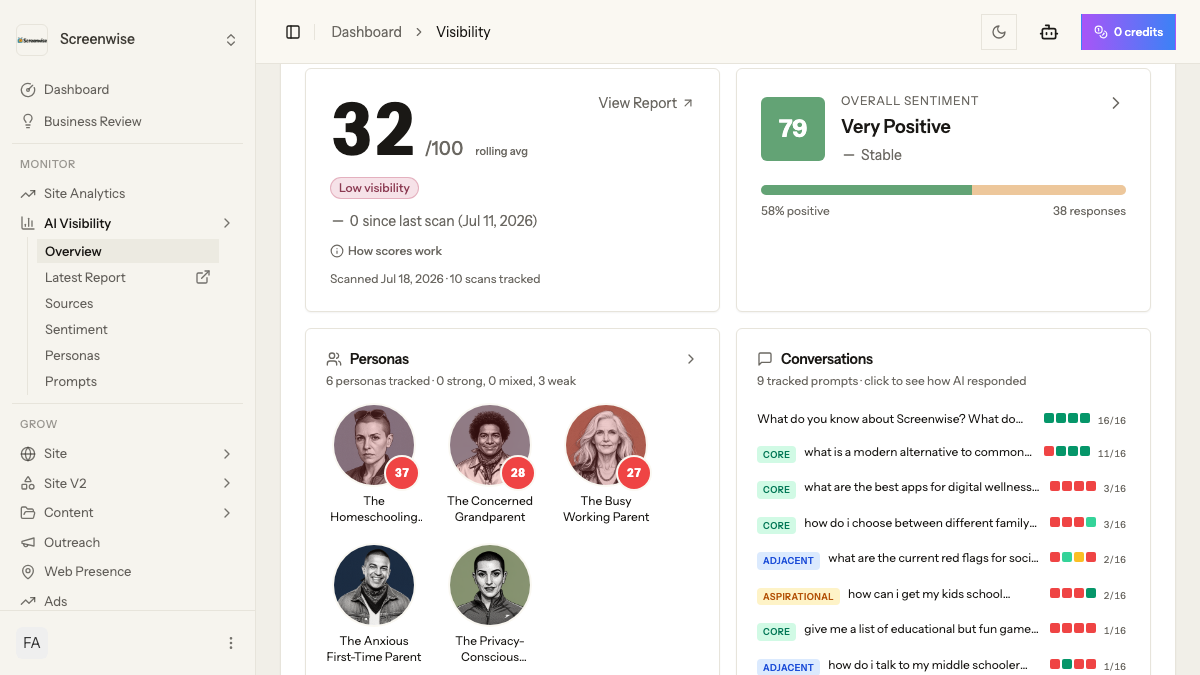
Inside, you'd spend your days in the Visibility Explorer. It rates you out of 100, gives a separate sentiment score and scores each of your buyer personas on its own. If you open the public demo account, you'll find a sample family app sitting at 32, tracking nine prompts across six personas, with every prompt tagged core, adjacent or aspirational.
When you look at the homepage, don't mistake the "Real Life Examples" row for a customer list. Logos like Rippling and Patagonia each link to a public scan preview Pendium ran on that brand, which makes them sample reports.
The first week on each tool
Want to try Pendium without paying? You get one baseline scan with 150,000 credits, once, and no card. The scan shows what the AI platforms say about you and where they source answers in your category, then ranks what to fix, and Pendium will also write one article free for each brand. Everything after that costs money, including repeat scans, the content engine and a Site on your own domain.
Try RankControl and you have 7 days, with your card taken up front and $0 charged today. Your first job is reviewing the brand profile we draft from your site and fixing the products, buyers and competitors it lists. After the CMS is connected, you enter up to 50 questions and 10 competitors. Seven engines then get their first weekly check, and in the meantime the planner lays out a calendar built on the questions you're losing.

Your competitors are getting cited by AI. You're not.
Every day without citation tracking is a day your competitors pull ahead in ChatGPT, Perplexity, and Claude.
The price gap
Open Pendium's pricing page and the first thing you see is $295 a month, because it defaults to the yearly tab. That's the annual rate, which you'd pay as $3,540 up front. Pay monthly and Pro is $350. If you'd like Pendium's own people to do your outreach, backlinks, reviews and content, Managed is $4,950 a month, and you don't sign an annual contract for it.
On Pro you spend credits, 5 million a month, topped back up every billing cycle. The demo account gives you two numbers to work with: 50,000 credits logged for one visibility scan, and roughly 35,000 estimated for each content row. Pendium never says how many pages a month that adds up to, so I did the sums:
| If you spend your credits on | What it uses | What's left for articles |
|---|---|---|
| Articles only | Nothing on scans | Roughly 140 articles a month |
| The daily scans the Pro card promises, plus articles | 30 scans at 50,000, so 1.5 million | About 100 articles |
Those are my estimates, since Pendium doesn't publish a page count.
There's also a plan you might hear about that you can't buy from the pricing page. Pendium's terms and docs refer to a Starter plan, and its llms.txt file puts the lowest paid plan at $60 a month, yet the page offers only Free, Pro and Managed.
On RankControl you pay $400 a month or $4,000 a year for one plan. That buys 100 pages a month and five seats. The plan also covers 50 tracked questions, checked weekly on seven engines, and up to 10 competitors. Paying monthly, you'd spend $50 more than on Pendium Pro.
The moment you want people doing the work, it goes the other way. Pendium's done-for-you tier costs $4,950. On RankControl you'd add a dedicated strategist for $1,500, or five managed backlinks a month for $350.
RankControl vs Pendium.ai on AI visibility
Count Pendium's engines and you'll get two answers. The marketing pages list seven platforms: ChatGPT, Claude, Gemini and Google AI Overviews, plus Grok, Perplexity and DeepSeek. The docs list four, and the visibility score page says "every standard scan covers four AI surfaces," naming that first group. The demo account's platform filter matches the docs.
You'll also struggle to pin down how often it checks. Daily scans are what the Pro card promises. The docs, meanwhile, suggest you re-scan after publishing, and when I looked at the demo account, its automatic scans in July had run roughly weekly.
With RankControl you know the schedule: every week, seven engines, Grok, Google AI Mode and Google AI Overviews among them. For each question you see the competitors named in your place and the sources the answer leaned on. New citations come with a notification, and the weekly brief sums up what you gained.
If you need to dig into why an engine prefers a rival, Pendium goes further than we do. Each simulated buyer persona gets its own score, and you can read the reasoning a model gave for its answer. The free scan also gives you a baseline before you spend anything.
The annex
On Pendium, your articles go to a Site it hosts. Its docs say "Pendium publishes to your site first" and "you do not need a CMS connected to publish." The Site's first address is pendium.ai/yourname, and when you connect a domain, the pricing card's suggestion is agents.yourdomain.com.
I call this the annex. Your name is on it, but it stands next to your house on land that belongs to someone else. You don't have to take my word on the cost, because Pendium's hosting docs make the case themselves: they give the subdomain option partial SEO authority, "treated as a separate host," and recommend a subpath like yourdomain.com/blog. Setting that subpath up is your job, using a reverse proxy on your own server, a Vercel rewrite or a Cloudflare Worker.
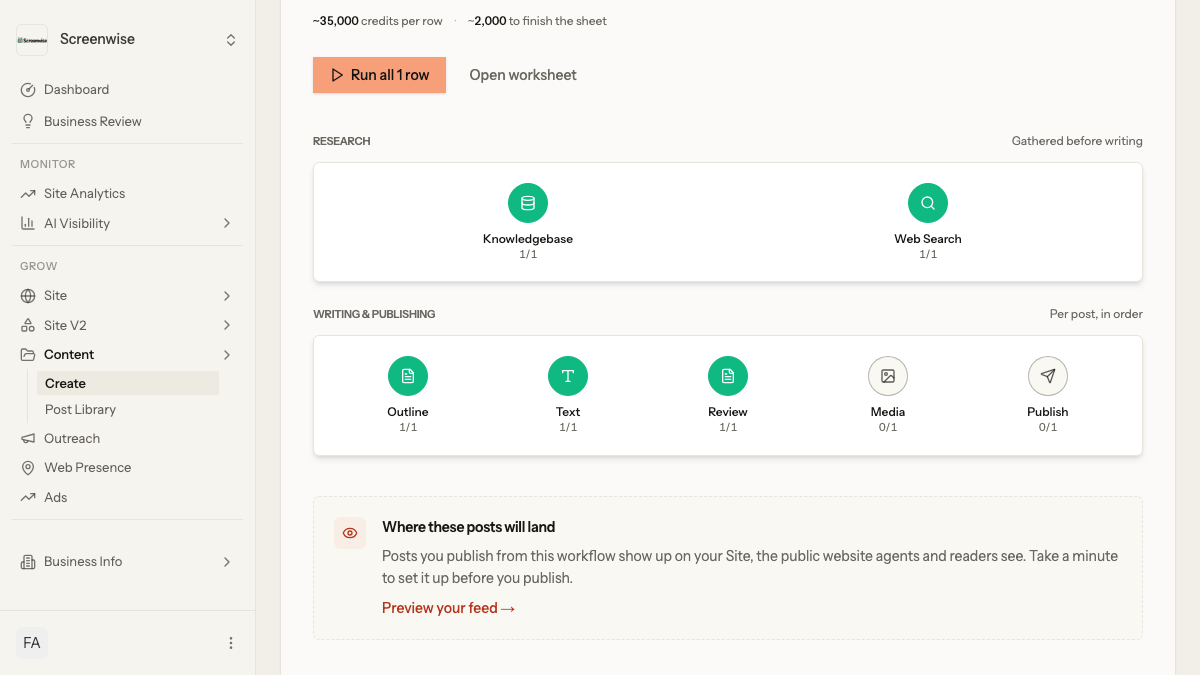
Your annex comes with a lease, too. The terms say "Blog availability is subject to your active subscription, and we may discontinue hosting upon account termination." Copying posts to a blog of your own is optional, and only WordPress, Webflow and Ghost are supported. Two more things turn up in the docs: AI crawlers are sent "the lightweight variant" of each page, and posts in Pendium's feed carry bylines from AI author personas, each with a name, bio and avatar.
Ask SEO people about subdomains and you'll get an argument. A September thread in r/TechSEO put the question of whether subfolders always win, and the reply at the top said that for SEO a subdomain is, in effect, its own website. Someone else noted that developers reach for subdomains because they're quicker to set up. The pushback with the most upvotes called "subfolders always win" a rule people repeat more than they should.
Are subfolders always better than subdomains?
Hey everyone. Recently, I had an argument with a web developer who suggested using subdomains, but I know it's better to use subfolders. Have you ever used both for the same website? If so, which was better?
Flavio Amiel, an SEO consultant, put it in practical terms in February. Shifting a blog from a subdomain into a subfolder, he said, is one of the unglamorous jobs that does more for rankings than anything flashy.
Everyone wants to rank on Google. Nobody wants to fix their meta titles, clean up their internal links, or move their blog from a subdomain to a subfolder. The boring work is the work that moves the needle.
 Flavio Amiel@fbaFeb 10, 2026
Your annex won't be invisible to AI, though. Lily Ray noted in August that running a site: search on a brand can turn up subdomains next to the main domain, and she wondered what that means for content written for LLMs that lives on one. What it costs you is authority and upkeep. You'd be running two sites, and Pendium can switch its one off if the payments stop.
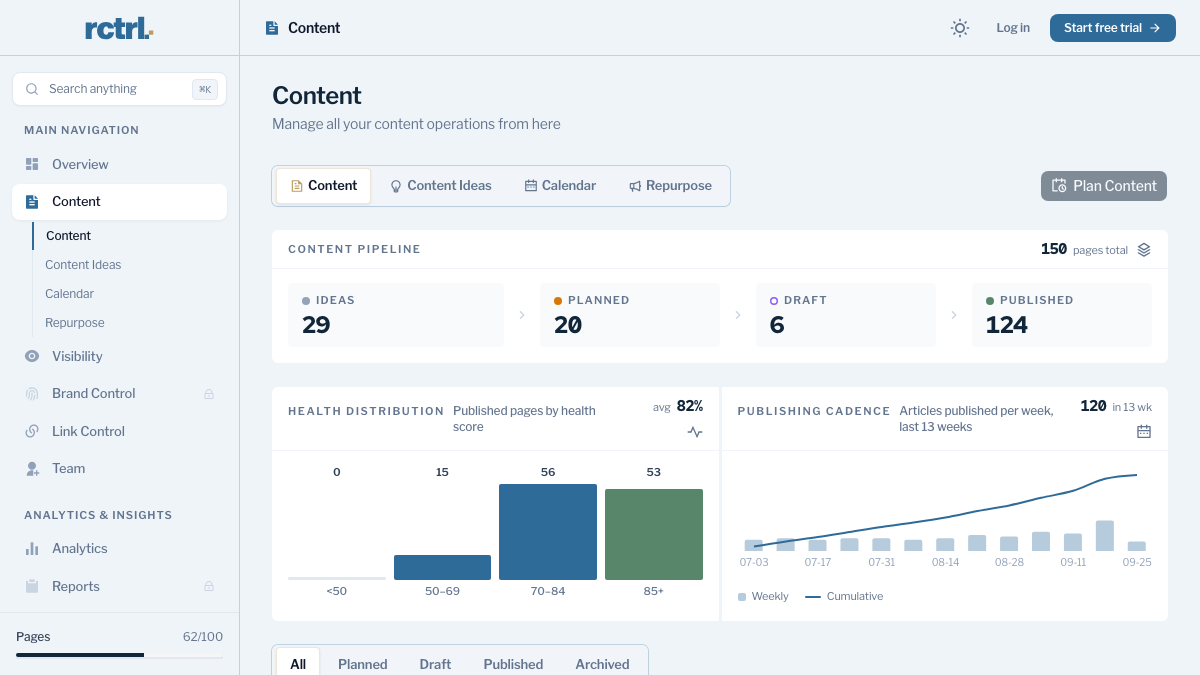
With RankControl, nothing is hosted for you. The content engine works out titles from the questions you're losing, studies the pages that already rank for each one before writing, and publishes into your own CMS as a native post through one of nine destinations. Nothing auto-publishes until you enable it, and cancelling doesn't move a single post.
200+ SaaS teams already track their AI citations.
They know exactly when ChatGPT mentions their brand, and when it stops. Do you?

Links and outreach
Pendium's Outreach tab gives you targets built from the sources AI engines already cite, in four kinds: edit suggestions, new post pitches, guest posts and Reddit threads. There are 33 waiting in the demo account. For each, Pendium drafts the email or comment, and sending it is manual, through your mail client or a paste into Reddit.
Finding the contact falls to you as well, because the docs say Pendium never invents a recipient's address, and nothing follows up on your behalf. If you want people doing outreach, backlinks and partnerships, that's Managed at $4,950 a month.
With RankControl's Link Control, your part is the approval. For each article you publish, Link Control tracks down prospects and a contact, writes the pitch and, once you say yes, sends it from your own mailbox, with follow-ups that stop the moment someone replies. Hand the links off entirely and Managed Backlinks adds five a month from DR 25+ sites for $350. The social agent, meanwhile, hunts for live Reddit and X threads that one of your articles answers and writes a comment you can post.
Working from Claude
If you work in Claude, both tools give you an MCP server. Pendium's is part of Pro, and so is a REST API that hands back your scans and scores and lets you export the Site. The docs can't settle how big the server is. The overview says 35 tools. The tool reference says more than 80 and lists 91 names.
RankControl's MCP server gives you 80+ tools for tracking, planning, writing and publishing. Claude can tell you which questions slipped this week and plan articles for them, and nothing publishes until you confirm the dry run.
Analytics
Pendium's Site Analytics plugs into your Search Console and counts visits from AI agents and from people, but only on the Site, the pages Pendium itself serves. There's a ranked list of recommendations too, although content suggestions stay hidden until Search Console is connected.
RankControl's AI visibility tracking sits alongside analytics that record AI crawler visits on your own domain and pull in Search Console data daily. Every published page has its Google and Bing positions tracked, so you'll see a new article climbing before an AI engine ever quotes it.
Trials, refunds and cancelling
You can't trial Pendium Pro for a set period; the free baseline scan is what you get. Paid plans renew automatically, and a downgrade takes effect at the next billing cycle. Don't expect money back either. The terms say "all fees are non-refundable unless otherwise required by law." They were last updated on April 12, 2026, and Delaware law governs them.
On RankControl, your 7-day trial charges nothing today. Cancel and the plan runs to the end of the billing period without pro-rated refunds, and your articles don't go anywhere, since they've been in your CMS from the start.
RankControl vs Pendium.ai: which wins AI search visibility?
For getting cited in AI search, RankControl is the one I'd pick. Your articles sit on your own domain as native posts. Pitches leave your mailbox with the contact already found and follow-ups looked after, and seven engines are checked for you each week, all for one $400 plan.
On monthly billing Pendium Pro costs you $50 less. Its defaults, though, put your articles in an annex on a separate host and leave your outreach as drafts, and paying people to do the work takes you to $4,950.
The loop works by hand if you have the time: get answers published on your own domain, pitch the sites the engines already cite and look at every engine weekly. RankControl's agents can take it over instead, beginning with a 7-day free trial. Before you choose, the free AI visibility check shows you who ChatGPT cites right now for three questions from your market.
How often does ChatGPT mention your brand?
Most founders have no idea. The answer might surprise you.