
If you run a Shopify store, the first thing to know about Frase is where it can publish. On October 19, 2026, its integrations page listed one-click publishing to WordPress, Webflow, Sanity and Wix, plus its own hosted FraseCMS. Shopify wasn't on the list.
That doesn't rule Frase out, but it changes the daily work. This comparison looks at RankControl and Frase through a store owner's eyes. It covers getting articles into Shopify, linking them to products, tracking AI answers, earning links and the price. Everything about Frase comes from its pricing page, integrations page and docs, checked on October 19, 2026.
The short version
For a Shopify store that wants articles written and published to its own blog without copy-paste, the best pick is RankControl, because it publishes native posts straight into the Shopify blog you choose.
For a store that wants outreach sent from its own mailbox, the best pick is RankControl, because it finds prospects and contacts for each article and drafts the emails for you to review and send.
For tracking whether AI answers mention your store across the most engines on one plan, the best pick is RankControl, because its single plan covers six engines, Grok and Google AI Mode included.
RankControl vs Frase for Shopify at a glance
| Frase | RankControl | |
|---|---|---|
| Price | $49, $129 or $299/mo; $39 to $239 billed yearly | $400/mo, or $4,000/yr |
| Publishes to Shopify | No native option; export or API | Native posts in your Shopify blog |
| Articles | 10, 40 or 100 a month | Up to 100 pages a month |
| AI engines | ChatGPT and Google AI on Starter; Perplexity from Professional; Claude and Gemini on Scale | ChatGPT, Perplexity, Claude, Gemini, Grok and Google AI Mode |
| AI check frequency | Daily | Weekly |
| Outreach | Drafts emails you send outside Frase | Finds prospects and contacts, drafts emails sent from your mailbox |
| Trial | 7 days, no card | 7 days, card up front |
Our main RankControl vs Frase comparison covers both tools for any kind of site. This one sticks to what changes when the site is a Shopify store.
Do Shopify store blogs rank?
Before choosing a tool, it's fair to ask whether a store blog is worth it. So on October 19, 2026, we searched 30 shopping-related how-to questions on Google, from "how to wash a weighted blanket" to "how to choose a dog bed." Then we counted the first-page results with the /blogs/ URL pattern that Shopify store blogs use.
| What we counted | Result |
|---|---|
| First-page results | 210 |
| Shopify-style store blog posts | 65 (31%) |
| Searches with at least one | 27 of 30 |
| Store blog posts in the top 3 | 17 |
| Store blog posts ranked first | 4 |
The winners were ordinary stores answering questions about their own products. Bearaby ranked first for "how to wash a weighted blanket." Turbie Twist ranked first for "how to wash silk pillowcase," and a leather goods shop, Moonster Leather, ranked first for caring for a leather wallet. The URL pattern isn't unique to Shopify, so treat 65 as a close estimate rather than an exact count.
Care and how-to questions were the strongest ground. Across 18 care and use searches, like washing, cleaning and storing, store blogs held 38 first-page spots and 12 of the top-three positions. Across nine "how to choose" searches, they held 22 spots but only four in the top three, since buying guides from big publishers and review sites crowd those results.
So for a store blog, the easiest wins are questions your customers ask after they buy, or right before. How do I wash this, how do I store it, what size do I need. Those are also the questions your product pages can link to.
That matches what store owners said in an r/bigseo thread asking whether an ecommerce blog is worth it. The replies said it pays when posts answer questions buyers already search, and that generic tips posts pull traffic that never buys. One reply pointed to JetPens, which shows its guides on related category and product pages so shoppers find them while browsing.
Is a blog on your ecommerce site actually worth it, or a waste of time?
Hi everyone, I have a question: does anyone here run an online shop with a blog attached to it? Is it actually worth having a blog for an online shop? Has anyone made real sales through their shop that came from blog posts? I'm asking becau...

Your competitors are getting cited by AI. You're not.
Every day without citation tracking is a day your competitors pull ahead in ChatGPT, Perplexity, and Claude.
Getting articles into Shopify
This is where the two tools differ most for a store.
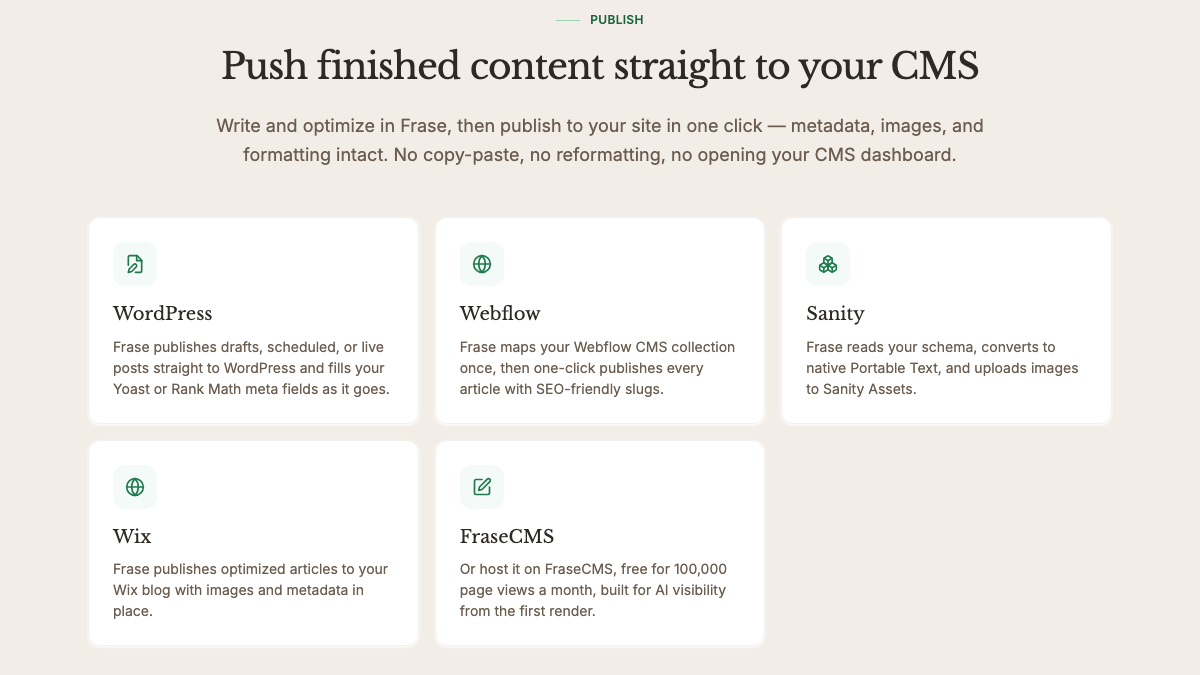
Frase gives a Shopify store three routes. You can export each article as HTML or Markdown and paste it into Shopify's blog editor, then add images and meta fields there. You can build a custom flow with Frase's REST API, which every plan includes. Or you can host the blog on FraseCMS, which keeps it outside Shopify's own blog section. Third-party automation tools also advertise Shopify and Frase connectors, though Frase doesn't list them.
RankControl publishes native posts straight into Shopify. You create a small private app in your Shopify admin, give it only the read_content and write_content permissions and paste its credentials into RankControl. Then you pick which blog the articles go into. The app can't touch orders, customers or your theme, and setup takes about three minutes.
Each article waits for your approval by default, since auto-publish is off unless you turn it on. When an article is updated later, RankControl revises the same Shopify post rather than creating a new one. Our destinations page lists every platform it publishes to.
The Shopify fields you fill in either way
Shopify's blog editor has a few fields that matter for search. Each post has a title, the body, an excerpt, a featured image, tags and a search engine listing, where you set the page title, meta description and URL handle. Shopify's Help Center covers each one in its guide to blog posts.
With an exported Frase article, you fill those in by hand for every post. That's quick for one article and tedious for 40 a month, which is the Professional plan's allowance. With RankControl, each article arrives in your chosen blog as a native post, and you review it before it goes live.
Linking articles to products
A store blog post earns its keep when it sends readers to a product or collection. Both tools write articles you can link from, but the product side happens in Shopify either way.
A tip from an r/shopify thread on adding blog posts to product pages works with either tool. Create a product metafield of the "article" reference type, then connect it to a blog block in your product template. Each product can then show its own guide, with no app needed. Another reply suggested a Custom Liquid section on the product template for the same result.
Frase's Professional plan adds internal linking suggestions. With RankControl, the articles publish into your blog as normal Shopify posts, so you add product links and metafields the same way you would for any post. Our ecommerce link building guide covers how product pages earn links from outside your store.
What gets written
Frase's article allowance depends on the plan. Starter includes 10 articles a month, Professional 40 and Scale 100, alongside its SEO and GEO scores and a brand voice setting.
RankControl writes up to 100 pages a month on its one plan. It plans topics from your brand profile and the questions buyers ask, writes each article against the pages already ranking for it and scores how easily AI engines can quote it. The content engine page covers the formats, from buying guides to comparisons.
Either way, the store blog posts that ranked in our check had a clear pattern. They answered a care, sizing or how-to question about the exact kind of product the store sells. Point either tool at those questions first.
Tracking AI answers about your store
Shoppers now ask AI assistants what to buy, so it helps to know whether those answers name your store. Frase checks AI visibility daily. Starter covers ChatGPT and Google AI with 50 prompts, Professional adds Perplexity with 200 and Scale adds Claude and Gemini with 500.
For a store, the questions worth tracking are buying questions where an AI answer names a few brands, like "best weighted blanket for hot sleepers" or "where to buy a silk pillowcase." RankControl checks 50 questions like these every week on ChatGPT, Perplexity, Claude, Gemini, Grok and Google AI Mode, all on its one plan. It shows which engines named your store and which pages they cited, alongside your Google rankings. Its analytics count AI-referred visitors separately, so you can see whether those answers send shoppers.
200+ SaaS teams already track their AI citations.
They know exactly when ChatGPT mentions their brand, and when it stops. Do you?

Links and outreach
Product pages mostly earn links from gift guides, reviews and best-of lists, as our ecommerce link building research found. Both tools help with outreach, in different ways.
Frase's Backlinks feature finds link gaps and drafts outreach emails, which its docs say you copy and send outside Frase. RankControl's Link Control finds prospects and contacts for each published article and drafts personalized emails that go out from your own mailbox after you review them. It also checks the links it built every week. The Managed Backlinks add-on places five links a month from DR 25+ sites for $350.
What it costs a store
Frase is cheaper to start. Its Starter plan is $39 a month billed yearly, or $49 monthly, for one site and 10 articles. It also checks AI answers daily and watches published pages for Google decay with its Content Guard feature, which proposes fixes you approve.
RankControl is one plan at $400 a month, or $4,000 a year. That covers up to 100 pages a month published to your Shopify blog, six AI engines, weekly rank tracking, outreach drafting and social drafts for eight platforms from each article.
The fairer comparison is with what a store pays to get the same output from Frase. To publish 100 articles a month and track Claude and Gemini, you'd need Frase's Scale plan at $239 to $299 a month. Then you'd still paste each article into Shopify or build an API flow.
What a month takes on each
Here's a rough monthly budget for a store publishing eight articles a month, by our estimate. It assumes Frase's export route, since there's no native Shopify publishing.
| Task | With Frase | With RankControl |
|---|---|---|
| Pick topics and brief articles | 2 to 3 hours | Review the planned topics, under 1 hour |
| Write and optimize eight articles | 4 to 6 hours of editing AI drafts | Review drafts, 2 to 3 hours |
| Paste into Shopify, add images and fields | 2 to 3 hours | None |
| Link posts to products | 1 to 2 hours | 1 to 2 hours |
| Check AI answers and rankings | Done daily by Frase | Done weekly by RankControl |
| Total | 9 to 14 hours | 4 to 6 hours |
The paste-and-format row is the one a Shopify store feels most with Frase. At eight articles a month it adds two to three hours, and it grows with every extra article you publish.
How to choose for your store
Start with the job you want done. If you want articles researched, written, published to your Shopify blog and tracked across AI engines every week, RankControl does all of it on one plan, with no copy-paste step between the tool and your store.
If you're already on Frase, our guide to switching from Frase covers what exports and what doesn't. For other options, our list of Frase alternatives compares seven tools.
Doing it yourself or handing it off
You can research, write, paste and track every article by hand with any tool. Or RankControl can plan, write and publish articles to your Shopify blog every month, track which AI engines mention your store and draft the outreach, while you focus on your products.
How often does ChatGPT mention your brand?
Most founders have no idea. The answer might surprise you.