
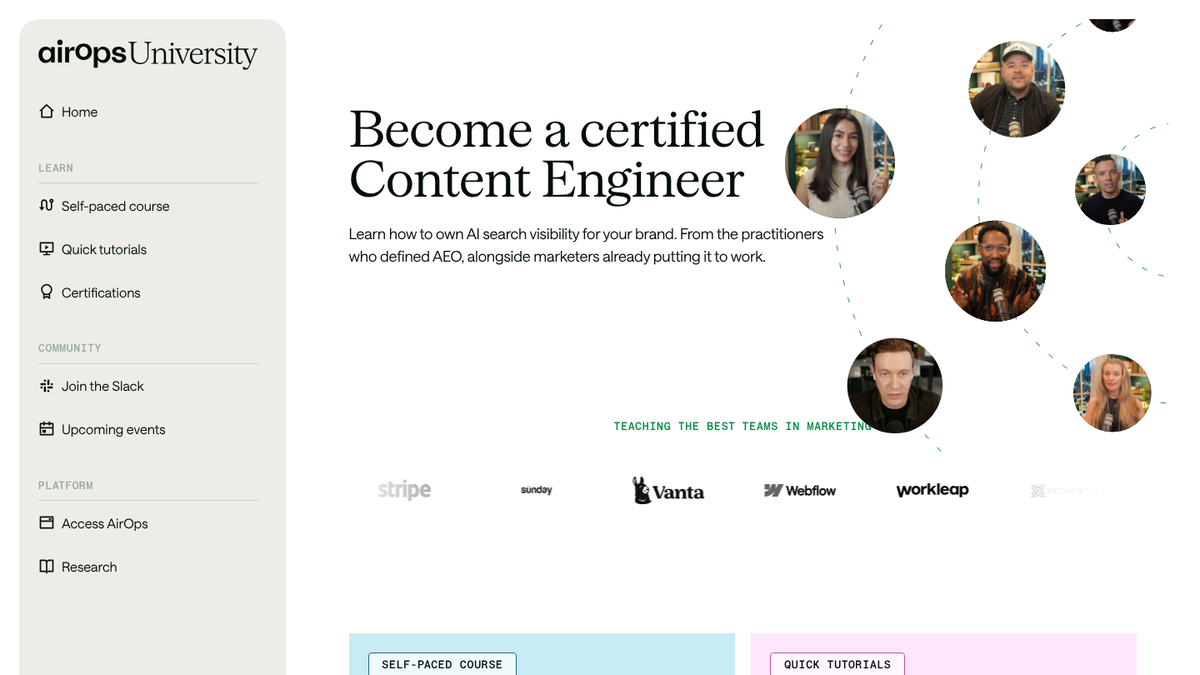
AirOps' training arm sells itself with a job title, not a feature list. The headline on its University homepage reads "Become a certified Content Engineer," set above photos of the people teaching it, and two certification tracks sit below, one of them called Systems Builder. That phrase tells you who AirOps is built for before you've read a single pricing row.
This piece is for the opposite kind of team: a marketer or two, no engineer on staff, trying to decide between AirOps and RankControl. I spent a day in AirOps' world on October 19, 2026, reading all 282 pages of its documentation, its pricing page and its training site, counting how much of it assumes you can write code.
The short answer
For a small marketing team with no engineer, RankControl is the better fit. There's nothing to build. We plan, write, publish and track the work, and your only job is to approve it.
For a solo marketer who wants AI search work handled without learning a new craft, RankControl wins again, because setup takes an afternoon and the bill stays flat at $400 a month no matter what happens underneath.
For a team that still wants a person steering strategy, pair RankControl with the Dedicated Strategist add-on at $1,500 a month. The price is published up front, and you can cancel the add-on on its own without touching the base plan.
AirOps earns its keep in one place RankControl doesn't touch. Give it, or someone you hire, a taste for building, and AirOps lets that person chain their own steps, assign a different model to each one and run the result across hundreds of pages at once. RankControl has no equivalent builder, so a team chasing a custom pipeline won't find one here.
Side by side for a team with no engineer
Here's how the two compare on the things that matter most when nobody on staff can write a script.
| AirOps | RankControl | |
|---|---|---|
| What you get | A platform to build Workflows and Playbooks on, plus a services team | Agents that plan, write, publish and track |
| Price | Not listed for Solo or Pro; Enterprise through sales | $400/mo or $4,000/yr |
| What limits use | Tasks (35,000 on Solo, 100,000 on Pro) | 100 pages a month, 50 tracked questions |
| AI engines | ChatGPT on Solo; 7+ on Pro | ChatGPT, Perplexity, Claude, Gemini, Grok, Google AI Mode, Google AI Overviews |
| Who does setup | You, or Enterprise onboarding | It drafts your brand profile from your site |
| Code you might meet | JSON, Liquid, JavaScript or Python steps | None |
| Publishing | Map Grid columns to CMS fields | Native posts to 9 destinations, after approval |
| Training on offer | AirOps University and a cohort course | None needed beyond setup |
| Trial | 14 days, no card until the end | 7 days, card up front, $0 today |
Every AirOps figure above comes straight from its pricing page, docs and training site, read on October 19, 2026.
What I counted in the AirOps docs
AirOps posts its entire documentation set as a plain index built for AI tools to crawl, which happens to make it easy for a person to read start to finish too. The whole thing runs 282 pages and about 169,000 words. Marc Brysbaert's 2019 review of silent reading speed puts the average reader at 238 words a minute, which works out to roughly 12 hours to get through it once.
Most of those pages don't ask much of you. A third of them do. Eighty-nine of the 282 mention JSON, Python, JavaScript, SQL or the {{ }} syntax AirOps uses to pass data from one step to the next, and in the Workflows section, where the actual content gets built, it climbs to 39 of 82 pages, nearly half.
The tutorial for building a first Workflow runs 40 numbered steps, and its sample prompt already leans on {{ keyword }} and {{ step_1.output }}. So on day one, you're wiring the output of one step straight into another. Open the Code step page and you'll find the same output written for Python, as step_1["output"], with a note that your code needs a return statement.
None of that is a knock on AirOps. It's a description of who the product expects to show up. Call it the builder seat, one spot on the team whose job is keeping the machine running, and AirOps assumes somebody already fills it.

Built by the team that got cited in 48 hours.
Content generation, backlink building, AI visibility tracking, and Google rankings. One platform, zero guesswork.
The no-code parts, and where they stop
AirOps isn't blind to this problem, and it has spent the past year building around it. Playbooks take plain-language instructions instead of code, and the first Playbook tutorial has 16 steps with nothing a non-coder would stumble on. Quill, an assistant that sits in the corner of most pages, can draft or edit a Playbook from a request typed in plain English. Power Agents go further still, with ready-built Workflows for the jobs most teams actually want, such as briefs, articles and refreshes.
The trouble starts once you want to change something. Forking a Power Agent, which is how you'd edit its prompts to sound like you instead of AirOps, is an add-on, and only on Enterprise plans. The Playbook best-practices page also tells you to keep publishing separate from writing, so a finished article still has to leave through a Grid column mapped to your CMS fields, a second Playbook, or a connector built for the job.
Quill has a blind spot worth knowing about too. Its own docs say it doesn't show up inside the Workflow editor at all. That editor has a different helper, called Copilot, which can explain what a Workflow does and suggest a fix. Someone on your side still has to read that suggestion and decide whether it's right.
What AirOps' training says about the job
AirOps University is genuinely well put together. There's a self-paced course, a set of quick tutorials and two certifications, AEO Analyst and Systems Builder. Read the graduate quotes on the page and a pattern shows up fast. A Director of SEO, a Senior SEO Manager, content managers at brands like BigCommerce, nearly all of them talking about workflows they built.
One of those graduates, a content manager at Sunday, wrote that the cohort "turns you into a pro in just two weeks." Somebody in r/AskMarketing asked in January whether the certificate, which they'd started seeing all over LinkedIn, was actually worth doing. The one graduate who answered said yes, and to expect to give up some free hours across three weeks to get there.
So the real cost of AirOps, for a team with no engineer, isn't the subscription. It's the two or three weeks someone spends learning the craft, and then the ongoing hours to build and keep running what they learned, before a single article ships.
Content engineer is now a job title
That training has started showing up on job boards. A Content Engineer listing from Wpromote and Giant Spoon was still live on Google Jobs on October 19, asking the hire to design AI content workflows end to end, from research and briefing through drafting, editing and delivery. The posting is blunt about what it isn't. "Not a traditional copywriter role," it says plainly.
A B2B demand marketing manager on X made fun of a similar ad making the rounds. It wanted someone who could write and also run AirOps. On top of that, it wanted the old SEO toolkit, a headless CMS, UX sense and analytics chops, all from one hire.
Just saw two "Content Engineering" jobs. If you are a content writer, know AirOps and all the old SEO tools. Know writing, AI promoting, Content Editing, headless CMS or WordPress, UI & UX, Google Analytics et all, know all low or no code content tools. = Content Engineer. 😂
 Princewill@ThePakumaOct 23, 2025
If your whole team is one marketer, that tweet is the problem in miniature. AirOps rewards whoever already has most of that list, and that person doesn't come cheap or come easy to replace.
AirOps now sells the people too
AirOps seems to have reached a similar conclusion about its own product. On September 2 it launched AirOps Services, a strategy team that runs AI search programs next to yours. The company's own "Working with AirOps" page says its experts "build and run programs on the platform alongside your team."
A Google Jobs search on October 19 turned up open AirOps roles for an Insights Strategist, a Senior AEO Strategy Lead and an Enterprise Customer Enablement and Training Specialist, all hired to help customers run the platform they already bought.
One SEO consultant who used AirOps and later moved on wrote on X in September that the shift to services told him most teams couldn't adopt the platform without paid help. That's a single opinion, and AirOps would likely frame it differently. Its own pricing page does back up a piece of it regardless, since Enterprise plans come with 1:1 expert onboarding and what AirOps calls a forward deployed engineer.
See your first AI citation report in under 5 minutes.
No setup calls. No onboarding meetings. Connect your domain and see where AI mentions your brand right now.

A week in each tool, for a two-person team
Picture the same two-person team a month into each tool, and here's the week that repeats.
| This week's job | AirOps | RankControl |
|---|---|---|
| Pick topics | Run a Grid or Playbook on your keyword list | Approve or skip the titles it planned |
| Write | Review drafts at Human Review steps | Review finished articles before they go live |
| Publish | Push reviewed rows to mapped CMS fields | Goes out to your site on approval |
| Fix things | Debug a step when an output breaks | Nothing to maintain |
| Watch cost | Check the task balance | Nothing to watch |
| Check results | Read Insights dashboards | Read the weekly email and dashboard |
Watch the "fix things" row, because it's the one that actually bites a small team. An LLM step starts returning JSON shaped differently than before, the next step breaks, and somebody has to reopen the Workflow and work out why. Copilot can help with the debugging, but a person still has to read its explanation and trust it.
What RankControl asks of you instead
RankControl is built for the team that doesn't have a builder seat to fill. Setup starts with us reading your live site and drafting a brand profile: your products, your buyers and your competitors, already filled in. You correct anything that's wrong, add the 50 questions you want tracked, and connect your site. Call it an afternoon's work, not a sprint.
From there, the content engine plans titles from what your buyers are actually searching, lays them on a calendar and waits for your approval. Each article gets written against the pages already ranking for its keyword, then scored for how easily an AI engine could quote it back, with a list of fixes attached. Auto-publish stays off until you switch it on, and once you do, each piece goes out as a native post through whichever destination you've connected.
Every week, RankControl checks those 50 questions across ChatGPT, Perplexity, Claude, Gemini, Grok, Google AI Mode and Google AI Overviews, and tracks where each page sits in Google and Bing. Five seats come with the plan. When the writer gets a fact wrong, which happens, you fix it once in the brand profile and the correction carries into the next article.
Price, when nobody on the team reads a task log
Nobody on a two-person marketing team wants to become the person who reads a task log for fun, and AirOps' pricing more or less requires it. Solo includes 35,000 tasks a month, Pro steps up to 100,000, and anything past Solo's limit costs $0.025 a task. AirOps' own FAQ admits the number of tasks "depends on both the step type and the data being processed," which is a hard thing to budget around if nobody on the team knows what a step actually costs.
Earlier this year, people in an r/bigseo thread described bills running from about $250 a month for one brand up to $2,000. Our full RankControl vs AirOps comparison walks through one user's invoice in detail: 5,147 tasks, $128.68.
RankControl skips the meter entirely. The plan is $400 a month, or $4,000 a year, covering 100 pages, 50 tracked questions across seven engines and five seats, and the bill stays the same no matter how many steps an article took behind the scenes. Want a person steering strategy too? The Dedicated Strategist add-on runs $1,500 a month, billed and cancelled separately from the base plan.
Hours before the first article
Here's roughly how the clock runs before either tool has published anything, based on what each product's own pages describe. Treat these as estimates, and check them against your own team.
| Step | AirOps, no engineer | RankControl |
|---|---|---|
| Learn the platform | 10 to 20 hours (course, tutorials, docs) | About 1 hour |
| Set up brand and context | 2 to 4 hours (Brand Kit, Knowledge Bases, Insights prompts) | 2 to 3 hours (review the drafted profile, add questions) |
| Build the content process | 4 to 10 hours (Workflow or Playbook, testing) | None |
| Connect publishing | 1 to 2 hours (map Grid columns to CMS fields) | Under an hour |
| Total before article one | About 17 to 36 hours | About 4 to 5 hours |
The clock doesn't stop at launch, either. Budget a few hours a month in AirOps to fix broken steps and refresh prompts. In RankControl, budget about 30 minutes an article to read it and hit approve.
Which one fits a team without engineers?
For a team with no engineer, I'd pick RankControl, and not by a small margin.
AirOps is a genuinely capable platform. Its docs, its training arm and its new services team all point toward the same truth. It works best with someone on your side who builds and maintains the system, or with AirOps' own people doing that for a fee. Skip that person entirely and you're really buying a workshop, then volunteering yourself as the one who has to learn the tools inside it.
RankControl removes that step rather than making it easier. We plan, write and publish articles on your own domain once you've approved them, check seven AI engines every week, and charge one number you can see in advance. A month in, you'd have a title calendar running itself, articles going live as you sign off on them, and four weekly visibility checks already filed.
Learning content engineering and keeping the workflows running is a real option, if someone on your team wants that job. Or RankControl can do the work every month while you stay focused on your product. If you're already on AirOps, the guide to switching covers what to export first, and the AirOps alternatives list runs through six more options.
Your competitors are building backlinks while you read this.
Organic outreach, social mentions, and citations from Editorial Circle member sites, with managed backlinks available as an add-on. Grow your domain authority without running the campaign yourself.