
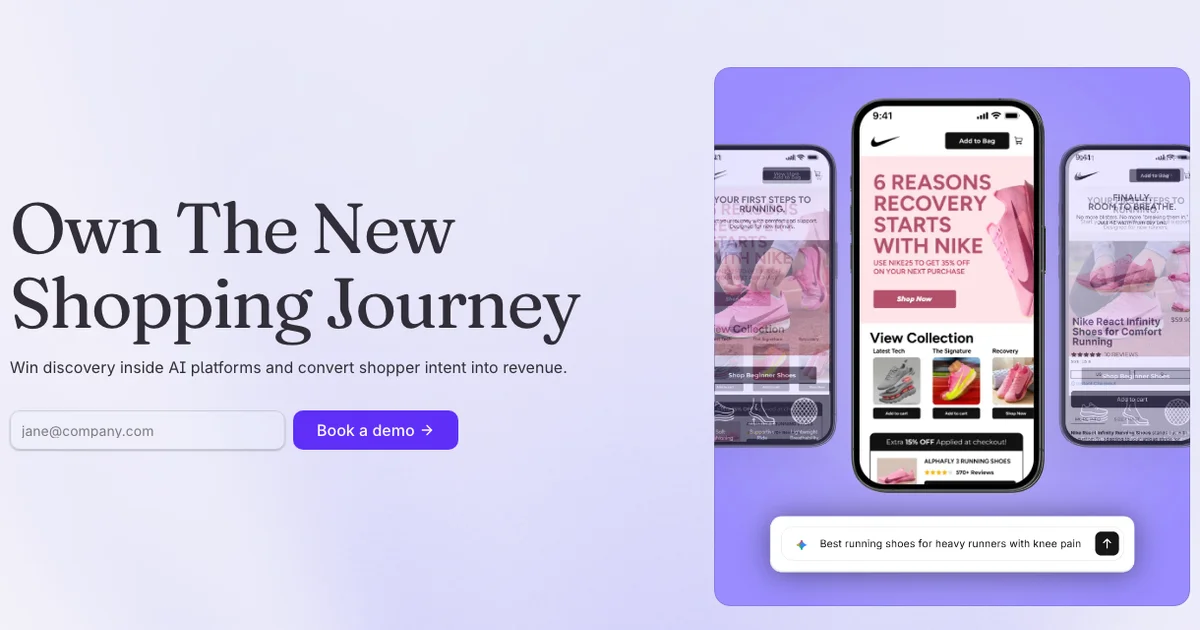
Nudge is a commerce platform that plugs into your Shopify store, so a switch from Nudge is mostly about your contract and your storefront. Its AI visibility reports, catalog scores and funnel pages come from a platform connected to your store, under an order form with fixed terms. The data comes back on request, and the timing is set by the contract.
Nudge launched its AI commerce platform in June 2026 with a $1.1 million pre-seed round. It tracks which of your products AI shopping answers name, scores product pages for AI agents, and builds personalized landers and product page variants. Pricing is quoted after a demo.
This guide covers the contract, what to ask for, what to move into Shopify, and where the work lands in RankControl. I read Nudge's site and its master subscription agreement on September 27, 2026. For the two tools side by side, see our RankControl vs Nudge comparison.
Why teams look past Nudge
Nudge works the product side of AI shopping: the page a shopper or agent lands on, and whether it converts. That work pays off once AI answers already name you. Smaller stores often find the harder problem comes earlier, getting named at all, and that depends on content and on what other sites say about you.
Shopify owners are running into this now. In r/AutomateShopify this July, a store owner asked what makes a store show up in ChatGPT's recommendations. One reply came from a seller getting about one sale a week from ChatGPT or Claude who still couldn't tell what drove it. Another argued that what customers say elsewhere counts for more than what's on your own pages.
How are you optimizing your Shopify store to drive sales from chatgpt?
I have been seeing more people talk about getting traffic from chatgpt and other AI assitants, but I still don't understand what actually makes a Shopify store show up in recommendations. I know about the basics like SEO, product pages, rev...
The contract is the other reason. Nudge sells through a demo and an order form, and its pricing depends on the optimization opportunities you get each month, the prompts you track and usage. Teams that want to add or drop tracking month to month find that structure slow. Nudge also doesn't publish which AI engines it checks or how often, so comparing its numbers with anything else takes a call.
15 hours a week manually. Or 15 minutes with RankControl.
Track citations, monitor competitors, and fix content gaps across every AI search engine. Automatically.

The term wall
I call it the term wall: the date on an order-form contract before which you can't leave on your own. Nudge's master subscription agreement says neither side can terminate without cause unless both agree in writing. It also makes fees non-cancellable and non-refundable. So the real exit date is whatever your order form says, not the day you decide.
Find three things in your order form: the subscription term's end date, any renewal clause, and the notice address. The agreement says renewals run at Nudge's rates at the time, with at least 30 days' written notice of any fee change. Under the agreement, every notice goes by email to the addresses listed in the order form, so check they're still current.
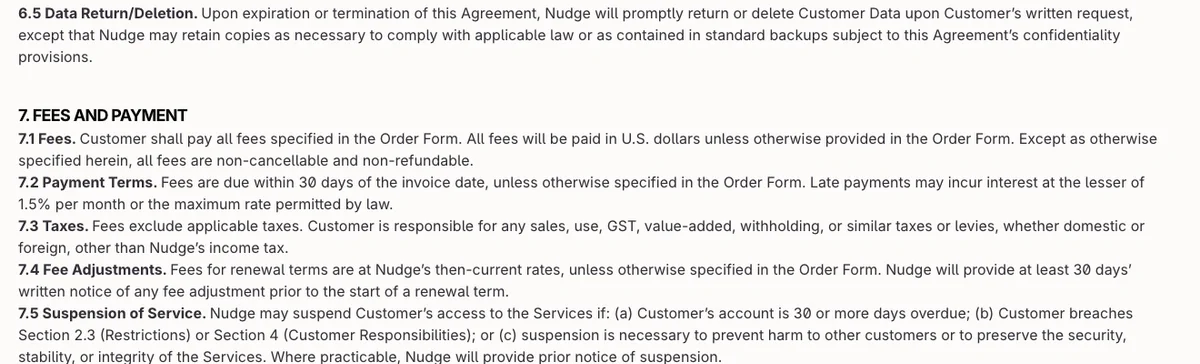
There's one real way out early. If the service doesn't perform as documented, you can describe the problem in a written notice. If Nudge can't fix it within 30 days, either side may terminate, and Nudge refunds any prepaid, unused fees. Don't stop paying to force an exit, though. Invoices are due in 30 days, late balances carry 1.5% a month in interest, and Nudge can suspend accounts 30 or more days overdue.
Send your non-renewal notice in writing to that address, well before the term ends. Then use the remaining months to run RankControl alongside Nudge, so the new tracking has a history before the old one stops.
What stays when you switch from Nudge
Your Shopify store and everything written into it stays. If Nudge's catalog fixes were applied to your product data, the improved descriptions and specs stay in Shopify, and so do any pages built into your theme.
What's less clear is anything Nudge serves itself. Its site describes funnel pages, product page variants and shoppable guides, but it doesn't say whether they sit in your theme, run through a script or load from Nudge's own servers. Ask your contact for a list of every live page and variant and where each one is served from. Anything served by Nudge stops when your access does.
Your tracking history stays in Nudge. That includes the visibility scores, product mentions, citations, AI traffic by SKU and experiment results.
How to export your data from Nudge
Nudge doesn't publish a help center, an API or an export button. So a Nudge export is a written request plus some work on your side, done while your access is still live.
| What | Where it lives | How to keep it |
|---|---|---|
| Prompts, brand info, catalog data you supplied | Customer Data under the agreement | Ask in writing for its return |
| Visibility reports, rankings, recommendations | Nudge's dashboard | Ask for exports; screenshot what you use |
| Winning product page and lander copy | Nudge's funnels | Copy it into your Shopify pages and products |
| Experiment results | Nudge's funnels | Ask for a summary of each test |
| Your products | Shopify | Products, then Export, in the Shopify admin |
The agreement splits your data into two kinds. It says you keep all rights in your Customer Data, defined as the brand information, catalog data and prompts you give Nudge, and that Nudge will return or delete it on written request after the agreement ends. The reports and recommendations it generates are called Service Content, and the agreement doesn't say they're yours. Ask for them before the term ends, not after.
Move the winners first. If a product page variant beat your control page, put that copy into the product itself in Shopify so it survives the switch.
Check your Shopify AI channels
Some of the AI shopping setup lives in Shopify, not in Nudge. Matt Caron, who runs SEO for Shopify brands, posted in September that Google had switched on buying inside AI Mode and Gemini for Shopify stores. On one client store, six AI shopping channels were already on. The place to decide what stays on is Sales channels, then Agentic, in the Shopify admin.
🤖 AI is moving the sale off your website, and this week Google switched it on for Shopify. Shoppers can now buy your products inside Google's AI Mode and Gemini with Google Pay, without ever visiting your site. On a client store I checked this morning, 6 AI shopping channels
 Matt Caron@AskMattCaronSep 25, 2026
Those settings don't change when you leave Nudge, so review them on purpose. The product data those channels read stays in Shopify too.
Take back access
Once your data and page copy are safe, remove Nudge's access. Uninstall its Shopify connection and delete any theme app blocks or scripts it added. Revoke its Google Analytics, Search Console and Meta access, and remove any staff or collaborator accounts it used. Then ask in writing for your Customer Data to be deleted, if you don't want it returned. Keep every written request and reply on file next to your order form.
Where things land in RankControl
RankControl has no import tool, and it doesn't cover every part of Nudge. It won't edit product pages, run page experiments or attribute revenue to variants.
| From Nudge | Into RankControl |
|---|---|
| Shopping prompts | Up to 50 tracked questions, re-added by hand |
| Competitor brands | Up to 10 competitors |
| Shoppable guides and comparisons | Articles published to your Shopify blog |
| Product page variants and funnels | Not covered; keep the winners in Shopify |
| AI traffic by SKU | AI crawler visits and Search Console data in analytics |
AI visibility tracking checks your questions every week on six engines, including ChatGPT, Gemini and Google AI Mode, and shows which sources each answer quoted. The content engine publishes up to 100 articles a month through one of nine destinations, including your Shopify blog, with auto-publish off until you turn it on. Link Control pitches the sites those answers cite from your own mailbox after you approve each email.
AI search traffic grew 835% this year. Is your content ready?
RankControl generates 26 content formats optimized for ChatGPT, Claude, and Perplexity. Published on your domain, matched to your brand.

The switch from Nudge, step by step
- Find the term end, renewal clause and notice address in your order form.
- Send written non-renewal notice to that address.
- Ask in writing for your data, reports and experiment results.
- Copy winning page variants into Shopify and export your products.
- Start the RankControl trial and run it alongside Nudge.
- Remove Nudge's access when the term ends, and ask for deletion.
The contract sets the pace, so start early. The slower work is publishing pages that answer your shoppers' questions and getting other sites to mention you. You can run that by hand after the switch, or RankControl's agents can run it every month for $400, with a 7-day free trial. Before you start, the free AI visibility check shows who ChatGPT cites for three questions from your market.

Built by the team that got cited in 48 hours.
Content generation, backlink building, AI visibility tracking, and Google rankings. One platform, zero guesswork.