
If you run a small business and you've priced SEO tools, you've probably seen Search Atlas at $99 a month and RankControl at $400. That gap looks like the whole decision. It isn't, because the two tools do different jobs, and they help with different searches.
This comparison covers RankControl and Search Atlas for one reader, a small business owner without an SEO person. We ran 12 real Google searches for a local trade business to see which kinds of searches each tool helps with. Everything about Search Atlas comes from its pricing and product pages, checked on October 19, 2026. For the wider comparison, see our main post on RankControl vs Search Atlas.
RankControl vs Search Atlas at a glance
| Search Atlas | RankControl | |
|---|---|---|
| What it is | An all-in-one SEO suite you run yourself | A service that plans, writes, publishes and tracks articles |
| Small business price | Starter $99/mo, Growth $199/mo | $400/mo, or $4,000/yr |
| How usage is counted | Universal Credits, 50,000 on Starter | 100 pages and 50 tracked questions a month |
| AI answer tracking | None on Starter; 3 engines on Growth | 6 engines, checked weekly |
| Google Business Profile tools | Yes, 3 profiles on Starter | No |
| Articles | You prompt them in Content Genius | Planned from buyer questions and written for you |
| Publishing | Connects to your CMS | 9 destinations, including WordPress and Wix |
| Seats | 1 on Starter, 3 on Growth | 5 |
| Trial | 7 days, with onboarding call | 7 days, card up front |
The short answer
- For a small business that wants its customers' questions answered on its own site without doing SEO work, the best pick is RankControl, because it plans, writes and publishes those pages every month.
- For a small business that wants to know whether ChatGPT and Google's AI recommend it, the best pick is RankControl, because Search Atlas's $99 plan doesn't track AI answers at all.
- For a business with less than $100 a month to spend, the best start is free. Fill in your Google Business Profile and ask every customer for a review.

Built by the team that got cited in 48 hours.
Content generation, backlink building, AI visibility tracking, and Google rankings. One platform, zero guesswork.
What small businesses actually search for
Before comparing features, it helps to know which searches matter. We picked a common small business, an HVAC company in Austin, and ran 12 Google searches from Austin on October 19, 2026. We recorded whether each showed the local map pack, an AI Overview, or both.
| Search | Map pack | AI Overview |
|---|---|---|
| hvac repair austin | Yes | No |
| ac repair near me | Yes | No |
| best hvac company austin | Yes | No |
| ac tune up cost austin | Yes | No |
| emergency ac repair austin | Yes | No |
| how much does ac repair cost in austin | No | Yes |
| how much does a new ac unit cost in texas | No | Yes |
| why is my ac running but not cooling | No | Yes |
| how often should i replace my ac filter in texas | No | Yes |
| is it worth repairing a 15 year old ac unit | No | Yes |
| heat pump vs ac in central texas | No | Yes |
| austin energy ac rebate | No | Yes |
The split was clean. Every "find me a company" search showed the map pack and no AI answer. Every question showed an AI Overview and no map.
Then we looked at who the AI answers cited. Of the 21 sources across the seven question searches, 11 were HVAC and electrical contractors' own websites, like a page called "Heat Pump vs. AC in Texas" from a local company. The rest went to YouTube, Reddit, Facebook, Carrier, Austin Energy, a cost-guide site and an advocacy group. Six of the cited pages had 2026 in the title, most of them price guides.
So a small business has two separate jobs. One is the map pack, which runs on your Google Business Profile and reviews. The other is the question searches, which run on pages on your own website. That's the lens for the rest of this comparison.
What Search Atlas gives a small business
Search Atlas is a big suite. Starter costs $99 a month for one project and one seat, with 50,000 Universal Credits. Search Atlas says that's enough for about 50 premium AI articles, or 100 AI content edits, or 1,500 rank checks, or a mix. Starter also includes OTTO, its agent for technical fixes, Content Genius for writing, 2,000 tracked keywords and three Google Business Profiles.
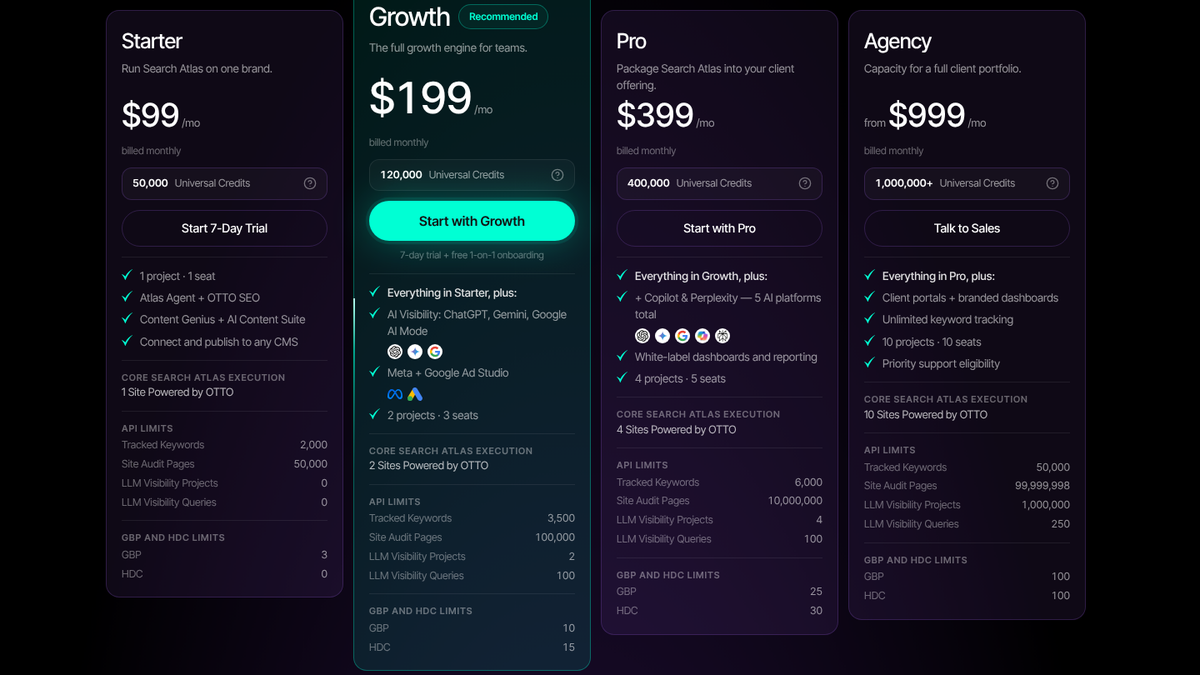
Look at the LLM Visibility rows on that screenshot. Starter has zero projects and zero queries, so the $99 plan doesn't check AI answers. Growth, at $199, adds tracking on ChatGPT, Gemini and Google AI Mode with 100 queries, plus three seats and an ad studio.
Here's where Search Atlas is genuinely stronger for a local business. Its GBP Galactic tool runs your Google Business Profile, replying to reviews, writing and scheduling posts, adding Q&A and filling missing profile details, and its local heatmaps track map rankings by street or ZIP code. RankControl doesn't manage your Business Profile at all.
The catch is that a suite is a set of tools, not a plan. Someone still has to decide which keywords matter, which articles to write, which OTTO fixes to approve and how to spend the credits each month. For a business owner who's also running jobs, that's the hard part.
What RankControl gives a small business
RankControl works on the second job, the question searches. It finds the questions your customers ask, plans article titles onto a calendar and writes each article from your brand profile, which holds your services, prices, service area and the way you talk. Our post on SEO for local businesses covers why those pages matter.
Each article publishes as a normal post on your own site, through WordPress, Wix, Webflow, Shopify, Framer, Ghost, Notion, webhooks or a headless API. Auto-publish is off by default, so you approve each article before it goes live. Then RankControl checks 50 buyer questions every week across ChatGPT, Perplexity, Claude, Gemini, Grok and Google AI Mode, and tracks each page's Google rankings.
It's one plan at $400 a month, with 100 pages, five seats and a 7-day trial. There are no credits to budget.
In the Austin test, the pages that got cited were exactly this kind of page. They were plain answers to one customer question, like what AC repair costs in Austin or whether to fix a 15-year-old unit. A local company that publishes those answers gives Google and ChatGPT something to quote.
What a month looks like on each
Say you own that HVAC company and spend an hour or two a week on marketing.
On Search Atlas Starter, you'd log in, review OTTO's suggested fixes, pick keywords, prompt Content Genius for an article or two, edit them, publish, and check your rank tracker. GBP Galactic would handle review replies and posts. If you want to know whether ChatGPT mentions you, you'd move up to Growth at $199.
On RankControl, the calendar would already hold next month's titles, like "AC repair cost in Austin in 2026" or "heat pump or AC for a Central Texas home". Drafts would arrive written from your brand profile. You'd read each one, fix anything that's wrong about your business and approve it. The weekly AI check would show whether those pages start getting used in answers.
Our post on SEO for small business has a fuller weekly plan for owners doing it by hand.
The credit math
Search Atlas prices by credits, so the real cost depends on what you do. Starter's 50,000 credits buy about 50 premium articles if you spend nothing else. Most owners would spend some on rank checks and edits, so the article count drops.
RankControl's 100 pages a month don't share a pool with anything. A small business rarely needs 100 pages a month. Most get more from 8 to 15 well-made pages on their real customer questions than from volume.
What small business owners say
A one-person business asked r/localseo whether to pay for Semrush, Ahrefs or Search Atlas while launching a new site.
Semrush, ahrefs, or Search Atlas for a 1 man business?
These tools are expensive for a single business to afford but it feels necessary for me who is launching a new business website. I would love to hear from others experiences about which service they feel is best overall or would be best to...
The replies leaned toward the older tools, and one said they'd heard horror stories about Search Atlas, without details. Another suggested buying a single month of a tool for keyword research and a health check, rather than paying every month. That's sensible advice for a tight budget.
Search Atlas also has fans. In a thread on r/Agentic_SEO asking what people think of it, several users praised it, and one said it was overwhelming at first but became intuitive. That fits a suite. It rewards the person who learns it.
Neither tool gets you reviews
One thing neither tool does is ask your customers for reviews, and for the map pack that matters most. A local SEO consultant made the case in r/localseo in September, in a post with 93 upvotes.
I do local SEO for a living. Most small businesses are sitting on a review goldmine and doing nothing with it.
Your Google reviews are the first thing a customer checks after finding you — before your website, before your prices. And most small businesses I look at have fewer than 20, with the newest one from eight months ago. Here's the system that...
The system is simple. Text every customer a direct review link after the job, keep a steady pace of a couple of reviews a week, and reply to all of them. Search Atlas can draft the replies, but getting the reviews is still on you.
See your first AI citation report in under 5 minutes.
No setup calls. No onboarding meetings. Connect your domain and see where AI mentions your brand right now.

Before you start either trial
Both tools offer a 7-day trial. Search Atlas adds a free 30-minute onboarding call to set up the account, and RankControl asks for a card up front. Seven days goes fast, so decide what you're testing before you sign up.
- List ten questions customers ask you on the phone. Price, timing, "is it worth fixing" and comparisons are the usual ones.
- Search those questions on Google from your town and note which show an AI Overview, and whose pages it cites.
- Check which website builder you use. Both tools publish to WordPress, but small business builders vary, so confirm yours is supported.
- Decide who will spend time in the tool each week. If the answer is nobody, pick the one that does the work.
At the end of the week, count how many of those ten questions now have a draft page you'd be happy to publish. That's a fairer test than comparing dashboards.
RankControl vs Search Atlas for small businesses: the verdict
If your only goal is the map pack, you don't need either tool to start. A complete Business Profile and steady reviews do most of that work for free.
If you want the question searches too, the ones that now show AI answers citing local companies, you need pages on your site that answer them. Search Atlas gives you tools to make those pages yourself, starting at $99 and $199 if you want AI tracking. RankControl makes them for you for $400, publishes them after your approval and tracks whether six AI engines use them. For an owner who's short on time, that's the better fit. If you already pay for Search Atlas, our guide to switching from Search Atlas covers keeping OTTO's fixes, and our Search Atlas alternatives list compares six other options.
What this costs in hours
Doing the question-search work by hand takes about 20 hours to start. That's four hours to list the questions your customers ask, then about two hours each to write and publish eight answer pages. After that, plan on six to eight hours a month for new pages and two hours to check Google and a couple of AI engines.
You can do all of this yourself. Or RankControl can do it for you, writing pages from your business facts, publishing them after you approve and checking six AI engines every week, while you focus on your customers.
Your competitors are building backlinks while you read this.
Organic outreach, social mentions, and citations from Editorial Circle member sites, with managed backlinks available as an add-on. Grow your domain authority without running the campaign yourself.