
This year Advanced Web Ranking shipped a metric that makes our argument for us. AI vs Organic Overlap takes every keyword you track and asks two things: do you rank in Google's top 10, and does an AI Overview cite you? Each keyword ends up as both, one or the other, or neither. AWR's write-up says the overlap "has collapsed from 75% to under 38% in barely a year." The figure comes from a February 2026 Ahrefs study.
I'd start any look at RankControl vs Advanced Web Ranking with one of those groups. We call it the organic-only list: keywords where you rank well and the AI answer still cites somebody else. AWR is very good at showing you that list, and then it stops. Working through it is the job RankControl was built for.
We make RankControl, so weigh what follows with that in mind. I checked everything about AWR against its own pricing, product and help pages, plus its terms, on September 26, 2026.
RankControl vs Advanced Web Ranking at a glance
| Advanced Web Ranking | RankControl | |
|---|---|---|
| What it is | Rank tracker and reporting platform with AI search tracking | Plans, writes, publishes and tracks articles, plus link outreach |
| Price on monthly billing | $139, $279 or $699/mo; Ent Plus 50k at $980/mo by demo | $400/mo, or $4,000/yr |
| How usage is counted | Keyword units, from 7,000 to 50,000 a month | 50 tracked queries, 100 pages a month |
| AI engines | AI Search: AI Overviews, AI Mode, ChatGPT, Perplexity, Gemini | ChatGPT, Perplexity, Claude, Gemini, Grok, Google AI Mode |
| AI check cadence | On demand, daily, weekly, biweekly or monthly | Weekly |
| Search engines for rankings | 4,000+, including YouTube and Amazon | Google and Bing positions for its own articles' keywords |
| Users and projects | Unlimited on every plan | 5 seats |
| Content writing | None | 26 content types, written and published for you |
| Link outreach | None | Finds prospects and drafts outreach |
| MCP server | 48 tools, Agency and up | 80+ tools, included |
| Trial | 7 days, no card; 30-day money-back | 7 days, card up front |
What Advanced Web Ranking is
AWR doesn't hide what it is. The headline on its pricing page reads "The most trusted SEO rank tracker with full AI Search Visibility." Underneath it sits a line about "20+ years of proven SERP accuracy." The company behind it is Caphyon, a software maker in Craiova, Romania, and its tracker follows rankings on more than 4,000 search engines, YouTube and Amazon included.
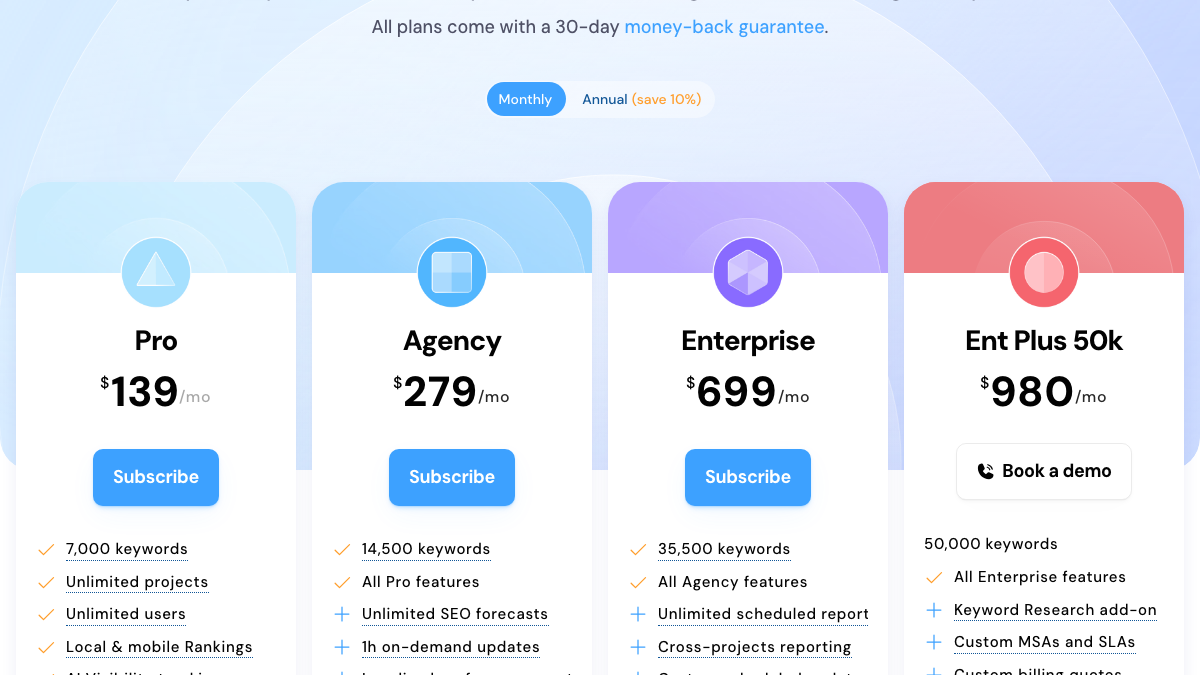
Every plan comes with unlimited projects and unlimited users, which is a big deal for an agency with a dozen people logging in. RankControl doesn't try to match that part. If your job includes a daily rank report across thousands of keywords, several countries or marketplaces like Amazon, a dedicated tracker does it better than we do.
Instead of counting keywords, AWR counts keyword units. One unit is "one query made weekly for one search engine, for one device with a search depth of 5 pages." Each plan gets a monthly allowance:
| AWR plan | Keyword units a month |
|---|---|
| Pro | 7,000 |
| Agency | 14,500 |
| Enterprise | 35,500 |
Tracking daily instead of weekly costs seven times as many units, and a second device doubles them. AWR also does forecasting. Its SEO Forecasting predicts traffic, conversions and revenue from the ranking gains you expect, with one forecast per project on Pro and unlimited forecasts on Agency.

Built by the team that got cited in 48 hours.
Content generation, backlink building, AI visibility tracking, and Google rankings. One platform, zero guesswork.
How AWR tracks AI answers
You don't buy AI tracking separately at AWR. It comes with every paid plan from Pro up, and the FAQ is upfront about the catch: "Tracking an AI platform for a keyword uses your existing keyword quota, just like adding another search engine or location would."
AWR's own unit math shows what that means. Say you track 1,000 keywords on Google, whose report includes AI Overviews, and add AI Mode, ChatGPT and Perplexity:
| How often you check | Keyword units | Plan you need |
|---|---|---|
| Weekly | 4,000 | Pro |
| Daily | 28,000 | Enterprise, at $699 a month |
So the decision to check daily is what moves you from Pro to Enterprise.
Which engines you get depends on which AWR page you're reading. The AI Search product covers Google's AI Overviews and AI Mode, then adds ChatGPT, Perplexity and Gemini, with Gemini live in four markets so far. AI Brand Intelligence is a separate product that starts from your brand rather than your keywords. It drops the Google surfaces and adds Claude. One bullet on the tracking page even calls Gemini and Perplexity "Google and Anthropic's LLMs," which looks like something left over from an older draft.
RankControl keeps one list of six engines, and Claude, Grok and Google AI Mode are all on it. Every week it checks all six for the 50 queries in your AI visibility tracking. AWR covers Google's AI Overviews, which we don't, and we cover Grok, which none of AWR's pages mention.
Setting up: a project wizard or a brand profile
In July, AWR rebuilt project setup as a four-step wizard. You start with your brand and competitors, then pick the keywords, prompts and engines to track. As you go, the wizard projects how many keyword units the project will use. I'd watch that number closely, since units are where AWR bills get surprising. Coming from another tool? AWR will import your historical rankings, and its help center says a migration team can do that for you.
RankControl starts from your site. Brand Control reads your pages and drafts your voice, products, buyers and competitors, so your job is correcting a draft instead of filling in a form. Your tracked queries start from the questions buyers ask, and you can keep up to 50 of them.
The organic-only list
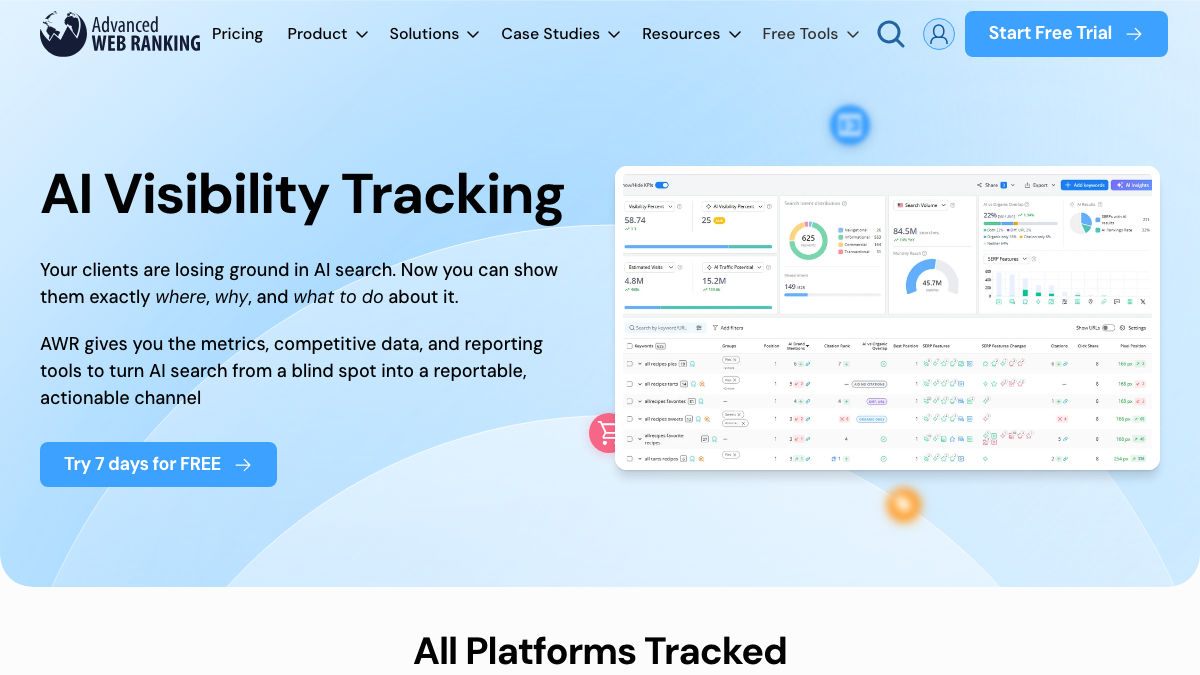
AI vs Organic Overlap is the best thing on AWR's site. Each keyword gets a state such as both, organic only, citation only or neither. Behind the metric sits a real argument, that ranking and citation are drifting apart.
Organic only is the state I'd look at first. Those are pages Google already trusts, answering questions where AI Overviews quote someone else. A tracker can hand you that list every morning. Someone still has to read what the cited pages say that yours don't, write the better answer, publish it and go after links to it.
AWR's AI Insights chat can find the same keywords, and one of its listed uses is spotting "queries where you rank #1 organically yet aren't cited at all." It runs on credits, with 1,000 included each month. AWR puts that at roughly 7 to 10 sessions. A forecast can put a price on closing those gaps, too.
What AWR doesn't have is any content or outreach feature. Its product menu covers rank tracking, reporting, forecasting and research, and the two AI products sit next to those. So the organic-only list turns into a task for your team, and every keyword on it stays there until someone writes the page.
RankControl picks up from there. When competitors get cited for one of your tracked queries, that query feeds the content engine. It writes an article against the pages already ranking for the query and scores the draft for how easily AI engines can quote it. Once you approve it, the article goes out as a native post on your site through one of nine destinations. Then Link Control finds link prospects for it and drafts outreach from your own mailbox.
See your first AI citation report in under 5 minutes.
No setup calls. No onboarding meetings. Connect your domain and see where AI mentions your brand right now.

Working the list: authority or presence
One line on AWR's AI tracking page is worth borrowing, whatever tool you end up with. It asks whether a visibility problem is about "authority (not sourced as a reference) or presence (not mentioned at all)." The two need different fixes, and treating one like the other can cost you a quarter.
With an authority problem, the engines know your brand but quote someone else's page, so the fix is usually your page. Put the direct answer in the first two sentences. Add the specific numbers the cited page has and yours doesn't, and show a visible updated date. A comparison table often does more for you than another 500 words.
A presence problem is harder. The engines don't name you at all, and a better page on your own site won't change that by itself. You need mentions on the sites the engines already cite for that question, and getting those is outreach. RankControl sends the first kind of problem to the content engine and the second to Link Control. The weekly check then tells you which kind you still have.
Competitors, alerts and reports
AWR benchmarks your AI visibility against up to 50 competitor domains. You get a Market Share report and a view of which domains show up next to yours. Email or Slack alerts go out when citations, mentions or sentiment shift. The report builder exports PDF, CSV or Excel, while Looker Studio and the API come with Agency plans and higher.
RankControl tracks up to 10 competitors in its share of voice, and the weekly check shows which engine named them alongside you or instead of you. You get a notification for a new citation, and another when a competitor's AI visibility rises or falls. Reports cover citations, rankings and AI-referred traffic by source, which gives the question of whether a new article worked one place to live.
Rank tracking got harder to trust this year
Anything that reads Google results has had a rough year, and that includes AWR and RankControl. There's a busy r/SEO thread this week titled "I'm pretty sure SEMRush and Ahrefs are broken." In it, one practitioner traced the trouble to a run of Google changes going back to January 2025. The num=100 parameter went away in September 2025, and new jump-link URLs arrived this summer. Across 10 to 20 client domains, positions past page two stopped looking reliable to them.
I'm pretty sure SEMRush and Ahrefs are broken. And so is SERP.
I've been watching rankings climb and fall for 9 months now with no descendible pattern or end in sight. Google gets more and more cryptic about what constitutes "helpful content" and has outwardly admitted to the DOJ that existing traffic...
Our take is to read any tracker's positions as a trend and keep Search Console open beside it. RankControl's analytics shows Google and Bing positions for its own articles' keywords next to Search Console clicks and impressions. AWR connects to Search Console as well, and in the end we're both reading the same Google.
AI answers move for a different reason. Ask the same question twice and different sources can get cited, so one day's reading tells you less than a rate over several weeks. AWR lets you check daily or on demand, which helps you catch a sudden change, but every check costs units. RankControl checks weekly and keeps the history.
Both work inside Claude
AWR's MCP server has 48 tools, up from 22 before its latest update, and it's on Agency plans and higher. If you use ChatGPT, you can add AWR as an app as well. The AI Insights chat is a separate layer inside AWR. It includes 1,000 credits a month, and add-ons run from $10 to $100 a month.
RankControl's MCP server has more than 80 tools and comes with the plan. From a chat you can check citations, plan titles and publish an article to your CMS, and publishing stays a dry run until you confirm.
Pricing, trials and leaving
| Monthly billing | Billed yearly | |
|---|---|---|
| AWR Pro | $139/mo | $125/mo |
| AWR Agency | $279/mo | $251/mo |
| RankControl | $400/mo | $4,000/yr |
AWR's trial runs 7 days with no card, and every plan carries a 30-day money-back guarantee from the first subscription. You can also pause once per subscription instead of cancelling.
RankControl's price covers everything above, with a 7-day free trial and the card taken up front. If you're moving over, our separate guide on switching from Advanced Web Ranking covers the 20,000-row export limit and the 30-day window to log in after you cancel.
RankControl vs Advanced Web Ranking: which wins AI search visibility?
For AI search visibility, I'd pick RankControl, and I'd judge both tools by one thing: whether your organic-only list is shorter next month than it is today.
AWR will measure that list carefully. It reads more of Google than we do and fewer engines outside it, and every extra check comes out of your keyword units. What it won't do is shrink the list. RankControl checks six engines every week and then goes to work on the list itself. It writes the missing articles, publishes them and pitches them for links.
You can work the list by hand if you'd rather. That means pulling the overlap report and briefing a writer for every organic-only keyword. Then you publish, build an outreach list and check again. Or RankControl's agents can do it every month for $400, starting with a 7-day free trial, while your team keeps whatever rank tracker it already trusts.
Your competitors are building backlinks while you read this.
Organic outreach, social mentions, and link exchanges, with managed backlinks available as an add-on. Grow your domain authority without running the campaign yourself.