
We pulled Google's results for "accuranker review" this week to see who ranks for it. G2 holds the first organic spot, Trustpilot the second, and a Reddit thread the third. Above all three sat an AI Overview that answered the question before anyone reached a link.
That page is the RankControl vs AccuRanker question in miniature. AccuRanker tells you exactly where you rank, and it's been doing that from Aarhus, Denmark, since 2013. RankControl is built for the part above the links: getting your brand into the answers that ChatGPT, Perplexity and Google's AI features write. Every AccuRanker price and feature below comes from its own site, checked on September 26, 2026.
RankControl vs AccuRanker: the short answer
AccuRanker measures. Its core product tracks Google positions daily, lets you refresh them on demand, and reports pixel position and click-through estimates for thousands of keywords. For AI answers it sells a second product, AccuLLM, which tracks prompts across ChatGPT, Perplexity, AI Overviews and AI Mode on its own price list.
RankControl does the work that moves those numbers. We pick the questions your buyers search, write articles in your brand's voice, publish them as native posts on your domain, and draft backlink outreach. Then we check 50 queries every week across seven AI engines, plus Google and Bing positions, for $400 a month.
If the goal is getting cited in AI answers, a tracker can only confirm it hasn't happened yet. For that job we'd pick RankControl, and the rest of this post shows the reasoning.
Side by side
Here's how the two compare on the things buyers ask about, with AccuRanker's rank tracker and AccuLLM counted together.
| AccuRanker | RankControl | |
|---|---|---|
| What it is | Rank tracker, plus AccuLLM for AI answers | Pipeline for AI search visibility and Google rankings |
| Price | Rank tracking from $224/mo (2,000 keywords); AccuLLM from $206/mo (100 prompts) | $400/mo or $4,000/yr, one plan |
| AI engines | ChatGPT, Perplexity, AI Overviews, AI Mode | ChatGPT, Perplexity, Claude, Gemini, Grok, Google AI Mode, Google AI Overviews |
| AI check frequency | Daily | Weekly, 50 queries |
| Google rankings | Daily, on-demand refresh, 2,000 to 25,000+ keywords | Weekly Google and Bing positions for tracked queries and published pages |
| AI Overviews | A prompt surface in AccuLLM, plus an AI Overview page in the rank tracker | Whether one showed, and whether it cited your page, per ranked keyword |
| Articles | Not offered | 100 pages/mo across 26 formats |
| Publishing | Not offered | Native posts on 9 destinations, including WordPress, Webflow and Shopify |
| Backlink outreach | Not offered | Drafted from your own mailbox; Managed Backlinks add-on at $350/mo |
| Seats | Unlimited | 5 |
| MCP | AccuRanker MCP, read-only, for ChatGPT and Claude, included | MCP server and CLI with 80+ tools |
| Try before paying | No trial; 14-day refund from first purchase | 7-day free trial |
What AccuRanker is in 2026
AccuRanker still leads with rank tracking, and the main table shows why people like it. Each keyword gets its position, how many pixels it sits from the top of the page, an estimated click-through rate next to the maximum for that spot, and a column labeled AI SoV.
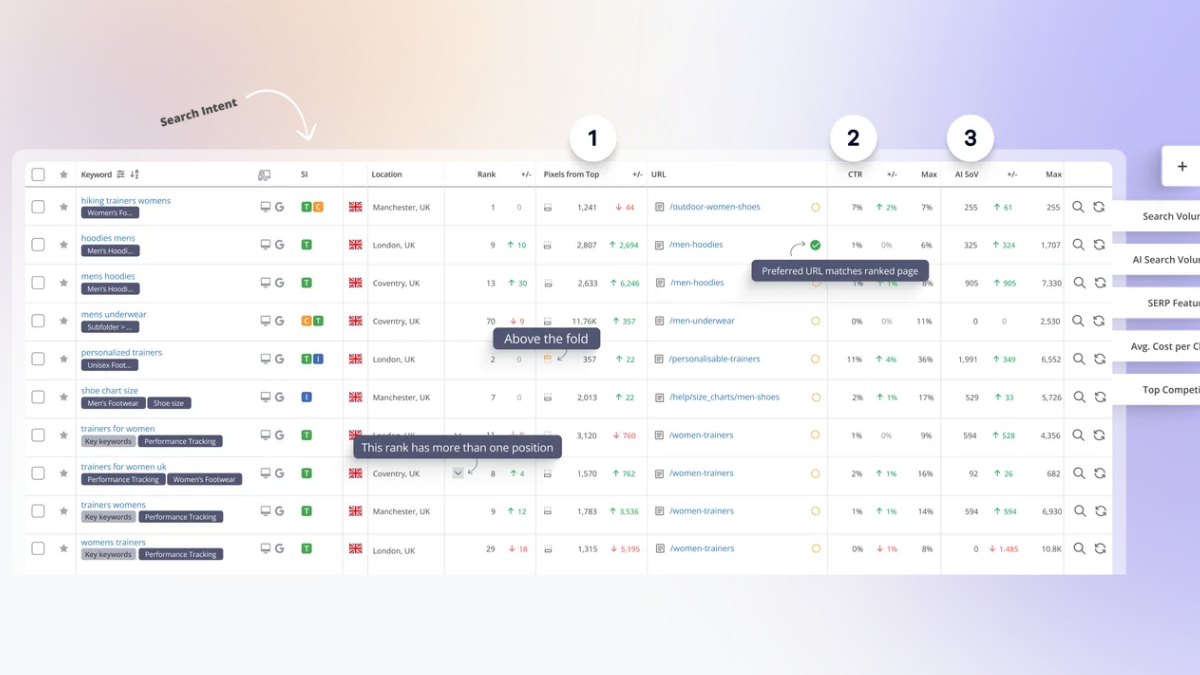
That last column is a naming trap. The "AI" features on AccuRanker's rank-tracking side, which cover AI Share of Voice, AI CTR and AI Search Volume, are the company's own models run over Google data. They estimate traffic and demand from search results. None of them reads a ChatGPT answer, so a team that buys the rank tracker expecting AI search coverage finds it priced separately under AccuLLM.
Where AccuRanker is stronger than RankControl is raw rank tracking. It updates every keyword daily, refreshes one keyword on demand or a whole domain every two hours, and scales to tens of thousands of keywords across countries and cities. RankControl checks positions weekly for the queries you track and the pages we publish.
Depth is worth a look too. When Google stopped honoring the num=100 parameter in September 2025, trackers that used to pull 100 results in one request needed ten requests to see the same depth. At the time, AccuRanker said it would track the top 30 positions daily and the top 100 twice a month.
More communication from the various SEO tool companies about the num=100 situation. Accuranker says it will track the top 30 listings daily and the top 100 twice per month. ahrefs also posted today that they are still figuring things out. Doesn't sound great IMO. A quote from https://t.co/Gb0ACzmXx5
 Glenn Gabe@glenngabeSep 19, 2025

That trade-off made sense for classic SEO, where page four rarely sends traffic.
How often does ChatGPT mention your brand?
Most founders have no idea. The answer might surprise you.

AccuLLM: the AI search product you buy separately
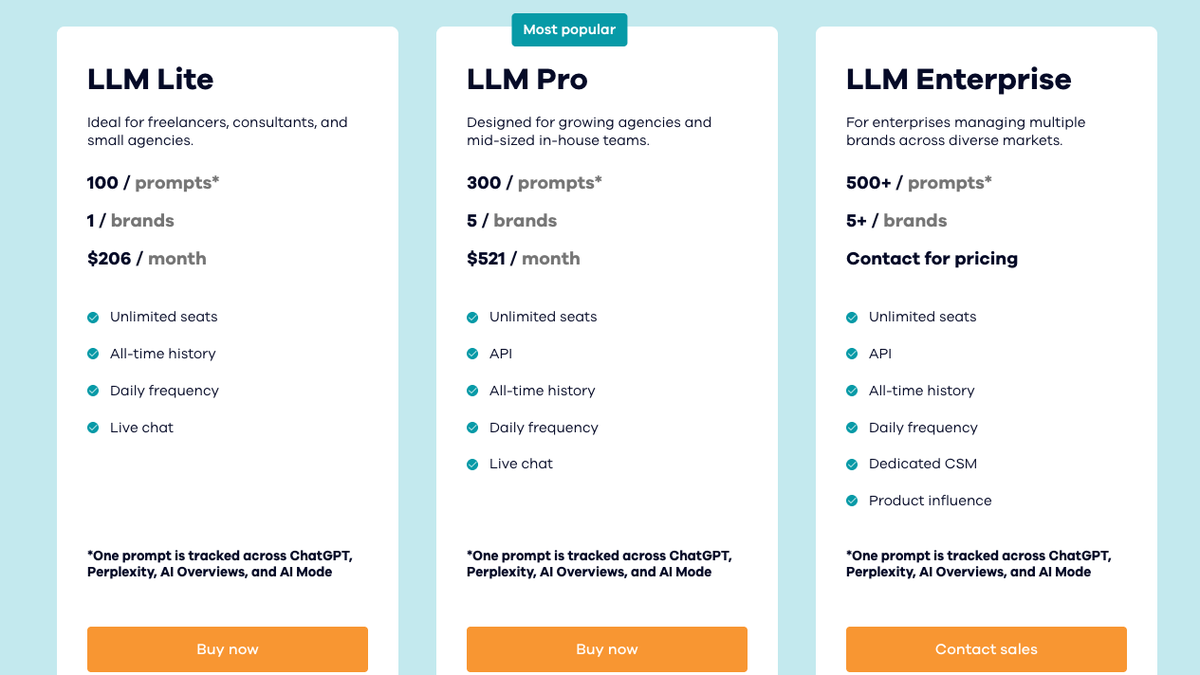
AccuRanker launched AccuLLM on September 30, 2025, and its pricing footnote is precise: "One prompt is tracked across ChatGPT, Perplexity, AI Overviews, and AI Mode." For every prompt you add, it reports where your brand lands in the answer, how often you're mentioned and cited, and a sentiment score from 1 to 100.
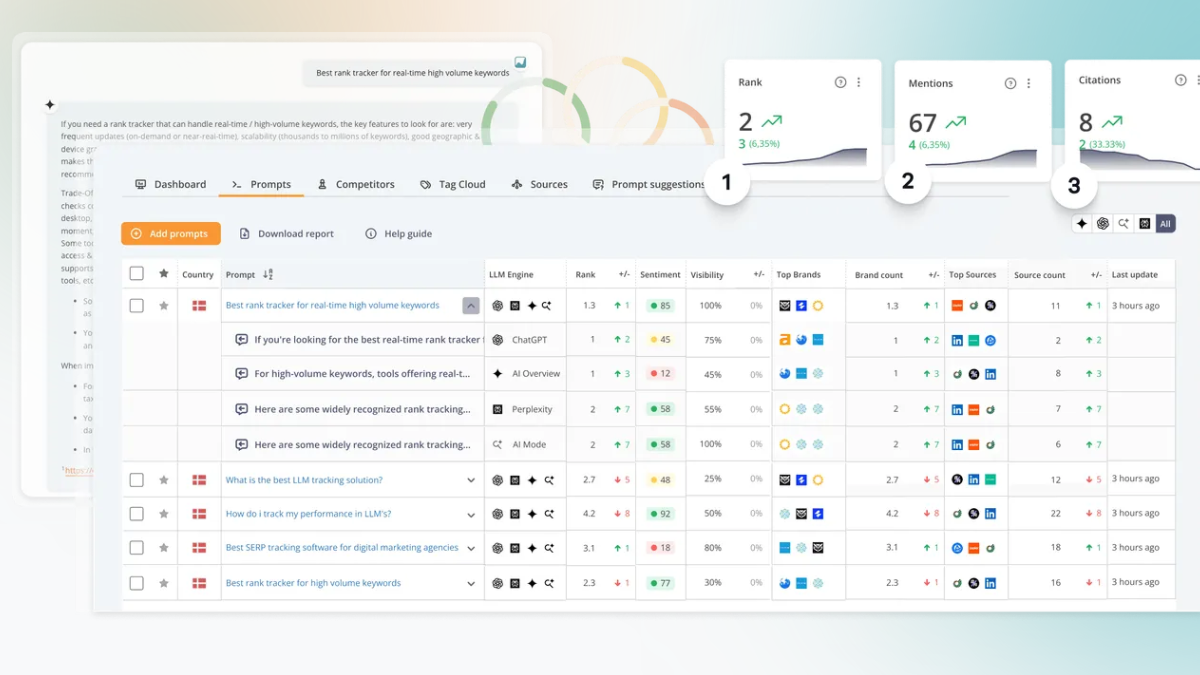
The metric we liked most is the web search rate, which shows how often a model went to the live web instead of answering from what it already knows. AccuRanker frames those searches as your chance to influence the answer, since that's when a fresh page on your site can be fetched and cited.
The engine list is shorter than it first appears. Claude, Gemini and Grok aren't on it. If your buyers draft vendor shortlists in Claude at work, or ask Gemini from inside Google's own apps, AccuLLM won't show you what those answers say about you.
Then there's the price. LLM Lite is $206 a month for 100 prompts and one brand, LLM Pro is $521 for 300 prompts and five brands, and Enterprise is custom. Every tier checks daily and includes unlimited seats, and none of them includes writing or publishing.
The quote gap: why a top ranking doesn't earn a citation
We call it the quote gap: the distance between where your page ranks and whether an AI answer quotes it. A rank tracker measures one side of it, and the gap has been getting wider.
Ahrefs studied 863,000 keyword results for a March 2026 report and found that only 37.1% of the URLs cited in Google's AI Overviews also ranked in the top 10 blue links for the same query. Nine months earlier, a similar comparison came out at about 76%.
Read that as a warning about what your rank report can see. In the same Ahrefs data, just over a third of cited URLs didn't rank in the top 100 blue links at all, which puts them outside a top-100 report and far outside a daily top-30 check. So when an AI Overview quotes a page sitting at position 140, the rank report shows nothing, and you'd only find it by reading the answer.
The clicks tell the same story from the other side. Pew Research Center tracked the searches of 900 US adults in March 2025. People clicked a regular result on 8% of visits when an AI summary appeared, against 15% when none did, close to half the rate.
We wrote a longer piece on why ranking first on Google doesn't guarantee a ChatGPT citation, and another on tracking AI Overviews separately from organic rankings.
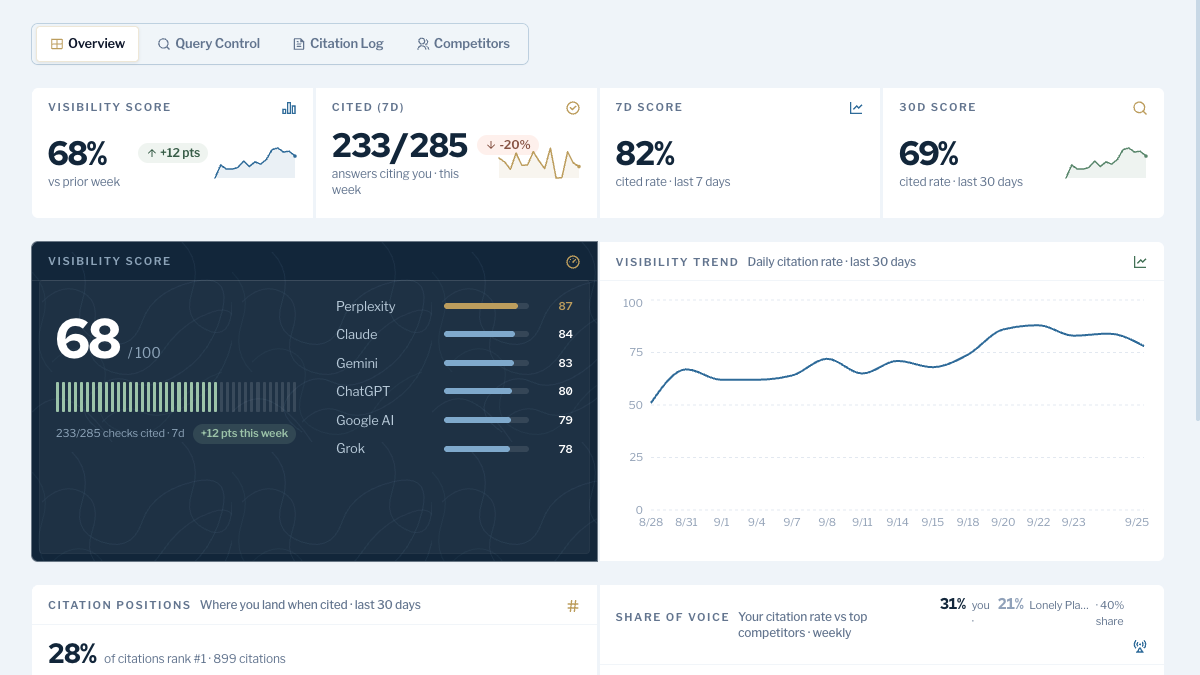
RankControl reads both sides of the gap. RankControl's AI visibility tracking checks 50 queries every week across all seven engines and keeps a citation history per engine. The weekly rankings check records Google and Bing positions and, on every Google check, whether an AI Overview appeared and whether it cited your page, whatever position that page holds.
15 hours a week manually. Or 15 minutes with RankControl.
Track citations, monitor competitors, and fix content gaps across every AI search engine. Automatically.

What happens after the report?
AccuRanker's newest release, AccuRanker MCP from May 2026, connects its rank and AccuLLM data to ChatGPT and Claude. You can ask "what changed this week?" in a chat window and get a clean summary back. It's read-only, and it's included with any plan.
It's a handy way to read your numbers, and the answer in ChatGPT stays the same until something on the web changes. When the report says a competitor is cited for "best CRM for small agencies" and you aren't, here's roughly what winning that one query takes by hand:
- Read the answers across engines and note which pages they cite instead of yours: 30 to 45 minutes.
- Write or rewrite a page that answers the question directly, with sources: three to four hours.
- Add internal links, images, a meta description and FAQ markup: about an hour.
- Format and publish it in your CMS: 20 minutes.
- Pitch a few sites for a link or a mention: two to three hours.
Call it seven to nine hours per query. Ten target queries a month puts you at 70 to 90 hours, and that's before anyone rereads the answers to see whether the page got picked up. These are our estimates, and yours will differ, but a monitoring subscription covers none of those hours.
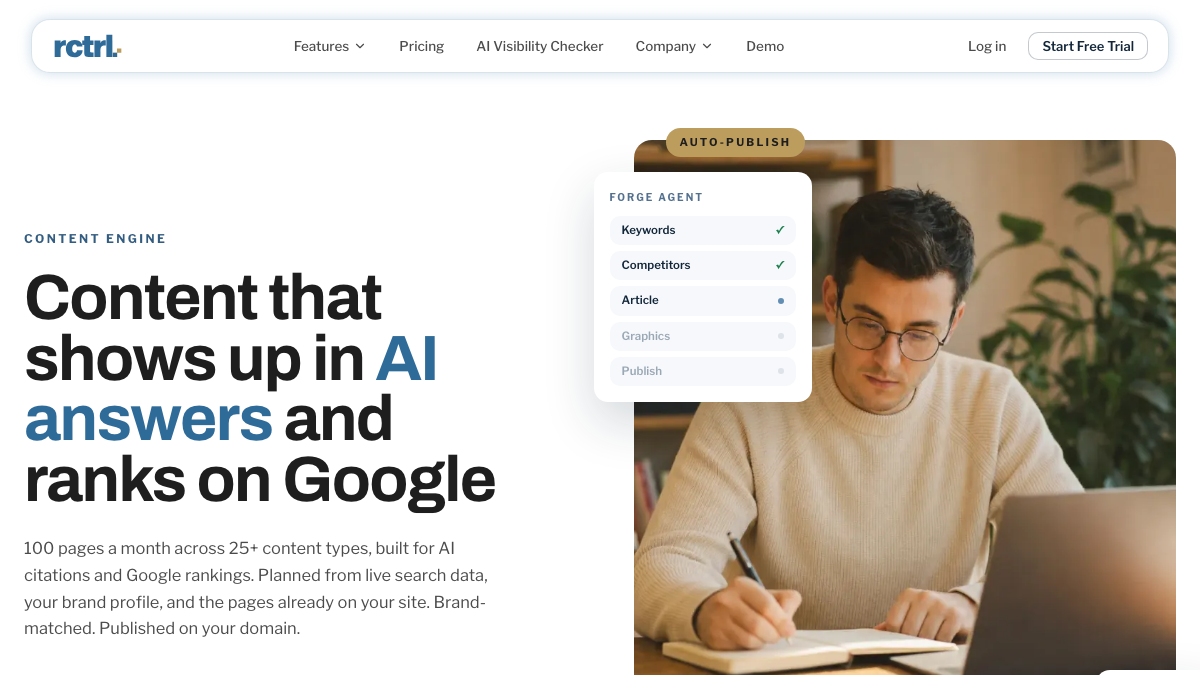
RankControl's content engine covers the middle of that list. The content engine plans titles from the questions your buyers search and writes each article in the voice of the brand profile built from your site, against the pages already ranking for its keyword. Every article gets a score for how easily AI engines can quote it, with a fix list, before it goes out through the publishing destination you connect.
Link Control handles the fifth step. Link Control finds prospects and contacts for each published article, then drafts personalized outreach that goes from your own mailbox, and follow-ups only go out when nobody replies. Auto-publish is off by default, so you approve each article until you trust the output.
The harder problem shows up around month three. A page cited in week two can drop out of the answer by week nine, and nobody notices because nobody is rereading 350 answers a week (50 queries across seven engines). RankControl sends a notification when a new citation lands, and a lost one shows up in the citation history on the dashboard, so the gap is visible the next time you look.
If you'd rather run all of this from Claude or Cursor, RankControl's MCP server and CLI come with the plan and give you 80+ tools to plan articles and check citations from a chat window. Publishing still waits for your confirm.
RankControl vs AccuRanker on price
The cheapest way to cover both Google rankings and AI answers at AccuRanker is Professional at $224 a month plus LLM Lite at $206. That's $430 a month for 2,000 keywords, 100 prompts, one brand and four AI surfaces. Our roundup of the best rank tracking software puts AccuRanker's price next to nine other trackers.
| The job | AccuRanker | RankControl |
|---|---|---|
| Google rank tracking | $224/mo, 2,000 keywords, daily | Included, weekly |
| AI answer tracking | AccuLLM from $206/mo, 100 prompts, 4 surfaces | Included, 50 queries, 7 engines |
| Both together | $430/mo | $400/mo |
| Articles written and published | Not offered | 100 pages/mo included |
| Backlink outreach | Not offered | Drafts included; managed links $350/mo add-on |
| Try it first | 14-day refund after purchase | 7-day free trial |
AccuRanker's pricing page says an annual payment takes 10% off. We clicked the Monthly and Yearly toggle twice on September 26, and the cards stayed at $224 and $764 both times, so budget from the monthly figure until checkout shows you the discount. Go over your keyword allowance and AccuRanker doesn't block you: its help docs describe billing the overage for each day you're above the limit.
There's no free trial either. AccuRanker's FAQ offers a 14-day refund from the initial purchase, which several SEO blogs describe as a free trial. The pricing page itself never uses the word.
Prices on third-party pages drift, too. One result on the first page for "accuranker alternative" still headlines AccuRanker at $129 a month.
RankControl is one plan at $400 a month, or $4,000 a year with two months free. That covers five seats and 100 pages a month, with publishing and outreach drafts included. The 50 tracked queries get checked across seven engines every week. The 7-day free trial runs on that same plan with $0 charged today, and you can cancel at the end of any billing period.
What Reddit says about AccuRanker and AI visibility
We read six recent Reddit threads where people asked which tool to use for ChatGPT and AI Overview visibility. Across dozens of replies, nobody recommended AccuRanker or AccuLLM. People named Semrush, Ahrefs and a long tail of newer startups, many of them founders answering on behalf of their own products.
An absence isn't a verdict. AccuLLM is only a year old, and those threads were crowded with vendors recommending themselves. It does suggest most buyers still file AccuRanker under rank tracking, and the tool roundups we saw on X put it there too.
The rank tracker thread worth reading is on r/SEO_Experts. Its author went looking for a comparison in August, found five articles quoting the same tool's entry plan at five different prices, and built their own table instead. Their core point is that a "tracked keyword" isn't a standard unit, so a 2,000-keyword plan can mean 2,000 checks or about 667 once engines and devices multiply it.
10 SEO keyword rank tracking platforms, sorted by what they're structurally good at instead of star ratings
I went looking for a decent rank tracker comparison last month and gave up. Five articles published within eight weeks of each other quoted the same tool entry plan at $109, $116, $224, $236 and $249. Hear me out... Same tool, same quarter,...
The same post makes a pricing point about AccuRanker specifically: its on-demand refresh is the reason to pay its rate, and a team that doesn't use that refresh every month is paying roughly double. The top reply was blunter, from a practitioner who said rank data rarely matches their other sources and takes up maybe 15% of their week.
Moving from AccuRanker to RankControl
Export your history before you change anything, since your baseline is the one thing you can't rebuild later. AccuRanker's help docs give the steps:
- Open the Keywords list for the domain.
- Pick the dates to compare and any filters.
- Click Download Report.
- Choose CSV, Excel, Sheets or PDF, plus a template and language, then click Download.
The AccuLLM competitor tab exports to Excel, CSV or Google Sheets as well.
Plan changes live under Account, then Subscription, then Change plan. The help docs say a downgrade waits until your next renewal, so you keep full access for the period you've already paid for.
In RankControl, don't copy over all 2,000 keywords. Pick the 50 questions where you most want to be the answer, add them as tracked queries, and let the first weekly check set your baseline across seven engines. We walked through a similar move from another rank tracker in our guide to switching from Keyword.com.
Which wins AI search visibility?
For AI search visibility, the verdict is RankControl.
AccuRanker is a precise measuring tool, and AccuLLM adds a clear view of four AI surfaces for $206 a month and up. Neither one writes a page, publishes it, or earns a link, so the hours between "you're not cited" and "you're cited" stay on your team.
RankControl runs that whole loop for one job. We pick the questions and write the articles in your voice, then publish them on your domain and draft the outreach. Every week we check seven engines to see what moved. In the first month you get a calendar of titles planned from your tracked queries, articles going live on the schedule you set, outreach drafts waiting for approval, and four weekly readings of where you stand.
You can do all of this by hand: track the answers, write and publish the pages, pitch the links, then reread every answer each week. Or RankControl's agents can run it every month while you work on your product. Already on AccuRanker? Our guide to switching from AccuRanker covers what to export first.
Not sure where you stand today? Start with a free check of your brand in AI answers, then use the trial week to count what's live on your site at the end of it.
AI search traffic grew 835% this year. Is your content ready?
RankControl generates 26 content formats optimized for ChatGPT, Claude, and Perplexity. Published on your domain, matched to your brand.