
Switching from Keyword.com to RankControl is a switch between two different kinds of product. Keyword.com is a measurement instrument: it launched as SerpBook in 2011, has been part of the saas.group portfolio since 2022, and is built for verified accuracy at agency scale. RankControl is an operating pipeline: measurement wired to production, where the same platform that tracks your visibility writes, publishes, and earns the assets that move it.
People make this switch when the instrument stops being the bottleneck and the engine becomes it. Here's how to do it without losing a row of data.
What Keyword.com is
Keyword.com is a rank tracker built for agencies and SEO teams. Where it beats RankControl is raw tracking depth: hundreds of keywords per project, refreshed daily or on demand, with verified positions down to city and ZIP level.
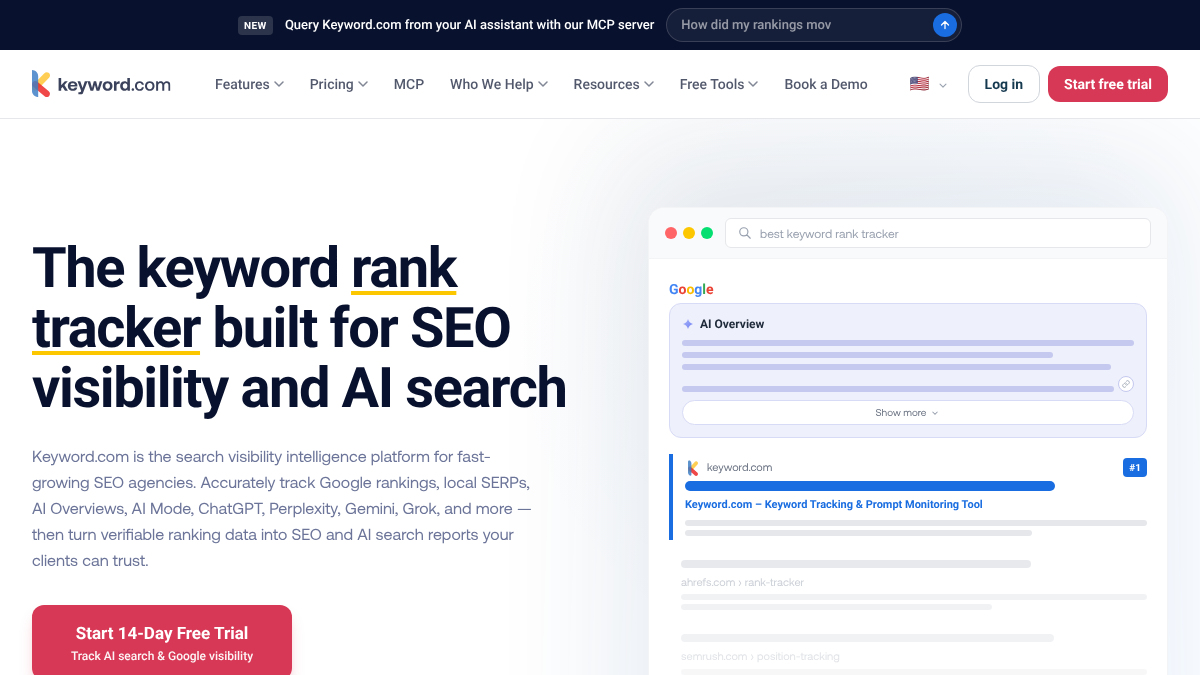
It has added AI visibility tracking too, sold as credits on top of keyword bundles. Pricing is modular, from a few dollars a month for Google-only tracking to enterprise plans near $490 a month, with a 14-day trial.
Teams rarely leave because the readings are wrong. They leave because nothing in a tracker acts on them. Our RankControl vs Keyword.com comparison sets the two side by side.
Why teams switch
Two forces drive it, one internal and one industry-wide.
The internal one is the instrument-without-an-engine problem. A tracker tells you, with verified precision, what happened. Nothing in it writes the page, publishes it to your CMS, earns the link, or answers the buyer's question in an AI answer. For an in-house team watching its own brand, that means the tracking subscription is forever accompanied by a content stack, a publishing workflow, and someone stitching the three together with exported CSVs. The switch to a pipeline collapses that stitching: the queries you track are the queries the content engine plans against, and the loop closes weekly without an operations layer.
The industry-wide force is quieter: pure Google position data is getting more expensive to collect and less complete as a picture. Google's rollout of goto redirect URLs made SERP scraping dramatically harder, with practitioners estimating hundreds of requests per query for trackers to keep verified positions, and the community has started asking openly how long position data stays trustworthy at reasonable prices.
Google confirmed the goto redirects. Rank trackers now need 500-1,000 requests per query. How long do we keep trusting position data?
Google confirmed the goto rollout on Aug 26 — result links now pass through google.com/goto with an encoded destination. Nozzle's numbers: resolving all links for a single five-page ranking takes somewhere between 500 and 1,000 requests, be...
Meanwhile, on the AI side there's no static rank to track at all: answers regenerate, sources churn between checks, and visibility is a trend line, never a position. None of this makes trackers obsolete, but it does mean the center of gravity is drifting from "where do I rank" to "am I in the answers," and that second question rewards a system that can also act on it.
200+ SaaS teams already track their AI citations.
They know exactly when ChatGPT mentions their brand, and when it stops. Do you?

The migration, step by step
- Export everything (20 minutes): keyword lists per project, full ranking history CSVs, Share of Voice reports, and screenshots of any dashboard views you'll want to reproduce. Keyword.com hosts no content of yours, so this export is the entire data-loss surface; once it's filed, nothing can be lost.
- Distill the list into 50 buyer queries (45 minutes). This is the real intellectual work of the migration. Cluster the exported keywords by intent, then choose the 50 where an AI answer could plausibly shape a purchase: comparisons, alternatives, integrations, pricing questions, constraint-heavy phrasings. Head terms you rank for but never convert on don't make the cut, and that's the point.
- Connect your CMS (20-30 minutes). RankControl publishes to nine kinds of destination, including the Content API for headless setups. This step has no Keyword.com equivalent, because it's where the pipeline part starts: published articles land as native posts on your own domain.
- Run the baseline week. Load the 50 queries and let the first weekly check run across six AI engines, alongside Google and Bing rankings. Save this next to your exported history; the two files together are your before-and-after seam, dated.
- Rebuild the one report that mattered. Most teams reproduce a single view: the trend line an executive actually reads. Wire it from the weekly data and resist rebuilding the other six dashboards nobody opened.
- Cancel the old subscription once the baseline week is saved. Your exported history and the first weekly check, filed side by side, are all you need from it.
The distillation, worked
Step two deserves a worked example, because compressing 300 keywords into 50 queries feels like loss until you watch it happen.
A typical exported list splits into four piles. Pile one, branded terms: your name and its misspellings, maybe 20 rows. Keep two as tracked queries (your brand, and "your brand vs" as a stem) and let the rest go; you'll rank for your own name without surveillance. Pile two, head terms: "project management software" and cousins, high volume, tracked for years, converting never. Retire them; an AI answer for a term that broad cites incumbents, and nothing you publish next quarter changes that. Pile three, the long tail you added during keyword-research enthusiasm: 150 rows of variants that were always the same twelve intents wearing different word orders. Cluster them, and each cluster contributes its best phrasing as one tracked query. Pile four, the quiet gold: comparison, alternative, integration, and constraint-heavy terms, "X vs Y," "X for agencies with client portals," "does X integrate with Y." Nearly all of these make the 50, because these are the queries where answers shape purchases and where your own pages can realistically win the citation.
Run that sort and the 50 stops feeling like a downgrade from 300. It's the same demand, deduplicated, with the decoration removed, and every row on it is something the pipeline can actually act on.
What maps to what
| Keyword.com | RankControl |
|---|---|
| Keyword lists (50-500+ per bundle) | 50 tracked buyer queries, chosen for purchase influence |
| Daily / on-demand Google refreshes | Weekly checks across six AI engines plus Google and Bing |
| AI visibility trackers and credits | Citation tracking built into the same weekly loop |
| Share of Voice reports | Per-engine citation and ranking trends per query |
| White-label ViewKeys, Looker Studio | In-dashboard reports for your own team |
| API and MCP server for your tooling | Pipeline acts on the data itself: content, publishing, outreach |
| Per-bundle pricing, scales by keyword count | $400/mo flat, production included |
The last row is the decision in miniature. One product prices measurement by the unit and leaves action to you; the other prices the whole loop flat and constrains the measurement to the queries that feed it.
How often does ChatGPT mention your brand?
Most founders have no idea. The answer might surprise you.

What the weekly check records
Each of the 50 queries gets the same reading every week. The AI side checks it on six engines and keeps a citation history for each one, so you can see which engine picked you up and when. You get a notification when a new citation lands, and a lost one shows up in that history on the dashboard.
The rankings check records Google and Bing positions for your tracked queries and for every page RankControl publishes. It also notes whether an AI Overview appeared and whether it cited you. Coming from a tracker, that column is the one to watch, because a page can hold position three while the AI Overview above it cites a competitor.
The Reports screen puts citations, rankings and Search Console data side by side, and a weekly email lists the gains. Your exported Keyword.com history stays the long-range record, and the weekly readings start the new one.
Who this switch is for
The switch is for the other user Keyword.com has always had: the in-house marketer or founder pointing an agency-grade instrument at their own single brand. If your keyword list has 300 rows and your content calendar has a stitching problem, you're paying for precision you read monthly while the actual bottleneck, producing and publishing the assets that change the readings, lives in three other tools. That's the user the pipeline shape was built for. Start the free trial during your final Keyword.com month, run both side by side, and watch which one changes your numbers rather than just charting them.
Reading the first month
Your Google rankings trend won't move from switching trackers; positions belong to your pages, and both tools will agree on the big picture even if daily-versus-weekly sampling disagrees on the wiggles. The new information arrives on the AI side: which engines cite you for which buyer queries, where competitors own answers you assumed were yours, and how those citations churn week to week, which is normal and is exactly why weekly trend lines beat snapshots. And the real difference shows in month two, when the first pipeline-produced pages start publishing against the queries your old tracker could only watch. That's the moment the migration pays or doesn't, and it's measurable on the same 50 queries you chose in step two, which is precisely why you chose them.
15 hours a week manually. Or 15 minutes with RankControl.
Track citations, monitor competitors, and fix content gaps across every AI search engine. Automatically.