
If you plan to switch from BrightEdge, the date that decides how it goes probably isn't on anyone's calendar. The last public version of BrightEdge's master subscription agreement says a contract "shall be automatically renewed for one or more successive twelve (12) month renewal terms" unless either side gives written notice "at least thirty (30) days prior to the end" of the term. The same agreement adds 8% to the price at each renewal.
We call it the minus-30 date: thirty days before your renewal, the last day your notice counts. Miss it, and you've bought another year. That agreement also says that cancelling early without cause makes the rest of the term's fees due at once, so an early exit doesn't save money either.
One caveat up front. That agreement is dated 2017 and isn't linked from BrightEdge's legal page today, and enterprise contracts get negotiated, so your Order Form is what counts. This guide uses BrightEdge's public pages, product terms and privacy policy, all checked on September 26, 2026. It assumes you're moving your AI search work to RankControl. Still comparing tools? See our list of BrightEdge alternatives.
Start with the contract, not the data
Find your Order Form before you export anything. It tells you the end of the current term, the notice period, any renewal increase and whether a multi-year commitment is still running. Third-party buyers' data on Vendr says BrightEdge contracts typically run a 12-month minimum, with multi-year terms common.
Put the minus-30 date in two calendars, and send your non-renewal notice in writing well before it, even if you haven't picked a replacement yet. Ask BrightEdge to confirm receipt in writing too.
While you have your account manager's attention, ask two questions in the same email: which exports your plan includes, and what you're allowed to keep after the term ends. The second one matters more than it sounds.
What the contract says is yours
The 2017 agreement splits your data in two. It calls your inputs Customer Source Data, and the list covers your keywords and keyword groups, plus the pages, backlinks and competitors you entered. Those are yours. The analysis BrightEdge returns, such as rankings and share of voice, is described as "BrightEdge's Confidential Information," which you "may use... for its internal business purposes."
Then comes the clause that catches people. On termination, each side "will return... or destroy" the other's confidential information. Read literally, rank history you exported during the term could fall under that clause. We're not lawyers, and your contract may say something different, which is why the written question to your account manager matters.
BrightEdge's current product terms add one more line worth knowing: "BrightEdge does not warrant that it backs-up any Customer Content." Keep your own copies of anything you've built, starting with keyword groups and competitor sets, which are yours under any reading.
How to export your data from BrightEdge
BrightEdge's step-by-step export guides sit behind its customer login. The help article titled "Export page groups to a CSV file" returns an access error to the public, so I can't give you menu paths, and your account team is the first stop.
The routes BrightEdge documents publicly are these. The Connect API is a REST interface that BrightEdge says "1,500+ brands" use, set up with a customer success manager. Its integrations page names Looker Studio, Google Analytics and Search Console among the connections. The Connect API page still lists Coremetrics, which IBM retired years ago, so confirm current options with your account team rather than trusting that page.
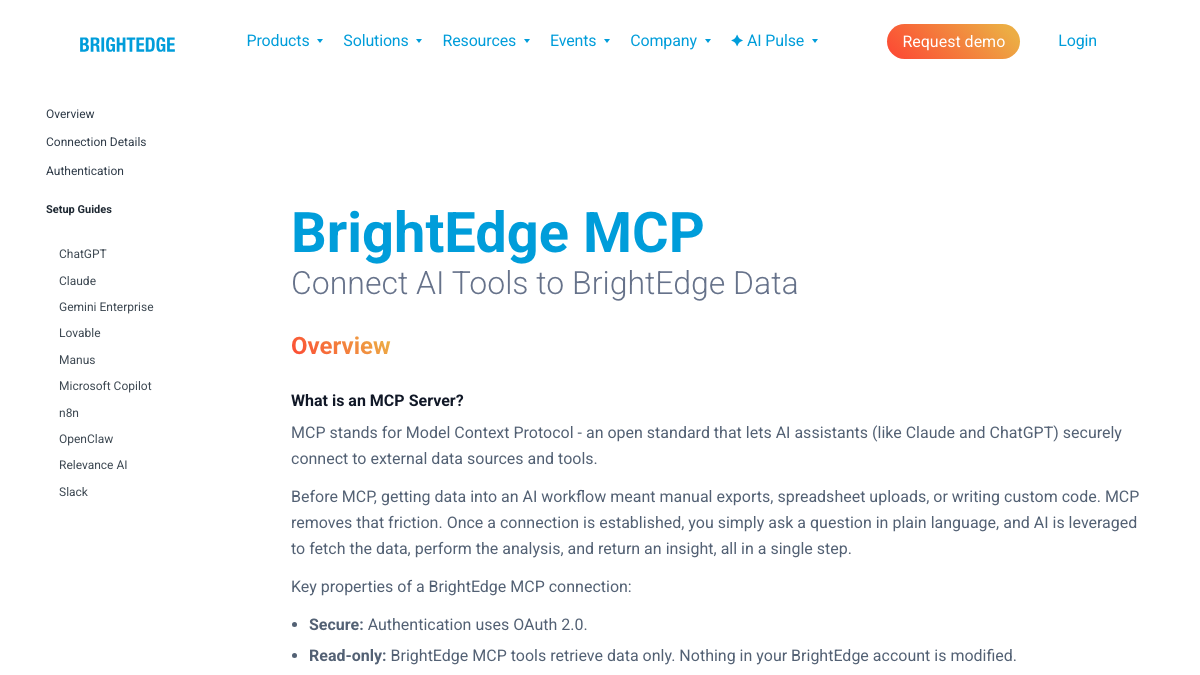
The newest route is the easiest one for a small team. BrightEdge's MCP server connects Claude or ChatGPT to your account with OAuth, and BrightEdge describes it as "read-only," pitched as the end of "manual exports, spreadsheet uploads, or writing custom code." If your contract includes it, you can ask Claude for your keyword groups, rankings and share of voice as tables and save them, one report at a time.
Whichever route you use, start with keyword groups, rank history and share-of-voice reports. Competitor sets and page groups come next. Export your Custom Reporting dashboards as PDFs too, so you remember what leadership expected to see.
26 content formats. Published on your domain. Matched to your brand.
Guides, comparisons, listicles, case studies, and more. RankControl generates content that gets cited by ChatGPT, Perplexity, Claude, Gemini, Grok, and Google AI Mode.

Site Agents and Autopilot changes
This is where BrightEdge is easier to leave than some rivals. What used to be Autopilot is now the Site Agents Suite. Its Publishing Agent "pushes BrightEdge's recommended updates to title tags, meta titles and H1 tags directly into WordPress, Drupal or another major content management system." A person confirms every change first, and BrightEdge's product terms grant a "perpetual, irrevocable" license to use and maintain content it generated for your site.
Changes written into your CMS stay in your CMS. BrightEdge doesn't publish a statement on what happens after cancellation, though, so spot-check before you remove anything. Open a few key pages and compare the title in the page source with the one in your CMS editor. If they match, the change is yours. On WordPress, the BrightEdge Autopilot plugin can come out after that check.
AI search data and prompts
BrightEdge's AI tracking comes in two products. AI Catalyst is pitched as its "intelligence layer for AI search," and AI Hyper Cube, launched in March 2026, covers AI demand and intent.
The engine list depends on the page. The live AI Catalyst page names ChatGPT and Google AI Overviews and then "other AI platforms," while a BrightEdge blog post from March lists seven, including Claude and DeepSeek. None of them mention Grok. Save whatever prompt or query list you track there, because it becomes your first set of tracked queries in RankControl.
BrightEdge's own research is a good reason to keep tracking after the move. In its August launch of a product for AI agents, it reported that from June 2025 to June 2026, across nine industries, the number of sources ChatGPT cited per answer rose by close to 90%, while the number of brands it actually recommended fell by about a quarter. More pages get cited while fewer brands get named, so a citation count alone overstates how you're doing. It's vendor research, but the pattern is worth watching for yourself.
One thing to be fair about: BrightEdge runs site audits across millions of pages and can push on-page fixes across a large site, and RankControl doesn't try to do either. If that's a big part of your program, keep a crawler for it and move the AI search work.
Where things land after you switch from BrightEdge
RankControl has no import tool, so your exports become reference material rather than data to load.
| From BrightEdge | Into RankControl |
|---|---|
| Keyword groups and competitor sets | Up to 10 competitors in your share of voice; keywords guide the content plan |
| AI tracking prompts | Up to 50 tracked queries, checked weekly on six AI engines |
| Rank history and share-of-voice exports | Your archive; RankControl reports Google and Bing positions for its own articles' keywords |
| Custom Reporting dashboards | A reference for what your weekly and monthly reports should show |
| Site Agents changes | Stay in your CMS |
RankControl's AI visibility tracking checks six engines every week, Claude and Grok among them, and keeps the cited pages for each answer. Brand Control reads your site and drafts your voice, products, buyers and competitors, and you correct the draft.
The content engine plans articles from your tracked queries and publishes them through one of nine destinations once you approve them. WordPress has a plugin, and other stacks can use a webhook or the Content API. Link Control finds link prospects for each article and drafts outreach from your own mailbox. If you liked pulling BrightEdge data into Claude, RankControl's MCP server works the same way and can also publish, as a dry run until you confirm.

Your competitors are getting cited by AI. You're not.
Every day without citation tracking is a day your competitors pull ahead in ChatGPT, Perplexity, and Claude.
What the budget looks like after
BrightEdge doesn't publish prices. Vendr, which tracks software purchases, puts the median buyer at $50,000 a year across 46 BrightEdge deals. That's a middle point from buyers who shared their numbers rather than a list price, and neither it nor the next figure comes from BrightEdge. SpendHound's benchmark runs higher, with an enterprise average of about $119,000. Discounts off list are common enough that practitioners on Reddit mention them.
RankControl is $400 a month or $4,000 a year, with a 7-day free trial and the card taken up front. Against even the lower estimate, that leaves about $46,000 of the old line item for writers, links or a crawler.
The switch from BrightEdge, step by step
- Find the Order Form, note the minus-30 date and send written non-renewal notice: 30 minutes.
- Email your account manager about included exports and what you may keep after the term: 15 minutes.
- Export keyword groups and competitor sets, then rank history and share of voice, through the API, Looker Studio or MCP: 1 to 3 hours.
- Save Custom Reporting dashboards as PDFs and copy your AI tracking prompts: 30 minutes.
- Spot-check Site Agents changes in page source before removing the plugin: 30 minutes.
- Start RankControl, correct the brand draft, and add tracked queries, competitors and your CMS: about an hour and a half.
That's roughly four to six hours spread over the notice period. After the switch, the AI search work can run by hand: someone turns tracked queries into articles, publishes them, pitches them and checks six engines every week. Or RankControl can run that loop every month for $400, with a 7-day free trial, while your team keeps whatever crawler it trusts for the technical work.
200+ SaaS teams already track their AI citations.
They know exactly when ChatGPT mentions their brand, and when it stops. Do you?