
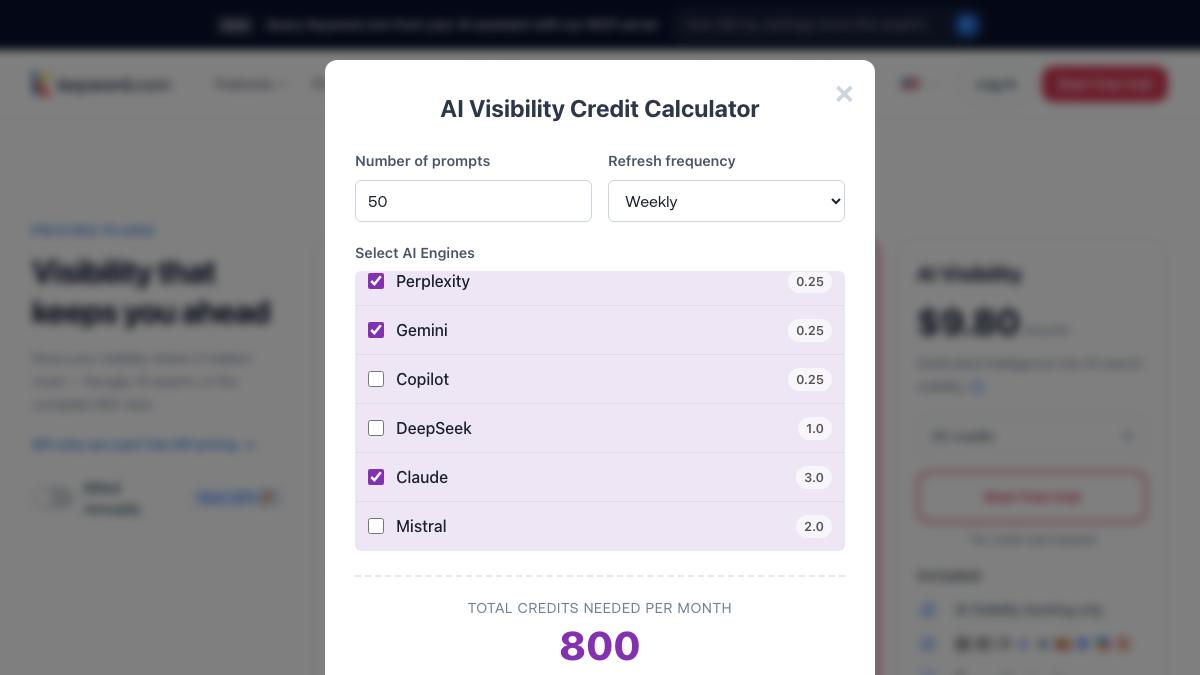
Keyword.com's pricing page has a credit calculator for AI Visibility, and it's the clearest way to see how the product thinks about AI search. Enter 50 prompts, refresh weekly, and tick ChatGPT, Perplexity, Gemini and Google AI Mode. Each of those costs 0.25 credits per check, so the month comes to 200 credits. Tick Claude as well and the total jumps to 800, because a Claude check costs 3 credits, twelve times a ChatGPT check.
That's a tracker's pricing model: you pay for each measurement. RankControl charges one flat price and spends it on the work that changes the measurement. This comparison covers engines, what the same 50 prompts cost on each, who publishes the page, and a verdict. Keyword.com's pricing and product pages were checked on September 26, 2026.
RankControl vs Keyword.com: the short answer
Keyword.com is a rank tracker built for SEO agencies. It tracks Google rankings daily or weekly down to the ZIP code, verifies its accuracy through a third-party system, and sells AI visibility tracking through credits. It reports what's happening, and your team decides what to do next.
RankControl is a pipeline. We plan titles from the questions your buyers ask, write and publish the articles as native posts on your site, draft outreach for each one, and check 50 queries every week across seven AI engines. We charge $400 a month, flat.
For AI search visibility, the question is who produces the pages engines cite. With Keyword.com your team does. With RankControl the pipeline publishes them, then checks whether they got cited.
Side by side
| RankControl | Keyword.com | |
|---|---|---|
| What it is | Publishing pipeline with AI tracking | Rank tracker with AI visibility credits |
| Price | $400/mo or $4,000/yr | From $4/mo; 360° from $33/mo; AI Visibility from $9.80/mo (monthly billing; annual saves 20%) |
| Free trial | 7 days | 14 days, no card, 100 keywords and 20 credits |
| AI engines | 7, weekly: ChatGPT, Perplexity, Claude, Gemini, Grok, Google AI Mode, Google AI Overviews | 9 in the credit calculator, no Grok; Claude costs 3 credits a check |
| Google rank tracking | Google and Bing positions for pages it publishes | Daily or weekly, city and ZIP-code level, third-party verified |
| Articles | Written and published to your CMS, up to 100 pages a month | None listed |
| Backlink outreach | Drafted from your own mailbox; Managed Backlinks optional | None listed |
| Reporting | Reports screen and weekly email | White-label reports, custom report domain as an add-on, Looker Studio |
| MCP server | Included, 80+ tools | Included |
| Users | 5 seats | Unlimited |
How often does ChatGPT mention your brand?
Most founders have no idea. The answer might surprise you.

What Keyword.com is in 2026
Keyword.com calls itself a search visibility platform for fast-growing SEO agencies, and its homepage says 2,000+ agencies and SEO teams use it. The core is rank tracking: Google positions across devices and locations, share of voice, SERP features and Google AI Overviews. Its Spyglass system verifies ranking accuracy through a third party, down to the city and ZIP code. Agencies get white-label reports, an API, an MCP server and a Looker Studio connector, with unlimited users and projects on every plan.
AI visibility sits on top of that. The AI Visibility product tracks prompts on ChatGPT, Perplexity, Gemini, Claude and more, with competitor benchmarking, citation analysis, brand sentiment and prompt research. You can buy it alone or as credits bundled with rank tracking in the 360° Visibility plan.
Keyword.com is the stronger rank tracker, and RankControl doesn't compete there. RankControl tracks Google and Bing positions only for the pages we publish, while Keyword.com tracks thousands of keywords at ZIP-code precision with third-party checks.
How the pricing works
Keyword.com prices by keywords and credits. On monthly billing, Search Visibility starts at $4 a month for 50 Google keywords. 360° Visibility runs from $33 a month for 1,000 keywords and 15 AI credits up to $260 for 10,000 keywords and 250 credits. The AI Visibility plan alone runs from $9.80 a month for 20 credits to $180 for 2,000. Custom plans start at $490, and annual billing takes about 20% off.
The credit rate depends on the engine. The calculator charges 0.25 credits per check for six engines, ChatGPT and Google AI Mode among them, then 1 for DeepSeek, 2 for Mistral and 3 for Claude. So 50 prompts checked weekly on ChatGPT, Perplexity, Gemini and AI Mode use 200 credits, which the $57-a-month tier covers. Add Claude and you need 800 credits, which means the 1,000-credit tier at $120 a month. Grok isn't in the calculator.
That unit problem isn't unique to Keyword.com. A marketer in r/SEO_Experts who compared ten rank trackers in August found five articles quoting the same tool's entry price five different ways. The reason, they wrote, is that "tracked keyword" isn't a standard unit, so no two plans are directly comparable.
10 SEO keyword rank tracking platforms, sorted by what they're structurally good at instead of star ratings
I went looking for a decent rank tracker comparison last month and gave up. Five articles published within eight weeks of each other quoted the same tool entry plan at $109, $116, $224, $236 and $249. Hear me out... Same tool, same quarter,...
RankControl has no credits. The $400 plan checks 50 queries every week on seven engines, Claude and Grok included, and covers the content, publishing and outreach as well.
Rank tracking in an AI search year
Rank tracking itself has become harder to trust this year. In r/SEO this month, a thread on Google's new redirect links for search results noted that resolving the links for one five-page ranking now takes 500 to 1,000 requests. One reply said position data is becoming a directional measure rather than a source of truth, best paired with Search Console clicks and conversions.
Google confirmed the goto redirects. Rank trackers now need 500-1,000 requests per query. How long do we keep trusting position data?
Google confirmed the goto rollout on Aug 26 — result links now pass through google.com/goto with an encoded destination. Nozzle's numbers: resolving all links for a single five-page ranking takes somewhere between 500 and 1,000 requests, be...
Rankings also explain less of who gets cited in AI answers than they used to, as our RankControl vs Nightwatch comparison covers with Ahrefs' data. Positions still matter, and RankControl tracks Google and Bing positions for every page we publish. But for AI search, the weekly citation check on a fixed set of buyer questions is the number that shows whether the work landed.
The two signals are most useful read together. A page that ranks on page one but never gets cited usually buries its answer, so the fix is to move the answer up and make each section stand on its own. A page that gets cited without ranking is answering a narrower question well, which is a hint to write more pages like it. RankControl keeps both numbers for every page we publish, so you can see which case you're in without exporting data from two tools and lining it up by hand.
Who publishes the page?
Keyword.com's plans list tracking, keyword research, reporting and integrations. They don't list content writing or publishing, so turning a gap in the data into a page is your team's job.
RankControl's content engine plans titles from the questions your buyers ask and writes each article against the pages already ranking for its keyword. The content engine scores each one for how easily AI engines can quote it, then publishes it as a native post through the CMS you connect, whether that's WordPress, Webflow, Shopify or a headless site. Auto-publish is off by default, so you approve each article until you trust the output.
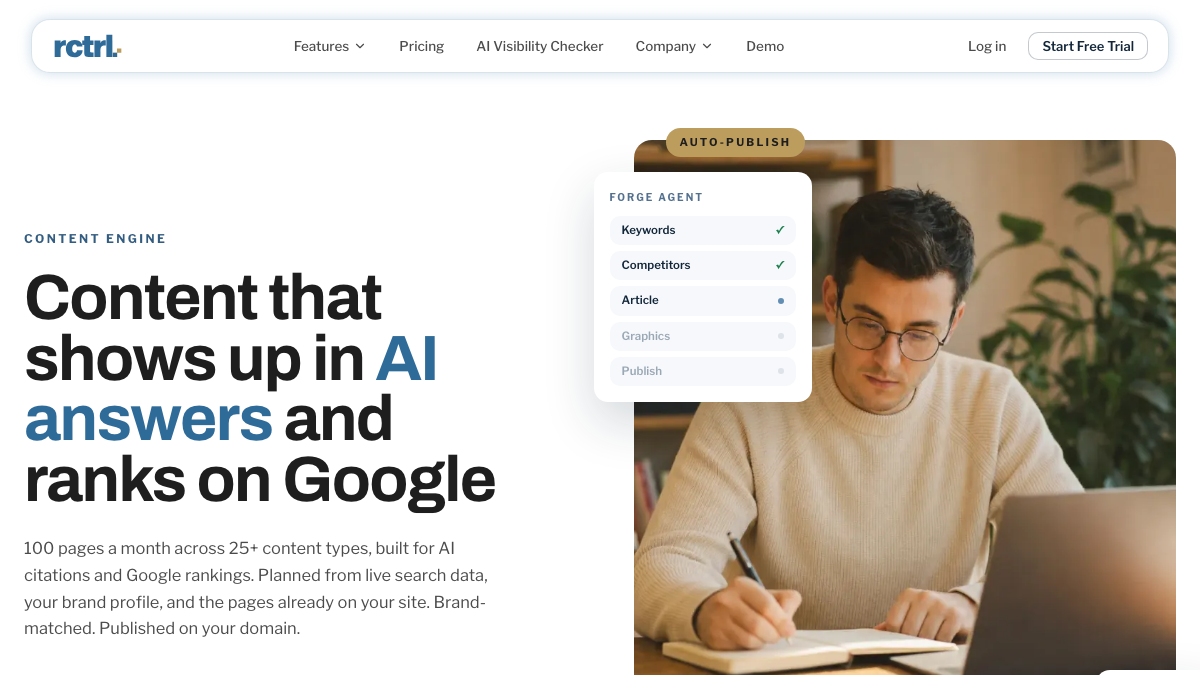
Then AI visibility tracking checks the questions weekly and keeps a citation history per engine, so you can see which article started getting cited where. Link Control drafts outreach for each article from your own mailbox, and the Social agent finds Reddit and X threads where an article answers the question.
15 hours a week manually. Or 15 minutes with RankControl.
Track citations, monitor competitors, and fix content gaps across every AI search engine. Automatically.

What to report on AI visibility
Whichever tool you use, the number you report matters. A marketer in r/DigitalMarketing this week described clients asking why their "AI ranking" dropped, and pointed to a SparkToro study in which the same prompt, run again, had less than a 1 in 100 chance of returning the same list of brands. One reply described the fix they settled on: stop reporting positions and report the share of test prompts that mention you, how often you're cited, and which pages get pulled as sources.
RankControl's weekly check is built around those numbers. Each of the 50 questions is checked on seven engines every week, and the citation history shows which of your pages each engine cited and when. Because the question set stays fixed, a change from one week to the next means something.
Reporting for a team or for clients
Keyword.com's reporting is built for agencies. It offers white-label reports, live report links, a Looker Studio connector and an API, and a custom report domain is available as an add-on.
RankControl reports to the team that owns the brand. The Reports screen shows citations, rankings and AI-referred traffic, and a weekly email lists new citations and ranking gains. The same data is available through the API, the CLI and the MCP server if you want it in your own dashboards.
A month of work, priced both ways
Take a team that wants 20 articles a month and wants to track 50 buyer questions on five AI engines, Claude included.
| Job | With Keyword.com | With RankControl |
|---|---|---|
| AI tracking, 50 prompts weekly with Claude | About $120/mo (1,000 credits, monthly billing) | Included |
| Google rank tracking | From $4/mo | Positions for published pages, included |
| Writing 20 articles | Your team or another tool | Included |
| Publishing and linking | Your team, 20 to 40 hours | Included, native posts |
| Backlink outreach | Your team or another tool | Drafted from your mailbox |
| Monthly total | About $125 plus the content work | $400 |
The tracking line is the smallest one in the table. The cost that decides this comparison is the rest of the month. Writing, linking and publishing 20 researched articles takes roughly 40 to 60 hours of someone's time, or a writer's fee per article, and that's the work RankControl's plan covers. Those hours are a rough estimate, but they're the ones a tracker, however accurate, leaves with your team.
Using each from Claude or Cursor
Both products ship an MCP server. Keyword.com's lets an AI assistant answer questions like how your rankings moved this week, which is handy for pulling numbers into a conversation. RankControl's MCP server has 80+ tools that act as well as read. Claude can check citations, propose article titles, approve them onto the calendar and publish, with every publish a dry run until you confirm it.
Getting started on each
Keyword.com's 14-day trial needs no card and includes 100 keywords and 20 AI credits, enough to test a small prompt set on the cheaper engines. You add a domain, import keywords and pick your prompts.
RankControl's 7-day trial starts with connecting your CMS. We build a brand profile from your site, you name up to 10 competitors and choose 50 questions to track, and titles land on a calendar for review before anything goes live. If you already track prompts in Keyword.com, your existing prompt list is the natural starting point for those 50 questions, since it reflects what your team decided was worth watching.
Which wins AI search visibility?
For AI search visibility, RankControl wins for teams that want the work done. We write and publish the articles, draft outreach and Reddit replies, and check seven engines every week, Claude and Grok included, for one flat price with no credits to count.
If you're moving over from Keyword.com, our guide to switching from Keyword.com without losing data covers the exports and turning a big keyword list into 50 tracked questions.
You can keep buying credits and publishing the pages yourself. Or RankControl's agents can run the month for you while your team approves the pages.
AI search traffic grew 835% this year. Is your content ready?
RankControl generates 26 content formats optimized for ChatGPT, Claude, and Perplexity. Published on your domain, matched to your brand.