
LLMrefs' homepage makes a pointed promise: "Forget vague visibility scores." Instead of one blended number, it reports three columns for every brand on every keyword: share of voice, average position and citations. "No magic numbers," it says. "Transparent data."
LLMrefs is built around that idea. RankControl takes a different approach. We track fewer engines and fewer prompts, and then we do the work that changes the numbers: writing, publishing and link outreach. This comparison is about which of those you need. Every LLMrefs detail below comes from its site, terms, privacy policy and API docs, checked on September 26, 2026.
RankControl vs LLMrefs: the short answer
LLMrefs is an AI search rank tracker. You enter keywords, it generates the prompts behind them, and it checks them across 11 AI engines for $79 a month. It doesn't write or publish anything.
RankControl is a pipeline for AI search visibility. We check 50 buyer questions weekly on seven engines, plan and write articles, publish them on your domain and draft link outreach. One plan, $400 a month.
For AI search visibility, we'd pick RankControl, because a tracker only shows you the gap and RankControl works on closing it.
Side by side
| LLMrefs | RankControl | |
|---|---|---|
| What it is | AI search rank tracker | AI search visibility pipeline |
| Price | $79/mo, one plan | $400/mo or $4,000/yr, one plan |
| What it tracks | Keywords, with prompts generated from them | Up to 50 buyer questions you write |
| Prompt volume | 500 prompts | 50 queries, each on seven engines |
| AI engines | 11, including Copilot, Meta AI and DeepSeek | 7: ChatGPT, Perplexity, Claude, Gemini, Grok, Google AI Mode, Google AI Overviews |
| Cadence | At least weekly | Weekly |
| Writes and publishes | No | Yes, 100 pages/mo to 9 CMS destinations |
| Links | Sources list only | Outreach from your mailbox; Managed Backlinks $350/mo |
| API and MCP | Read-only API; no MCP found | MCP server and CLI included |
| Help center | None found | Docs and email support |
What LLMrefs is
LLMrefs was founded by James Berry and launched on Product Hunt on May 1, 2025, where it finished #3 Product of the Day with 315 upvotes. It lists a London address, and its about page says it's trusted by more than 10,000 marketers.
The product is keyword-first. "With LLMrefs you track keywords, not prompts," its homepage says. It generates fan-out prompts for each keyword from real conversations and weights the results into share of voice and position. A Sources tab lists the domains AI engines cited, and a set of free tools covers things like an llms.txt generator and a query fan-out generator.
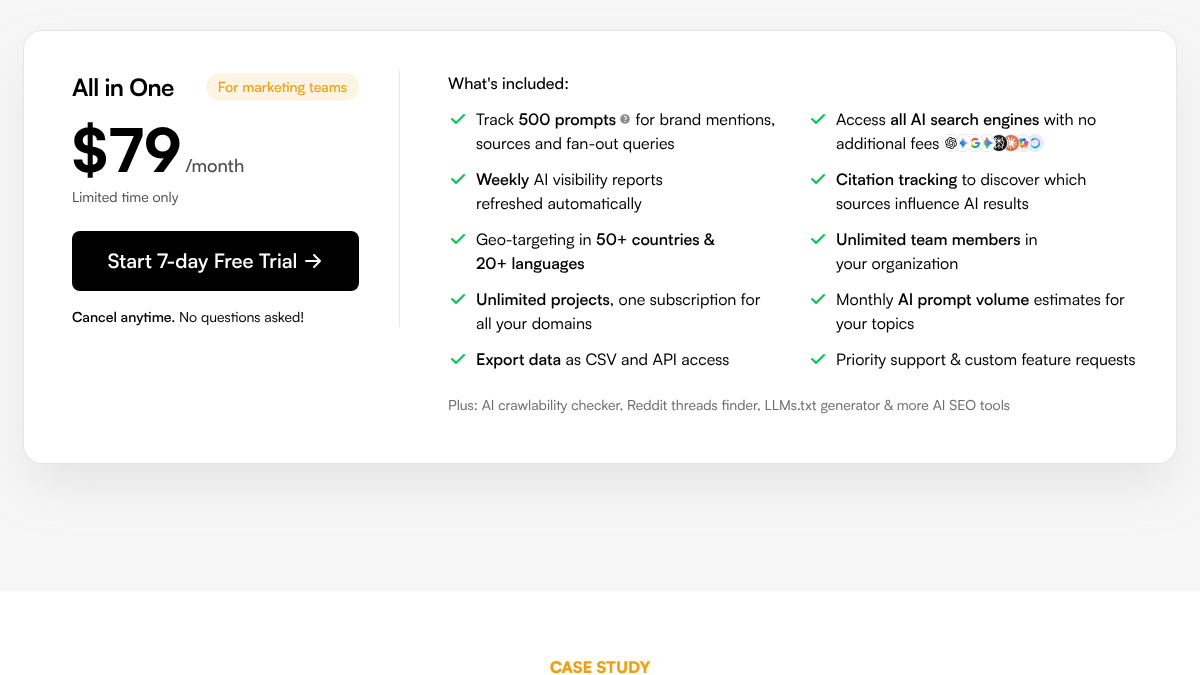
Where LLMrefs goes further than RankControl is breadth for the price. For $79 it reads 11 engines, including Copilot, Meta AI and DeepSeek, across unlimited projects and team members.
Know exactly what AI says about your competitors.
RankControl's Recon Agent monitors competitor citations across ChatGPT, Perplexity, Claude, Gemini, Grok, Google AI Mode, and Google AI Overviews. See where they show up and you don't.

Keywords or questions
LLMrefs starts from the keywords you'd track in Google and builds prompts from them. That makes setup quick: type your core SEO keywords and, as its FAQ says, the dashboard shows insights within five minutes. The trade-off is that the prompts are generated for you, so you're reading how engines answer questions LLMrefs chose.
AI visibility tracking in RankControl starts from the questions themselves. You track up to 50, written the way your buyers ask, such as "What's the best tool for tracking AI citations for a small agency?" Each one is checked every week on all seven engines, and you see which engines named you, which competitors they named instead, and which sources they quoted.
Both approaches meet the same problem: AI answers vary from run to run. SparkToro's research with Gumshoe found the odds of an engine returning the same brand list twice were under 1 in 100. LLMrefs answers that by aggregating many generated prompts per keyword "to ensure statistical significance."
RankControl's answer is a fixed set of questions, asked the same way every week, so the trend compares like with like. Either way, read the direction over several weeks rather than a single reading.
What each one reports
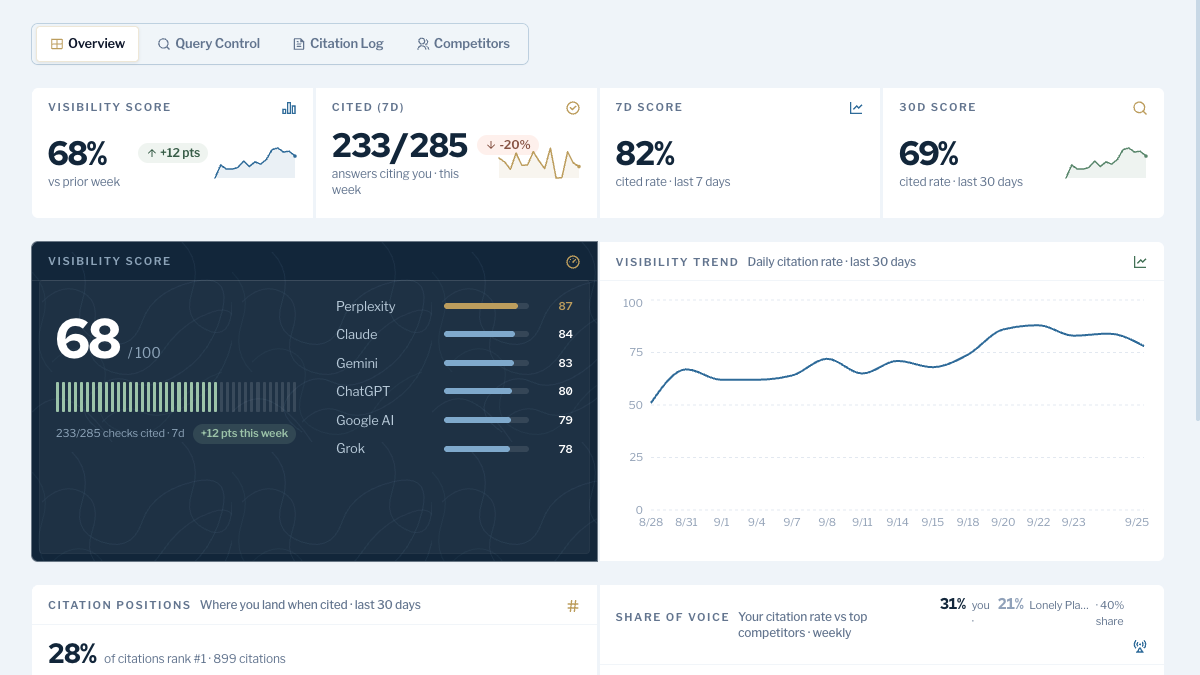
LLMrefs gives you three numbers per brand on each keyword: share of voice, average position and the number of cited URLs. It adds monthly prompt volume estimates, so you can see which keywords people ask AI engines about most, and a Sources tab for each keyword. Everything exports as CSV.
RankControl reports per question and per engine. For each of your 50 queries, you see which of the seven engines cited you that week, which competitors were named instead, and which pages the engines quoted. The weekly rankings check adds your Google and Bing positions and whether an AI Overview cited your page. RankControl's analytics also count visits from AI crawlers and from people who clicked through from an AI answer, and a weekly email sums it all up.
One detail on LLMrefs' coverage: its pricing card promises geo-targeting in "50+ countries & 20+ languages," while another section of the same page says 20+ countries and 10+ languages. If you track outside English, ask which is current before you commit.
What happens after the reading
This is where the two split. LLMrefs stops at the report. Its Sources tab shows which sites the engines trust for each keyword, and a content gap view hints at what to write, but writing and publishing are left to your team.
RankControl's content engine plans titles from the questions your buyers ask, writes each article against the pages already ranking, and scores it for how easily AI engines can quote it, with a fix list. The content engine publishes through the destination you connect, with nine to choose from. Auto-publish stays off until you turn it on.
Then we work on the rest of what engines look at. Link Control finds prospects for each published article and drafts outreach from your own mailbox. Our Social agent finds Reddit and X threads where your articles answer the question and drafts a reply. Each article also becomes drafts for eight social platforms.
26 content formats. Published on your domain. Matched to your brand.
Guides, comparisons, listicles, case studies, and more. RankControl generates content that gets cited by ChatGPT, Perplexity, Claude, Gemini, Grok, Google AI Mode, and Google AI Overviews.

Support and reliability
LLMrefs has almost no independent review footprint. When we checked, G2 and Capterra showed no reviews, and Product Hunt had one. That's thin for a tool claiming more than 10,000 users.
The public complaints that do exist cluster around support and billing. A February 2026 r/GEO_optimization thread was titled "not able to cancel subscription," and users there found the cancel control under an Organization screen after failing to reach support. A May review thread included a comment calling its support the worst the commenter had seen in a long time. In August, a user on X asked whether LLMrefs had shut down after a week without tracking updates and no reply from support.
any body using llmrefs.com ??? not able to cancel subscription
Hello everybody! Is anybody using llmrefs com ??? I am not able to cancel my subscription? dashboard has no billing options neither billing history? No replies last 2 days on their chat window neither email adress?
LLMrefs also has no help center we could find, and its terms say cancellation is possible "at any time" without saying how. Those are fixable problems, but they matter when a tool sits in your weekly reporting and you need an answer the week a number looks wrong. RankControl's billing runs through Stripe, cancelling takes effect at the end of the period, and support is at [email protected].
What each one costs
LLMrefs costs less: $79 a month for 500 prompts, 11 engines, unlimited projects and team members, CSV export and a read-only API, with a 7-day trial. The price is labeled "limited time only," so it may rise.
RankControl is one plan at $400 a month, or $4,000 a year. The plan includes 50 tracked queries on seven engines, five seats, and 100 pages a month written and published across 26 content formats, plus outreach drafts and social drafts. Used in full, that's $4 a page with the tracking included, and the 7-day trial asks for a card up front but charges $0 today.
| What you need | LLMrefs | RankControl |
|---|---|---|
| Track AI answers weekly | $79/mo, 11 engines | Included, 7 engines |
| Articles written and published | Not offered | 100 pages/mo |
| Link outreach | Not offered | Included; managed links $350/mo |
| Reddit and X reply drafts | Not offered | Included |
| MCP access | Not found | Included |
The comparison isn't like for like, because the $400 covers work LLMrefs doesn't do. Weigh it against what writing, publishing and outreach cost you today in hours or agency fees.
Your first month with each
The two feel very different in the first four weeks.
| Week | LLMrefs | RankControl |
|---|---|---|
| 1 | Enter keywords; generated prompts and first readings appear | Setup reads your site; you correct the brand profile and add queries |
| 2 | Share of voice and position build up across engines | First titles planned; you approve them |
| 3 | You decide what to write from the sources and gaps | Articles publish; outreach drafts arrive |
| 4 | Weekly trend across 11 engines | Fourth weekly check on seven engines |
LLMrefs gives you a picture quickly. RankControl gives you a picture and, from week two, the articles and outreach that are meant to change it.
Questions to ask before you choose
Who will do the work after the report? If nobody on your team has time to write and publish, a cheaper tracker will show the same gap every week.
Which engines do your buyers use? Make sure they're on the list you pay for. RankControl checks seven, including Grok, Google AI Mode and Google AI Overviews, on one plan.
How much do you rely on support? Check how quickly each vendor answers a pre-sales email, and read the public threads before you put a tool in your weekly reporting.
What will you do with the sources list? Knowing that the engines cite Reddit, review sites and your competitors' comparison pages is useful only if someone acts on it. That means replies in the right threads, pages that answer the same questions, and outreach to the sites that keep coming up. Decide who owns that before you choose a tool.
Working from an AI assistant
LLMrefs offers a read-only API with a 10-request-a-minute limit, and its docs describe the keyword detail endpoint as returning the current period. We found no MCP server.
RankControl's MCP server and CLI have 80+ tools and come with the plan. From Claude, Cursor or Codex you can ask how your visibility changed, plan titles, draft an article and publish it. Anything that publishes is held as a dry run until you confirm.
Which wins AI search visibility?
For AI search visibility, the verdict is RankControl.
LLMrefs is a tracker. It reports where you stand across many engines for little money, and then leaves the work to you. Its support record and missing reviews are worth weighing if it's going to sit in your weekly routine.
RankControl tracks seven engines, Grok, Google AI Mode and Google AI Overviews included, and does the work behind the numbers. We plan from your buyers' questions, write and publish on your domain, and draft the outreach and replies. In the first month you get a calendar of titles, articles going live on your schedule and four weekly readings of where you stand.
You can run the loop yourself: write the pages, publish them, pitch the links and check the engines every week. Or RankControl's agents can run it every month while you focus on your product. Already on LLMrefs? Our guide to switching from LLMrefs covers what to export before you cancel.
Want a baseline first? Run a free check of your brand in AI answers.

Your competitors are getting cited by AI. You're not.
Every day without citation tracking is a day your competitors pull ahead in ChatGPT, Perplexity, and Claude.