
You want your brand in the answer when buyers ask ChatGPT and its rivals, and you're not sure if that takes a tracker or something that does the work. LLM Pulse is the tracker. From €49 a month it runs your prompts through five AI engines every week, and the bigger plans pile on reports about sentiment and reputation, shopping and ads. RankControl is the pipeline, one $400 plan on which our agents handle the planning, writing, publishing and pitching, with seven engines checked weekly.
Put plainly, LLM Pulse tells you where you stand, cheaply, and RankControl works on changing it.
For LLM Pulse I relied on its own pricing and feature pages, its FAQ, terms and refund policy, all read on September 27, 2026. Already decided to leave it? Our LLM Pulse switch guide walks through exports and the refund rules.
RankControl vs LLM Pulse at a glance
| RankControl | LLM Pulse | |
|---|---|---|
| Price | $400/mo or $4,000/yr | €49, €99 or €299/mo weekly; €79 to €449 daily; plus VAT |
| AI engines | 7: ChatGPT, Perplexity, Claude, Gemini, Grok, AI Mode, AI Overviews | 5 included: ChatGPT, Perplexity, Gemini, AI Mode, AI Overviews; Claude, Grok and others paid |
| Cadence | Weekly | Weekly by default; daily plans cost more |
| Tracked questions | 50 | 50, 150 or 450 prompts |
| Content | Up to 100 articles a month, written and published | GEO Writer: 3, 5 or 15 tasks a month, exported as PDF or Markdown |
| Outreach | From your mailbox after approval | None |
| Seats | 5 | Unlimited |
| MCP / API | 80+ MCP tools | MCP on every plan; API, CLI and Looker Studio from Scale |
| Trial | 7 days, card up front, $0 today | 14 days on weekly plans, card required |
What LLM Pulse is in 2026
You'd be dealing with a Spanish company. LLM PULSE SL is based in Barcelona, Spanish law governs its terms, and it was built by Esteve Castells, Daniel Peris and Adrian Rojas with no investors behind them. Their about page says the product launched in mid-July 2025 and won a customer that same day. By December it had crossed 100 customers, and the pricing page today reads "Trusted by 5,000+ users worldwide."
You'd use it to see where AI engines mention and cite your brand for the prompts, countries and languages you choose. Share of voice, sentiment and citation sources come with that, plus AI-driven traffic drawn from your web analytics and a log of AI crawler visits. Higher plans unlock GEO testing, reputation monitoring and tracking for ChatGPT Shopping and for ChatGPT ads. Expect the product to keep moving, since the team says new features reach customers "in days, not quarters."
The first week on each tool
Start with LLM Pulse and you'll need a payment method even for the 14-day trial on weekly plans. Prompts are your first job. Write them or take its suggestions, then set countries, languages and competitors inside a project. When the first weekly run finishes, all five engines show up in the dashboard, and you can invite as many colleagues as you like, because team members are unlimited.
Start with RankControl and the trial lasts 7 days: the card goes in at signup, and you're charged $0 today. Your early effort mostly goes into checking our homework: setup goes through your site and drafts the brand profile, products, buyers and competitors for you to correct. Once you've linked a CMS and entered up to 50 questions and 10 competitors, seven engines get checked for the first time. Meanwhile the planner turns the questions you're losing into a calendar, and your first articles begin drafting that week.
Know exactly what AI says about your competitors.
RankControl's Recon Agent monitors competitor citations across ChatGPT, Perplexity, Claude, Gemini, Grok, Google AI Mode, and Google AI Overviews. See where they show up and you don't.

RankControl vs LLM Pulse on AI visibility
For pure measurement, your euro goes further at LLM Pulse. Each prompt you track gets asked on all five included engines, across whichever countries and languages you pick, and it still counts as a single prompt. The FAQ works out that Starter's 50 prompts produce "over 1,000 stored AI responses per month." Growth brings in sentiment and AI traffic, and Scale throws in reputation reports and custom reports.
Your data arrives weekly by default, which I think is right. The FAQ calls weekly "the cadence where trends show up without daily noise," and in September the brand's X account worked through an example. You might read a rise from 8 of 25 answers as a win. Getting to 12 of 30 turned out to be too small a change to detect, because the two ranges overlap once sampling noise is taken into account.
Buyers ask this of every tool in the space. Under an August post in r/GEO_optimization asking "what should these tools prove?", one reply pointed out that none of these tools comes with an error bar. When a score goes from 34 to 38, the reply went on, there's no telling whether your work did that or the sampling did.
For people actually paying for AEO/GEO tools — what’s the one thing you wish these tools could prove reliably, rather than just give you as a score or percentage?
Is it actual citations, which sources are influencing the answer, brand mentions, competitor visibility, or something else?
RankControl gives you 50 questions checked on seven engines each week, with the sources every answer quoted. Google AI Overviews is among them, and LLM Pulse includes it on every plan too. For brands selling in several markets, LLM Pulse will also run a single prompt across several countries and languages together.
Ahrefs' CMO, Tim Soulo, put all this in context last December. Most AI visibility tools, his post argued, do the same job of custom prompt tracking, which he called "just the very tip of the AEO/GEO iceberg." LLM Pulse has built more around that tip than most. You're still only looking at the answers, though, and nothing in it changes them for you.
- “Tim, what does @Ahrefs think of all these new "AI visibility" tools popping up this year?” ^ you can imagine I get this a lot. (Once it even came from someone working at one of these tools.) Well... Here’s my honest take: Right now, these tools are mostly competing with
 Tim Soulo 🇺🇦@timsouloDec 22, 2025
The engine surcharge
Watch for what I call the engine surcharge: what a tracker charges on top of its plan for engines outside its base set. Claude and Grok are both outside LLM Pulse's base five, and RankControl checks both of them every week. The add-on price climbs with your plan, since each add-on is applied to every prompt in the plan.
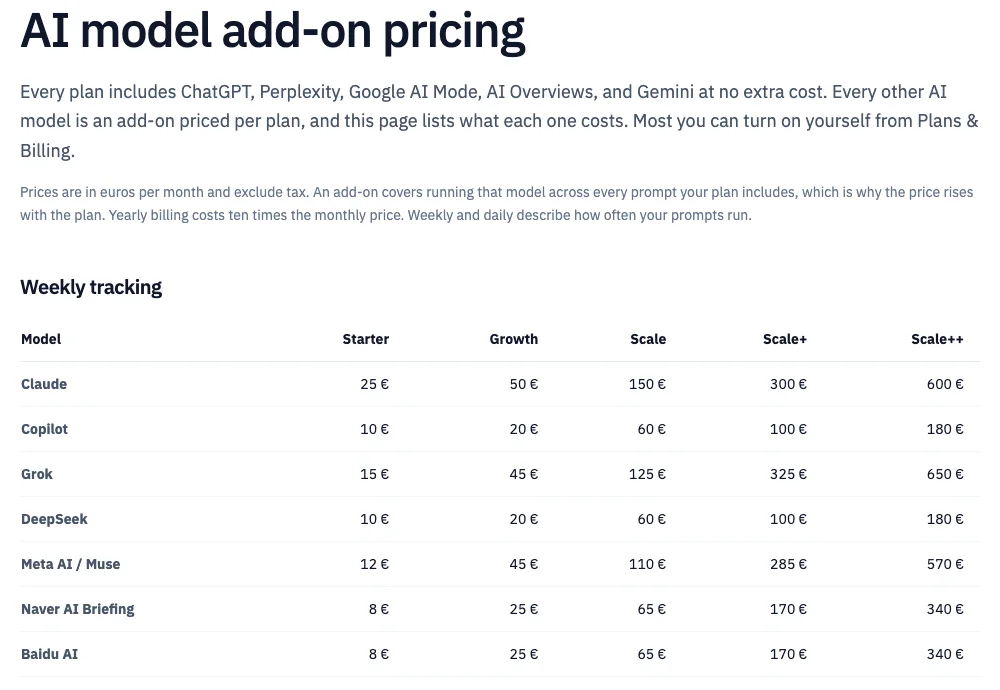
Here's the weekly cost of Claude and Grok by plan:
| If you're on | You add | Your plan becomes |
|---|---|---|
| Starter at €49 | €40 | €89 |
| Growth at €99 | €95 | €194, nearly double |
| Scale at €299 | €275 | €574 |
Daily tracking makes the jump bigger. On daily Starter, Claude and Grok come to €160 a month, which is four times the weekly price.
So to match RankControl's seven engines on LLM Pulse, you'd be on Starter at €89 a month, about $107 before VAT. That gets you answers from the same seven engines for 50 prompts, at about a quarter of what RankControl costs. If tracking is all you need, LLM Pulse costs less.
Content and publishing
Need content? LLM Pulse's GEO Writer drafts from your tracking data, whether you want a content brief, a full article or an update to a page you already have. It will also write positioning notes for your product and angles for PR. You pick the prompts it draws on and describe your audience and tone, then take the result as a PDF or Markdown file, or paste it wherever you work. Starter's allowance is 3 tasks a month. Growth's is 5, and Scale's is 15.
What happens after the draft is up to you. A person on your side has to edit it, add pictures, get it into the CMS and press publish, and its recommendations point out what to fix without fixing it.
A marketer in r/DigitalMarketing said much the same in September. Their team went down the tracking path and never quite trusted the figures, and even when they did, the dashboards impressed but didn't translate into real decisions.
How are people actually handling AI-search visibility? Not sure these tools are worth it.
Curious how others are approaching this. There's a whole category of tools now that track how your brand shows up when people ask ChatGPT/Gemini/Claude for recommendations. We've tried going down that road, and I'm not sure what to make of...
On RankControl, the content engine carries on from there. The content engine builds titles around the questions you're losing, looks at what already ranks and writes the articles, images and internal links included, across 26 content types. Up to 100 a month publish as native posts to one of nine destinations, and auto-publish waits for you to switch it on, which lets you read every piece first.
26 content formats. Published on your domain. Matched to your brand.
Guides, comparisons, listicles, case studies, and more. RankControl generates content that gets cited by ChatGPT, Perplexity, Claude, Gemini, Grok, Google AI Mode, and Google AI Overviews.

Links and outreach
LLM Pulse will show you where you ought to be mentioned. Citation sources name the domains the engines trust in your market, while source intelligence and the Reddit reports flag places you'd want to show up, and there's a solutions page about growing off-site mentions. Sending the requests is still on you.
With RankControl, Link Control digs up prospects, with contact details, for every article you publish, and the pitch leaves from your own mailbox after you've approved it. Follow-ups stop as soon as someone replies. To hand it off entirely, Managed Backlinks costs $350 a month for five links a month from DR 25+ sites.
Sentiment, shopping, ads and reputation
Some of what you'd get from LLM Pulse, RankControl doesn't measure at all. On Growth there's sentiment analysis, and owned media tracking covers YouTube, your social accounts, apps and Reddit. Scale gives you ChatGPT Shopping tracking and ads tracking for ChatGPT, backed by an ads library, as well as reputation reports and GEO testing. It also tracks app store visibility for mobile apps, and Naver and Baidu add-ons cover Korea and China.
Ecommerce brands, reputation teams and agencies reporting across lots of markets will get value from these views, and RankControl provides none of them.
Agencies and teams
Running an agency? LLM Pulse was built with you in mind. Team members are unlimited on every plan, you get two projects on Growth and five on Scale, and the larger Scale and Partner plans take you to 35 projects and 10,000 prompts. Enterprise is where white label, embedded dashboards and your own domain come in, and an affiliate program pays recurring commissions.
RankControl gives you one workspace per plan and five seats. If you need to cheaply track a long list of client brands, LLM Pulse is set up for it better.
Price
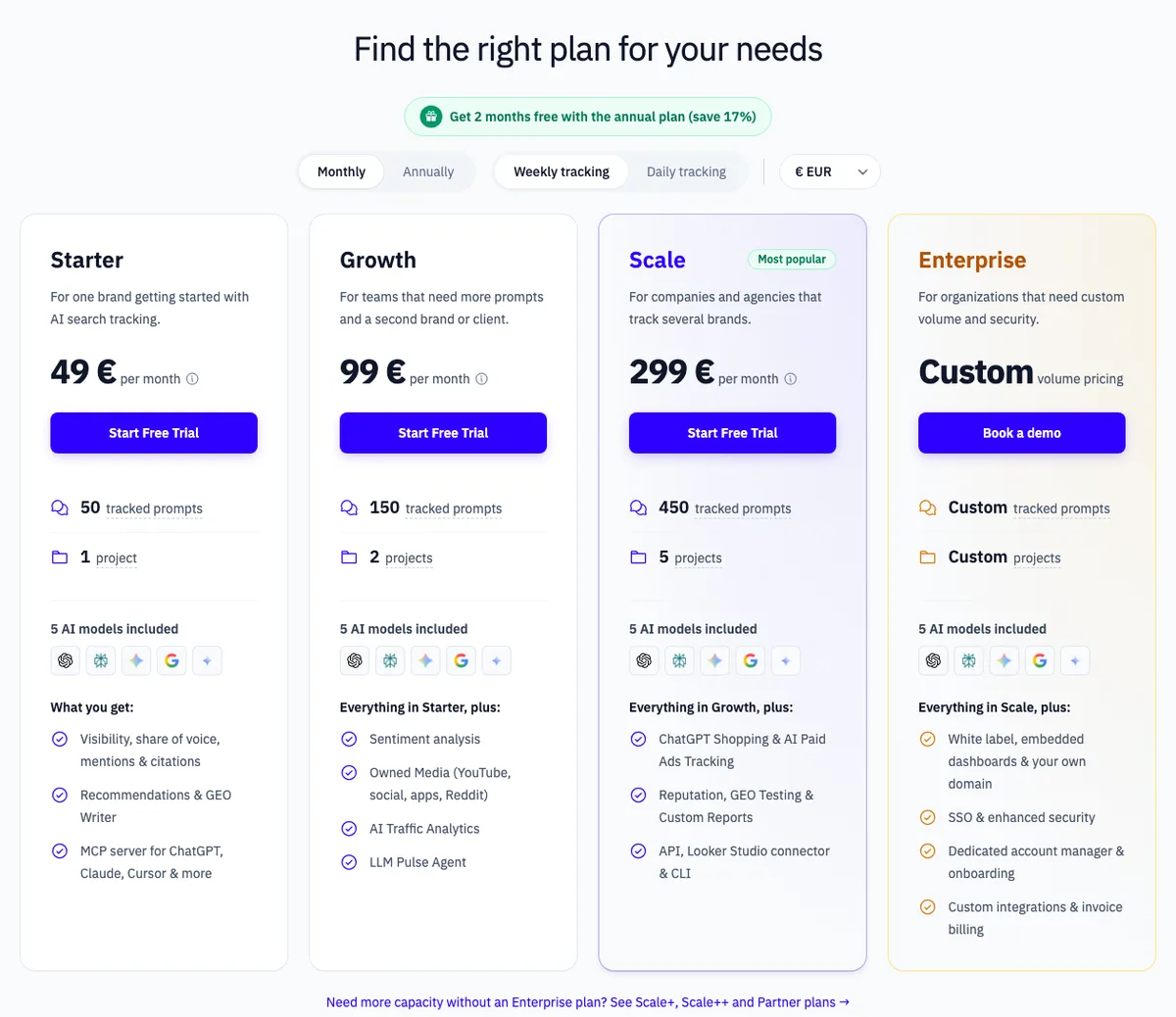
LLM Pulse quotes euros without VAT, and the conversion happens at checkout through Stripe. The dollar figures below are the site's own conversions for the weekly plans:
| Plan | Weekly tracking | Daily tracking |
|---|---|---|
| Starter | €49/mo (about $59) | €79/mo |
| Growth | €99/mo (about $119) | €149/mo |
| Scale | €299/mo (about $358) | €449/mo |
Pay yearly and you get two months free. Extra capacity is self-serve: another project costs €50. For €100 a month you get 100 more prompts.
On RankControl you pay $400 a month or $4,000 a year. The plan bundles five seats, outreach, tracking and up to 100 published articles.
Working from Claude
If your team works in Claude, ChatGPT or Cursor, LLM Pulse's MCP server connects to all three over OAuth, on any plan and even during the trial. The REST API, the command-line tool and the Looker Studio connector need Scale, and any report can go out as CSV or Excel. RankControl's MCP server gives you 80+ tools for tracking, planning, writing and publishing, and anything that would publish is held as a dry run for your go-ahead.
Contracts and cancelling
LLM Pulse takes payment up front, by the month or the year, and plans renew on their own. To cancel, go to Plans & Billing in the app; the plan runs to the end of the current period. Don't count on a refund. The policy is "no refunds by default," and that covers unused features, downgrades and the rest of a yearly plan. If a self-serve price changes, you'll hear by email at least 30 days ahead.
The data clause deserves your attention too. The stored answers, mentions, citations and metrics, which the terms call platform data, belong to LLM Pulse, while whatever you exported or reported while subscribed is yours to keep and use. The terms also give you a way to switch providers under the EU Data Act, and taking your data out costs nothing.
With RankControl, your 7-day trial charges nothing today. Cancelling ends your plan with the billing period, pro-rated refunds aren't offered, and the articles you published remain in your CMS.
RankControl vs LLM Pulse: which wins AI search visibility?
For getting seen in AI search, RankControl is the pick, because your budget pays for the work that changes answers. You get as many as 100 articles a month published on your own site, pitches from your mailbox to the sites the engines already quote, and a weekly view of which of the seven engines' answers mentioned you.
If your job is measurement, LLM Pulse is the sharper instrument. It costs less, it reaches more engines once you've added them, and it reports on sentiment and reputation, shopping and ads, with unlimited seats on every plan. A tracker only describes change, though, and change rarely happens without new pages and mentions. To see how the two categories fit, read our guide to SEO platforms vs AI visibility trackers and our roundup of trackers by engine coverage.
Do the loop yourself, or hand it to RankControl's agents with a 7-day free trial. First, though, try the free AI visibility check, which shows who ChatGPT cites right now for three questions from your market.

Your competitors are getting cited by AI. You're not.
Every day without citation tracking is a day your competitors pull ahead in ChatGPT, Perplexity, and Claude.