
In late August, the executives at a small manufacturer asked their PR lead something simple: does ChatGPT mention us? The answer was supposed to go into the quarterly report on PR impact. Asking ChatGPT question after question by hand was the only method available, and it was slow and hard to trust, so the PR lead asked r/digital_marketing for a better way. When the brand did come up, there wasn't always a link attached, which meant Google Analytics showed nothing either. It's a request a lot of teams now get.
How can I see brand mentions in ChatGPT? I have no official way to monitor this.
I’m in charge of PR and comms for a small manufacturing company in a niche market. Our executive team is currently obsessed with AI mentions. And they want to know if our brand is showing up when people ask chatGPT questions related to our...
At a big company, the same question would probably go to whoever owns social listening, and Brandwatch is one of the best-known names in that field. We read three Reddit threads on how to see brand mentions in ChatGPT, with 164 comments across them, and not one commenter suggested Brandwatch. That surprised me, because it now sells a product for monitoring generative AI.
Below, I compare RankControl vs Brandwatch to explain that gap, and to show what each one really does about AI answers. RankControl is ours, so keep that in mind as you read. My description of Brandwatch is based on its own website as of September 26, 2026.
RankControl vs Brandwatch: the short answer
Brandwatch calls itself "a Cision company," and it says half of the Forbes 100 use its enterprise consumer intelligence suite. Listening is the heart of it, with extra tools for managing social media and running influencer campaigns, and there's a newer addition called Search Intelligence and GenAI Monitoring. To see a price, you have to book a demo.
RankControl costs $400 a month and has a single aim: getting AI answers to cite your brand and Google to rank it. It figures out what your buyers are asking, writes articles that answer them in your brand's voice, and publishes each one on your site like any other post. It drafts link outreach as well, and each week it asks six AI engines the same 50 queries.
For AI search visibility I'd choose RankControl. Brandwatch exists to report on what's being said, and AI visibility tends to rise when fresh pages go live and engines start using them. It can show you the domains an LLM relies on. It can't produce the page that gets you onto that list.
Side by side
Here's each product on the points that count for AI search, based on what the two vendors' sites said in late September 2026.
| Brandwatch | RankControl | |
|---|---|---|
| What it is | Consumer intelligence and social suite | Pipeline for AI search visibility and Google rankings |
| Price | Not published; demo request for every plan | $400/mo or $4,000/yr, one plan |
| Free trial | None mentioned | 7 days on the full plan |
| AI answer tracking | Search Intelligence and GenAI Monitoring, powered by partner Trajaan | 50 tracked queries checked weekly, citation history per engine |
| AI engines named | ChatGPT, Perplexity, Gemini, Google AI Overviews | ChatGPT, Perplexity, Claude, Gemini, Grok, Google AI Mode |
| Social listening | 1.7 trillion conversations back to 2010, 501 million added daily | Not offered |
| Content | Social posts through a shared calendar | 100 articles/mo across 26 formats, written in your voice |
| Publishing | Social networks only | Native posts on your CMS (9 destinations) |
| Links and outreach | Not offered | Prospects and outreach drafted from your mailbox |
| Reddit and X | Listening, publishing and a social inbox | Threads worth a reply for each article, with drafted replies |
| Google rankings | Not offered | Google and Bing positions for every page it publishes |
| API and MCP | Six data APIs, no MCP server found | MCP server and CLI with 80+ tools, included |
200+ SaaS teams already track their AI citations.
They know exactly when ChatGPT mentions their brand, and when it stops. Do you?
What Brandwatch is in 2026
Listening made Brandwatch's name, and its Consumer Research page still leads with the scale. The archive holds 1.7 trillion conversations reaching back to 2010. Another 501 million arrive every day, and its access to the X firehose is official. Analysts can lean on Iris, the built-in AI assistant, which notices sudden jumps and tells you what caused them, as in this demo dashboard.
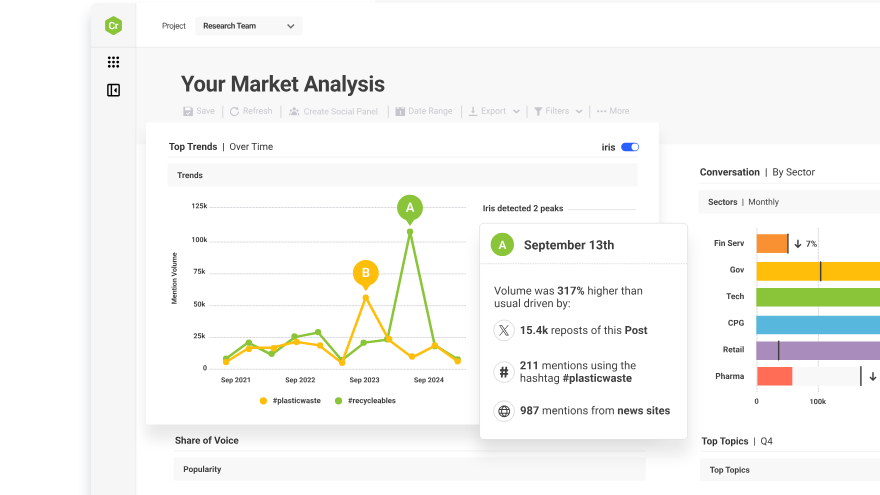
Everything else in the suite hangs off that core. There's a tool for managing social media, where teams share a calendar and an inbox for Instagram, LinkedIn, TikTok, Reddit and other networks, plus a product for influencer marketing. Teams that want humans to write their briefings can pay for an analyst service. Among the logos on its customer wall are GSK, Delta and Standard Chartered.
On Reddit, people don't say Brandwatch is bad so much as wrong for them. One r/digital_marketing user called it massive overkill for a mid-size brand, saying the team spent more effort writing Boolean queries than getting insights. In that same thread, a former user from a SaaS company of 40 to 50 people complained that the alerts misfired and irrelevant mentions buried the team.
Brandwatch listens far more deeply than we do. We don't track social conversation at all, and nothing in RankControl comes close to a conversation archive that starts in 2010.
The GenAI monitoring piece
Brandwatch's AI search product is Search Intelligence and GenAI Monitoring, and its page carries the title "Powered by Trajaan." In Brandwatch's webinars, Trajaan appears as a partner, and Trajaan's founder has spoken at them. The pitch reads: "with Trajaan you can monitor how leading LLMs cite your brand and competitors across thousands of prompts worldwide." Sentiment shifts, it adds, surface "in near real time."
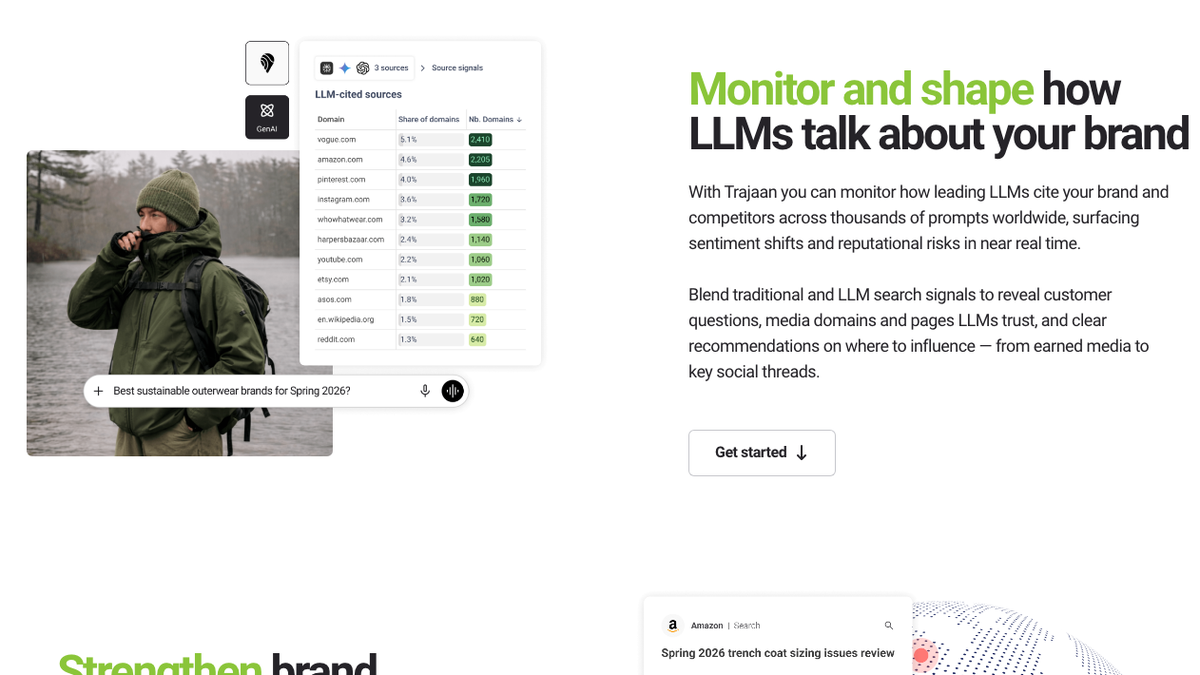
Which engines does it watch? I checked Brandwatch's pages and both of its 2026 blog posts on AI search. They name ChatGPT, Perplexity, Gemini and Google AI Overviews, and nowhere did I see Claude, Grok or Google AI Mode. Search Intelligence shows up as a standalone solution on every demo form, which hints that it's sold on its own.
The line I keep rereading closes that part of the page: "clear recommendations on where to influence, from earned media to key social threads." That output has real value. It's still a list of tasks, though, and every one of them is your team's to do. Brandwatch's AI search guide goes as far as advising readers to put their top 100 questions to ChatGPT, Gemini, Perplexity and AI Overviews to see if their brand appears.
Brandwatch's best AI search stories end in content
The examples Brandwatch picks for its guide to winning AI search tell an interesting story. Orange, the telecom operator, used Search Intelligence to find holes in the troubleshooting content aimed at its French-speaking markets. According to Brandwatch, contact volume at the call center dropped 25% as a result. The monitoring tool found the problem, and people wrote the fix, which was content.
Aromazon, a skincare brand from France, is the other example. The post says it went "from zero to €40 million in revenue per year" by creating content around the questions people searched for. Brandwatch reports both results itself, and we have no way to verify them.
Whatever the exact numbers, both stories follow the same shape. The insight came from Brandwatch, and the payoff came from people who wrote and published pages. That second part is what RankControl takes off your hands.
Monitoring tells you where, and somebody still has to show up
In September, Glen Allsopp published a study for Ahrefs that went through over 70,000 responses from AI engines. Roughly 6 in 10 of the citations went to articles, and that held for ChatGPT and for Google's AI Overviews. So when monitoring reveals which pages an engine leans on, the fix is usually to add more pages of that kind, on your own domain and on the sites that write about your category.
Writing those pages is the content engine's job in RankControl. It plans titles around your buyers' questions and writes each article against the pages that currently rank for its keyword. Each draft is scored on how quotable it is for AI engines and comes with a list of fixes, and then it goes out through the destination you connect. Since auto-publish starts switched off, you approve each article yourself until you trust what it writes.
Mentions matter every bit as much. Ahrefs studied 75,000 brands and found that AI Overview visibility followed branded web mentions about three times more closely than it followed backlinks. For every article, Link Control tracks down people to pitch and how to reach them, then drafts emails that send from your mailbox, with follow-ups going out only if there's no reply. RankControl will also find Reddit and X conversations that the article honestly answers, check the subreddit's rules and write a draft reply.
Doing all that manually for 20 articles a month adds up fast. Say each AI draft needs roughly two to three hours before it's published and linked. Add the outreach, and you're looking at 40 to 60 hours a month, and nobody has looked at an AI answer yet. That's our own estimate, and yours will shift depending on how heavily your brand edits.
How often does ChatGPT mention your brand?
Most founders have no idea. The answer might surprise you.

Who checks the answers every week?
RankControl's AI visibility tracking runs one fixed set of 50 queries on six engines every week, Claude, Grok and Google AI Mode included, and records a citation history per engine. After four weeks, the cited rate you're reading comes from four rounds of checks, and you can compare your share of voice with as many as 10 competitors.
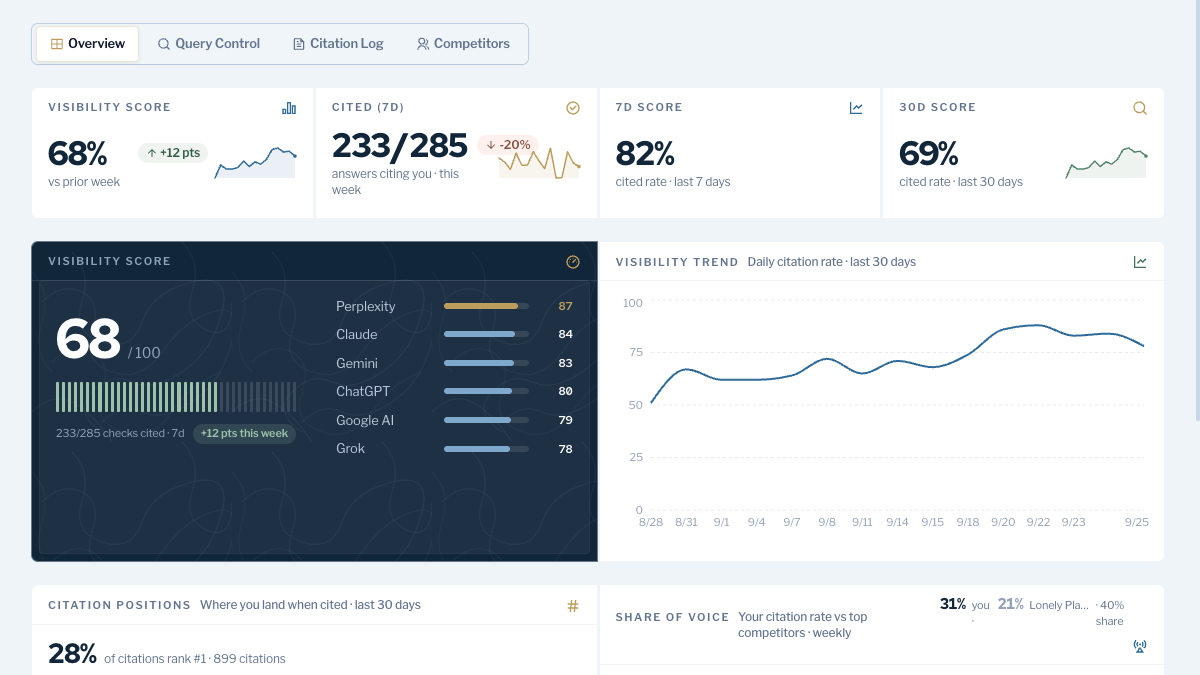
That repetition is the thing the PR lead at the manufacturer was missing. A commenter in the same thread made the point that ChatGPT doesn't give deterministic answers, which turns any one manual check into a sample of one. To do it by hand at the same scale, you'd read 300 answers a week (50 queries across six engines), which at a minute apiece is around five hours.
A new citation triggers a notification from RankControl. A lost one is logged in the dashboard's citation history, where you'll find it the next time you check, and that record is what a quarterly report needs.
RankControl vs Brandwatch pricing
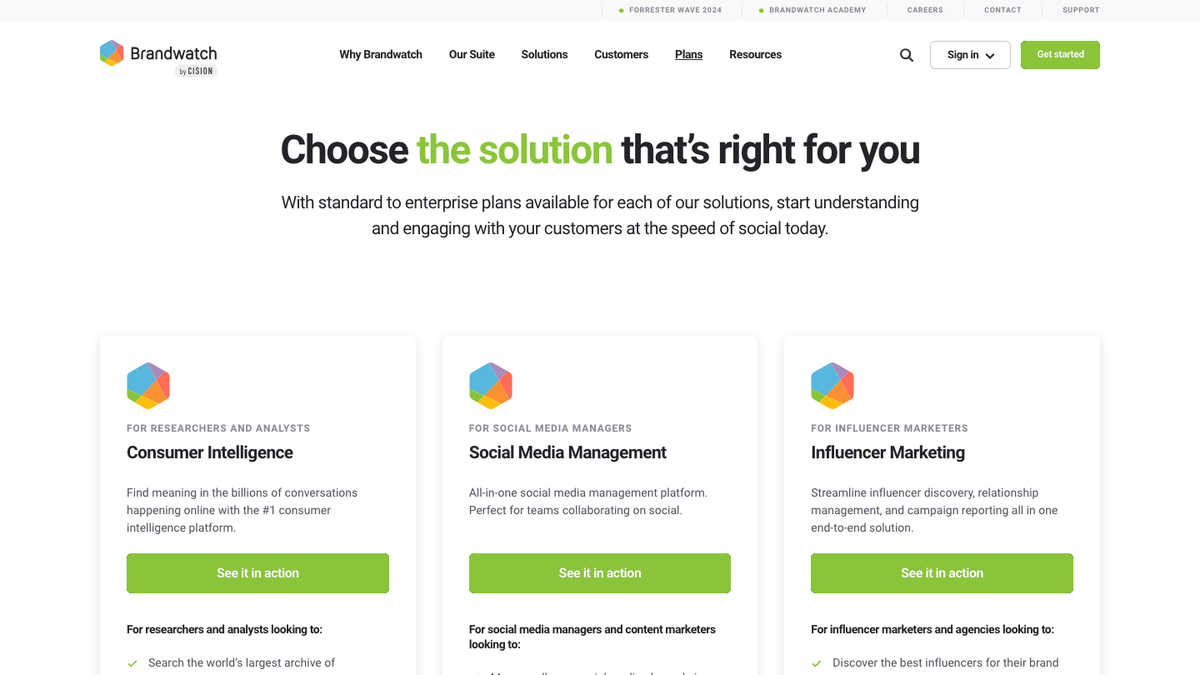
How expensive is Brandwatch? You won't find out from its website. The plans page lists "standard to enterprise plans" under each solution, and the one button on each tile, "See it in action," opens a demo request. There were no public prices anywhere I looked, and no free trial. When you do get on that call, a commenter on r/marketinteltools suggests asking what it costs per seat and what limits apply to listening queries, because that's where the bill climbs.
For RankControl, you pay $400 a month, or $4,000 for a full year, which saves two months. A 7-day free trial comes first on either cycle. That buys five seats and 100 pages a month. It also covers 50 queries tracked on six engines, with publishing and outreach included. Teams that want humans on top of the software can add a Dedicated Strategist at $1,500 a month or Managed Backlinks at $350, and both are optional.
| The job | Brandwatch | RankControl |
|---|---|---|
| See what LLMs say about you | Search Intelligence, separate solution, price on request | Included, 50 queries weekly on 6 engines |
| Put new articles on your site | Not offered | Included, 100 pages/mo |
| Earn links and mentions | Recommendations only | Outreach drafted from your mailbox |
| Reply where buyers talk | Social inbox and publishing | Thread discovery and drafted replies per article |
| Listen to the social web | Core product | Not offered |
Point tool or pipeline: the verdict
My verdict for AI search visibility is RankControl.
Brandwatch's GenAI monitoring gives a big brand a view of where LLMs get their information and what they're saying. You receive a list of places worth influencing, and the influencing itself falls to your team: writing new pages, pitching for mentions, replying in the threads that matter, then checking again to see whether anything changed.
RankControl covers less ground, and it runs the whole loop itself. It decides which questions to go after and gets the pages written and published. Outreach emails and thread replies get drafted as well, and every week the same questions go back to six engines, so you can see the change.
You can cover all of it with a monitoring tool and a content team. Somebody turns the recommendations into writer briefs, somebody else publishes and pitches, and a third person goes back through 300 answers each week. Or you can hand the monthly loop to RankControl's agents and let your team spend its time on the product and on telling its story. Current Brandwatch customers can read the guide to switching from Brandwatch, which covers what you're able to export, how your Order handles renewal and where your data ends up. And if you'd like a baseline before choosing, run a free check of your brand in AI answers.
15 hours a week manually. Or 15 minutes with RankControl.
Track citations, monitor competitors, and fix content gaps across every AI search engine. Automatically.