AIclicks, also written AI Clicks, is one of the cheaper ways to start tracking AI answers. Its Starter plan buys 30 prompts checked every day on three engines, plus five AI-written articles, for $59 a month. RankControl costs $400, so RankControl vs AI Clicks looks like a price question at first, until you ask where each tool stops and a person has to take over.
AIclicks measures a lot and writes a little. It runs your prompts through live browser sessions, sorts what the engines say into positive and negative themes, watches ChatGPT ads and drafts articles you publish with one click. Everything it learns about other websites, the ones AI engines cite in your place, arrives as a list for your team to work through.
Everything below about AIclicks comes from its own site, docs and Terms of Service, which I read on September 26, 2026. If you've already decided to move, our guide to switching from AI Clicks covers the exports.
RankControl vs AI Clicks at a glance
| AIclicks | RankControl | |
|---|---|---|
| Price | $59, $189 or $499 a month ($49, $140 or $357 billed yearly) | $400 a month or $4,000 a year |
| Tracked prompts | 30, 150 or 300 | 50 |
| Check frequency | Daily | Weekly |
| AI engines | 3, 4 or 6 by plan, chosen from a list of 10+ | 6 on the one plan |
| Articles | 5, 15 or 30 a month | Up to 100 pages a month |
| Publishing | WordPress, Webflow, Shopify, Framer | 9 destinations, as native posts |
| Outreach | A ranked list and a CSV; you send the pitches | Contacts found, emails sent from your mailbox after approval |
| MCP and API | Pro and Business | Included |
| Trial | 3 days | 7 days, card up front, $0 charged |
| Seats | Unlimited | 5 |
The article row changes how the prices read. At $499 a month, AIclicks' Business plan costs $99 more than RankControl's only plan and includes 30 articles, less than a third of the 100 pages RankControl allows.
What AIclicks is in 2026
AIclicks is run by MB Purai, a company registered in Vilnius. Its about page names eight people, three of them co-founders. It started as a tracker and still leads with tracking. The prompt-tracking page says it queries each platform "through live browser sessions, not APIs," so the citations it records are the ones a buyer would actually see.
Around that tracker sit a writer, an agent and a couple of worklists. AIclicks Writer 2.0 searches Google for your keyword, crawls the pages already ranking and builds guidelines from them before it drafts a blog post, article or listicle, a run the feature page puts at one to two minutes. Clicky, which the homepage banner announces as live, is a chat agent inside the app that answers questions like why visibility dropped, and proposes new prompts or competitors for you to approve.
Two more features point at other people's websites. Get Mentioned turns the sources AI engines cite, where your brand is missing, into a ranked outreach queue. Engage Online collects threads on eight platforms, Reddit and Quora among them, and drafts a reply for you to paste from your own account. Anything you'd rather hand off entirely is sold as a managed service, from $250 per brand mention or $75 per Reddit placement.
Week one on each tool
A team trying AIclicks gets three days on Starter or Pro, while Business buyers get a live demo instead. You add your brand and a prompt set, choose your engines, and the daily results start to fill the dashboard.
Inside those three days you can ask Clicky which sources cite your competitors and skip you, then send a prompt you're losing to the writer. The draft comes back with a hero image, internal links pulled from your sitemap and metadata already filled in, and a Publish button that pushes it to WordPress through an application password.
On Starter that button covers five articles a month. Any prompt past those five waits for someone on your team, or for an upgrade to Pro and its 15.
RankControl's trial runs seven days, with a card up front and $0 charged that week. Setup starts from your website: Brand Kit reads it and drafts your products, buyers and competitors for you to correct, and the first check across all seven engines runs during setup. The planner then puts article titles on a calendar from the questions you're losing, and the writer drafts them against the pages already ranking.
Auto-publish is off by default, so the first articles wait for your review before they go to your CMS. Week one feels slower on the tracking side, because the next citation check comes a week later, and busier in the review queue, where articles and the outreach drafts for anything you publish start to collect.
26 content formats. Published on your domain. Matched to your brand.
Guides, comparisons, listicles, case studies, and more. RankControl generates content that gets cited by ChatGPT, Perplexity, Claude, Gemini, Grok, Google AI Mode, and Google AI Overviews.

RankControl vs AI Clicks on tracking
Tracking is where AIclicks spends most of its effort. Every plan checks prompts daily, and each plan card says "Choose 3 from" (or 4, or 6) above a row of engine icons. The comparison table sets ChatGPT, Gemini and Perplexity as Starter's defaults and lists Claude, Grok and Google AI Mode among the engines you can swap in.
AIclicks reads more answers than RankControl does, which matters for teams whose whole job is measurement. Daily checks on up to 300 prompts, plus a ChatGPT ads monitor that shows which brands buy sponsored placements against your prompts, go past what RankControl reports.
RankControl's AI visibility tracking checks 50 queries weekly on seven engines, and Claude and Grok are both on the one plan, so there's no tier to climb before you can see them. Google AI Mode is reported on its own. Up to 10 competitors sit in your share of voice, and a new citation triggers a notification.
Daily data sounds better than weekly. For judging whether your work is moving citations, the extra readings count for less than they seem to. AI engines give different answers to the same question from one run to the next, so a single day's result moves around even when nothing on your site has changed. Comparing monthly citation rates is the fair test between the two tools, and at that scale a weekly cadence gives up very little.
Articles: five a month or a hundred
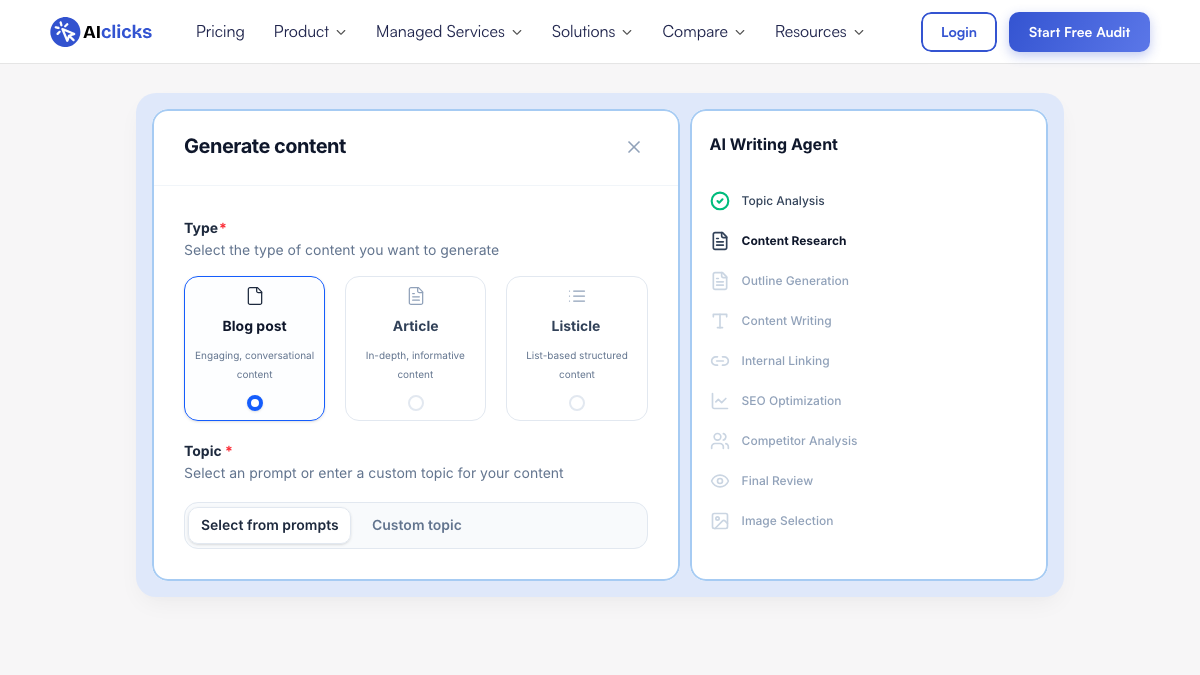
AIclicks Writer 2.0 works one article at a time. Its Content Score grades the draft against the live results for your keyword and updates while you edit, and you can switch on a review step to approve the outline before any writing starts. The Generate content dialog offers three formats, blog post, article and listicle, and a topic can come straight from a tracked prompt you're losing.
Publishing takes one click once a CMS is connected, and publishing the same article again updates the post instead of duplicating it. The pricing table and the setup docs list four systems: WordPress, Webflow, Shopify and Framer. The writer's own feature page still names only the first three, so confirm Framer inside the app if that's your site. Every article goes live when a person presses Publish; I found no scheduled or automatic publishing anywhere in AIclicks' docs.
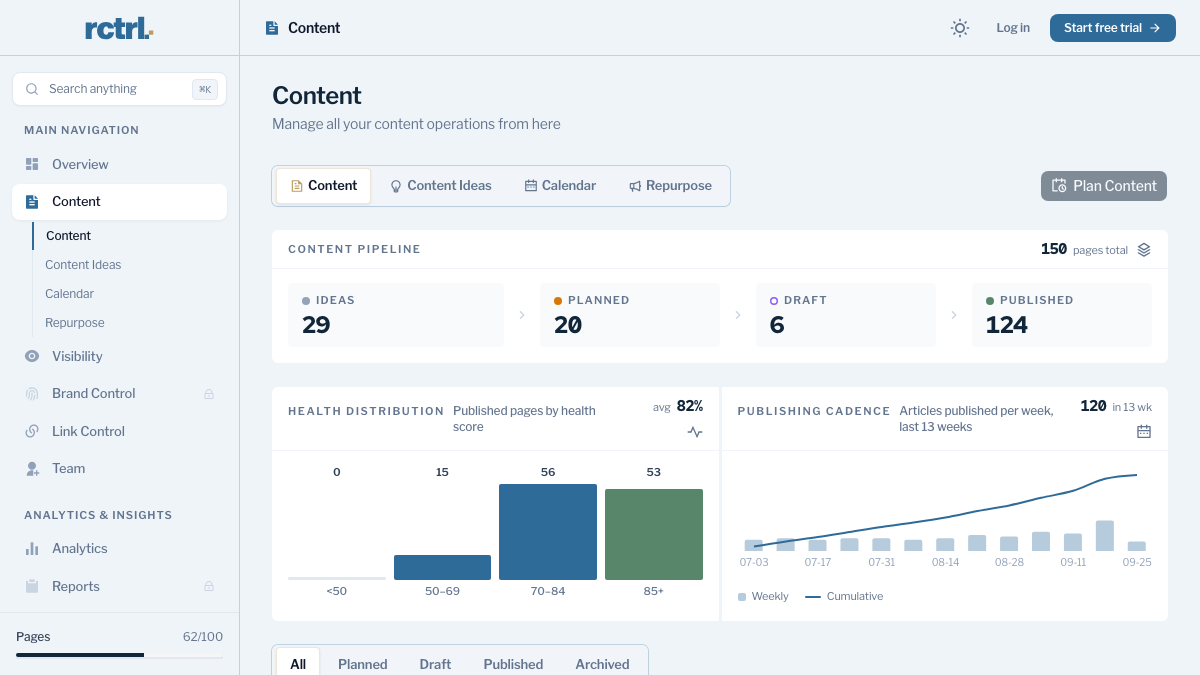
RankControl's allowance is up to 100 pages a month across 26 content types, guides and comparisons through FAQs and case studies. Each article is written against the pages already ranking for its keyword and scored for how easily AI engines can quote it, with a fix list. The content engine sends finished articles to nine destinations, Ghost and Wix among them, where they become native posts on your own site.
Auto-publish is off by default, and once you switch the setting on, articles publish on their scheduled dates without anyone pressing a button.
If articles are the part you're paying for, AIclicks works out to roughly $12 an article on Starter and $12.60 on Pro, then $16.63 on Business, against $4 on RankControl if you use the full allowance. Business is the plan where AIclicks' price passes RankControl's, and it's also the plan with the highest cost per article.

Your competitors are getting cited by AI. You're not.
Every day without citation tracking is a day your competitors pull ahead in ChatGPT, Perplexity, and Claude.
The handoff count
The number I'd use to compare these two tools is what I call the handoff count: how many times a month a person has to carry a tool's output out into the world by hand. A dashboard insight is free until somebody acts on it, and every handoff is a small task that someone on your team has to own.
In AIclicks, most off-site work is a handoff. Get Mentioned gives you a queue of source sites with notes, a status for each row and a CSV export. Its docs leave the outreach itself with you, down to the step where you "send pitches." Engage Online drafts a reply in one of three styles, one of them free of any brand mention, and the posting is yours too.
RankControl moves the email side of that work into the product. Backlinks finds prospects for each article you publish, finds a contact at each site and drafts the pitch, then sends it from your own mailbox once you approve it, with follow-ups that stop when someone replies.
RankControl's social agent finds Reddit and X threads where one of your articles answers the question and drafts a comment, though you still post that one yourself. For links with none of the work, Managed Backlinks adds five a month from DR 25+ sites for $350.
Off-site work matters more than a dashboard makes it look. In a September thread on r/DigitalMarketing, a B2B team said two months of schema, directory listings and three articles a week had left its AI citations flat. The replies put a normal wait at three to six months, and one commenter said the thing that finally moved citations was mentions on other sites, with the on-site articles treated as table stakes.
2 months into AI visibility work (schema, directories, 3 articles/week) and citations barely moved. What was your actual timeline?
B2B services company, niche industry. About 2 months ago we went all in on AI visibility. Here's what we've done so far: Article schema on every post, plus Organization schema sitewide Publishing 3 well-sourced articles a week Directory lis...
MCP, API and working from Claude
AIclicks' MCP server sits at a single endpoint. Since August 2026 it can add prompts, competitors and brands as well as read your data, and it asks for confirmation before anything changes. It comes with Pro and Business but not Starter, and the same key drives a documented REST API for scheduled reports and warehouse syncs. Clicky covers similar questions inside the app, reading whichever page and date range you have open.
RankControl's MCP server comes with the one plan and has more than 80 tools that reach the whole pipeline, from tracked queries to articles and outreach. Publishing through the MCP server stays a dry run until you confirm it, so an assistant can't push a post live by accident.
Pricing and what the difference buys
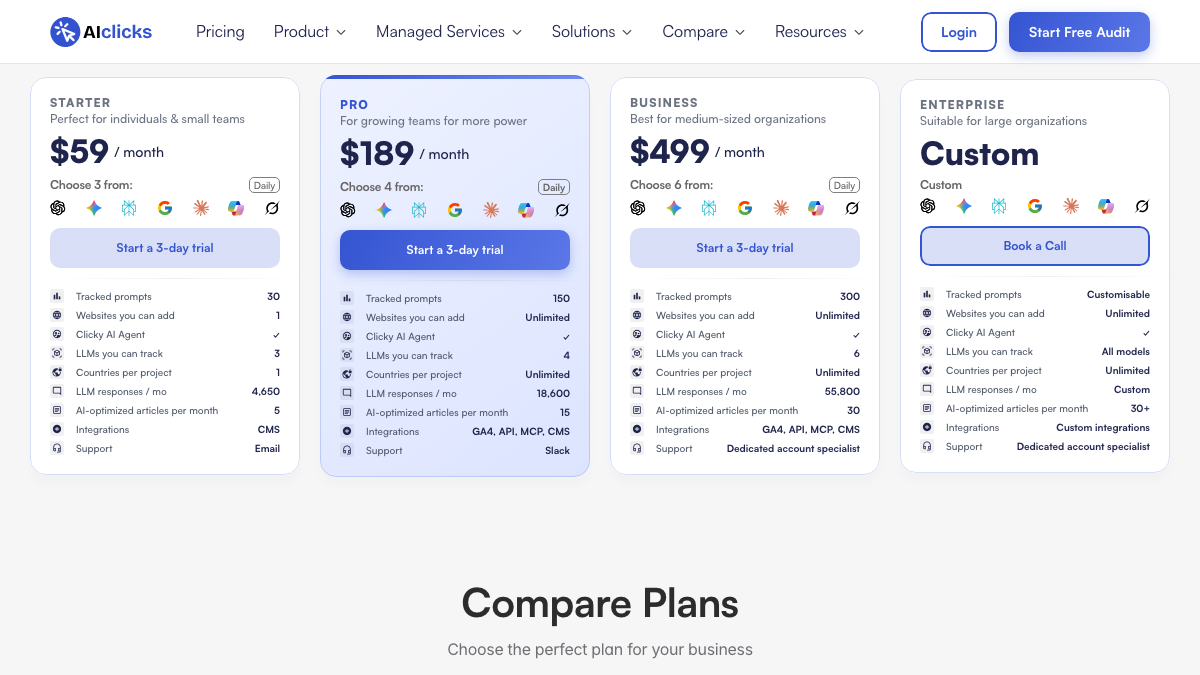
AIclicks lists Starter at $59 a month, Pro at $189 and Business at $499, or $49, $140 and $357 a month billed yearly. The yearly discount isn't flat: Starter saves 17% and Business about 28%, though the toggle advertises up to 29%. Extra prompts can be added to any plan, and Enterprise is priced after a call.
RankControl is one plan at $400 a month, or $4,000 a year, which comes to about $333 a month. Against AIclicks Pro, RankControl costs $211 a month more. That difference pays for up to 100 pages instead of 15, outreach sent from your own mailbox and two more engines, while Business at $499 costs more than RankControl and still leaves the pitching to your team.
Trials, cancelling and refunds
The pricing FAQ says the three-day trial needs no credit card. Section 3.1 of AIclicks' Terms of Service says "a valid payment method is required to start a trial," and that the subscription starts automatically when the trial ends, so check the signup form before you plan around either version.
The refund terms are clearer. You can ask for a full refund within seven days of your first payment, once per customer and only for the first paid term. After that, section 4.9 says fees are non-refundable, cancelling takes effect at the end of the current term, and unused allowances expire at the end of each term without rolling over.
RankControl's trial is seven days with a card up front and $0 charged during the week. Cancelling takes effect at the end of the paid period, and unused time isn't refunded.
RankControl vs AI Clicks: which wins AI search visibility?
For AI search visibility, RankControl wins for teams that want the work done rather than listed. AIclicks will tell you every day which prompts you're losing and which sites the engines cite instead, and its writer will close 5 to 30 of those gaps a month. Everything after that, from the pitches and community replies to the articles past your allowance, stays with your team.
RankControl reads the same gaps once a week and then works on them. Up to 100 pages a month go to your CMS, outreach goes out from your mailbox after you approve it, and the weekly brief lists the citations you gained.
You can work the AIclicks list by hand: find the contacts, write the pitches and chase the replies yourself, then check the answers again each week. Or RankControl's agents can run that loop every month for $400, with a 7-day free trial. Before you decide, the free AI visibility check shows who ChatGPT cites for three questions from your market.
200+ SaaS teams already track their AI citations.
They know exactly when ChatGPT mentions their brand, and when it stops. Do you?