
We checked SE Ranking's pricing on September 26 for this RankControl vs SE Ranking comparison, and we counted three different ways to buy its AI search tracking. The Core plan now includes 100 AI prompts tracked daily. You can also buy the AI Search add-on, which sells 200 prompts plus access to SE Visible. Or you can go straight to SE Visible, a separate product on its own site whose plans cover 200 to 1,000 prompts.
What the pricing page doesn't tell you is whether the base plan's prompts and the add-on's prompts stack. To me that says a lot about where SE Ranking is right now: an established SEO suite adding AI visibility quickly, from several directions at once. RankControl came at the same problem from the other end, as a pipeline that makes the pages AI engines cite and then checks whether they do.
RankControl vs SE Ranking: the short answer
SE Ranking's job is measuring. It tracks thousands of keywords a day, audits your site and researches backlinks, and now it also tracks how AI engines answer your prompts. What you get at the end is a set of findings.
RankControl acts on the AI search part of that. It plans articles from the questions your buyers ask, writes them and publishes them to your CMS once you approve, drafts outreach for each one, and checks six AI engines every week. If your team has the SEO data but not the hours to turn it into pages, that's the gap RankControl fills.
Side by side
| SE Ranking | RankControl | |
|---|---|---|
| Price | Core $129/mo ($103.20 annual), Growth $279/mo; AI Search add-on $89/mo | $400/mo or $4,000/yr, everything included |
| Trial | 14 days, no card (SE Visible: 10 days) | 7 days |
| Seats | 1 on Core, 3 on Growth | 5 |
| AI engines | ChatGPT, Gemini, Perplexity, AI Overviews, AI Mode | ChatGPT, Perplexity, Gemini, AI Mode, Claude, Grok |
| AI check cadence | Daily | Weekly |
| Rank tracking | 2,000 keywords daily on Core, 5,000 on Growth | Google and Bing positions for its own articles' keywords |
| Content | Content Editor and AI Writer (English only) | Plans, writes and publishes 100 pages a month |
| Publishing | Export to .docx, HTML, Google Docs or WordPress | 9 destinations, including WordPress, Webflow and Shopify |
| Links | Backlink checker, monitor, gap analyzer, disavow | Prospects and drafted outreach per article |
What SE Ranking's AI tracking actually covers
SE Ranking's AI Results Tracker and SE Visible both cover the same five engines: ChatGPT, Gemini and Perplexity, plus Google's AI Overviews and AI Mode. SE Visible's FAQ says Claude "will be added soon." We didn't find Grok mentioned anywhere we looked.
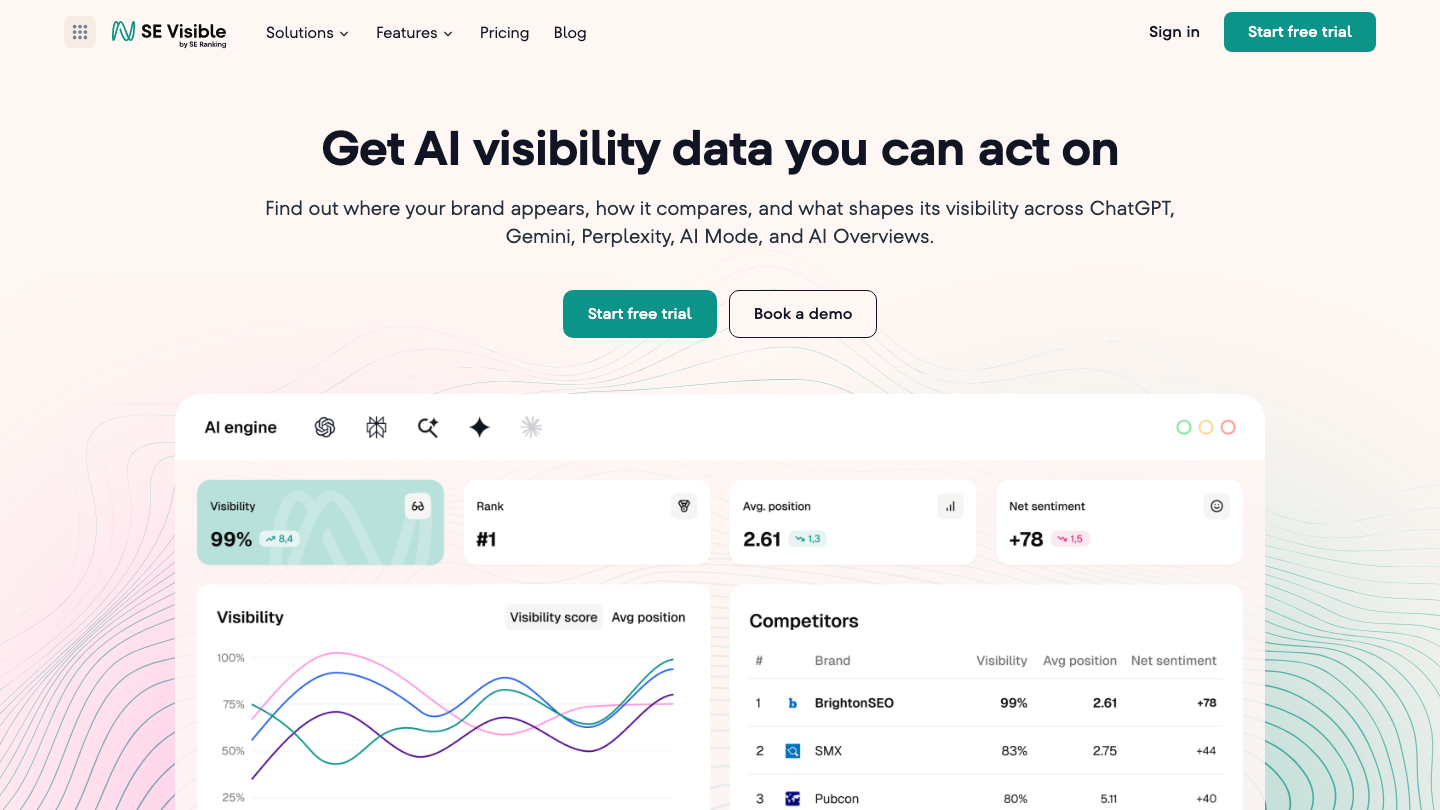
Of the two, SE Visible is the more complete. It collects answers "using a browser and graphical user interface, not simulated answers or API-based results," and refreshes them daily. You get visibility, average position and sentiment, plus a competitor table. It tracks seven countries in five languages, and its trial runs 10 days, four fewer than the main platform's. These are its plans:
| SE Visible plan | Prompts tracked |
|---|---|
| $99 a month | 200 |
| $189 a month | 450 |
| $355 a month | 1,000 |
In July, SE Ranking added prompt groups and bulk prompt import, along with a competitor gap view that shows which sources cite your competitors but not you. That gap view is useful. What you do with it afterwards is the question this whole comparison turns on.
What the cheapest AI tracking buys
It's easy to misread the prompt limits. SE Visible's FAQ explains that the limit counts prompts rather than checks, so 200 prompts on five engines means every prompt gets asked on every engine daily. That works out to about 30,000 checks a month. The same logic seems to apply to the daily prompts on SE Ranking's Core plan, though the pricing page doesn't spell it out.
The free trial is smaller, with 20 AI prompts a day alongside 750 tracked keywords. That's enough to see what the reports look like, but you can't fit a real prompt set into it.
RankControl, for comparison, tracks up to 50 queries and asks each one weekly on six engines, which comes to about 1,300 checks a month. You get far fewer checks, and that's a deliberate trade. We'd rather track fewer, better questions that are tied to pages you'll actually write.
The to-do list problem
Every AI visibility tracker ends up in the same place, with a list of prompts where you don't appear and sources that cite your competitors instead. SE Ranking's version of that list is detailed and refreshed daily. Somebody still has to write the page that answers each prompt, publish it, and get it mentioned on the sources the engines trust.
We call that the to-do list problem, and it's where most of the cost of AI search sits. A tracker at $89 a month can hand a small team 50 gaps a week, which is more work than most small teams get through in a month.
RankControl is built around that list. When a tracked question shows a gap, the content engine plans an article for it and writes it against what already ranks. It scores the draft for how easily AI engines can quote it and publishes it to your CMS once you approve. Then Link Control looks for link prospects for that article and drafts outreach from your mailbox. Auto-publish is off by default.

You're getting AI traffic. But do you know where it comes from?
RankControl credits every visit to the assistant that sent it: ChatGPT, Perplexity, Claude, Gemini, Copilot, or Grok. Full source attribution, next to your Google traffic.
Daily checks vs weekly rates
SE Ranking checks daily and RankControl checks weekly, so you're right to ask which is better. Daily catches movement sooner, but a lot of what moves in AI answers is noise. SparkToro's January study found the same prompt almost never returned the same brand list twice, even while the leading brands kept appearing.
A practitioner on r/localseo ran a smaller test of their own this month, with five runs per prompt. The top pick held about 78% of the time, while the full list of named brands churned by about 22% between identical runs. That's one person's test at five runs per prompt, so treat the exact numbers loosely. Over on r/SEO_LLM, the consensus in a September thread was that a visibility score means little if you can't see how it was made.
That's why RankControl's AI visibility tracking reports a rate per engine over weeks, with the cited pages underneath, rather than a daily score. Daily data isn't wrong. The decision it should drive, which article you write next, just doesn't change from one day to the next.
When a tracker has a bad month
In March, an r/SEO thread described SE Ranking rankings dropping across clients from early in the month, with no matching drop in traffic. One agency commenter said support acknowledged a tracking issue that took weeks to resolve, and that they lost three clients who believed their own SEO had failed.
We're not bringing that up to single SE Ranking out. Any tracker can have a bad month, ours included, because every one of them depends on scraping answers or results that change without notice. The practical lesson is to keep a source of truth you control, which for Google means Search Console. When a third-party tool shows a sudden drop, read it as a question before you treat it as a finding.
Using both inside Claude
You can use both products from inside an AI assistant now. In June, SE Ranking shipped seven pre-built Claude skills that run on its hosted MCP server, and one of them checks AI search visibility across ChatGPT, Perplexity, Gemini and AI Overviews. Its current plans include API credits and MCP access, with 25,000 credits a month on Core and 100,000 on Growth.
RankControl's MCP server has 80+ tools for visibility checks, planning and publishing, and the publish step stays a dry run until you confirm. With both connected, a single Claude conversation can pull SE Ranking's keyword and backlink data and then ask RankControl to plan the articles that close the gaps.
Competitors, and why a human should check the list
Both tools start the competitor list for you. SE Ranking's audits and research suggest competitors from search data. RankControl's Brand Control drafts them from your site, along with your voice, products and buyers.
just did a SEO audit with SE Ranking and it said that "Agent Sex Change" is a competitor i was so confused until i realized its actually "Agents Exchange" 🤣 https://t.co/WZLQC4AjPM
 Patrick Tobler@PadierfindAug 21, 2026
Automated lists get things wrong, though. One user's SE Ranking audit this August listed a competitor called "Agent Sex Change," which turned out to be a site named Agents Exchange with the words split in the wrong place. It's funny, and it's also a good reminder about any tool, ours included.
RankControl lets you correct the draft and track up to 10 competitors in your share of voice, and it's worth giving the list ten minutes before you trust any report built on it. In RankControl the list also drives share of voice, so a single wrong entry skews the number a lot of teams report upward.
Content and publishing
SE Ranking's Content Marketing tools include a SERP-driven Content Editor with a content score and an AI Writer with 10 tones of voice. According to its own AI Writer page, the tool currently works in English only. Finished drafts export as .docx, HTML or Google Docs, or go to WordPress through its API or a WXR file.
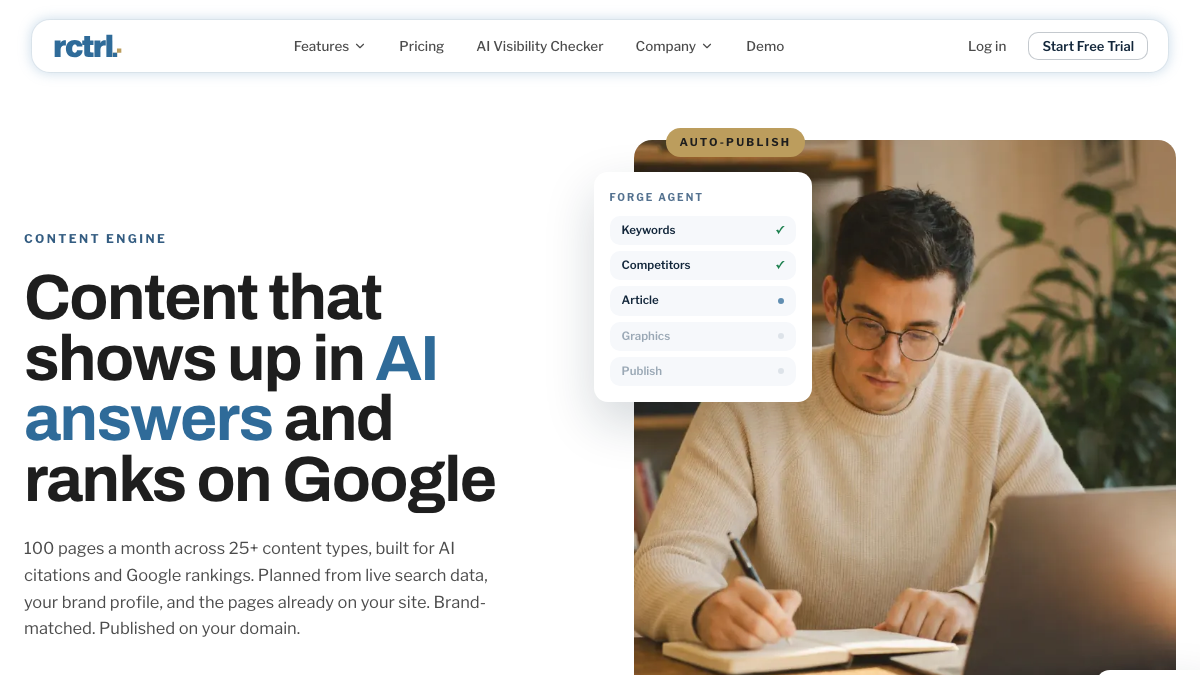
RankControl writes in 23 languages across 33 markets and publishes natively to nine destinations, WordPress, Webflow, Shopify and Ghost among them. Your plan covers 100 pages a month, and you can turn each article into social drafts for eight platforms.
One oddity turned up in our check. SE Ranking's AI Writer page still quotes an older price, with plans "starting at $65/mo" and "Pro and Business plans," names that no longer appear on its pricing page. If you're budgeting for its content tools, confirm the current price with sales.
Pricing, and what matching the bundle costs
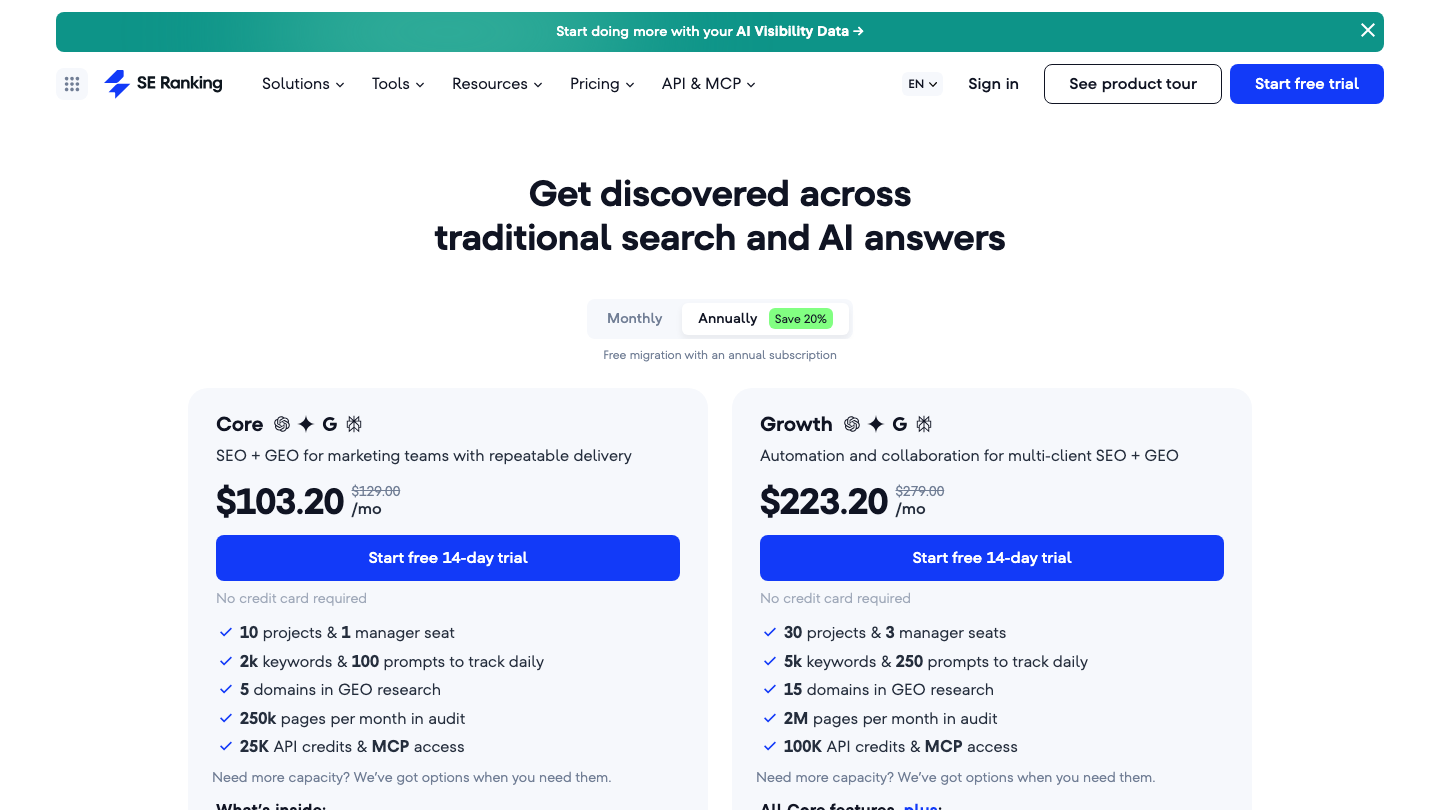
SE Ranking's Core plan costs $129 a month. Add the AI Search add-on at $89 and you're at about $218 a month on monthly billing. Billed annually, the pair comes to about $174.
For that you get rank tracking for 2,000 keywords, site audits and backlink research. You also get one seat and AI tracking on five engines, and if you need more seats, Growth at $279 includes three.
RankControl is $400 a month with five seats. That covers 50 queries tracked weekly on six engines and 100 pages written and published a month, with outreach drafted for each one. The price gap is roughly what the work SE Ranking hands back to you would cost, so the right choice comes down to who's going to do that work.
Read the billing terms before you pick. SE Ranking bills annual plans upfront, and its pricing FAQ suggests talking to sales if you want an annual commitment paid quarterly. Its payments are non-refundable except where the service wasn't delivered as promised. RankControl's annual plan is $4,000, two months free against monthly, and if you cancel, the plan stops at the end of the period you've paid for.
Where SE Ranking is stronger
As an SEO suite, SE Ranking covers far more ground, starting with daily rank tracking for thousands of keywords and site audits of up to 2 million pages a month on Growth. On top of that sit its backlink index, which it puts at 2.9 trillion links, and its local SEO tools, and RankControl doesn't replace them.
Which one wins AI search visibility?
RankControl wins it for teams that want the visibility to change rather than just get reported. SE Ranking will tell you, daily and in detail, where AI engines skip you. RankControl works through that list every month: it plans, writes and publishes the pages and drafts the outreach, then checks six engines, Claude and Grok among them, to see whether the answers moved.
If you're already moving your AI search work over, our guide to switching from SE Ranking covers the exports, the 60-day data window and the cancellation steps. RankControl has a 7-day free trial.
We'll show you exactly where your brand stands in AI search.
No commitment. $0 due today, cancel anytime. See how ChatGPT, Perplexity, Claude, Gemini, Grok, and Google AI Mode talk about your brand today.

You can run this loop by hand with any tracker. Read the gaps, write the pages, publish and pitch them, and re-check every week. Or RankControl's agents can do it every month while your team uses whatever SEO suite it already trusts for the rest.
Know exactly what AI says about your competitors.
RankControl's Recon Agent monitors competitor citations across ChatGPT, Perplexity, Claude, Gemini, Grok, and Google AI Mode. See where they show up and you don't.